
Verizon’s nationwide wireless outage on January 14, 2026, was the kind of event that doesn’t just disrupt a Tuesday: it hands every competitor field rep a talking point they’ll use for the next 18 months. Recon Analytics surveyed 1,702 business decision-makers between January 21 and February 25, 2026, capturing reactions in the immediate aftermath. The results tell a story that is both better and worse for Verizon than the company probably wants to hear.

The Outage Was Not Felt Equally

The January 14 outage was not a uniform experience across the business market. Impact scaled with company size, and the 23-percentage-point spread between large and small business is the first structural finding.

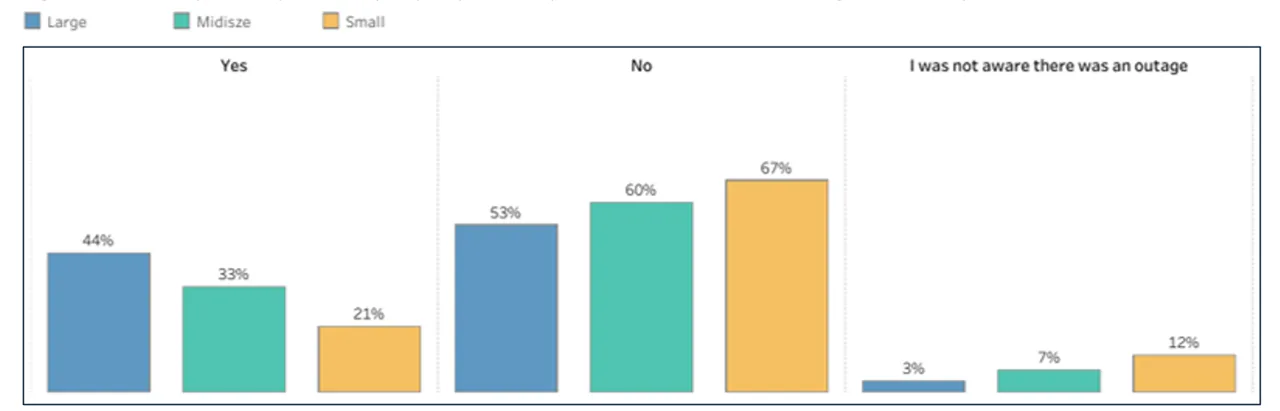
Large businesses reported the highest direct impact: 44% said the outage affected their company. Midsize companies came in at 33%. Small businesses sat at 21%. The remaining respondents in each segment indicated either no impact or were unsure. The gradient makes operational sense. Large organizations run more lines, more devices, more mission-critical workflows over wireless. A national field service operation or a distributed retail chain has thousands of points of exposure. A five-person shop has a handful. The outage hit large businesses hardest because they have the largest surface area. Large enterprises also operate more redundancy infrastructure, dedicated IT, secondary carrier contracts, Wi-Fi fallback. Whether the 44% figure reflects greater network dependency or greater issue-reporting sensitivity is not separable from this data.

The awareness data runs in the opposite direction. Among small businesses, 12% said they weren’t even aware an outage had occurred, compared to 3% of large enterprises and 7% of midsize. Small businesses run lean. If the phones worked well enough that day, or if the outage was brief enough in their geography, it didn’t register as a business event. Large enterprises have someone whose job is to know when the carrier goes down.

This awareness asymmetry matters for Verizon’s sales team. The enterprise segment felt the outage acutely and paid attention. That’s also the segment where Verizon has historically leaned on network reliability as its core value proposition. The pitch is that you pay more because the network doesn’t go down. January 14 complicated that pitch in the accounts where it matters most.

Figure 1: Was anyone in your company impacted by the Verizon Wireless outage of January 14th, 2026?

Source: Recon Analytics B2B Pulse, January 21st-February 25th, 2026. Percentages based on business respondents. Total n = 1,702, MoE = 2.4%; Large Business (1,000+ employees) n = 561, MoE = 4.1%; Midsize (20-999 employees) n = 538, MoE = 4.2%; Small Business (<20 employees) n = 603, MoE = 4.0%

Opinion Change Was Contained, Not Neutral

Among business customers who were aware of the outage, stated opinion change was limited. Across all size segments, roughly two-thirds said the outage did not change their opinion of Verizon. Opinion stability was statistically consistent regardless of company size.

The more operationally significant data is among those whose opinions did shift. Roughly 5-6% across segments said, “much more negative” and 27-29% said “somewhat more negative.” Combined negative sentiment ran approximately 32-35% across all segments. For an event that hit on a single day lasting about 10 hours, generating negative opinion change in roughly a third of aware business customers is a credibility problem if the narrative isn’t actively managed.

One caveat on the “no change” majority: it captures two distinct customer types that the data cannot separate. The first is the genuinely loyal customer who considers this within the bounds of acceptable carrier performance and has no intention of changing anything. The second is the customer who already held a neutral or negative opinion of Verizon before January 14, who are already at risk of leaving. Both sit in the same response bucket. The data cannot tell you how large each population is.

 Figure 2: (only if impacted by outage) How has the network outage changed your opinion of Verizon Wireless?

Source: Recon Analytics B2B Pulse, January 21st-February 25th, 2026. Percentages based on business respondents who indicated they were impacted by the outage. Total n = 551, MoE = 4.2%; Large Business n = 246, MoE = 6.2%; Midsize n = 179, MoE = 7.3%; Small Business n = 126, MoE = 8.7%

The Loyalty Question Is Where the Size Gap Becomes a Revenue Conversation

Because no pre-outage baseline is available for switching intent in this sample, the figures below represent a post-event snapshot, not a measured change from prior intent levels.

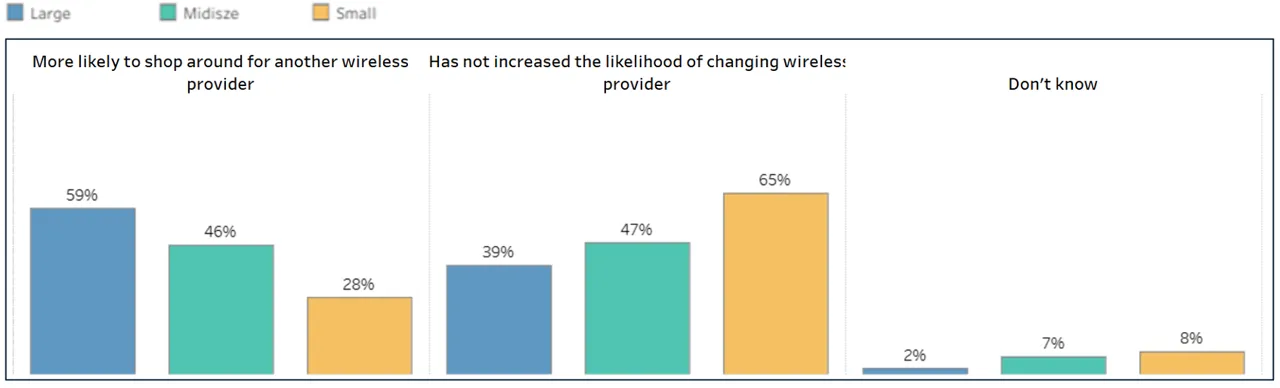
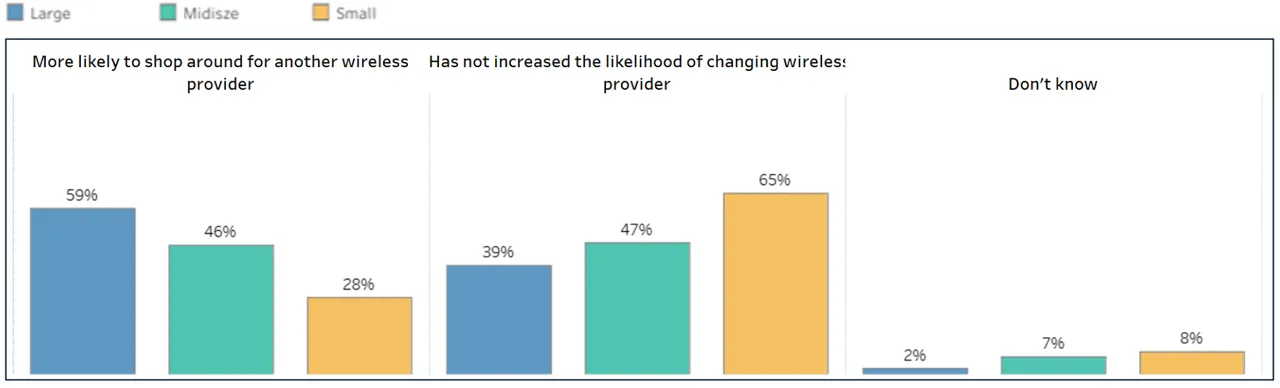
Among current Verizon Wireless business customers asked how the outage affected their likelihood of staying after their current agreement, small businesses were the most forgiving: 65% said the outage had not increased their likelihood of changing providers, 28% said they were more likely to shop around, and 7% were unsure or did not respond. Large businesses showed a different picture, with 39% saying the outage had not increased their likelihood of switching, 59% said they were more likely to evaluate alternatives, and 2% were unsure. Midsize was a statistical tie.

Among large business Verizon customers, 59% said the January 14 outage made them more likely to evaluate alternatives when their contract comes up. Remember, intent to shop is different from switching. Contract lock-in, device payoff schedules, multi-line complexity, and the operational headache of migrating a large business all create meaningful friction between stated intent and revealed behavior. Enterprise switching intent historically overstates eventual switching behavior. Even accounting for that gap, a post-event snapshot where 59% of large business Verizon customers express elevated interest in alternatives is a leading indicator that the competitive pipeline has expanded.

Enterprise wireless agreements typically run one to three years. The cohort of large accounts whose contracts expire in 2026 and 2027 is now at elevated churn risk compared to January 13. Verizon’s enterprise sales team should be in front of those accounts before AT&T and T-Mobile arrive with a pitch deck that opens on January 14.

 Figure 3: (currently using Verizon) How did the outage impact the likelihood of you staying with Verizon Wireless at your next renewal?

Source: Recon Analytics B2B Pulse, January 21st-February 25th, 2026. Percentages based on business respondents who self-reported current Verizon Wireless use. Total n = 510, MoE = 4.3%; Large Business n = 201, MoE = 6.9%; Midsize n = 167, MoE = 7.6%; Small Business n = 142, MoE = 8.2%

The Non-Verizon Market: Enterprise Forgives, Small Business Does Not

Among business customers not currently on Verizon, the outage produced differentiated responses that also track with company size.

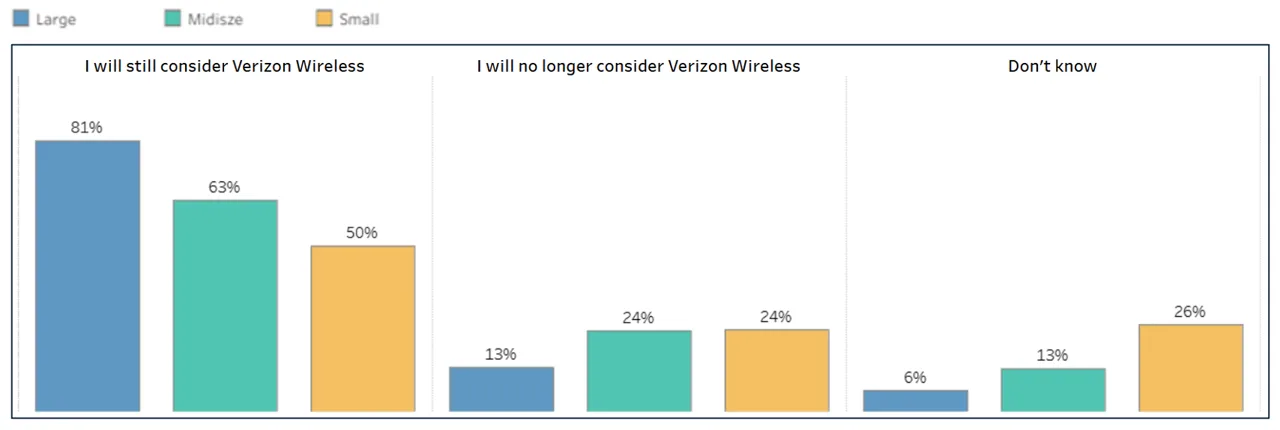
Large businesses remained the most open to Verizon despite the outage: 81% said they would still consider Verizon when their current agreement expires. One bad day doesn’t remove a major carrier from consideration. Enterprise procurement decisions involve pricing, coverage, device ecosystems, and account support infrastructure. Small businesses reacted more negatively to the outage, even though they did not experience the outage directly. 24% of small businesses said they would no longer consider Verizon, while 26% said they were unsure. A single outage is a data point, not a disqualifier, but can unbalance customers that are on the fence.

Figure 4: (Not currently using Verizon) How did the outage impact the likelihood of you considering Verizon Wireless next?

Source: Recon Analytics B2B Pulse, January 21st-February 25th, 2026. Percentages based on business respondents who do not use Verizon Wireless (self-reported). Total n = 1,064, MoE = 3.0%; Large Business n = 341, MoE = 5.3%; Midsize n = 334, MoE = 5.4%; Small Business n = 389, MoE = 5.0%

What Verizon Has to Do Now

The January 14 outage created a two-front problem. In the existing base, large business accounts are at elevated renewal risk. In the prospect market, small businesses have partially written Verizon off. But both are addressable.

Verizon’s enterprise team should prioritize proactive outreach to its large account base before those contracts expire. Generic reliability commitments won’t land. The message needs to be specific: what failed, what was fixed, what redundancy was added, what the SLA improvement looks like going forward. Enterprises don’t need apologies. They need engineering answers.

On the prospect side, the small business perception problem is harder because it’s driven partly by information Verizon doesn’t control. The counter-narrative has to reach small business decision-makers through channels they trust: peer networks, trade media, and the resellers and agents who carry Verizon’s products into that segment.

The January 14 outage was one bad day, which must be addressed with customers to protect accounts that could take years to win back if lost.


RECON ANALYTICS ACQUIRES ATOM INSIGHTS, EXPANDING GLOBAL DEVICE INTELLIGENCE

Boston, MA and Montreal, Canada — March 16, 2026 — Recon Analytics has acquired Atom Insights, a device market intelligence firm with operations in Canada and India. Terms were not disclosed.

Hanish Bhatia, Founder of Atom Insights, joins Recon Analytics as Vice President of Device Intelligence. Bhatia previously served as Associate Director at Counterpoint Research, where he covered global smartphone and device markets for seven years. All employees of Recon Analytics Canada, Recon’s U.S.-based device intelligence group, and its India operations will report to Bhatia.

The acquisition integrates Atom Insights’ global device shipment, sell-through, and component-level intelligence into Recon’s customer research platform, creating the industry’s first end-to-end intelligence service from silicon to subscriber sentiment. Atom Insights tracks device sell-through at the model level across 40-plus countries, covering 400-plus device OEMs and 25-plus semiconductor vendors across smartphones, tablets, wearables and PCs.

“We have spent four years building the customer insights infrastructure that the U.S. telecommunications industry runs on. We built this platform deliberately, like a puzzle, with a connector piece already designed for exactly this moment. We can measure what subscribers experience across 22 dimensions of satisfaction matched to their specific handset hardware, and we know what is inside those devices. What we needed was someone who could tell us how many of them shipped, through which channels, and across which markets. Atom Insights and Hanish Bhatia are the piece we built the that connector for,” said Roger Entner, Analyst and Founder of Recon Analytics.

“Recon is the only firm that can show how a specific handset performs on customer satisfaction matched to real hardware IDs, and tell clients what to do about it,” said Bhatia. “Combining that with Atom Insights’ supply-side data creates a device analytics capability that does not exist anywhere else.”

“Atom Insights lets us answer which device configurations drive satisfaction, which component choices create churn risk, and how OEM decisions ripple through carrier economics,” said Brett Clark, Analyst and COO of Recon Analytics.

Atom Insights’ device intelligence integrates alongside Recon’s Pulse service, on which the largest U.S. telecommunications companies rely for competitive decision-making. Pulse fields more than 15,000 U.S. telecom consumers and up to 1,200 telecom businesses weekly in English and Spanish. Beyond telecom, Pulse reaches 6,000 consumer and business AI respondents, the largest AI customer insights service in the world, and up to 6,000 airline travelers weekly.

Atom Insights’ data will also be available across all three tiers of Recon’s AI platform: Ghost Lab for outside-the-firewall analytics across Recon’s insights and 150-plus third-party databases including speed test data, spectrum data as well as government databases; Recon Enclave deployed inside the client’s firewall; and the Reconnaissance Platform, Recon’s autonomous intelligence system for scenario simulation and decision-ready recommendations.

“The analytical frameworks we have built over four years transfer across industries and geographies,” said Entner. “The device value chain is the natural next frontier, and we intend to keep building.”

About Recon Analytics

Recon Analytics is the largest telecom operator-centric market research provider in the United States, with active verticals spanning AI consumer behavior and commercial aviation. The firm’s dataset includes almost a million device-matched respondents and a historical repository of 2 million-plus total respondents. Our Pulse service delivers near real-time customer insights on a weekly basis answering the specific questions our clients are looking for. Recon delivers intelligence through a three-tier AI architecture: Ghost Lab, Recon Enclave, and the Reconnaissance Platform. www.reconanalytics.com


About Atom Insights

Atom Insights provides model-level device sell-through, shipment tracking, semiconductor market analysis across 40-plus countries and 400-plus OEMs. www.atom-insights.com

Media Contact

Sarah Leggett | [email protected]

Sowmyanarayan Sampath is out as CEO of Verizon Consumer Group, effective March 31. Dan Schulman announced the departure this morning in an internal letter layered with corporate gratitude and strategic intent. Alfonso Villanueva, Schulman’s former PayPal colleague who joined Verizon barely ten weeks ago as Chief Transformation Officer, takes the interim role. The word interim is doing a lot of work in that sentence.

I wrote in October that Sampath was “the undisputed heir apparent” and that Schulman’s appointment was a “special mission with a defined timeline” designed to set the stage for Sampath to inherit the company. I was wrong. So was most of Wall Street. When you’re wrong, you say so, explain why, and recalibrate.

The $4 Million Tell

The signs were in the SEC filings. The 8-K/A filed on October 14, nine days after Schulman took the CEO job, disclosed a $4 million one-time retention RSU award for Sampath, vesting December 31, 2027. You don’t pay someone $4 million to stay unless you think they might leave, and you don’t think they might leave unless the succession conversation went badly. That retention award was designed to keep Sampath in place while Schulman assessed the team. It was a bridge, and it led nowhere.

Schulman came in with his own vision and his own people. Villanueva arrived from PayPal on November 20. Within two months, he had absorbed strategy, corporate development, data/analytics/AI, and supply chain under his Transformation Organization. Now he runs the consumer business too. This wasn’t a performance termination. Sampath was most likely told he would not succeed Schulman as Verizon CEO. Once that became clear, his departure was inevitable. An executive of his caliber with multiple offers wasn’t going to stay as a subordinate with no path to the top job.

The Q4 Numbers: Schulman’s Plan, Sampath’s Execution

The Q4 results need proper attribution. Verizon added 551,000 consumer postpaid phone subscribers in Q4, the best quarter since 2019. For the full year, consumer postpaid phone net adds came to positive 137,000 after losses of 356,000 in Q1, 51,000 in Q2, and 7,000 in Q3. Add the Business segment’s 225,000 phone net adds and total retail postpaid phone connections grew by roughly 362,000 in 2025. Verizon broke even on its most important subscriber metric after years of persistent losses.

That Q4 turnaround was Schulman’s strategy. He directed the spend-to-grow posture during his October earnings call. Sampath executed the plan, delivering 2,679,000 consumer postpaid phone gross additions in Q4, up 15% year-over-year. The gross add performance was strong. The churn problem remains: 0.95% in Q4 versus 0.88% a year ago, part of a steady climb from 0.83% in Q1 2024 across every single quarter. That 12-basis-point churn increase on a base of 75 million consumer postpaid phones translates to roughly 90,000 additional lost subscribers per quarter, or about $540 million in annualized revenue walking out the door that wasn’t leaving two years ago. Stopping that escalation is the unresolved challenge.

The financial profile tells the story of what aggressive growth costs. Consumer segment EBITDA for full year 2025 was $43.8 billion on revenue of $106.8 billion, a margin of 41.0% versus 41.8% in 2024. The Q4 consumer EBITDA margin compressed to 36.5% from 37.5% a year ago, and wireless equipment revenue jumped to $8.2 billion from $7.5 billion as Verizon spent heavily on device subsidies to drive those gross adds. The fundamental tension Schulman is navigating: buy growth now, restructure costs to fund it, and find the right permanent leader to sustain both without destroying the margin structure that supports a $11.5 billion annual dividend.

Where the October Analysis Broke Down

The October analysis underestimated Schulman’s intensity. He cut 13,000 jobs within weeks, began franchising 179 retail stores, and brought in his own transformation chief from PayPal. That’s not bridge management. It also underestimated the depth of the board’s frustration. Verizon’s consumer postpaid phone base was essentially flat for three consecutive years. ARPA kept climbing, from $141.31 in Q1 2024 to $147.36 in Q4 2025, but extracting more revenue from a stagnant base is a finite strategy. Most simply, Sampath was told he wouldn’t get the CEO job. Stay and execute someone else’s vision with no upside, or leave and run something. He chose correctly.

The Rescue Team Has an Expiration Date

Schulman and his team are a rescue operation, not a long-term management structure. Schulman is 67. His contract runs through December 2027. Villanueva is from the same professional generation. It’s very likely that they will be gone in two years but the timeline might be slipping due to operational necessities.

The Consumer Group CEO hire isn’t just about filling Sampath’s seat. It’s an audition for the person who will eventually run all of Verizon. Whoever takes this job permanently is being positioned for the corner office. That changes the candidate profile: Verizon isn’t looking for a division head. It’s looking for a future CEO who starts in the consumer role, with the operational depth to run a $107 billion revenue business and the strategic vision to navigate convergence across wireless, fiber, and FWA.

It also changes the competitive dynamics of the U.S. wireless market. A Consumer CEO who is auditioning for the overall CEO job cannot tread water. Treading water gets you passed over. Going backward is unthinkable. The person in that seat will have every incentive to compete aggressively, because their personal career trajectory depends on delivering visible, measurable wins on a compressed timeline. Whoever lands in this role will be the most motivated competitor Verizon has fielded in years.

Why Europe

The permanent replacement will most likely come from outside the United States. The reason is structural: non-compete agreements. Any senior executive at AT&T, T-Mobile, or a major cable operator is almost certainly bound by non-compete clauses. International candidates, particularly from European operators, don’t carry that baggage. European non-competes are weaker by law, and the competitive overlap with Verizon’s U.S. consumer business is zero.

Verizon’s one unambiguous success in the Consumer Group CEO role was Ronan Dunne, recruited from O2 in the UK. He ran O2 for eight years, grew its base from 18 million to 25 million, and served five productive years at Verizon. The one failure, Manon Brouillette from Canada’s Videotron, proves that scale matters, not that international hires are risky. O2 was the right weight class. Videotron was not.

T-Mobile’s succession provides a useful contrast. Srini Gopalan wasn’t an outside hire. He was an inside-the-family transfer from Deutsche Telekom, moved from running Germany to COO at T-Mobile US with the explicit understanding he was the successor. Verizon doesn’t have a European parent to draw from, so it has to recruit externally from that same talent pool. Given the CEO audition dynamic, the candidate needs to be someone who has already won competitive battles at scale. There’s no time for on-the-job learning. The FT reported headhunters are already active. Schulman needs that person in the consumer seat by mid-2026. Identifying and onboarding such a high caliber candidate in such a compressed time is extremely difficult.

The Immediate Math

Near-term operational risk is manageable. Villanueva owns both the transformation portfolio and the consumer P&L, eliminating finger-pointing during restructuring. The new value proposition launches in H1 2026. The longer-term risk is strategic: the $20 billion Frontier acquisition needs consumer-side integration, FWA grew to 5.7 million combined subscribers, Fios internet hit 7.3 million, and total broadband topped 13.6 million. Each growth vector requires a permanent consumer leader with deep telecom operating experience. Villanueva was hired for transformation, not operations.

Verizon’s Consumer Group has turned over its leader four times in seven years. Dunne served five years and built the 5G consumer strategy. Brouillette lasted less than one. Sampath stabilized the business over two years but wasn’t Schulman’s pick. Villanueva is holding the seat with ten weeks of Verizon experience. Every transition resets institutional momentum, disrupts middle management, and gives competitors a window. The revolving door is itself a competitive disadvantage, and it compounds: each new leader inherits not just the business challenges but the organizational scar tissue from the last transition.

Schulman and Villanueva are the rescue team. They’ll stabilize and restructure. But they’re not the long-term answer, even as timelines will be slipping. The next Consumer Group CEO hire is the most consequential personnel decision Verizon will make this year, because that person is almost certainly being positioned to eventually run the whole company, and because an executive auditioning for that job will compete with an intensity Verizon hasn’t shown in years. The non-compete constraints, the Dunne precedent, and the active headhunter outreach all point to Europe. Get it right, and Verizon’s competitors face a newly dangerous opponent backed by the largest network in the country. Get it wrong, and the revolving door spins again.


Numbers and facts are important because they define ultimate limits and capabilities, but numbers and facts don’t make decisions: People make decisions. Nowhere is this truer than in the United States satellite broadband market of late 2025. If we look strictly at the operational scoreboard, the game is over. Starlink has achieved a scale that no competitor can mathematically replicate within the relevant investment horizon. While the data based on now a bit over one million respondents from our Recon Analytics Telecom Pulse Service shows that Starlink holding a massive customer satisfaction lead in rural America over terrestrial as well as satellite legacy providers like HughesNet, dwelling on this gap is an exercise in archaeological irrelevance. HughesNet is effectively liquidating its business model, and ViaSat is pivoting away from it. Both are implicitly acknowledging that the laws of physics have rendered them obsolete. Rural telcos stuck with DSL are holding on for dear life in an era that is rapidly coming to an end. The war against legacy GEO is not just over; the battlefield has been cleared. When the last remnants of rural DSL are being swept away by its skyborne replacement is only a matter of a few years.

The real narrative is not about Starlink beating zombies; it is about the politically engineered survival of its future competitors. The industry is bifurcating into two distinct realities: SpaceX’s operational “rout” and the strategic mandates sustaining Amazon Leo and AST SpaceMobile. These companies matter not because they are currently beating Starlink on metrics—they aren’t—but because the U.S. government and the nation’s largest wireless carriers have decided that a Musk monopoly is strategically unacceptable. Consequently, we are witnessing the creation of a managed market where strategic intervention and corporate hedging sustain competitors that market forces alone would eliminate.

The Carrier Insurgency: The “Never Musk” Wager

While T-Mobile grabbed headlines by pairing with an iconic inventor and a proven technology years ahead of the competition, the most consequential satellite-communications decision of recent years happened quietly in AT&T’s and Verizon’s boardrooms in 2024. Their commitments of capital and spectrum to AST SpaceMobile weren’t bets on the best technology available: they were bets on strategic independence. Even in 2024, it was clear that AST was operationally behind, struggling with a single-digit satellite count while Starlink was deploying thousands. The carriers knew that AST’s service would likely launch later and offer less initial capacity than the vertically integrated juggernaut of SpaceX. They looked at the spreadsheets, saw the performance gap, and decided to stomach it.

This was a calculated strategic sacrifice. AT&T’s decision to lock into a binding agreement with AST through 2030 represents a deliberate strategy to preserve network sovereignty rather than a forced reaction to market constraints. Management feared, and correctly so, that utilizing Starlink would ultimately accelerate Elon Musk’s ambition to become a full-fledged service provider, leading to their own disintermediation as network operators. If they partnered with Starlink, they risked becoming mere resellers in a Musk-controlled ecosystem, effectively funding their own future competitor. Consequently, AT&T was willing to endure the short-term pain of AST’s operational delays to nurture a competitor that preserves their control, calculating that the cost of funding a future Starlink monopoly far exceeds the risks of supporting a slower, inferior alternative.

Verizon followed a similar, albeit more hedged, logic. Their $100 million investment in AST was a coldly calculated but necessary option premium. Verizon leadership recognized that T-Mobile’s exclusivity with SpaceX was temporary, but they also recognized that a world with only one satellite provider gives that provider infinite pricing power. By propping up AST, Verizon keeps a non-SpaceX option alive to discipline the market. They are funding AST not because the tech is currently better—the gap between AST’s 5 satellites and Starlink’s 660 D2C satellites is 100-to-1—but because the contract isn’t with Musk. AST has effectively become a compliance cost for the wireless industry, a tax paid by carriers to ensure they never have to bend the knee to SpaceX.

This “Not-Musk” imperative explains why the investment thesis for AST remains robust despite the fact that its primary differentiator—broadband to the phone—has been neutralized. SpaceX’s confirmed Q1 2026 rollout of full data and voice capabilities has effectively evaporated AST’s unique value proposition. Yet, the carriers cannot waver. The 2025 rupture between Donald Trump and Elon Musk only validated the carriers’ 2024 foresight: relying on a single, politically volatile billionaire for critical infrastructure is a fiduciary hazard. AT&T and Verizon are stuck with AST, and they are happy to be stuck, because the alternative is captivity.

Amazon Leo: The “Too Big to Fail” Regulatory Gamble

If the carriers are engineering AST’s survival through capital, the federal government is engineering Amazon Leo’s survival through regulation. Amazon Leo is not a standard growth story; it is a binary derivative trade on regulatory relief. The scale of Amazon’s deployment deficit is staggering. As of late 2025, Amazon has managed to place only 153 satellites into orbit, leaving a gap of 1,465 satellites against the FCC’s deadline requiring 1,618 by July 2026. This gap is mathematically uncloseable through launch cadence alone. Consequently, Amazon requires a waiver that would typically invite withering scrutiny.

However, Amazon has successfully constructed a regulatory shield by securing BEAD awards for 211,194 locations across 33 states. These awards create a government interest in Amazon’s success. State broadband offices, desperate to show competition, accepted Amazon’s paper promises over SpaceX’s operational reality, effectively making Amazon too big to fail without collapsing a critical federal program. If Amazon cannot illuminate these locations, states face clawbacks and the administration faces a failure of its signature infrastructure project.

The most dominant policy force in the market today is the BEAD program. Amazon Leo’s dominance of the BEAD program was achieved by aggressively buying the market with average bids of just $560 per location, effectively undercutting Starlink by a factor of three. This secures a guaranteed revenue floor estimated at $177 million annually, which exists independent of consumer preference. Regulators are expected to grant the accommodation to avoid entrenching a SpaceX monopoly, using the waiver to provide political cover while maintaining the appearance of regulatory neutrality. The Trump administration increasingly favors Jeff Bezos over the volatile Elon Musk in this context, rendering regulatory accommodation probable. Amazon Leo survives not because it executed, but because the government cannot afford to let it die.

The Political Overlay: 2025 as an Accelerant

While the carriers made their anti-monopoly decisions in 2024, the political volatility of 2025 acted as a powerful accelerant, hardening the “Not-Musk” resolve across the ecosystem. The alliance between Donald Trump and Elon Musk collapsed in June 2025 due to disputes over fiscal policy and devolved into name calling. Although a pragmatic reconciliation began in November, the era of automatic regulatory preference for SpaceX is finished. The relationship has stabilized at “neutral,” a significant downgrade from the “favored” status Musk enjoyed early in the year.

This political oscillation drives strategic positioning. The Pentagon, seeking to hedge political risk rather than simply improve capability, directed “Golden Dome” defense planners to diversify away from exclusive reliance on SpaceX in favor of Amazon. This directive to “diversify” is now embedded in procurement logic, creating a permanent, protected market for a “second source” regardless of the headlines. Just as AT&T and Verizon funded AST to avoid commercial captivity, the Department of Defense is funding Amazon and AST to avoid strategic captivity.

The Reality of Market Bifurcation

The satellite internet industry has organized into four distinct competitive segments, and understanding this structure is essential because winners in one segment do not necessarily dominate the others. While Starlink dominates the LEO consumer broadband market with a +42 Net Promoter Score, the government and carriers have effectively decided to subsidize competitors to ensure market health. This creates a floor for Amazon and AST, and a ceiling on Starlink’s monopoly power.

The numbers are definitive: Starlink’s operational dominance provides a shield that regulation cannot easily penetrate. Its satisfaction lead creates a political asset, insulating the company because no administration can politically afford to disconnect rural American voters. However, the strategic landscape proves that performance is not the only metric that matters. Amazon Leo’s 211,194 committed BEAD locations provide a survival path even if the FCC denies a consumer waiver, converting it into a government-subsidized utility. AST SpaceMobile’s binding contracts with AT&T and Verizon ensure it remains a viable entity, serving as the industry’s indispensable “Plan B”.

Ultimately, the satellite industry acts as a mirror for the broader political economy. The “SpaceX Paradox” defines Amazon’s desperate position: to compete with Starlink, Amazon was forced to contract launches from its primary competitor, implicitly admitting that SpaceX’s capacity was necessary for its own survival. Yet, Jeff Bezos has successfully positioned himself as a “responsible” alternative, securing a vital revenue lifeline to sustain Amazon Leo. The market has bifurcated: Starlink wins on physics and performance in the consumer zone, while Amazon and AST win on politics and diversity mandates in the regulatory and carrier zones.

For investors and executives, the lesson is clear: The narrative of “failure” surrounding legacy providers is simply the sound of the past dying; ignore it. The real signal is the deliberate, expensive, and strategic effort by the world’s largest telecom companies to prevent a SpaceX monopoly. AT&T and Verizon knew exactly what they were buying in 2024: an inferior product that offered the superior benefit of independence. They decided to stomach the lag, the risk, and the cost because the alternative was a future where Elon Musk held the keys to their network. The data tells us who has the best product, but the strategy tells us who will be allowed to survive.

If you want to read more about the interplay between the satellite and broadband industry have a look here.
https://www.reconanalytics.com/products/2027-november-satellite-report-vf/