• As every year, the second quarter is a weak net subscriber addition quarter. The overall muted expectations in the economy did not help either.
  • Non-operator branded wireless connections are the majority source of customer additions. Almost half of the increase of mobile connections came from customers that mostly do not know the network they were actually using. Amazon Kindles, Barnes & Noble Nooks, countless other connected devices, and MVNOs such as Tracfone were driving the growth of the industry with more than 52% of net additions.
  • The second largest growth segment was no-contract with almost a third of new subscriber additions. Contract net additions were less than 16% of overall net subscriber additions.
  • Smartphones are representing about 75% of device sales and depending on the operator between 29% and 50% of the installed based. Maybe it is time to stop segmenting smartphones from feature phones and report market share and sales figures for phones again?
  • Network evolution is the name of the game. Every operator is working on their own flavor of 4G. Sprint dominates the 4G market with 1.7 million 4G net adds compared to 1.2 million Verizon Wireless net adds. Metro PCS nor AT&T had sufficient 4G net adds to mention it during in their earnings.
  • Verizon is outperforming everyone else in contract net additions. This is aided by a balanced device strategy that offers something for everyone than. Single and doubles with 4G, iPhone, and feature phones proved to be the contract game winner for Verizon. AT&T’s contract growth is significantly dependent on the iPhone. Sprint’s contract winner are clearly their Sprint-branded 4G devices.
  • Sprint’s contract focus area – Sprint-branded – grew nicely by 275,000 whereas the segment that Sprint is no longer intend on growing and therefore not advertising – iDEN – shrunk by 327,000
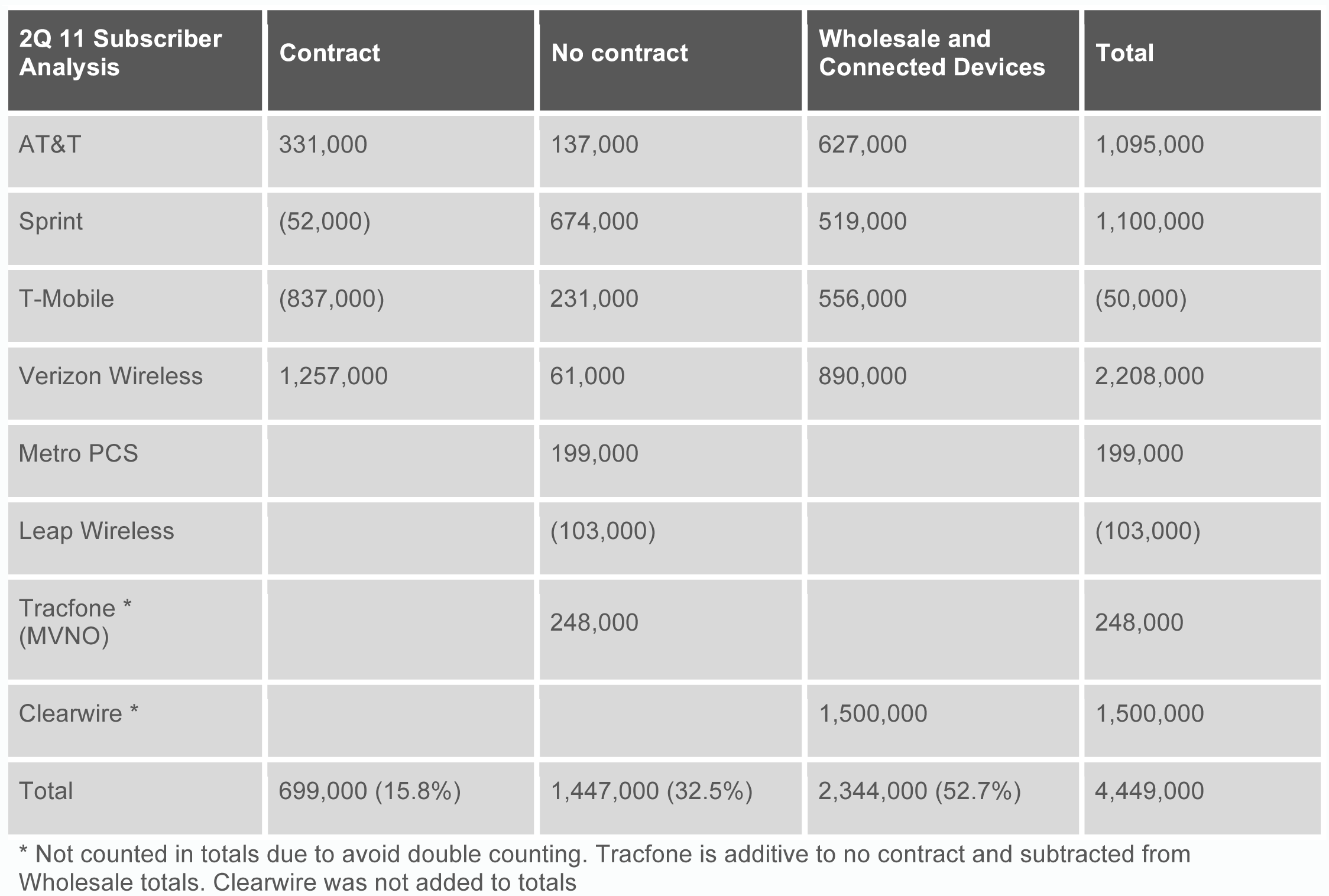

AT&T kicked off the Q2 wireless earning season. The company gained 1.1 million subscribers of which were 331,000 contract net adds, 137,000 no contract net adds, 379,000 connected device net adds, and 248,000 reseller net adds. AT&T sold 3.6 million iPhones of which 24% were new to AT&T. This means that 900,000 new iPhone contract users joined AT&T. Without this iPhone induced growth, AT&T would have lost about 600,000 contract subscribers. While this trend continued unabated since the Verizon iPhone launch, it may hurt AT&T when the iPhone becomes available at Sprint and T-Mobile that offer lower prices than AT&T and Verizon. Overall AT&T, with the iPhone 4 and 3GS, outsold Verizon with the iPhone 4. Furthermore, iPhone churn fell in this first full quarter of iPhone competition from Verizon. It indicates that the vocal dislike of AT&T was all talk and no substance since no meaningful impact can be discerned in AT&T’s numbers. Data-only internet devices like tablets also grew by 545,000 during the quarter to a total of 4 million customers. Wireless data revenue increased by more than a quarter, leading to an overall increase of total ARPU by 2%, even though voice ARPU declined again.

Verizon reported 2.2 million subscriber net additions for Q2 2011. The net additions were comprised of 1.3 million contract net adds and 890,000 wholesale and other connections. Verizon iPhone sales were 2.3 million with approximately 22% or 530,000 new to Verizon. This was lower than AT&T iPhone sales, but are only iPhone 4, whereas AT&T sells both the iPhone 4 and a $49 iPhone 3GS. The company also mentioned that it had 1.2 million 4G LTE net adds. This comes on the heels of very heavy investments in the build out of Verizon Wireless’ 4G LTE network, which now covers 160 million Americans. Verizon is significantly ahead of its deployment goal and will probably slow down with its 4G LTE build out. Overall ARPU grew on the basis of data revenues growing faster than voice revenues were declining.

Sprint had a good quarter, laying the founding for growth in the next few years. Sprint added 1.1 million subscribers of which 674,000 were no contract, 519,000 were wholesale and affiliate customers, 275,000 Sprint-branded customers, and it lost 327,000 iDEN customers. Sprint also lower contract and no contract churn, which historically was one of the weaknesses of the company. While 1.75% is for Sprint a significant achievement – indicating that the average time a Sprint contract customer stays with Sprint is now more than 4 ½ years –  it is only a milestone on the path to close the gap to AT&T and Verizon, who’s contract churn is about 1.1%. What is even more important is that Sprint continued to make progress in terms of customer recognition as preferred provider and customer services. These metrics are leading indicators that indicate toward improvements in Sprint’s net additions and churn.

Sprint’s losses increased by $120 million due to high equipment subsidies, a switch from mail-in rebates to instant rebates, and higher SG&A costs. The $2 increase in contract ARPU that was made possible through the increased expenditure will add $200 million per quarter for at least the next several years. Sprint has also invested more into its network to expand data capacity. Wall Street seems to be intend on punishing Sprint for all investments in the future, apparently blind to the fact that if Sprint does not prepare for the future it will perish. The lesson of T-Mobile’s increasing difficulties caused by chronic underinvestment in its network should be a warning sign for all.

One of the least known facts in the mobile industry is that Sprint’s network is the oldest in the industry. Due to the significant challenges Sprint has it skimped on the network. It easily could as subscriber numbers declined, but now as the company is growing again, it has to put the network house in order. With the already launched Network Vision initiative Sprint benefits greatly from new network elements and the technological advances, and this is just within the CDMA standard, over the last five to seven years. The effect of higher capacity, larger cells, more efficient backhaul will yield immediate savings greater than the cost of the network enhancements. In addition, it will allow Sprint to launch 4G, most likely LTE. Sprint has 10 MHz nationwide in the PCS spectrum band, which is can use to launch the new 4G network. How important 4G overall and Sprint specifically shows its 4G WiMAX net adds. In Q2 2011, it added 1.7 million 4G subscribers. Even Verizon, which is heavily promoting 4G, added only 1.2 million during the same period.

The Sprint LightSquared agreement should be viewed as an LTE expansion and augmentation under the unannounced network vision plan. I would expect some coordination between Sprint and LightSquared about which markets to build out, since from the most recent reports it seems that LightSquared has only core network built by Nokia Siemens Networks. It would allow Sprint to take advantage of LightSquared’s network where needs additional coverage or capacity. The $13.5 billion in cash and network credits are also nothing to cough about.

T-Mobile continues to struggle in the market place. At first glance, the company had only a modest customer decline of 50,000. While its connected devices segment grew significantly with 256,000 net adds, the phone contract business continued to hemorrhage customers. In order to improve its contract numbers T-Mobile reclassified its growing MVNO business as contract. By triangulating the data of T-Mobile USA’s and Deutsche Telekom’s earnings releases we can determine that T-Mobile added 300,000 MVNO customers in the second quarter. If we subtract the MVNO net adds and connected device net adds from the contract base, we receive a much clearer picture of T-Mobile’s traditional contract phone-centric business: A net loss of 837,000. The company continues to build out its 4G HSPA+ network and covers now 200 million Americans. Another sign of weakness is that smartphones make up on 29% of T-Mobile’s base, which is now the lowest among the nationwide operators.

MetroPCS added about 200,000 subscribers in the second quarter 2011, slightly below expectations. This was due to the increase in churn from 3.6% a year ago to 3.9% in the most recent quarter. Even MetroPCS, with a customer base that is lower income and exclusively no contract, had a 40% take rate of Android devices among new customers. This is about two thirds of what the large contract operators are reporting. Another interesting data point is that 38% of all subscribers are on family plans, which is in line with the Big 4 national operators.

Leap lost 103,000 subscribers in Q2 2011, as voice customer net adds of 29,000 could not offset 3G broadband customer losses of 132,000. The relative difference in performance between Leap versus Metro and T-Mobile, with one operators offering 3G and the other two offering 4G, is clear. The faster network attracts more customers to data centric devices as both Metro and especially T-Mobile added data-centric customers.

Clearwire announced 1.5 million wholesale net adds. This came on the heels of Sprint announcing it added 1.7 million 4G WiMAX customers in the same time period. The discrepancy indicates that Clearwire’s cable partners have lost 200 WiMAX subscribers and highlights the continued challenges that Clearwire has with its Cable TV partner channel. The Cable companies are continuing to underestimate the challenges wireless solutions provide to integrated service providers. Cable companies are experts in bundling different products into packages that are a win-win for the cable company and customer alike. They instinctively understand that they need a wireless solution in their portfolio, but to everyone’s surprise have not yet figured out how to include wireless into the mix.

Furthermore, Clearwire announced that it will move to LTE TDD subject to more funding. The change to LTE TDD should be relatively cheap considering that Clearwire uses dual-mode base stations that are designed to run LTE and WiMAX simultaneously. One the device side, there should also be few problems thanks to multi-mode chipsets. During the Mobile World Congress in February 2011, Qualcomm announced their MDM9615 chip that is a multimode chipset that lets device manufactures make one device capable of using LTE FDD, LTE TDD, EV-DO Rev B, DC-HPSA+, and TD-SCDMA will make it substantially easier for carriers like Sprint to fully integrate Clearwire’s LTE TDD network into its LTE FDD network.

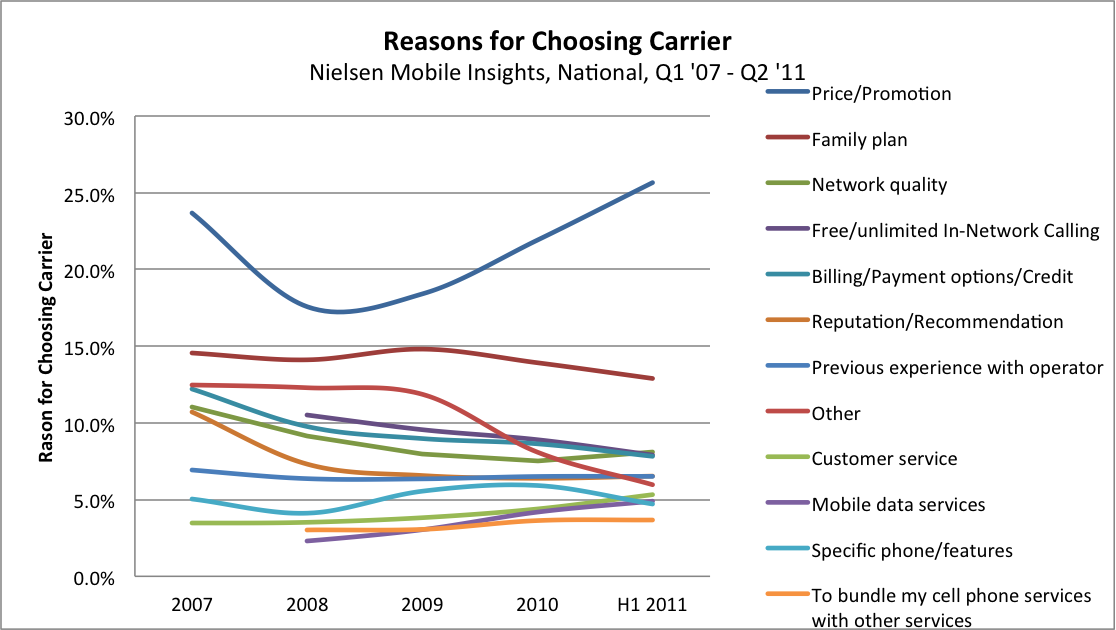
The reasons for choosing a wireless carrier changes over time but then do they really change that much? New data from Nielsen shows the trends.

With the current merger between AT&T and T-Mobile underway, the reasons why and how people pick their carrier are quite significant, and the data is certainly illuminating. The most important purchase decision factor is price, and it has become more important since the beginning of the recession. Mobile data services is the purchase decision factor that, other than price, has more than doubled in importance over the last three years.

Not surprisingly, price and promotion are the most important purchase decision factors and they have resurged since a low in 2008. Three years ago, in 2008, 17.6% of people said they picked their carrier based on price. In mid-2011, this  skyrocketed to 25.7%, due to the continued difficult financial times many Americans are experiencing. With price being the most important purchase factor, one would think that T-Mobile, which is described by many merger critics as the low cost provider in the industry, would flourish and consistently gain customers. However, T-Mobile is losing customers. How can that be? The reason is that T-Mobile is actually the most expensive low-cost carrier in the country. Providers that offer prices lower than T-Mobile – Metro PCS, Leap Wireless, and Tracfone – are growing by leaps and bounds, capitalizing on this shift back to price consciousness.

The importance of Family Plans and Free in-Network Calling has lessened over the last several years. In 2008 and 2009, the combined metric was actually more important than price to consumers with a 2009 high of 24.4% for the combined metric versus 18.4% for price. Sprint adeptly recognized both the threat and the opportunity that lay hidden in that data point. Their inability to match Verizon’s or AT&T’s free calling circles was strangling the carrier’s gross additions and they had to break free from it without destroying value by going unlimited. The Any Mobile, Any Time plans, which offer free calling to any mobile device did exactly that. It provided a better value by offering more free mobile calling at a lower price. The plan was launched in September 2009. The impact was immediately measurable with a significant uptick in gross additions. The massive impact of this plan, supported by a focused marketing message, turned around the fortunes for the Sprint-brand of the company. The relative decline of this metric may indicate the need for Sprint to adjust their go-to-market strategy.

Network quality as the most important purchase decision factor has also declined since 2007 from 11% to 8.1%. This represents a maturing of the networks in major urban areas, where the difference between the best and the worst networks – contrary to the vitriol on blogs – has actually declined. It is now a matter of “good enough” not of being perfect. This is a dangerous trend for Verizon, where network superiority has been a cornerstone of the company’s success . It’s massive 4G LTE build-out is a testament that the company still believes it can revive the network theme when making the generational shift to LTE. The industry-leading net subscriber add numbers are supporting that the investment was well spent, especially as it shifts its network superiority investment and message to wireless data.

Billing, payment choices and credit declined in importance as each carrier basically offers the same options.. The only carrier that offers something unique is AT&T with Rollover Minutes, where unused minutes can be carried over for up to one year.

Contrary to the hype we hear on the internet, that people will leave the combined AT&T and T-Mobile if the merger goes through, only 6.5% consider the reputation of the carrier as their main reason for choosing their operator, down from 6.9% in 2007. The facts just don’t support the rhetoric.  This is similar to the impending doom that would befall AT&T if Verizon acquired the iPhone. In Q2 2011, AT&T sold more iPhones than Verizon, even though Verizon grew faster than AT&T in the first full three month period when the devices were available at both carriers.

The reputation of the carrier and the recommendations of others are becoming less important to Americans as they have more and more first-hand experience with the majority of operators. The 6.5% of respondents that consider carrier reputation their most important decision criterion represents about a quarter of the people who consider price the most important reason for choosing a carrier. In 2007, 10.7% considered this the most important factor in choosing a wireless carrier. In mid-2011 it was down to 6.5%. Bundling continues to be a minor issue, with only 3.7% making it their top priority, albeit up from 3.1% in 2008.

With so many Americans having first-hand experience with various carriers, and mobile devices becoming more complex, it is no surprise that customer service is an increasingly important factor. In the first half of 2011, 5.3% of people responded that customer service was their main reason for choosing their carrier, compared to 3.5% in 2007.

About 4.7% of Americans consider a specific phone (everybody can guess that this is code for the iPhone, since it gets the juices going like nothing else) to be the main reason for choosing a wireless carrier. A sobering fact – being, in fact, the second to last important factor in choosing a provider – considering how high handset exclusivity is on the mind of many policy makers. Just as the discussion is heating up in Washington, the importance is declining compared to previous years. In the first half 2011, it has declined below the 2007 percentage.. The drop is particularly large when we compare 2010 with first half of 2011 with 5.9% compared to 4.7%. About 25% fewer people consider a given device their number one decision factor after the iPhone was available from both AT&T and Verizon. With the rumored launch of the iPhone on T-Mobile and Sprint in the fall, the number will probably decline even further.

Last, but not least, mobile data services have significantly gained in importance over the last several years. Considering that more than two-thirds of the devices sold in this country are smartphones, it is hardly surprising. In 2008, only 2.3% considered data their most important decision criterion for selecting a carrier. By the first half of 2011, this has increased to 4.9%. With America’s love affair with accessing their data and being entertained by their mobile devices, continuing to grow, this number will only go up. Considering that this fall, everyone will largely have the same device line up, the network that powers mobile data services will become ever more important. The days are over when some operators were able to skimp on their 3G data networks or could even skip it completely due to the dominance of voice. A carrier will have an extremely hard time competing if it doesn’t have a 4G network in 2012 and beyond.

The release of the 15th CMRS Report regarding the state of competition in the wireless industry turned the entire wirelessly focused crowd in Washington into something that can only be compared to children waiting for Santa at Christmas.

Everyone was full of anticipation about what Santa might bring them.

The hope was that we would find out who was naughty and who was nice – and which way the AT&T/T-Mobile merger would go. The logic was that since this report was so late, it would have something juicy in it. Traditionally, the competition report comes out very early in the year and rumor has it that the report made it out of the Wireless Bureau on time but it got stuck on the 8th floor. Considering how much editing must have gone on there, the outcome is a tome that is heavy on facts and numbers and light on opinion.

The operator community reacted with a nod – the facts are well known especially since the focus of the report was 2009. While they feel slightly disappointed that they didn’t get the “wireless industry is competitive” nod from the commission, which the data that the report cites strongly supports, everyone has gotten used to this perceived slight. On the other hand, the consumer advocacy groups reacted with outrage, since their hope of finding support for their positions was dashed.

I guess Santa made nobody really happy this year.

Well, I am actually happy with the report. The FCC is taking the right steps to become a fact-based regulator and the first step in this is to collect the facts – 308 pages of it. Nobody can say that the FCC cut any corners. There are numbers and facts in abundance. Most of the analysis that went into the report was sound and thorough. There were some interesting nuggets that revealed that the commission is looking at the state of the industry with open eyes that study the facts on the ground, rather than from the orthodoxy of the ivory tower.

Although the Herfindahl-Hirshman Index is the established theory around the study of the predicted impact of mergers, the theory clashes with reality. While some people happily discard reality in order to hold onto a comfortable theory, the Commission pointed out that the wireless industry does not behave like the text books predicted.

Industry concentration in 2009 actually declined, even though companies exited the industry – both through divestiture by shutting down entirely. In addition, even though the industry is what is often described as “highly concentrated” by economic theory, the facts show that it is far from being in the clutches of price fixers and evil doers who want to stop innovation.

Prices have declined, wireless data usage has exploded, choices (especially around handsets) have increased substantially, and the number of people who can choose from several providers stayed roughly stable.

Looks like a pretty healthy market to me, even though the theory would predict something else.

I can’t state it better than the FCC: “Shares of subscribers and measures of concentration are not synonymous with a non-competitive market or with market power – the ability to charge prices above the competitive level for a sustained period of time.”

I am looking forward to more of such enlightened fact-based thinking from the FCC.

A year ago in June 2010, I undertook the first endeavour to quantify the data tsunami that is challenging wireless operators. Nielsen kindly provided again the data to quantify the strength of the data tsunami.

So what has happened over the last year?

Most carriers introduced changes to their pricing plans. Tiered data pricing has gained traction, with AT&T continuing to offer full-speed tiered pricing, whereas T-Mobile USA has just introduced tiered pricing that includes throttling after the purchased amount of data has been used up. Sprint opted to maintain their unlimited plans but increased the price by $10 per month, and while Verizon was standing pat with its unlimited plan, it announced that this would change by summer – most likely with the introduction of the next generation iPhone. This means that the four nationwide operators have four different approaches to data pricing and consumers. Despite many dissonant voices on the web to the contrary, consumers do not seem to have a distinct preference for any one of them as indicated by the relatively unchanged net subscriber and churn metrics.

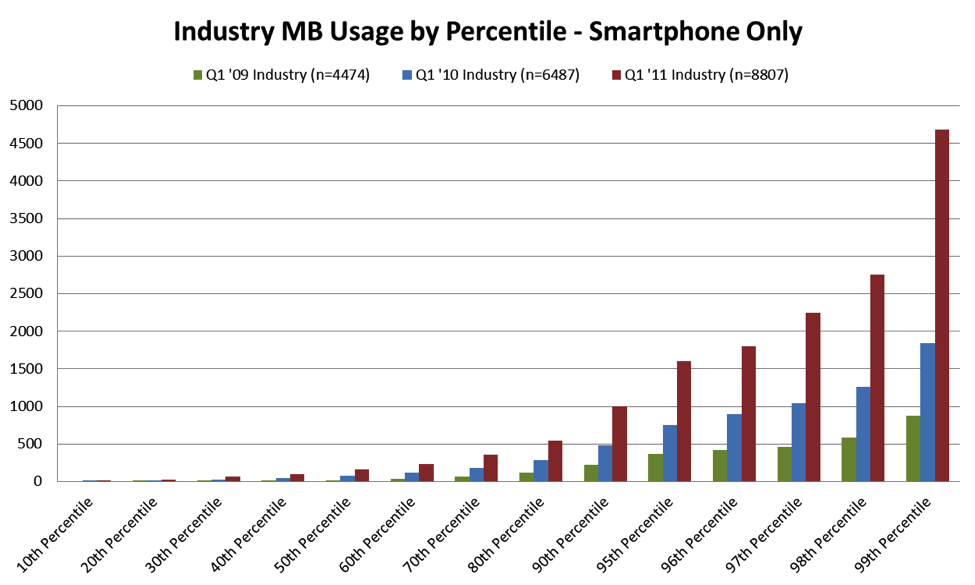
As the data in the table below shows, the demand for wireless data continues to increase dramatically.

Exhibit 1:


Source: Nielsen, Customer Value Metrics, Single Line Accounts

Not only has the ownership of smartphones dramatically increased, but usage has increased within every usage percentile by a factor of two or more. Smartphone owners at the 20th Percentile are now using 27 MB of data per month, almost three times more than the 8 MB than they used in 2010, and 479-times more than in 2009 when the 20th Percentile used only 50 KB per month. The median customer (50th Percentile) uses 160 MB in Q1 2011, up more than two-fold from 77 MB in 2010, and eight times more than in 2009 when it was 20 MB per month. We are seeing the most dramatic increases among the heaviest users. Usage at the 90th Percentile increased to almost 1 GB in 2011, up by about a factor of two compared to the 478 MB in 2010, and 4.5 times more than the 222 MB they consumed in 2009.

The distribution of total mobile data usage among smartphone owners has also changed. While the new tiered data plans have introduced more fairness to data pricing and usage because low usage customers no longer subsidize high usage customers as they did under the “one size fits all” model; they have not stymied usage or skewed take-up. The iPhone launched with Verizon Wireless in February 2011 with an unlimited plan whereas AT&T continued to offer 200MB and 2GB data packages. Per day sales, in the next 60 days was almost identical for both operators with about 40,000 each. This is even more remarkable as in Q1 2010, the top 5% of bandwidth users consumed 41.9% of all data consumed, whereas a year earlier, the top 5% of bandwidth users consumed 43.6% of bandwidth.

What the Exhibit 1 does not show is that this per-subscriber usage increase occurred simultaneous with a huge increase in smart phone ownership, which doubled compared to a year ago, leading to the overall conclusion that total data consumption quadrupled over the last 12 months. While this is a smaller percentage growth rate than in 2009, in the year 2010 the United States consumed more wireless data was than has been consumed since the beginning of this technology in 1999.

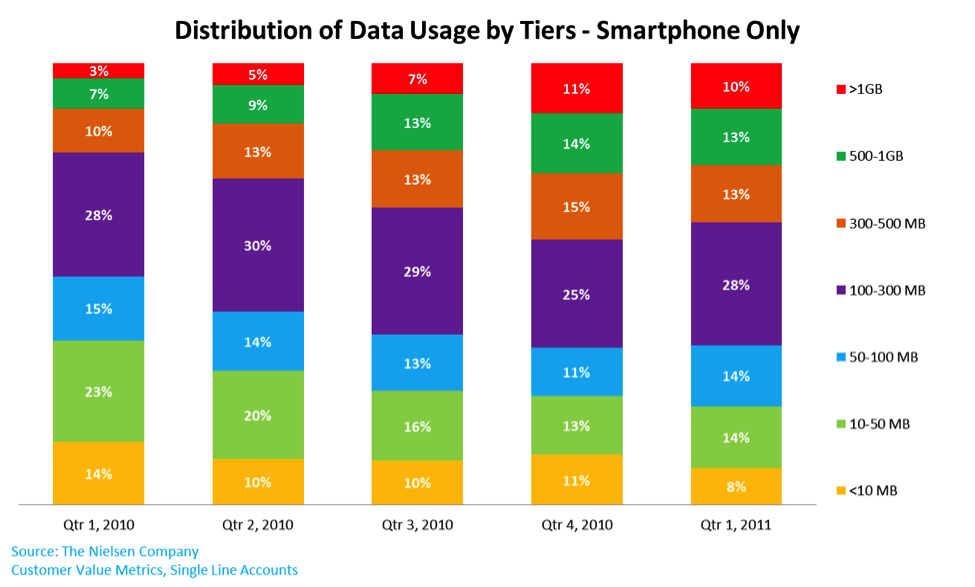
One of the most interesting factoids from last year’s research note was the fraction of smartphone owners that used only very small amounts of data. As we can see in Exhibit 2, the percentage of smartphone users that used less than 10MB per month almost halved from 14% in Q1 2010 to 8% in Q1 2011.

Exhibit 2:


At the same time, the segment using more than 500MB per month increased from 10% to 23%, while the percentage of smartphone users using less than 50MB declined from 37% to 22%. All the other usage buckets stayed basically the same over the course of the last year. This is particularly remarkable because during this time period the absolute number of smartphone owners more than doubled and we would expect low usage categories to expand as more people are becoming smartphone users. New devices with larger screens, faster processing capabilities, and new video formats optimized for smartphones have made data usage more conducive and seductive and consequently data consumption increased significantly.

I am talking about the wireless handset – you know the device in your pocket/ purse that you rely on for everything from phone calls to driving directions?  Well keeping it powered in an environmentally sustainable manner is about to get much harder.  

With the next generation of 4G devices, power consumption is taking a quantum leap yet again. The higher throughputs that 4G devices are providing are made possible by higher modulation, compression, and encryption schemes that need more power to compute.  Further, this is compounded by the need to run several radio interfaces (as the 4G networks are not ubiquitous), ever larger screens and more powerful (and therefore more power consumptive) processors – to let the consumer watch more video or play games in higher resolutions. As a result, the common mantra in almost every 4G handset review is that battery life of  is horrible. It is the irony of modern technology that consumers can use the new technology only sparingly because it uses more power than the handset can hold for a 12 hour day.

Device manufacturers and operators are working hard to improve the power efficiency of smartphones, but there is only so much they can do. As more 4G devices are released device manufactures and carriers are applying the lessons learned and are making smartphones as  power efficient as the current technology allows, but the fundamental problem remains: The industry is fighting a losing battle against the increasing demand for power. All the activity and schemes introduced at the chipset and system level to address   are far too little to counteract the onslaught of demands on the phone. Just one or two active applications that monitor social media in the background  use more power than can be saved by all that engineering brain sweat. Lithium-Ion batteries, what is currently powering mobile handsets, are increasing in power capacity by about 5% per year. At the same time, to lessen the power crunch the size of the battery of devices has also increased. While feature phones have batteries that hold 3.5 Watts-Hours ([email protected]), smart phone batteries are considerably larger with an average size of about 5.7 Watts-Hours ([email protected].) This is to accommodate the increase in daily power consumption by about 2000 Watt-Hours per day of using a smart phone versus a feature phone. As many “power users” can testify, they are using a lot more power than their battery can hold, which forces them to recharge their phone more than once a day, while they would have to recharge their feature phone only once every few days.

The wireless industry has begun to reduce the impact it has on the environment through phone recycling programs, paperless billing, solar panels on store roofs, and alternative-fuel vehicles. Unfortunately, it is not making any significant progress when it comes to reducing the impact of increased power consumption. In 2009, power consumption in the United States was roughly 3,587 TWh[1] of electricity in thousands of power stations. Mobile devices use about 14 TWh per year or roughly the entire electric power consumption of the state of Montana. The transition to smartphones increases the power consumption to about 23 TWh. The incremental electricity usage is as much as the entire state of Rhode Island uses. It is like smartphones represent power-wise the 51st state! In addition, the increase in power usage will increase the carbon footprint by roughly 12 million tons of CO2 per year. While the industry is doing a lot to save power in data centers and on the invisible backend of operations, it can do more to become “more green” on the consumer side.

The next step into the right direction is clear: fuel cells – more precisely, Butane fuel cells. This breakthrough technology is about one year away from the store shelves. With energy densities five times greater than other technologies and a carbon footprint that is 1/6th of electricity power users will be able to recharge on the go while limiting the increase in demand for electricity power as well as limiting the increase in carbon footprint. The fuel cells are so safe that the FAA has less concerns about them than the lithium-ion batteries in today’s use. In addition, recyclable fuel cell cartridges will not have a harmful impact on the environment and reduce the number of traditional batteries that, despite the efforts of the wireless industry, end up in landfills.


[1] U.S. Energy Information Adminstration, http://www.eia.gov/emeu/states/_seds_updates.html

Sprint is formally asking the FCC to deny the $39 billion acquisition of T-Mobile USA by AT&T, stating that the combined company would “lead to higher prices and poorer service in the wireless industry.” This followed last week’s Congressional hearing  where lawmakers inquired about the impact of a combined company on competition in the wireless industry. AT&T, T-Mobile, the Rural Cellular Association, Consumers Union, as well as two anti-trust experts testified.

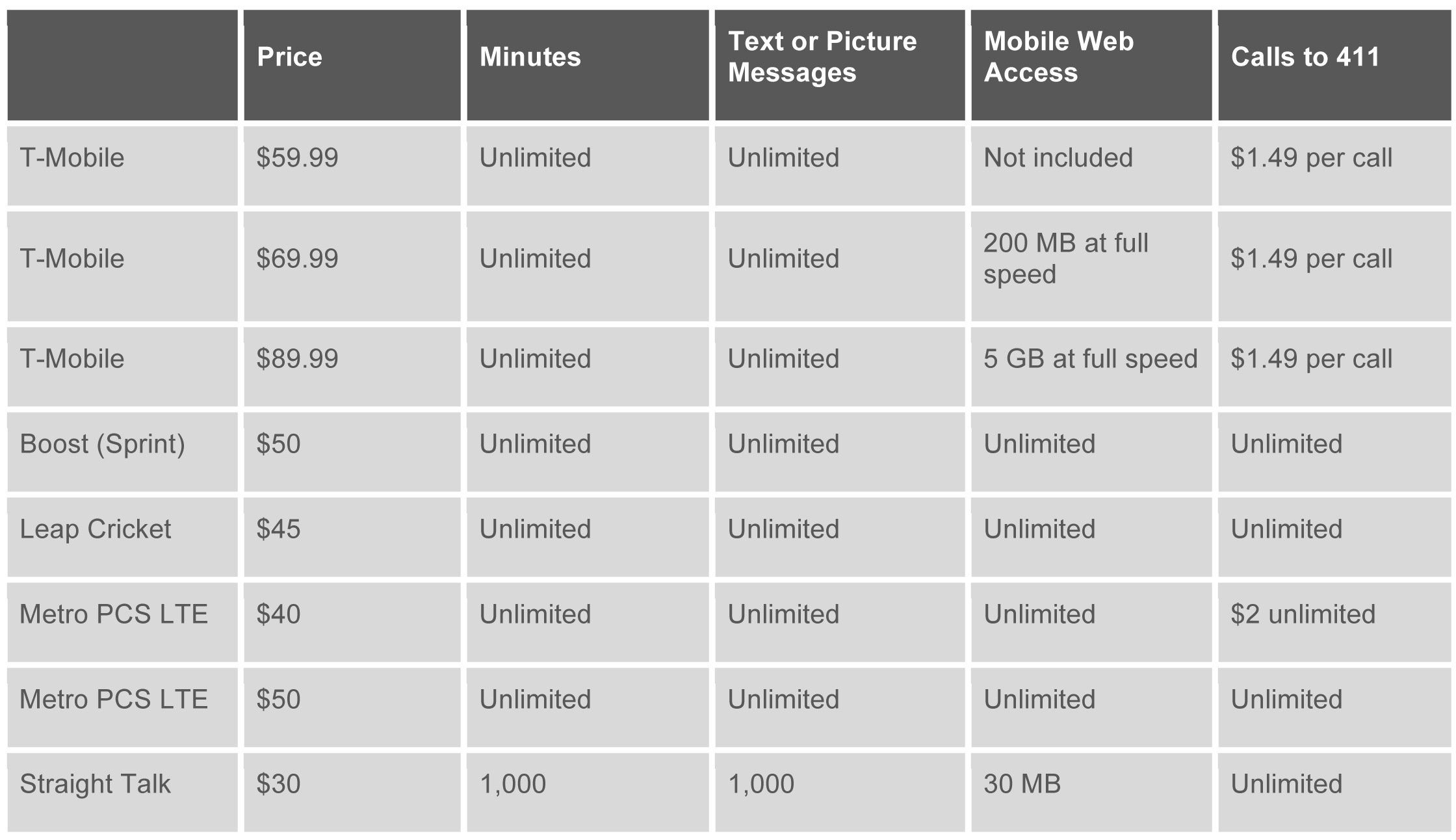
The Consumers Union prognosticated that the disappearance of T-Mobile USA “will likely lead to higher prices, not just for T-Mobile customers, but for all customers,” as it would eliminate the “largest low-cost provider” in the wireless marketplace. Some quick research gathered on the websites of various wireless providers shows a different story.   As the late Senator Moynihan famously said: “We are all entitled to our opinions, but not our own facts.”

Nationwide consumers have at least three offers available to them that are lower in cost than T-Mobile’s current offerings. Boost Mobile, which is owned by Sprint, and Tracfone’s Straight Talk offer nationwide plans that provide a lower-cost option than what is available from T-Mobile. In fact, Sprint’s Boost Mobile, Leap Wireless, Metro PCS, and Tracfone’s Straight Talk are all gaining customers, while T-Mobile’s higher priced services are losing customers. It is highly doubtful that Sprint, Leap, Metro PCS, and Tracfone will raise prices while competing vigorously against each other for customers at the low-cost end of the market, just because a higher priced competitor is no longer competing.

The best way to describe T-Mobile at this time is as “the most expensive low-cost phone provider” – an oxymoron indeed, and the exact reason for T-Mobile’s customer losses. The root of T-Mobile’s current churn and customer drop-offs lies in the lack of focus on a clear consumer segment. The provider’s plans are too expensive to appeal to customers who seek low-cost plans, while it is unable to provide a sufficient network that will satisfy the demands of customers who are willing to pay a premium.

Source: Service Provider Webpages

The lower cost options listed above are available to roughly the same number of Americans before a merger of AT&T and T-Mobile as after a merger of the two providers. In virtually every market, where T-Mobile is active, Sprint’s Boost service is available, as is Straight Talk. Additionally, either Metro PCS (covering approximately 100 million Americans) or Leap Wireless (covering approximately 95.3 million Americans) is also active in these markets, providing cheaper service plans that directly compete with T-Mobile USA’s offerings.

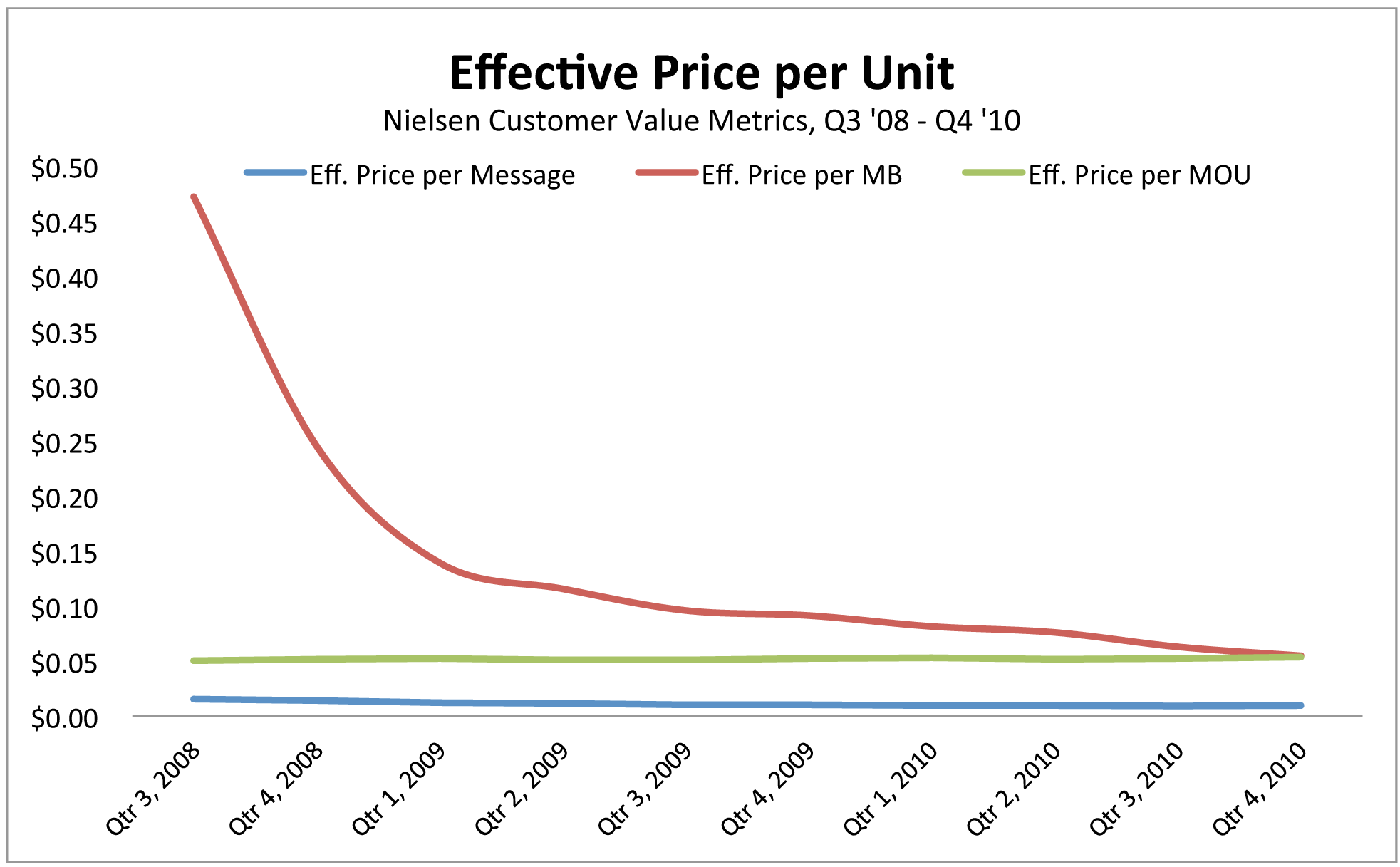
Another popular argument against the merger is that prices would rise – a claim made during every merger. In the wireless industry, however, this has not been proven; in fact, it is quite the contrary.  As previously published, prices for wireless voice, messaging, and data services have declined consistently over the last several years despite claims that prices would rise after multiple wireless mergers that occurred during this time period.  The below chart was included in a Recon Analytics’ Research Note from April 13, 2011 titled “What is the price of a megabyte?”


Based on The Nielsen Company’s Customer Value Metrics collection of more than 60,000 wireless phone bills per month, the price per voice minute held steady over the last two years, while the price per text messaging that consumers actually pay declined from about 2 cents to 1 cent per message, and the price per megabyte declined from 47 cents in Q3 2008 to 5 cents in 2010.

To say that T-Mobile is the only low- or lowest-cost provider or that there would be only high-priced service plans available to Americans after a merger of T-Mobile and AT&T is factually incorrect.  There may be reasons to oppose the merger, but fear that it will eliminate the lowest-cost competitor is not one of them.

Perhaps what is even more interesting is that Sprint, while loudly opposing the acquisition, will in all likelihood be the biggest winner of T-Mobile’s disappearance. It is already the best positioned value provider in the wireless industry. Sprint’s post-paid plans are providing great value, while its Boost brand is a leader in the disruptive unlimited segment, and its Virgin Mobile brand is well represented in the per-minute prepaid segment. No other provider has as firmly anchored itself as the low-cost provider as Sprint, and no other carrier in the U.S. has done a better job in improving its customer service than Sprint.

When Dan Hesse took over Sprint it was dead last in customer service. In the last four years, the company has gone from being the worst to being tied for the best customer service, and this has helped to attract and retain customers. When the remaining, value-conscious T-Mobile customers are looking for a new carrier, Sprint and its fighter brands will be at the top of their consideration list, and unless Sprint raises its prices, they will most likely become Sprint customers.

It’s a funny business indeed where one of the biggest beneficiaries of a merger is one of its biggest opponents.

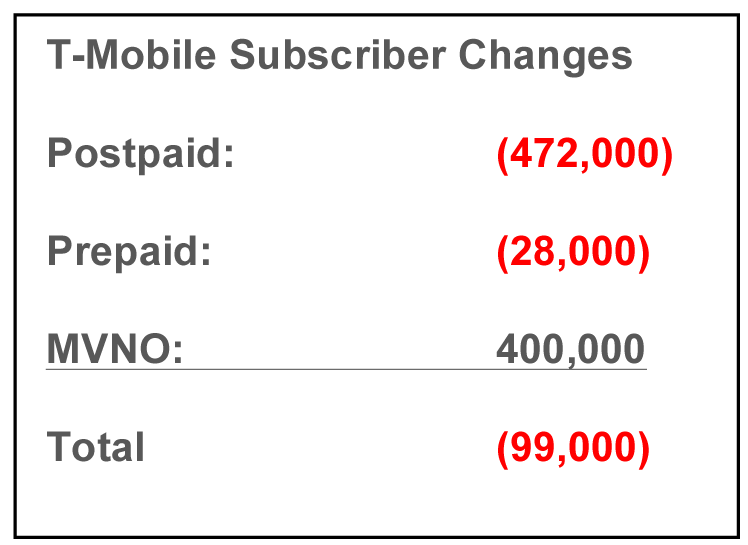
On May 6, 2011 T-Mobile USA released its quarterly results and it shows a carrier in distress. An improvement in APRU from $52 from $51 a year ago was the sole T-Mobile highlight of the quarter, but even that was offset by an increase in CCPU of $1. The company lost in aggregate 99,000 subscribers in the quarter.

When the numbers are disaggregated the picture becomes even bleaker: The company reported that it lost 471,000 postpaid subscribers and that it gained 372,000 prepaid subscribers including MVNOs. The number of MVNO customers increased to 3.2 million in Q1 2011 while it reported in the Q4 2010 results that it had 2.8 million MVNO customers. This indicates that about 400,000 MVNO customers were added in the quarter resulting in a net loss of roughly 28,000 T-Mobile prepaid customers. This means that 

T-Mobile lost subscribers in both own-label segements, postpaid and prepaid, and the only segment that is growing comes from partners not using the T-Mobile brand, namely Tracfone’s Safelink offer that markets to Americans on government assistance.

Due to the sins of the past (explained below) T-Mobile is melting at both ends of the subscriber spectrum. It is losing premium subscribers to Verizon and AT&T, it is losing value conscious subscribers to Sprint, and budget conscious subscribers to the disruptive unlimited providers such as Metro PCS, Leap Wireless, and Tracfone’s StraightTalk products. The only segment that seems to be growing at T-Mobile’s own brand product portfolio are the data-heavy unlimited offers, but even there is a price to pay as indicated by the increase in CCPU from $24 to $25 which offset the APRU increase. It raises the question: Where would T-Mobile be in five years from now without the AT&T merger?

While the company could survive the current storm, it could only do so through superior leadership, consistent and differentiated positioning, and the strong support from its parent. In the wireless market, everything happens with a significant lag period: It takes year one to change the fundamentals, it takes year two to change the perception of its own customers, it takes year three to change the perception of non-customers, and the results only change in year four – and that’s if you do everything right. At the beginning of the year, T-Mobile was the last of the nationwide wireless operators to make the regions directly responsible for the business results. Before that everything was controlled from its headquarters. While the move is laudable, one has to wonder what took T-Mobile so long? One of the factors that made Verizon Wireless such a machine in the early 2000s was Denny Strigl’s and Lowell McAdam’s decision to drive authority and responsibility to the regions. After Stan Sigman and Ralph de la Vega took over the reins at Cingular, which was losing customers at the time, they instituted a similar approach with tremendous success. Sprint is doing well with a similar approach of devolving responsibility at a regional level.

T-Mobile USA is in the current position because it was several years late launching a 3G network due to a lack of funding from its German parent. Only in late 2009 and in 2010, as the financial metrics already started to deteriorate, did T-Mobile USA build and then launch an increasingly competitive 3G/4G network. With it the company changed marketing campaigns and corporate positioning again and again from a value approach with Catherine Zeta-Jones to a social approach with its Stick Together campaign, back to a brief Catherine Zeta-Jones revival campaign in 2009, focusing on just handsets after that T-Mobile declared that “kids are free” to the current Largest 4G campaign. Just reading it makes you dizzy and confused and consumers became disoriented regarding what T-Mobile really stood for.. The current campaign around “Largest 4G network” will have to be changed again when Verizon will have a larger 4G network that T-Mobile and the company has to go looking for a new differentiator again. Carriers are growing through consistent, believable differentiation not through constant change what they are standing for.

The Sprint example shows that you can overcome a lot of adversity, if there is commitment to endure a long and arduous path combined with good leadership. The US market is competitive and companies can come back from near death when they do things right. The problem is that T-Mobile USA’s parent Deutsche Telekom is not committed to the US market the same way its competitors are – and nobody can be forced to be committed to a market. Deutsche Telekom chose the easy and financially prudent path out: Sell the company rather than rebuild the company and go through a costly corporate rebuilding and repositioning. The agreement with AT&T came just in time.