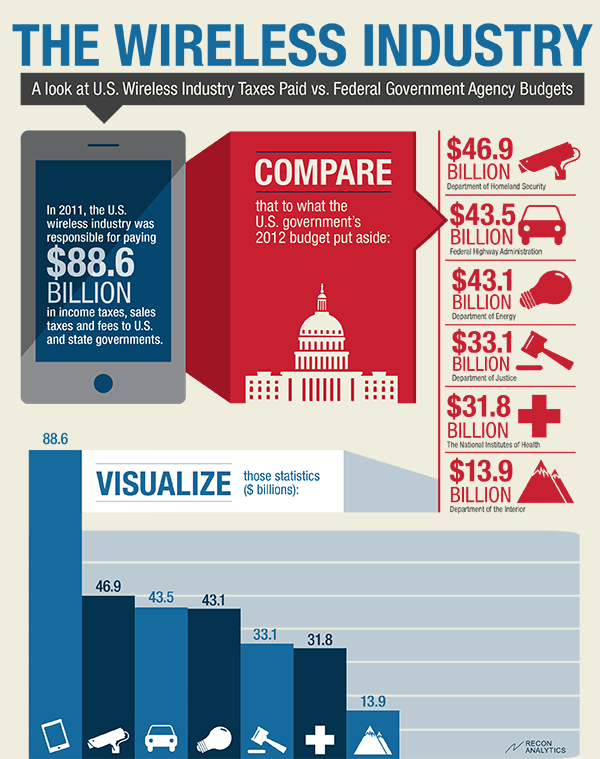
Recon Analytics undertook this in-depth report to determine the extent of the economic impact the wireless industry has on the US economy.

We ran an independent analysis based on numerous sources, including data that covered wireless carriers, wireless handset and equipment manufacturers and the overall wireless broadband industry. In addition, we applied our own analysis to the data we collected.

Download the report here.

The situation at the 4G wireless service provider just keeps getting worse, so here’s what it needs to do

One thing is clear about Clearwire: no matter what happens, it needs Sprint more than ever.

Just look at 2011. The 4G WiMax service provider’s best news was the increase in subscribers, from 4.4 million to 10.4 million. Impressive as that was, it came solely on the back of Sprint.

With growth like that, and lingering fears about its survival, you’d think Clearwire would play nice. But Clearwire played a high-risk game of chicken with Sprint during negotiations to extend its resale agreement, and now it’s in a bigger mess than ever.

This ill-advised negotiations tactic pushed Clearwire and Sprint to the brink. As both companies insisted the other needed them more, the deal wasn’t closed until the very day Clearwire could have gone into default in December.

As if that wasn’t enough excitement, the next day, half of its strategic investors — Comcast, Time Warner Cable, and Bright House — decided to stop selling Clearwire services and provide Verizon services instead. Not exactly a vote of confidence.

Could things get worse? Of course. Just a few months later, Google, another strategic investor threw in the towel. Google sold its $500 million initial investment for $66.5 million to Credit Suisse, Bloomberg reported.

How did Clearwire get into this mess?
First, let’s look at how it got here. In early 2011, things looked pretty good for Clearwire. Sprint’s 4G WiMax devices were adding more than a million customers a quarter — a well-needed boost for both companies. Extending the WiMax wholesale agreement between the two companies was a priority. Clearwire knew that its WiMax network gave Sprint an advantage so Clearwire thought it had Sprint over a barrel.

So it pushed for a nonsensical premium from Sprint rather than the more appropriate market rate or slight discount. The negotiations continued on and on for months. There was no progress, with two important deadlines looming: Sprint’s Network Vision investor conference on October 7 and a large Clearwire interest payment on December 1.

October 7 came and Sprint had to announce that it hadn’t renewed the contract with Clearwire. In a fit of hubris, Clearwire thought Sprint would be forced to agree to its terms to save its 4G strategy (and regain Wall Street credibility). Although Sprint’s share price did drop, Clearwire’s all but collapsed because Sprint presented a 4G strategy that didn’t critically rely on Clearwire beyond 2014.

In the next two months, as a possible debt payment default by Clearwire approached, Clearwire realized it needed to make a deal. Sprint was its only option. So they inked the new agreement, which enabled Clearwire to make a huge debt payment. The result is pretty good for both companies. Sprint will pay Clearwire a fixed $926 million for unlimited WiMax access for its customers. (In the old agreement, it had to pay by the megabyte.)

Sprint also will pay Clearwire for bandwidth to its TDD-LTE network — a variant of the 4G LTE network used by Verizon Wireless and AT&T — if Clearwire gets its network up in time. With this new agreement in place, Clearwire avoided bankruptcy and acquired additional funding. With a 49 percent voting share (54 percent ownership stake), bankruptcy would have been inconvenient and might have presented some PR challenges for Sprint, but not been lethal for Sprint.

Clearwire’s last remaining strategic investor, Intel Capital, seems to have forgotten it still owns a part of Clearwire. It neither bailed nor participated in the refunding of Clearwire. Intel’s initial intent was always obvious: create a showcase for a successful WiMax operator and make WiMax a global standard. After all, WiMax is essentially an Intel invention. Now that Clearwire is moving to using TDD-LTE, the WiMax play in the U.S. appears to have withered on the vine, and with that it is only a matter of time until Intel will sell its strategic stake in the company.

Is there any way for Clearwire to get out of this bind?
So, after a year like that, how can Clearwire get on track? Clearwire has made an important first step by being able to win Leap Wireless’ Cricket as an additional client. The remainder won’t be easy, because Clearwire has to add TDD-LTE to its current footprint rapidly. This will make it worthwhile for Sprint, Leap Wireless, and other operators to get on board.

Clearwire has even been able to persuade Wall Street and Sprint to invest billions more in it. It will also need to get the handset manufacturers on its side. Sprint has committed to help Clearwire develop TDD-LTE devices and Clearwire has just agreed with China Mobile, which uses the same technology, to work together on devices.

For operators and manufacturers, it’s all about economics. And it will only make sense for them to include Clearwire-compatible electronics in their devices if the network is widely available. The end of Sprint putting new customers on Clearwire’s WiMax network is in sight. With theiPhone 4S at Sprint, it added 1 million customers in the fourth quarter 2011, half the number added the previous quarter.

Even if Clearwire is doing everything right, there is the regulatory risk nobody is talking about: the FCC is developing a track record of being utterly unpredictable. Consider what happened with LightSquared. In roughly a year’s time, the company went from being the FCC’s choice to create a fifth national wireless provider to being the company that got its regulatory approvals put on hold by the FCC.

And let’s not forget about Dish. The FCC has pulled the rug out from under Charlie Ergen’s Dish by deciding, after months of comments and negotiations, to wait until after the November presidential election before it lets Dish know if the company can use its MSS spectrum to provide terrestrial wireless broadband services. At a minimum, the FCC is proving it is unpredictable.

How is this relevant to Clearwire? In the FCC’s wireless competition reports, the agency appears to view only half of Clearwire’s spectrum as suitable for wireless broadband.

Why? There’s no clear explanation. If the FCC truly believes only some of Clearwire’s spectrum is suitable for broadband, will the FCC try to reclaim it or bar Clearwire from using it to support wireless broadband? No one knows except the FCC, and that could present a very real risk to Clearwire.

With all of this, will more investors come forward to fund the remainder of Clearwire’s network build out?


At its last meeting, the FCC announced it was commencing a new rulemaking to resolve interference issues in the 700 MHz Block and assess how such interference issues impede interoperability among devices and networks using 700 MHz. Before we delve into a conversation about the FCC’s proposals, it is helpful to remind ourselves of the history of the issue.

The FCC knew about the issues it now wants to study in this newest NPRM (Notice of Proposed Rule Making) before the spectrum was auctioned in 2008. Further, the interference issues were taken into account by the FCC at that time, and informed the rules under which the spectrum was auctioned and purchased.

In its notice of proposed rulemaking, the FCC said that it tries to “protect and promote vibrant competition in the marketplace” and to “balance several competing goals, including facilitating access to spectrum by both small and large providers, providing for the efficient use of the spectrum, and better enabling the delivery of broadband services in the 700 MHz Band.” Furthermore, the FCC observed that “this spectrum is being built out less quickly than anticipated…” and that “the 700 MHz band, at 70 megahertz, one of the largest commercial mobile service bands, is the only non-interoperable commercial mobile service band.”

The potential impact of the FCC deciding to intervene in the way it has proposed is curious for several reasons.

Predictable and expected outcome of licensing a non-homogenous environment: The 700 MHz Block is not only the largest band, but it is also the most heterogeneously licensed. The 700 MHz band is a hodgepodge of interference and licensing problems trying to accommodate everything and everyone. And what we’ve got is a science fair project gone badly wrong. Every other band, whether the PCS band or the AWS band, is the same in terms of licensing requirements and interference. In an effort to accommodate everyone, the FCC moved forward with its plans to auction the 700 MHz for commercial wireless broadband services without fully addressing the fact that TV broadcasters on Channel 51 were causing interference to the lower block of 700 MHz. The A-Block has exclusion zones in the largest markets where interference is rampant. The C-Block has net neutrality restrictions unlike any other band. The E-Block is broadcast spectrum that permits transmission at 50,000 Watts instead of the 1,000 Watts that the paired spectrum around it is allowed to, and that’s why interference occurs. Furthermore, the FCC mixed paired wireless licenses next to unpaired broadcast licenses. Most agree the higher power operations authorized on the E-Block has been a significant contributing factor to the A-Block spectrum selling for less than half the price garnered by the B-Block license. Let’s not even talk about the D-Block, which had public safety restrictions on it that were so unrealistic that one bidder thought it might succeed with a bid below the reserve price.

In summary, contrary to what has been said in the NPRM, only the B-Block has any resemblance to what has been traditionally licensed to wireless operators. If all Blocks would have the same interference characteristics and licensing restrictions then there would be interoperability. However, the FCC decided to go down a different avenue when it licensed the 700 MHz Block that it did before and should not be surprised that it ended up in a completely different place.

Impact on consumers: The impact of interference can be mitigated through additional components and filters. These components have to be permanently powered to immediately thwart the interference, and therefore will reduce battery life, in addition to increase the cost, weight, and dimensions of the device. Considering that consumers will not know the negative impact that additional electronics will have on the battery life of their devices, they will just blame the carrier for it rather than the real culprit, the FCC. What makes this all even worse is that the B-Block and C-Block customers are probably never going to roam on A-Block licenses. So the 200 million customers of AT&T, Verizon, and smaller operators will have to live with the negative impact even though they will never need to have the benefit of having to roam on an A-Block network, as in all likelihood the networks of AT&T and Verizon are going to be comprehensive enough for them not to need to roam on A-Block networks.

The only benefit is that the electronics and filters for A-Block devices are going to be cheaper than they would be otherwise due to the increase purchase volume created by the B- and C-Block carriers. This is basically a government-mandated corporate subsidy from one corporation to another that forces them to buy electronics and filters they otherwise would not need. Furthermore, nobody is stopping any operator from adding the additional bands to the devices they are purchasing to make them interoperable.

The consequences of an interoperability mandate are quite far reaching and chilling. What will stop the FCC from requiring that all phones be interoperable? Every device would need GSM, CDMA, LTE, maybe even iDEN and WiMAX on every frequency used. After all, some of these technologies have been around for more than 20 years. From a practical perspective, such a Turducken device would be a consumer nightmare and become the most visible example of regulatory meddling and government overreach. Such devices would be abominations: larger, heavier, slower, more expensive battery hogs that wouldn’t provide any meaningful user advantage over the unimpeded market of today.

Impact on auction revenues. The winners of the B-Block, which range from AT&T to U.S. Cellular to the Buggs Island Telephone Cooperative, paid a premium for clean spectrum. The winner of the C-Block, Verizon Wireless, paid a smaller premium compared to the B-Block to have un-interfered spectrum that, nonetheless, carries with it net neutrality provisions. Now the FCC wants the winners, which deliberately paid more money to have interference-free spectrum, to “voluntarily” find a way to be interoperable with licenses that they deliberately rejected. If they do not voluntarily submit, the FCC has hinted that it would probably mandate interoperability. So much for “voluntary.”

If the FCC really proceeds with this threat, future auctions the FCC will likely raise less revenues from auctions, if some of the licenses are more impaired than others. The move the FCC appears to be contemplating would set a precedent that it will dramatically change terms and conditions of the licenses after the auction. Any rational buyer would pay only as much as the most impaired license is worth. Therefore, the level government revenues raised through the B- and C-Block licenses would not be equaled.

Impact on spectral efficiency. The FCC’s intended interoperability will perpetuate the problem of interference. This makes it impossible to follow a policy of allocating spectrum to ensure the best possible benefit of the American people. By doubling down on the bad choices that have been made regarding the 700 MHz Block highest, the FCC would perpetuate and expand the impact that interference has. This stands in contradiction to the stated objectives of the Administration and the FCC in the national broadband plan.

At best, the FCC’s proposed approach to addressing the 700 MHz interference issue seems misguided. At worst, it is an intentional ploy to further slow the full development of spectrum for the companies that need it to support their commercial operations. The proposed path on the interoperability issue seems to be a government-sponsored wealth transfer from one company to another, without any regard for the consumer impact. That’s an interesting twist on serving the public interest in a time of looming spectrum exhaust and potentially higher prices for wireless broadband services.


It’s that time of year again. The FCC has to develop its next annual report to Congress on the state of competition in the U.S. wireless industry. In the last few years, the FCC has done a good job of expanding the scope of information it analyzes to inform its opinion. The agency’s focus on the wireless industry value chain–from network infrastructure, to over the top operators, to device manufacturers–is a very good trend, but there is room for improvement. 2011 was a year of dramatic regulatory activity with the denial of the AT&T/T-Mobile merger and the proposed acquisition of the cable companies’ idle spectrum by Verizon Wireless. How will these watershed events be analyzed in the next competition report? I hope the FCC will generate a dispassionate, objective and fact-based report on the state of the industry. The analysis and utility of the report could improve if the FCC took the following into consideration:

  • The FCC must recognize the fact that wireless carriers are no longer the “Masters of the Universe.” Although they remain the core of our entire wireless-enabled ecosystem, they are no longer able to chart their own course due to competitive pressures being imposed by other parts of the ecosystem. Paradoxically, however, the FCC is intervening in the activities of the network operators more than it ever has before. It would be very helpful to have the FCC explain this dichotomy, and make clear how it figures that more regulatory hurdles for network operators would grow the ecosystem and serve consumers.
  • For customers, the wireless experience is so much more than just their service provider. If the FCC is going to craft sensible policies based on its wireless competition reports, the agency must adopt a holistic view of the sector and consider how application providers, operating systems and device makers inform and influence the industry’s competitive dynamic, including the consumer impact of over the top providers competing with network operators. Services ranging from WhatsApp to iMessage are competing with services offered by the carriers. This reality could relegate operators to being dumb pipes. Is this a good thing for consumers and the sector overall? Rendering a dynamic growth sector to a stagnant set of dumb pipes doesn’t sound terribly consumer friendly.
  • The FCC must recognize that it needs to view the sector through a clear lens, not one clouded by regulatory hubris. Google and Apple play an extremely powerful role in the wireless ecosphere now. For example, Apple has truly become a king maker in the wireless industry, highlighting how quickly the competitive dynamic changes in this space. If you are a wireless carrier and don’t have the iPhone, you are losing postpaid customers. And if you get the iPhone, your profitability takes a serious hit. In the fourth quarter of 2011, Sprint spent about $500 million on iPhones, which represented about one-third of its OIBDA profits. Despite this significant impact on profitability, the company felt it had no choice but to accept Apple’s terms. Fortunately, for US Cellular and many other providers, Google offers Android as the chess proverbial Queen to handset providers that lets them compete on an almost even footing with Apple. All the while, Google makes more than a billion dollar from mobile advertising through Android handsets. If the FCC fails to take this competitive dynamic into account, any policies it adopts will be immediately outdated and likely to distort the market.
  • The FCC must accept the fact that every wireless operator needs more spectrum. The more successful the operator, the more spectrum it needs, as more customers use more spectrum. Trying to hold up network upgrades and capacity enhancements by some operators as a way to help less successful carriers is a policy that will doom everyone, including the less successful players. Introducing spectrum restrictions on larger operators is, in the long run, akin to managing market share. When the larger, more spectrum-constrained operators have reached their respective spectrum wall, quality declines and prices rise, prompting customers to leave and join other less spectrum-constrained operators. Those networks then become spectrum constrained, leaving customers with nowhere to go for high-quality, low-cost services. The best approach is making more spectrum available to all, and quickly.
  • The FCC has to recognize that all spectrum allocated to CMRS is useful in a loaded network. Below 1 MHz spectrum offers immaterial advantages over above 2 MHz spectrum in a loaded network. At the same time, the FCC should elaborate on why it counts only half of Clearwire’s spectrum in its spectrum screen calculations. If half of Clearwire’s spectrum is unsuitable for mobile broadband service, then it should say so and take the necessary steps. If it is suitable, then it should include it in the spectrum screen since counting only half distorts the level playing field.
  • Contrary to what many want you believe, the market became even more competitive among operators in the last year. The resurgence of Sprint from its near-death experience when it acquired Nextel is living proof of a resilient wireless carrier ecosphere. Sprint is gaining subscribers from all of its major competitors as evidenced by the net positive porting numbers from those operators.
  • Reseller and Mobile Virtual Network Operators are more important than ever. Tracfone is the 5th largest service provider in the country. With a smart-tiered product portfolio, Tracfone demonstrates to the industry how profitable prepaid can be if it’s done right. Page Plus has carved out a healthy niche, and new entrants like Net Zero are planning to shake up the industry. Don’t expect all of them to survive; it’s a competitive market after all.
  • Side-entrants such as Amazon are also making a major impact. Over the course of the last year, Amazon has become the go-to place to get mobile devices and services. Not only does it resell service from all major operators, but it is providing its own hardware. It will be very interesting to see if a 4G Fire tablet will make the same impact on wide-area connected tablets as the Wi-Fi version has made on the local-area wireless tablet market.

We can only hope that the FCC recognizes that it is overseeing a vibrant market that is driven by consumer demand for more and faster mobile capabilities, and it is shaped by competitive forces. The FCC should expand its focus even further to give each part of the value chain the necessary attention it deserves.


  • The fourth quarter of 2011 was excellent for the wireless industry. More than 5.7 million net additions in the quarter were fueled by the iPhone 4S launch, demonstrating that massive growth is still possible in wireless. This is welcome news for handset makers, app developers, operators and network vendors alike. AT&T beat its best smartphone sales by more than 50percent in the quarter, Verizon Wireless had the best contract quarter in three years and Sprint had the best subscriber addition numbers since 2005.
  • The launch of the iPhone 4S and the impact it had on the fortunes of the wireless operators, especially Sprint and T-Mobile, made it clear who is the king maker in wireless: Apple–as long as nobody else starts to develop something different and completely magical.
  • Sprint as the most recent “iPhone have” gained contract customers for the first time in almost six years. At the same time, the woes of T-Mobile, as the last remaining nationwide “iPhone have-not” got worse. Customers left T-Mobile in large numbers on the heels of the iPhone 4S launch and the failed acquisition by AT&T.
  • Verizon and AT&T attracted the most contract customers, while Sprint and Tracfone attracted the most non-contract customers. AT&T and Sprint were most successful in attracting wholesale and connected device customers.
  • Who would have thought that Sprint would add 16-times more total customers in the fourth quarter of 2011 than Verizon?
  • The failed acquisition leaves T-Mobile the most vulnerable operator. With mounting customer losses, six months to two years behind the competition in 4G LTE and lukewarm support from its parent, life will be hard for the Seattle-based operator. Will they be able to make it alone or will a new suitor appear?
  • US Cellular is in a precarious situation as it is also behind with its 4G LTE network. In addition, it has to find a reason why people should join them, and it must do that quickly.
  • Clearwire has to execute like it has never executed before. Squandering a two-year lead on 4G (WiMAX) was bad enough. Now its strategic investors are bailing. The company has to build its 4G LTE network quickly to give Sprint enough of a reason to put the unique LTE Clearwire technology in enough of its devices. Without Sprint, Clearwire is dead. Better forget all the romanticized rumors of another white knight carrier coming along to come to the rescue of Clearwire. We have heard it before–many times over the years. Sprint is all you’ve got.
  • The opposition of the Department of Justice and FCC against the acquisition of T-Mobile by AT&T and the similar front lines appearing against the sale of the previously unused cable company spectrum by Verizon Wireless leaves one to wonder how successful carriers are supposed to get the spectrum they need to satisfy their customer’s demands.
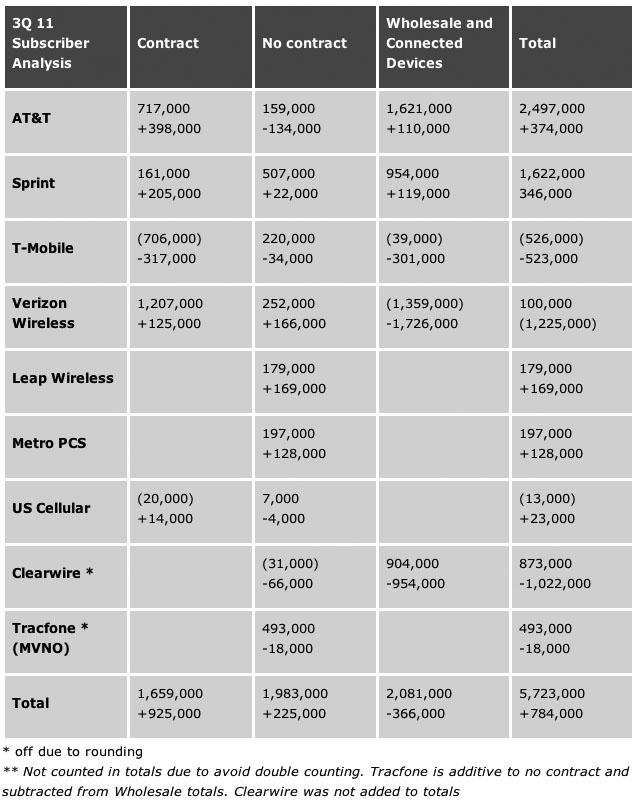
AT&T (NYSE:T) had a gangbuster quarter. It added 9.4 million smartphones in the quarter alone, smashing its previous smartphone record by 50 percent. On the heels of the iPhone 4S launch, AT&T more than doubled contract subscriber additions to 717,000 for the quarter. AT&T leads the industry with 56.8 percent of contract customers using a smartphone. Even though Sprint launched the iPhone for the first time, churn stayed muted at 1.4 percent. This shows that there is a significant disconnect between the negative press coverage that AT&T continues to receive and how customers are actually behaving as existing customers stay with AT&T near record low numbers and large numbers of new subscribers are joining them.  Surprisingly, prepaid was weak for the quarter, as prepaid phones are often given as holiday gifts, making December 25 typically the day with the most activations in the year. While Santa seems to have come up short on the prepaid side, the wholesale and connected group made massive gains. Since AT&T dominates the e-reader segment this has been largely driven by Amazon Kindles and Barnes & Noble Nooks.

In January 2012, AT&T introduced new data plans during the quarter. Customers get 50 percent more data for $5 more. There was widespread confusion and misreporting in the press regarding the motivations behind this change. The pricing move has to be looked at through the prism of declining operating margins, which plummeted from 22.9 percent last year to 15.2 percent. The reason for the decline in operating margin is smartphone handset subsidies. AT&T has to slow down the smartphone conversion rate to improve its operating margins as the typical smartphone comes with a $200 to $450 device subsidy. Early adopters and mainstream customers motivated by technical novelty and value have become smartphone users, driving ARPU significantly up. Technology laggards and less affluent customers still using feature phones remain to be converted. For these feature phone users, price is a major motivating factor if they are converting to a smartphone. By increasing the monthly recurring charge the conversion rate especially from their own feature phone base is going to slow down and margins are going to begin to improve due to a better revenue to subsidy ratio.

Santa was very good to Sprint (NYSE:S) in the fourth quarter. Sprint had the most customer additions in the last seven years. APRU went up by $3.68, the highest of any operator in the United States. Also, Sprint finally gained contract customers. The company now has more customers than ever and has officially recovered from its disastrous merger with Nextel six and a half years ago. While the Nextel platform is in terminal decline and continues to lose customers, the Sprint network is adding more and more customers. Sprint sold more than 1.8 million iPhones in the fourth quarter, and 40 percent of iPhone sales were to new Sprint customers. This translates into roughly 720,000 customers, which was substantially more than the 161,000 net contract additions. Numbers like that show that the power in the wireless industry has clearly shifted towards the makers of blockbuster devices. Without the iPhone it is quite likely that Sprint would have continued to lose customers in the fourth quarter. What is concerning is that the percentage of prime postpaid customers on Sprint declined from 83 percent to 82 percent, which is roughly 330,000 customers. This means that twice as many sub-prime customers became new postpaid customers at Sprint than the company had contract net additions. While Sprint was focusing on selling new iPhones, its sales of 4G WiMAX devices slowed down substantially. Sprint added almost 1 million customers on Clearwire’s 4G network. While this is still a respectable number, it was only half of what Sprint added in the previous quarter. Sprint’s churn numbers are also manageable, with contract churn at 1.99 percent and non-contract churn at 3.68 percent. Despite all the concerns about Sprint’s profitability, Sprint raised $2 billion in debt recently for the 4G LTE network expansion and to help out Clearwire.

T-Mobile had a pretty miserable quarter, losing 706,000 contract customers and a buyer. While the quarter began well with the introduction of T-Mobile’s value plans, the iPhone 4S launch on competing networks, combined with the collapsed AT&T deal, devastated T-Mobile’s hope for a positive quarter. Contract churn increased to a disappointing 3.6 percent–the range in which prepaid operators generally see their churn. T-Mobile’s prepaid churn was 6.8 percent. It is admirable that T-Mobile was able to add 220,000 prepaid customers when faced with such high prepaid churn. In an effort to get churn under control, T-Mobile is planning to recontract a lot of their customers, which is a complete reversal of their strategy of the last several years. In other positive news, T-Mobile was able to increase smartphone contract customers to 11 million or 40 percent of its base. T-Mobile’s wholesale business only declined by 39,000, despite one large customer disconnecting 265,000 lines during the quarter. The overall impact of this customer loss was negligible as these 265,000 lines represented only $1 million in revenues or 30 cents of APRU. A 20 percent increase in data ARPU helped to keep blended ARPU flat at $46. With the spectrum that T-Mobile is getting from AT&T as part of the break-up fee, the company is launching a 4G LTE network in the AWS band. It is able to use the optimal 20 MHz configuration in half of its footprint, with the other half using 10 MHz. T-Mobile is able to compete with this, even better than Sprint, which is initially using 10 MHz nationwide. While building out the AWS spectrum with 4G LTE, T-Mobile will move some of its HSPA+ to the 1900 MHz band. This will open the door for T-Mobile to offer the iPhone in the United States. In the short run, jailbroken iPhones running on T-Mobile will be able to take advantage of HSPA speeds first, giving them faster speeds than Verizon or Sprint customers until everyone will see some Apple 4G LTE love.

Verizon Wireless (NYSE:VZ) had a terrific quarter. It added the most contract customers, by far, in the fourth quarter, with more 1.2 million customers, over 50 percent above AT&T’s tally. The company had its best ever smartphone quarter in its history, with 44 percent of its contract base now on smartphones. Contract churn was near record lows at 0.94 percent. The no-contract segment of Verizon Wireless, which traditionally suffered from benign neglect, showed a nice customer uptick. On the heels of the nationwide rollout of its Unleashed product, prepaid net additions jumped to more than a quarter million. The $50 all-you-can-eat plan gives Verizon Wireless an offer to compete against other unlimited prepaid providers albeit with a quality premium built-in. Verizon had to clean up its connected device database, which led to a decline of more than 1.3 million connections. The company also announced that it has come to an agreement to purchase AWS spectrum that is currently owned by several cable companies; the spectrum covers 93 percent of the United States. While the spectrum is currently idle, Verizon Wireless will be able to use it for 4G LTE services–if the transaction gets approved. Verizon and T-Mobile would create a healthy ecosphere in this spectrum band, leading to lower prices for handset. Ironically, this would help T-Mobile the most even though it has petitioned against the spectrum acquisition. Verizon also expanded its 4G LTE network to 195 markets, covering more than 200 million customers.

Leap Wireless (NASDAQ:LEAP) gained 209,000 voice customers and lost 30,000 broadband data customers for a net gain of 179,000. This was a dramatic improvement from only 10,000 net additions during the third quarter. Interestingly, 65,000 new subscribers were added outside of Leap’s network footprint. Generally, operators try to minimize usage outside their own network footprint because roaming costs make these customers unprofitable. Like almost every other carrier out there, Leap is building its own 4G LTE network. MetroPCS (NYSE:PCS) benefitted from the seasonally strong forth quarter by adding 197,000 subscribers.

US Cellular is still in the doldrums, having lost 13,000 subscribers overall, with 20,000 contract customer losses and gains of 7,000 no-contract subscribers. The problem with US Cellular is that it does not get enough new people in the door as postpaid churn is a healthy 1.5 percent. Hence, the company is looking for a new advertising agency to reposition the company. The Belief Project advertising campaign worked well for the US Cellular customer base but did not inspire the proper belief in customers from other carriers. The good news is that US Cellular’s customers are very satisfied with the company and enjoy one of the best networks. The bad news is that this a very well kept secret. US Cellular is also lagging behind in smartphones with only 30 percent of its customers using one. Its smartphone percentage rose to just above 30 percent; 50 percent of devices sold this quarter were smartphones. The company knows that if it wants to remain a viable provider, it has to compete on 4G. The unlaunched 4G LTE network covers 25 percent of US Cellular’s licensed population, with an expected 50 percent by the end of 2012.

While Clearwire (NASDAQ:CLWR) had a good quarter, with 873,000 subscriber additions, the bad news from its strategic investors keeps piling up: Google announced it is selling its Clearwire stake for $47.1 million, which is a 94 percent discount from what it invested at Clearwire’s inception. To make matters worse, Google was only able to realize a price of $1.60 per share compared to the $2.15 the shares were trading at before the announcement. It is becoming clearer and clearer that Sprint is the only friend left for Clearwire. While its other strategic investors are bailing on Clearwire, Sprint is raising more money for them to give it a chance to surive. How dependent Clearwire is on Sprint becomes clear when we look at the net add breakdown. Sprint added 904,000 customers to Clearwire while the company lost 31,000 Clear-branded customers. This is half of the previous quarter due to Sprint’s focus on the iPhone, and this sends a direct message to Clearwire about how vulnerable it really is.

Tracfone had another great quarter, adding almost half a million subscribers. One of the most interesting developments is that Tracfone, one of the savviest advertisers and notorious for stamping out wasteful spending, has a full-fledged TV campaign for Straight Talk. It is a testament to Straight Talk’s success, product positioning, and widespread appeal that Tracfone is going down that route.

 

The gridlock between Capitol Hill and the FCC is holding the American consumer and economy hostage

In fact, the U.S. will run out of spectrum capacity to support wireless broadband networks in the next three to five years. That’s not just my opinion. The White House, the FCC, and Congress share it, which is remarkable in this era of never-ending disagreements inside the beltway.

So the hunt is on for more spectrum. But there are few options because spectrum is scarce, with most of it already in the hands of major companies or the government. On top of that, the government controls what can be done with it. Carriers that need spectrum can either buy the entire company that owns the spectrum, they can buy the spectrum flat-out, or bid on it at auction, which rarely happens. The problem is it’s unclear just what Washington will allow.

The ill-fated AT&T/T-Mobile acquisition made it clear that the current FCC is not a big fan of successful companies seeking spectrum through acquisition. The ongoing examination and growing political rhetoric around the Verizon purchase of spectrum from cable companies makes me wonder if pure spectrum purchase will even be allowed.

This leaves us with one giant question: How can the big wireless providers continue to satisfy demands that their customers put on their networks? The FCC writes every year a FCC Wireless Competition Reports to Congress describing how competitive the wireless industry is. After reading the most recent report, the FCC’s staff report on the AT&T/T-Mobile merger and the FCC staff Order on the Qualcomm/AT&T transaction, I was left with the feeling that the FCC does not see any benefit in allowing the two most successful companies in the sector to continue growing.

By starving the successful operators of the oxygen they need–spectrum–the government is creating conditions that force a company to provide inadequate service. Everyone agrees that this is an imminent problem: The most successful operators will run out of spectrum by 2015. When that happens, the reduced download speeds and connection reliability will push customers to leave in frustration and switch to other providers. Seismic shifts in market share will likely follow.

Customers should not be harmed and inconvenienced just because certain political forces object to the success of a carrier. Such policies undermine the massive investment being made in the sector, which drives opportunities for all companies. If one looks at AT&T and Verizon’s investments as a percentage of their wireless revenue, they are the same and often more than smaller providers.

Despite the conventional wisdom that “big is bad,” there is ample of evidence to the contrary.

Apple chose AT&T to launch the iPhone because a large carrier increased its chances of success (and AT&T was willing to make the network modifications Apple requested). Google tried a different route: It launched its first Android phone with T-Mobile USA and saw little to no impact in the market. Only when Google partnered with Verizon Wireless did Android sales take off.

Large companies often blaze a trail that makes it easier for the rest of the industry to follow. For example, Verizon Wireless famously broke with industry ranks to allow customers to keep their phone number when they changed carriers and later allowed prorating of early termination fees. Without programs such as Verizon Wireless’ rural LTE program, which extends the same prices that Verizon Wireless pays for its equipment to small operators, LTE might not be on its way to as many parts of the country as quickly as it is.

By hampering successful providers, Washington will slow the wireless economic growth engine that helps so many other industries become more efficient. The government should foster growth and should not hem in a company so that it ends up providing inadequate service. The last thing the wireless industry needs is to have the government managing market share. The results will be lousy service and less innovation.

Without a doubt such restrictions will significantly lower government receipts from the auction process at a time when Washington desperately searches for revenue, especially revenue sources that are not controversial. What the country needs is a regulatory environment that shepherds and enables American businesses and consumers to benefit from this significant national resource.


Research in Motion is the most recent example of how hubris comes before the fall amid the harsh realities of a competitive marketplace. Once upon a time (or, to be more exact, in late 2008), RIM was at the top of the world. It had won the enterprise world with its outstanding mobile email implementation and was making inroads into the consumer market. Carrier demand for its BlackBerry devices was exploding.

It seemed as if RIM was on a steady course. Its market share was growing as it continued to innovate and perfect its product, competing harder than its traditional rivals Microsoft and Palm.

And then the iPhone happened. In June 2007, the iPhone was released with good, but not blockbuster sales. The $400 price tag for the first generation iPhone muted demand. This all changed a year later, when Apple dropped the price of the mainstream iPhone to $199 because of subsidies from AT&T and the introduction of apps.

AT&T was suddenly going to market with a magic weapon, the iPhone 3G, and all the other carriers fought back with feature phones, the equivalent of the weapons of mere mortals. If you remember those days, AT&T was decimating the other operators and it was not a pretty sight anywhere but in Atlanta. Carrier executives were longing for a competitive answer, just as RIM was positioning the BlackBerry as a competitive weapon against the iPhone.

To be fair, the BlackBerry sort of looks like an iPhone. It had email, and a Web browser. Every carrier but AT&T tried to sell a BlackBerry to any prospective customer who was interested in something like the iPhone. As a result, BlackBerry sales exploded and RIM’s leadership thought this validated its strategy of marketing BlackBerries to consumers.

The problem is that RIM mistook the good fortune of being a barely adequate iPhone alternative for a grand validation of their business plan. As long as there was no real competitor other than the iPhone in sight, it was all working out. And then Google’s Android took the stage.

And that’s when RIM’s problems really started to materialize.

For a year, Google was in a quasi-public beta at T-Mobile with its G1 devices. It sold well, but not anywhere near what the iPhone did. Only when Verizon, which until then had been a mainstay of RIM’s business in the United States, threw its support behind Google’s Android platform did Android sales grow significantly. Quickly behind Verizon were Sprint and T-Mobile and all three carriers were rounding out a robust Android product portfolio that was growing to be the number one mobile device operating system in the United States.

But where was RIM?

The tragedy in these events is that almost four years later, RIM still believes that its enterprise-centric devices are attractive to consumers, rather than recognizing that the reason they sold so many to consumers was that they were force-fed to those consumers by operators desperate to have an answer to the iPhone. Even after a management change, the company still does not seem to understand the severity of the situation it is in and how much it is off course.

While it increased its overall phone shipments worldwide, and in the most competitive smartphone market in the world, the United States, sales are continuing to fall precipitously. RIM’s current device line up is simply not competitive anymore. At the same time, Microsoft together with its allies Nokia and HTC are launching very competitive devices with an appealing operating system. Their goal is to become the third operating system in the U.S. and thereby in the world.

In an interesting twist, both Nokia and RIM, the national champions of each of their small nations, are at a similar crossroads. What they do next will decide the fate of the two companies, but that’s about where the similarity ends. The decisions the two companies made about their future leadership couldn’t have been more different. Nokia made a dramatic break with its past by selecting an outsider to deliver it from its troubles, while RIM chose an insider who stands for continuity.

Nokia and its OS provider, Microsoft, are painfully aware that this is the time to deliver and they are putting all their efforts behind this endeavor. RIM’s new CEO thinks that better execution and marketing will do the trick. If Nokia and Microsoft succeed, RIM is dead. If they fail, Nokia will die. There is simply no room for four operating systems. But what really separates the two is that Nokia has nine months to sell a series of devices that are very strong and differentiated before RIM brings its new BlackBerry 10 devices to market. Nokia knows that the survival of the company is at stake, while RIM seems to be in denial about the state of affairs.

The future does not seem to be bright for RIM… by the time its first BB10 device comes out, it will likely be competing with the iPhone 5, Windows Phone 8, and the next generation Android after Ice Cream Sandwich. These choices likely will be two to three generations ahead of where RIM is now.

There is an important lesson for the entire mobile industry in the sage of Nokia and RIM. The industry moves so fast and is so competitive that even a company with leading technology and huge market share can’t rest on its laurels. If it does, in as little as two to three years it will find itself an outlier with few options and a dim future.


Sure, there were exceptions. But overall CES 2012 was pretty dismal for anyone interested in wireless.

This year’s CES was pretty dismal for anyone interested in wireless. Sure, AT&T had some good stuff and the Microsoft launched the LTE Windows Phone 7. But other than that, most people would’ve been better off hitting the snooze button.

Last year, by contrast, AT&T and especially Verizon Wireless made a huge splash with 4G announcements. There was so much excitement that I thought it might upstage the CTIA Show in the spring, which could have faded into oblivion like so many other trade shows.

But this year’s CES made it clear that, for the wireless industry, CES is still optional and the CTIA Show remains the industry’s premier event. So, now that I’ve got you down about CES, let me tell you what I was able to get out of it. There were a couple of bright spots, so it wasn’t a complete waste of time.

AT&T came out swinging again with several big announcements. The company showed an impressive array of support for developers who want to take advantage of GPS, carrier billing integration, and AT&T’s U-Verse TV service. This kind of integration, while limited to AT&T, can lead to richer and more exciting applications. Check out Glympse to see what’s possible with GPS integration.

AT&T has done the best job of selling smartphones to existing customers, with a 99-cent iPhone 3GS and several other smartphone devices under $30, all requiring at least a $15 entry-level monthly data plan. AT&T’s announcements built on that strategy, with the launch of three “LTE for the masses” smartphones for less than $50 and the launch of two types of Windows Phone 7 with LTE, one from HTC (the Titan II), and the other from Nokia (the Lumia 900).

Peter Chou, CEO of HTC, gushed with praise for the Titan II, noting that it’s his personal device. Nokia CEO Steven Elop was a bit more coy about what his company was unveiling because he wanted people to show up for his own press conference later that afternoon.

The Lumia 900 is a gorgeous device, upping the ante on virtually everything the Lumia 800 delivered: a larger, more luminous screen and LTE. It’s well-known that Nokia has also a CDMA + LTE version in the works, which, if it launches with Verizon Wireless, would give it the necessary breadth of operators to make a significant impact in the market. The operators have a vested interest in having at least three competing operating systems. Negotiations are a lot easier when one party has more than two options. With RIM imploding, Windows Phones are in a prime position to take that third slot.

The lower-priced phones are a big deal because people with disposable income already have smartphones. Reaching the rest of the people is the trick. It comes down to cost. A $200 phone and an additional $30 every month for data is not at the top of the list for some people in this economy. But today’s smartphones are addictive. Before people try them, they wonder what they could possibly use them for. After carrying one for a week, they can’t live without one and often end up upgrading.

One more big deal: With a lot of fanfare, Samsung introduced the Galaxy Note–a hybrid smartphone/tablet. In all likelihood, this will fail. Just one look confirms why. It’s too big to be a phone and it’s too small to be a decent tablet. It doesn’t pass the pants-pocket test unless you wear cargo pants all the time, and it looks absurd next to somebody’s ear–like holding a personal pan pizza next to your head.

Other operator and device announcements were underwhelming to say the least. Verizon Wireless and Sprint made announcements that they could have made during any other average week of the year. T-Mobile USA’s “we are still alive” press conference at CES was cute, but not much more than that. T-Mobile’s suggestion that the next iPhone could work with its AWS spectrum also made some waves, but probably irked the secretive Apple more than it it wowed regular consumers.

A few miscellaneous thoughts.

I am very skeptical regarding the Intel/Motorola multi-year, multi-device announcement. This means we will get two Motorola devices in two years using Intel’s new chips. Why am I so pessimistic?

Historically speaking, Intel’s chipsets were a lot more power hungry than ARM-based chipsets, while the radio Intel bought from Infineon is substantially inferior to Qualcomm’s. Have you heard of significant complaints about dropped calls with the iPhone since Apple has switched from Infineon to Qualcomm? Neither have I.

At the spectrum and Federal Communications Commission panels, the focus was on the broadcaster incentive auctions. Almost everyone, including FCC Chairman Julius Genachowski, thinks the auctions need to get done now. Only the broadcasters, which need to be convinced to give up the spectrum, do not see any urgency–the longer they wait to sell their spectrum, the more money they’ll get.

For the incentive auctions to go ahead, the House of Representatives and Senate first have to agree on the terms and conditions of the auction, which recent history shows is not likely. The auctions will put up for bid unused TV spectrum for wireless use. Republicans in the House want to limit the restrictions on the space, while Democrats in the Senate and the FCC want to be able to modify the rules on who can bid. One block of 700MHz spectrum in the 2009 auction had conditions put upon it, and never garnered enough interest by bidders, highlighting what happens when too many restrictions are in place.

So, it was a dull week with a few bright spots. I haven’t completely given up on CES, but am anxious to see what the Mobile World Congress next month and CTIA show in the spring have in store.


Non-Carrier Branded Adds Continue To Dominate

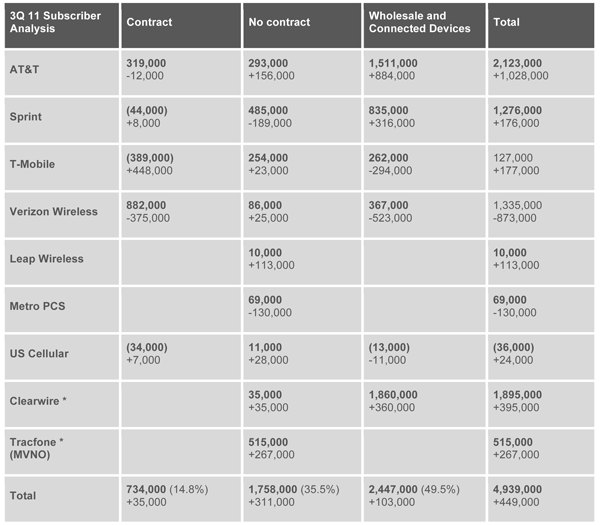
  • Wireless operators have abandoned their walled gardens. There were 4.9 million increases in wireless connections in 3Q 2011. Almost half or 49.5% or the new connections were among non-carrier devices, which were 2,447,000 connections. There were 734,000 contract additions (14.8%) and 1,758,000 no contract additions (35.5%).
  • There were increases in every wireless customer segment, with contract customers obtaining secondary devices and no contract customers flocking to great value at the $40 to $50 price point. The increase in number of connected devices and wholesale net additions are driven by e-readers, tablets, and Tracfone.
  • AT&T’s connected device group continues to lead  the wholesale and connected devices segment, leveraging its early lead in the e-reader space. Sprint is gaining market share in the space, while Verizon fell behind this quarter. T-Mobile’s connected device segment seems to have disappeared. One of the major differences between Sprint’s and Verizon’s connected device strategy is 3G versus 4G. While the future is 4G LTE, prices for modules are still favoring 3G devices.
  • The no contract customer segment grew again by leaps and bounds, led by Tracfone and Sprint. The two companies combined make up more than half of the market share among pre-paid subscribers. New price plans by AT&T, Sprint, and Verizon should make 4Q activity among pre-paid segment very interesting.
  • With the iPhone 4S in its lineup, Sprint is positioned to grow subs in 4Q.
  • Metro PCS and Leap Wireless retained their positions as premier, facilities-based no contract providers catering to price sensitive customers  Leap Wireless continues to address its subscriber losses related to its lack of a competitive wireless broadband offering.
  • Verizon Wireless continues lead the pack in growing its contract customer base with 882,000 adds, more than the industry total of 734,000. AT&T’s contract adds were constant at 319,000, similar to Sprint’s CDMA adds. T-Mobile is still struggling to hold on to contract customers, losing 389,000.
  • T-Mobile’s strategy of de-emphasizing contract customers in favor of no contract customers is almost impossible to execute profitably. One contract customer is as profitable as three to four no contract customers combined. Using this quarter as a benchmark, where T-Mobile lost 389,000 contract customers, it would have had to gain more than a million additional no contract customers to break even financially. In addition, it would have to bring its cost structure into alignment with a no contract business model, mercilessly slashing marketing expenditures and reducing its employee count.

* Not counted in totals due to avoid double counting. Tracfone is additive to no contract and subtracted from Wholesale totals. Clearwire was not added to totals

The third quarter 2011 was generally one of growth for almost all wireless carriers. Overall, 4.9 million new wireless connections were activiated for a run rate that is over 20 million new connections for 2011; however, we could be coming close to the all-time high of 25 million new connection activated in 2007 if all of the backorders for blockbuster smartphones such as the iPhone 4S can be filled before year end. In past years, prepaid feature phones were a favorite stocking stuffer, making December 25th the heaviest phone activation day of the year, while this year the phenomenon will shift to smartphones.

AT&T made significant improvements in 3Q in the wholesale and connected devices segment where it added 1.5 million new connection, more than twice as many than in Q2. The improvement was due to a resurgent Tracfone that started selling its StraightTalk on GSM, as well as AT&T’s increasing strength in the e-reader segment.

It will be interesting to see how Verizon’s market share is impacted by the much hyped Verizon Unleashed product that goes head to head with the other $50 unlimited no contract offers in the market. Verizon has certainly the network reputation to win head to head, as long as the marketing works and the handset portfolio compares well. The impact of affordable smartphones coming to no contract consumers will certainly reshuffle the relative market position of every provider at the $50 price point.

Sprint is continuing to tease the market with when they will actually go contract customer positive – 3Q was not that quarter.  To put it in perspective, Sprint’s CDMA contract customer base grows as quickly as AT&T’s. This is the comparison that is actually meaningful, since Sprint effectively no longer competes with its iDEN products and merely manages the decline until the network gets turned off. In the wholesale and connected devices segment, Sprint has also made significant progress by adding 835,000 new connections, which is an increase of 316,000. Sprint’s growth has come at the expense of Verizon and T-Mobile and has catapulted Sprint into the number two position among all US carriers.

The implications for competition are quite enlightening. Despite all the soothsayers, Sprint is competing well in the market. AT&T with twice the number of contract customers is growing in absolute numbers roughly as quickly as Sprint. Furthermore, Sprint has beaten Verizon again in the all-important non-carrier branded segment which encompasses the rapidly growing M2M segment. Sprint continues to add more 4G customers than anybody else – more than 1.8 million compared to 1.4 million new 4G customers at Verizon. The new double data allowance from Verizon for 4G devices is clearly taking aim at Sprint and its success with its unlimited data offering. We have to wait for 4Q numbers to see if Verizon is able to overtake Sprint in 4G adds when they have twice the 4G coverage that Sprint has.

Clearwire’s success is obviously dependent on Sprint’s 4G performance. Almost all new customers come in through Sprint. While the two are in the process of finding a solution on how they will work together time is running out. Clearwire has a debt payment due December 1, 2011. While it has enough funding on hand for this payment, the company believes it can also get together the money for the June 1, 2012 payment, but not without painful cutbacks. The dramatic fall of Clearwire’s stock price after Sprint’s investor conference in October should serve as a clear message by the market that Clearwire needs Sprint more than Sprint needs Clearwire.

Metro PCS and Leap both grew this quarter with 69,000 and 10,000 subscriber additions, respectively. The problem that Leap is facing in its broadband segment is the same that T-Mobile is facing: Too little investment, too late. Leap’s 3G broadband offer is competing in a 4G world and customers are moving to the faster technology. A clear path to 4G LTE is what is being rewarded by customers who think about who gives them the best value today and tomorrow.

US Cellular reported another lackluster quarter with a loss of 34,000 contract customers and a gain of 11,000 no contract customers. The company continues to focus on its Believe Project advertising and positioning play and its endeavor to have the happiest customers in the wireless industry. While the Believe Project seems to work well in containing churn (1.5% in 3Q compared to 1.4% in 2Q) it has not been able to get new people to believe. Rolling out 4G LTE is certainly a move in the right direction. What the company desperately needs is a new marketing campaign that actually moves people to join US Cellular.

Tracfone, with is multi-brand approach, is growing significantly again with more than half a million net adds. The combination of going more budget through the Lifeline services and more upscale through StraighTalk is gaining traction. The new Android devices are clearly taking StraightTalk to the next level as its customers graduate from voice only devices to integrated devices.

As always, T-Mobile reported concerning but improving customer metrics. The company lost 389,000 contract customers, an improvement of 448,000 compared to last quarter. In addition, it added 254,000 no contract customers, an increase of 23,000 compared to the previous quarter. It also added 294,000 wholesale and connected device customers, but which was 294,000 less than in the previous quarter. The big concern is that churn is increasing and T-Mobile itself is warning that it will increase even further. The value plans, which significantly reduces the handset subsidy that T-Mobile is recording, have helped the company to improve its short-term profitability. T-Mobile is trading a reduction in handset subsidy ($60 less in Q3 2011 than in Q2 2011), which is expenses as a cost, for a reduction in service revenue which becomes accretive over the duration of the customer’s stay with the company. T-Mobile is following the reverse strategy of Sprint with the iPhone. Sprint is expensing the handset subsidy for the iPhone now, which hits its profit line today, but will provide a significant profit in about two years. T-Mobile, in breaking with industry norm, is therefore able to improve its short term profitability compared to the other carriers. T-Mobile’s fundamental problem remains that its contract business is being savaged by StraightTalk, Metro PCS, and Leap from the low end and clobbered from the high end by Verizon, Sprint, and AT&T.

Google is all about advertising – and its Motorola acquisition is all about patents? Yeah, right. A closer analysis shows that Motorola’s share of essential patents has fallen as technology has advanced from GSM over WCDMA to LTE. The acquisition of Motorola’s patent portfolio is protecting the past a lot more than the future.

But what is Google really about?

Being a patent pool or being the premier monetizer of advertising? Why accept the farfetched answer when the real one could be all too near? Besides the obvious closer integration between Android and Motorola, Motorola’s leadership in cable TV set-top boxes is providing an opportunity to revolutionize television and the way we consume advertising.

Motorola has a more than 30% market share of cable TV set-top boxes (STB) and is particularly strong in high-end digital STBs. Google’s foray into the television space with Google TV has been less than a stellar success. Logitech, Google’s STB partner, announced that it had negative sales with Google TV in the most recent quarter; i.e., more units were returned that sold. Despite this spectacular failure to get customer adoption, Eric Schmidt announced during his MacTaggart Lecture at the Edinburgh International Television Festival that Google TV would come to Europe in 2012. We can just hope that it will be Google TV 2.0 and not its current incarnation. Maybe having its own STB manufacturer in house might help.

With the Motorola acquisition, nobody has a better shot at solving this problem than Google. The company will  be in  the majority of affluent households, monitoring everything that people consume digitally. They will be able to tell how people are consuming television, the Internet, and mobile – combined and separately. In short, it’s a data miner’s dream come true. Motorola’s deep understanding of STBs and Google’s capabilities in the online advert should help the combined company to create a considerably better solution with Google TV versions down the line. In addition, what is helping Google is the transformation of how we  watch television. The advent of the all-IP telecom universe in playing directly into Google’s strong suit of analyzing and delivering the right information to an IP connected device. It is further aided by the de-emphasis of linear television in favor of video on demand and delayed viewing. The point of consumption has moved from the stand-alone living room TV set with its barebones connectivity to a multitude of devices, such as the computer, tablet, mobile handset and, yes, the television set that is always connected to the IP cloud. Usage behavior is also changing. Many surveys show that younger people especially are multitasking while watching television shows. With the major drivers – technology, content packaging, consumption pattern, and consumer behavior – shifting towards interactive TV, Google seems to be on the right side of history. Even if Google TV fails, the acquisition of Motorola will give Google access to consumers’ viewing patterns and correlate them with their internet and mobile consumption patterns. This in turn will help Google to improve their internet and mobile advertising juggernaut.  But is it going to be enough to justify a $12.5 billion investment?

The key question remains: Is watching television an inherently active or passive endeavor? No other medium can enthrall us like television. It sucks us into the story and grabs our attention like nothing else. This has important implications regarding what other services are and to what degree  they are at all complimentary (if at all). Over the last fifty-odd years, interactive television has struggled to say the least – starting with Winky Dink and You in 1953. The core problem was and still is that viewers could not be properly motivated to interact or interact in the right way. The interactivity lost the tug of war between the engaging program and the technology  enabling the interactivity. People were either so engrossed by the program that they did not want to be interactive, or they were so bored by what they saw that they turned off the TV before they could or would want to be interactive. The bet that companies like Google are making is that with the Internet, they are able to get people to interact more with the television set and the data sources and programming capabilities attached to it, which in turn it could use to improve the advertising delivery mechanism. The key challenge for Google is how to create television programs that combine the engaging with the interactive so that Google can disrupt the current business model and create value for itself, probably at the expense of the current stakeholders. It is unlikely that the current stakeholders will make the rope with which they would be hanged.

After initial claims that there was “no grand strategy” behind Dish Network’s acquisition of Terrestar’s 20 MHz of S-Band MSS spectrum out of bankruptcy, Dish has proven sceptics wrong.

This week the company filed its FCC application seeking approval of the purchase. Dish requested that it be allowed to combine its purchase of Terrestar’s 20 MHz with its purchase of DBSB’s 20 MHz of MSS. The company also asked for a waiver of the FCC restrictions on using MSS spectrum primarily for terrestrial service. If the FCC grants Dish’s applications, the company will have a 40 MHz contiguous block of unencumbered S-band MSS spectrum which the company says it will use to offer mobile and fixed wireless broadband services on a retail basis. Because the S-band MSS spectrum does not present the GPS interference issues that Lightsquared’s L-band spectrum does, Dish is an even stronger new entrant into the US wireless industry. In fact, Dish Network, the country’s third largest pay-TV provider with more than 14 million customers, will be positioned as a formidable provider of a complete telecom offer — internet, TV and mobile – with greater geographic and population reach than AT&T, CenturyLink, Comcast, Cox, or Verizon.

Dish’s bold move proves that new entrants into the wireless market are more common than what popular wisdom may want you to believe. For example, many have derided MVNOs as not being “real” competition because they purchase minutes from other carriers rather than build a network. This perspective completely ignores the massive success of Tracfone, the country’s fifth largest service provider with more than 18.7 million subscribers at the end of Q2 2011. This reality should lead to at least a reassessment of the theory that MVNOs are not real competitors to facilities based mobile providers. Mobile virtual operators and facilities-based operators look and feel the same to consumers.

But back to Dish’s plans. The proposed wireless network would work well in conjunction with Dish Network’s Blockbuster acquisition, which has streaming movie rights just like Netflix and Dish Network’s Satellite TV service. Dish could offer a total communication and entertainment bundle. Satellite TV at home, 4G internet connection at home and on the go, with all the streaming video on top of it. Dish has 14 million customers it can use as a starting point for cross-selling. In addition, Blockbuster’s 500 stores could serve as Dish’ sales and customer service backbone. Think of Apple-like experience stores – a physical place where consumers can see and feel how it all connects and fits together. Some may think that 1,500 stores is insufficient to make an impact, but when you look at what a huge impact Apple’s 241 retail stores have, one could conclude that 1,500 stores done right could be a force to be reckoned with.

A question many are asking is where Dish will find the money to build the network. As we learned from Lightsquared, vendor financing has made a revival. There are many vendors that could view a Dish network build as an opportunity to gain a bigger foothold in the US market. Another question is whether Dish will mobilize a consortium of small and mid-size mobile wireless providers and partner with them to build out and/or offer service. And there is of course the question of timing for build. Will the FCC put Dish on a fast track similar to Lightsquared’s buildout schedule? No one knows for sure what Charlie Ergen’s plans are other than Charlie, but what we do know is that there is nothing about the US wireless industry structure that prevents him from becoming the country’s newest facilities based wireless broadband competitor. In fact, if Dish succeeds at the FCC and raises the money it needs for the network build, Dish would become the industry’s second, brand new facilities-based wireless entrant in less than two years. Calling this industry anything other than competitive is simply ignoring reality.