A raging debate over the future of the U.S. wireless industry has taken center stage in Washington, and attracted the attention of the Europeans whose own wireless industry is imploding.  The outcome of the debate will directly impact the US economy, shape US broadband technology and consumer trends for decades and could signal the US government wants to play a much larger role in the marketplace.

But first, a few words about the debate.  At this week’s Senate Commerce hearing, we heard evidence explaining why the most spectrum constrained companies – the companies with more demand on their network than they have capacity to support –need more spectrum and how that would benefit consumers and the US economy.  According to CTIA’s Steve Largent, citing Recon Analytics research, the U.S. wireless industry is responsible for 3.8 million jobs, directly and indirectly, accounting for 2.6% of all U.S. employment. The U.S. wireless industry created $195 billion economic activity around the world and would be the 46th largest economy if it would be a country. A total of $146 billion was retained in the United States.   The implication being if you feed more spectrum into the pipeline, these growth stats will grow even larger.  Representing the interests of smaller carriers, Steve Berry of CCA took a different view of things, and requested government help in improving the competitive positions of his member companies.  One of the big asks was for the FCC to ensure that future spectrum is steered away from the most spectrum constrained companies and into the hands of less spectrum constrained companies. In an interesting interjection Senator Warner countered the argument that barring Verizon and AT&T would enhance competition by stating that the only effect of such bidder restriction would be that T-Mobile and Sprint instead would beat the smaller competitors and nothing would have changed – convenient for T-Mobile and Sprint, but nobody else. Meanwhile, the cable companies made the case for making more unlicensed spectrum available and the equipment manufacturer Cisco reconfirmed that our wireless broadband networks are awash in mobile video and are about to collapse under the weight.

The calmly delivered testimony belied the intense policy debate raging through the halls of the FCC and Congress.  The FCC and DOJ’s antitrust division have made it clear they would like to manage market share in the industry by restricting spectrum ownership.  The two companies the government is eager to help manage are naturally a bit less than enthusiastic about the idea.  Competitors of the two companies are of course thrilled with the concept.  Three questions seem to be lost in the fury.   What is the problem the FCC and DOJ want to solve?  Will the proposed solution actually resolve the stated problem?  How will consumers be impacted?

The FCC and DOJ are fearful that the two largest companies today may continue to be the largest in the future and prices will go up.  Staff at both agencies indicate a concern with an industry where market share is not “more equally” distributed among the multiple providers.  The DOJ’s suggested remedy is to limit the amount of spectrum the two largest providers can use to support their networks.  As the New York Times put it, the DOJ is suggesting that the FCC limit competition in order to expand competition.

The theory seems to rest on the notion that customers of spectrum constrained companies will experience degraded service quality and higher prices over time, prompting the customers to defect to other providers, presumably the ones with more spectrum and fewer customers.  Or perhaps the theory is that steering spectrum away from some of the companies that need it, and into the hands of others that may not need it as urgently, will slow the growth of the larger companies and enable the smaller competitors to essentially catch up.  Either way, having a policy that effectively curtails the growth of some companies could certainly shift market share in the industry, but would it produce prices lower than they are trending today?  Would it produce more investment in faster build-out of 4G?  Would it catalyze the mobile app economy?  Would it give the American consumer a better value package than they are currently receiving?

Basic economies of scale and a quick review of recent history tell us that prices are lower when you have an abundance of a resource.  Prices are higher when resources are in short supply.  Apply that basic concept to spectrum and the US wireless industry and it holds true.  Prices for services have declined as more spectrum has come into the marketplace.  Just since 2005, prices for voice dropped by roughly 10 percent, prices for data by 90 percent, and for text messages by 85 percent.  Billions in investment has poured into the networks in the last 5 years alone – more than $140 billion. In this time of industry consolidation, text book economics predicts a decline in investment, but instead both in absolute numbers and in capital investment per subscribers, we are at or near historic highs. In 2012, wireless carriers invested $1,106 in capital investment per subscribers, a figure that was only higher between 1985 and 1993, when subscriber numbers and wireless networks were in their infancy.  And the FCC sped things along by holding spectrum auctions and enabling secondary market transactions, infusing the industry with more spectrum.

Americans have bigger, faster and more capable wireless broadband networks than their European counterparts.  Already today, Verizon Wireless is close to covering 90% of Americans with LTE, AT&T has about 65% and both AT&T and T-Mobile expects to have 90% LTE by the end of 2013. Sprint is not far behind and even regional carriers such as US Cellular have launched extensive networks. What are the European carriers doing? Most are launching their first networks in 2014 or 2015 as there are held back by regulatory dictates. It comes as no surprise then that more than half of all LTE subscribers are in the United States. More than a third of American households have found their wireless connection so useful, reliable and affordable that they have completely cut the cord.  According to an ITIF report[i] , US wireless broadband networks “speeds are higher than generally thought”, being “ranked 8th tied with Denmark” for average speed but “less well provisioned with spectrum” than those in other countries, reaffirming again the spectrum shortage the U.S. is already experiencing.

Regulators and policymakers are right to keep a close and careful eye on the sector.  But managing market share by restricting spectrum ownership seems a risky experiment, and one that should be catching the attention of industries beyond wireless.  If the US government finds it appropriate to cap a company’s growth at specific market shares when there are no indications of anticompetitive behavior or rising consumer prices, what is to stop the government from looking at all sectors of the US economy and jumping in with vigor to manipulate specific company’s growth prospects?

American regulators and critics of the US mobile industry have long judged the US harshly as compared to its European counterparts.  But the current reality of the European mobile marketplace provides a stark reminder that theoretical niceties of competition policy have precious little to do with getting networks built, increasing capacity and driving prices down. Billions and billions of investment in the networks are what build the networks, drive consumption and reduce prices.  Preventing billions of investment from being made would seem the exact wrong policy to pursue in the U.S.

While Washington wrestles with theories of competition and ideal market structure, companies like Softbank and Dish, and the recently refreshed T-Mobile, are actively jockeying for position to take on the largest two providers just as companies are ramping up their build of 4G.   The next few years hold tremendous promise for consumers, the industry, and the US economy.  Let’s hope Washington doesn’t limit competition in the name of promoting it before this happens.


[i] ITIF, The Whole Picture: Where America’s Broadband Networks Really Stand, February 2013.

Dish Network just threw its hat into another merger ring with its $25.5 billion bid to acquire Sprint. This follows Dish’s bid to purchase Clearwire, which Sprint was already in the process of purchasing. Dish’s announcement followed Friday’s news that Verizon Wireless is offering to purchase some spectrum from Clearwire, all while Crest Financial is adamantly opposing Sprint’s proposed  purchase of Clearwire. It looks like Sprint can’t catch a break here. Lets look at how the different constituents – Sprint shareholders, Sprint as the company, Sprint’s customers, Sprint’s competitiors, and the regulator – are affected:

Sprint shareholders are going to get more money. The Softbank offer values Sprint at slightly over $20 billion, while Dish’s offer values Sprint at over $25 billion. It is quite possible that Softbank will sweeten its offer to top that of Dish Network.

Sprint as a company is going to experience a longer phase of uncertainty. The company’s direction, while not in in limbo, will remain on the same course as it is now so as to preserve the opportunity to change direction for the new owners. Unfortunately for Sprint the current course includes postpaid customer losses and a course adjustment is very much needed. This is especially the case since T-Mobile has just announced a brand new positioning and Sprint as the other nationwide value leader brand needs to respond to it. The increased ability to bundle products with Dish could help make Sprint an integrated media company, an idea former Sprint CEO Gary Forsee always championed – unfortunately before its time. Maybe the time is right for Charlie Ergen? What speaks for Softbank is its expertise in running wireless networks and its deep pockets. Bringing Sprint’s network up to par after years of underinvestment will require significant financial resources which Softbank has in abundance.

Sprint customers might be the big winners when it comes to the ways Dish could bundle its offers with that of Sprint. How much can be bundled with linear television is yet to be seen after the MediaFlo flop. On-demand video on the other side is the major source of data consumption on wireless networks, but mostly short-form content rather than the movies that Dish has available through Blockbuster. With the huge infusion of additional spectral capacity, the post-merger company could support very high quality, very fast mobile video and other mobile data applications.  Dish’s traditional cost-cutting measures and low prices would make Sprint a solid value player. Dish is also known for its good customer service so customers would continue to benefit there. At the same time, they would forgo new impulses from Japan where customer service and network performance is legendary.

Sprint’s competitors, especially T-Mobile, will see this as a welcome development. As T-Mobile is going through a merger itself and is repositioning it as the “uncarrier” it benefits the most when its direct competitor for the value segment among the nationwide carriers has to battle warring suitors. Verizon and AT&T are probably standing by watching the spectacle in amazement. If Dish were to acquire Sprint, the combined company would hold more than double the amount of spectrum held by AT&T and Verizon, catapulting Sprint ahead of its competitors in terms of capacity to support intensive data use by subscribers.

Regulators must be feeling a tad embarrassed to be overtaken by events so quickly, yet again. Just last week the Department of Justice argued to the FCC that the agency limit AT&T and Verizon access to more spectrum in the upcoming incentive auctions and instead get the spectrum into the hands of the “smaller” national providers on the theory that the “smaller” providers needed the infusion of spectrum to compete.  Not even a week later, the proposed DISH/Sprint/Clearwire merger would create an operator that has 2.5-times as much spectrum as Verizon or AT&T. No fictional play could have made the Department of Justice’s position more untenable, more quickly. As the regulators desperately try to engineer the birth of another nationwide carrier, they forget how poorly such machinations have worked in the recent past. Terms like NextWave and LightSquared, seem to have evaporated from recent memory inside the Beltway. It will be interesting to see how this proposed transaction will be evaluated by the regulators, assuming the Sprint shareholders allow it to proceed. If nothing else, it’s another reminder that the wireless sector has a way of working issues out a lot faster than Washington.

The wireless industry has become a multi-polar competitive industry. The days of the carriers sitting at the center of the universe dictating the orbits of its vendors are over. Looking at just how operators are competing against each other is an overly simplistic way of examining how consumers make their choices and who derives revenues from consumers. In fact, in its most recent report to Congress on the state of competition in the commercial mobile wireless industry, the Federal Communications Commission (FCC) provides hundreds of paragraphs and data points that document this reality. “We provide an analysis of whether or not there is effective mobile wireless competition, but refrain from providing any single conclusion because…of the variations and complexities we observe.”1

In this piece, we look at the traditional carrier model that has been commonplace in the United States, the various carriers’ differentiators and sources of profit, the app-centric model of Apple, the ad-centric model of Google, the content-centric world of Amazon, and device manufacturers. What we find is that the competition in the wireless ecosphere is more intense and varied than ever before. While we have a half a dozen players competing against each other in the service provider sphere (AT&T, Sprint, T-Mobile, Tracfone, Verizon, and the US Government), the device space has three titans, Apple, Google and Samsung, fighting it out like Roman Gladiators with different weapons and positioning. This is compounded by the emergence of a very competitive mobile app market that is as wide open as the PC software market in the 1990s. Since this ecosphere is so interdependent, regulatory intervention has to be well thought through to recognize all possible repercussions and eliminate unintended consequences, as when one segment of the market is interfered with the others will be inevitably impacted.
Companies fundamentally compete in two different ways: By being the lowest cost provider or through differentiation. There can be only one lowest-cost provider and none of the companies we look at, with the exception of Google, is the lowest-cost provider available to their respective customers. As a result, the other players are differentiating and even Google—with the lowest cost operating system—is differentiating itself from its competitors. The more attractive the differentiation, the more value the company can generate from the business relationship with the customer. It is the classic “value for money” exchange.

AT&T is positioning itself as a premium wireless service provider. The company’s main differentiator is its large handset portfolio that gives consumers a wide choice of devices backed up by a large 4G HSPA+ and 4G LTE network. Currently, AT&T offers 92 different devices to consumers and businesses. Giving customers the maximum choice among devices has served AT&T well. When AT&T had the iPhone exclusively it was growing faster than any other carrier. After the exclusivity expired, it still remains the second fastest growing carrier in the US.

Sprint is differentiating around unlimited data, positioning itself as a value provider. Sprint and T-Mobile are the only nationwide operators that still offer unlimited data. Both carriers are able to do this because their networks are comparatively lightly loaded and can therefore accept higher data traffic per customer. Put another way – they have fewer customers than their competitors, and therefore less demand on their networks. The unlimited data strategy is working for Sprint as it is growing its customer base on the Sprint network, whereas Sprint’s technologically obsolete Nextel network continues to hemorrhage customers, resulting in net customer losses. The Nextel network will be closed down in 2013. Sprint’s overall success is hampered by its position as a laggard in the deployment of 4G LTE. The WiMAX network was an interim patchwork solution, but the overwhelming majority of its coverage is 3G. This means that most customers enjoy unlimited data at a significantly slower speed.

In the midst of a transformation, T-Mobile is positioning itself as a value provider. Before the current plan, T-Mobile suffered customer losses in the last few years as it changed its marketing positioning frequently, even though it offered unlimited data at the lowest prices of the nationwide network operators as customers considered other options as better value for money. On March 26, 2013, T-Mobile introduced its new “un-carrier” positioning. While the price plans were basically a rehash of the Value plans that were released in Fall 2012, the handset pricing came as a surprise. The new $99 upfront fee will make it more affordable for Americans to own new top of the line handsets, which they then pay off over 24 installments. If the new customers actually pay on time for their new devices T-Mobile will potentially benefit quite handsomely by expanding its smartphone customer base to people who can afford only $99 upfront of their handset. If they default substantially more on their devices, T-Mobile will be left with a significant loss.

Verizon has positioned itself as a premium provider differentiating around network quality. The company has always placed greater emphasis on network performance and development than any other carrier in the United States. It launched 4G LTE as the first operator in the world and enjoys a significant lead in 4G LTE coverage. Its network quality leadership has enabled it to be the fastest growing carrier in the United States. By offering customers a reliable network, Verizon Wireless is enjoying the highest customer loyalty in the wireless industry.

Apple is now the number one device manufacturer in the United States. The company has revolutionized the wireless industry with its breakthrough products and provides the best user interface combined with the industry-leading app store. The unprecedented level of handset subsidization that operators provided for Apple devices led to higher customer loyalty to operators. But it also created a previously not seen transfer of profits to a handset manufacturer. As customer loyalty increased and customers flocked to the providers with the Apple iPhone, the power of Apple has risen to a level where it is beginning to disintermediate the operators. With the launch of iMessage, Apple has invaded one of the cash cows of the wireless industry – the messaging business – with impunity. By making iMessage the default messaging provider, Apple is providing greater value for its iOS customer base at the expense of wireless operators.

Google has become the number one device ecosphere provider in the United States with the Android platform. The company provides the Android device operating system to device manufacturers for free. On top of it, Google is constantly improving Android by adding new cutting edge features, generally releasing them every six months. The large scale adoption of Android enables Google to be the premier mobile advertising company in the world with 90%-plus market share in the roughly $8 billion annual US mobile advertising market. The mobile ad market is expected to grow by 50% in 2013.

With revenue figures like that, Google’s bet that building a device operating system would result in advertising revenue has paid off more than handsomely. Apple’s attempt to compete with Google in the advertising segment, which started with a well-publicized foray with iAd, has not had a noticeable impact on Google. By providing a very successful operating system to device manufacturers free of charge, Google has gained significant influence over device manufacturers such that a majority of smartphones are now manufactured according to Google’s specifications for Android.

Microsoft has long been a player in the mobile operating system market with varying levels of success. While it had been a leader in the early 2000s, the introduction of the iPhone and Android found Microsoft being wrong footed and significantly behind the two new leaders. As a result, Microsoft’s Windows Mobile market share has fallen to insignificant levels.

In 2012, Microsoft launched a new operating system for mobile devices, which is competitive with the other leading operating systems. What holds Microsoft back is the embedded base of iPhone and Android users who have spent tens if not hundreds of dollars on applications for their phone and don’t want to buy them again. While Microsoft charges a fee per handset – rumored to be between $30 and $80 per device – Microsoft wants to defend its Windows and Office cash cows. With its renewed push into wireless and now into tablets, Microsoft is fighting for relevance in the post-PC world. Unfortunately for Microsoft, the mobile world has a significantly faster innovation cycle than computers. If Microsoft wants to have a chance in competing they have to release a new version of the phone operating system as often as they change the head of their mobile division, which is once every six months.

Amazon is the dark horse in this race. The company has become the largest online reseller of wireless service in the United States and has entered the device market with its popular Kindle and Kindle Fire tablets. Amazon sells its devices at cost or near cost and aims to make money by selling content for the devices. Once consumers have their devices from Amazon, they are locked into the Amazon ecosphere. The company can tailor their content and software offers around the usage and purchasing pattern of their customers and drive higher sales and revenues through their devices than otherwise possible.

Traditional device manufacturers have been largely relegated to work on other company’s operating systems tied to their specifications and conditions. This reduced amount of freedom has severely curtailed their ability to create significant amounts of profit. Only Samsung has been able to differentiate sufficiently on the Android platform to become significantly profitable. The global handset market, and by extension the US handset market, is far more concentrated than the carrier market.

According to Canaccord Genuity, in Q4 2012 Apple and Samsung accounted for all the profits of the global handset market, with 72% and 29% respectively. In terms of revenue, it is not much better: Apple has 43% revenue share, Samsung 36%, and Nokia 7%. The rest fight over the remaining 5%. The market power that Apple and Samsung have been able to accumulate in the last five years is simply astonishing. The easiest proxy for this are the big wireless tradeshows.

Traditionally, mobile devices were launched at mobile industry tradeshows, which are generally hosted by wireless operator industry associations such as GSMA or CTIA. Everyone was concerned that their news was downed out due to the large amount of news generated at these events. Apple’s decision to have stand-alone events that captured massive media attention and ushered in breakthrough devices with blockbuster sales the other device manufacturers started to desert the tradeshows in favor of their own events. This has basically devastated the tradeshows as there is now a dearth of news and no buzz whatsoever. The buzz these days is around devices and every one of them has decided to have their own party, even though now they probably could have more buzz if they would host a big launch at a wireless trade show.

As each of the competitors becomes more independent of the other, the competitive pressure grows in step as competition increases. Any observer of the Samsung Galaxy S IV launch event could not help but observe that Google was not mentioned once and Android was only mentioned on the spec sheet. Samsung is relegating Android and Google to invisible middleware, while at the same time it prominently mentions the often duplicate Samsung software that replaces Google components in Android and the hardware. Competition does not get much tougher than this.

Another sign of the evolving array of competitors in this space is the emergence of the app segment as a significant value driver. Both established game providers, such as EA and newcomers such as Rovio, are making a significant impact and are generating billions of dollars in revenue. As all of these companies are competing and cooperating with each other, including exclusive arrangements, the level of interaction will increase in lock step with competition in the entire segment. Similar to the messaging segment where Apple has begun competing with the wireless carriers by offering free messaging to all of its devices, we are going to see more and more competition between the app providers, the device manufacturers and the smartphone operating providers on the software side. Apple has eliminated competition on that front by outlawing software on its platform that is replicating, or threatening to improve, Apple software that is integrated into iOS. Imagine the outcry if a wireless operator would have refused to allow iMessage to be implemented as it competes with its text services.
1 Mobile Wireless Competition Report (16th Annual),
http://transition.fcc.gov/Daily_Releases/Daily_Business/2013/db0321/FCC-13-34A1.pdf, (March 2013, 33)

Wouldn’t it be nice if everything worked together like magic? Well, while wireless seems like magic to us, it is pure physics that make it work. Wishful thinking, ideological dictums, and philosophical preferences have no effect on how it actually works. On top of that, trying to make everyone happy usually results in making nobody happy.

The 700 MHz band is a mess created by the pursuit of a regulatory fantasy, aggravated by an artificial deadline provided by law, and compounded by the desire to please everyone and hurt nobody.

The combination of clean spectrum with highly encumbered spectrum that TV stations still use to broadcast, spectrum that comes with net neutrality and private-public partnership rules attached, and broadcast-only spectrum has been a disaster. The broadcast winner invested billions only to realize that there is no demand for broadcast TV the way they did it and therefore had to sell that spectrum. The net neutrality spectrum owner is currently in court to get the neutrality removed. The public-private partnership never happened because the private investors that were supposed to finance the network never showed up because of the onerous terms that the FCC imposed. The owners of the encumbered spectrum demand interoperability from the folks that deliberately bought clean spectrum to avoid the interference problems the encumbered owners are facing.

The encumbered/clean spectrum fight is the most fascinating one. It should come as no surprise that there was a significant difference in price for the spectrum: One has no problems, the other has significant interference issues; one was expensive to purchase, the other one was cheap. The ITU, which has a global perspective, looked at the issue and created a new band that separated the two. Many of the winners of the cheap, problematic A-Block cry foul and want the buyers of clean B-Block to put the same electronics in their phones as A-Block owners do, even though the winners of the B-Block do not own A-Block spectrum–and all of that in the name of competition. This is an unprecedented step because never before has there been a required interoperability between bands in the United States. The A-Block winners, many of them small operators, claim that AT&T, the largest winner of B-Block licenses, is effectively prohibiting them from providing service and force them to leave their spectrum idle and worthless. What is quite interesting is that even though U.S. Cellular complained in a letter to the FCC in December of 2009 that it would be left without equipment options and that there would be no coverage in rural America unless the FCC would mandate interoperability. Barely six months after AT&T, U.S. Cellular launched its 4G LTE on its A- and B-Block wireless licenses with blockbuster devices like the Samsung Galaxy S III. If it can do it, why can’t the others? This shows that any government-mandated technical solution is unnecessary and would be misguided. The right approach to fixing the problem is to fix the source of the problem–the relocation of the TV stations operating on Channel 51 that everyone knew would create problems. The alternative of forcing interoperability is just shifting the cost to consumers, of which more than 90 percent will never need the solution interoperability wants to fix.


Furthermore, in no other spectrum band, with the exception of cellular band with the very first cellular systems in the early 1980s, is anyone required to interoperate, but since then such interoperability has only be undertaken when it was opportune for the spectrum owner. For example, T-Mobile USA sells devices that only work on the PCS spectrum not the cellular spectrum, because for a long time T-Mobile USA only owned PCS spectrum. AT&T’s devices work on both cellular and PCS because it owns spectrum in both bands. Applying the same logic that the A-Band owners are using, T-Mobile would have to be interoperable with cellular even though the T-Mobile customers will never use the cellular band. The repercussions of requiring interoperability would have to be universal and would be extremely expensive for consumers with minimal if nonexistent benefits.

In any case, the FCC should not have sold impaired spectrum while it was hawking four different classes of spectrum in the same auction. There were simply too many balls in the air and it created an unrealistic expectation that the spectrum somehow would be the same. To aggravate the situation, the FCC didn’t proactively propose a solution, but instead just stepped away from the mess. In the future, the FCC could avoid further disasters like the 700 MHz auctions by only selling the same type of spectrum with the same properties and impairments. It is better for an entire auction to fail and then be redone the right way later on than to suffer through a hodgepodge of rules and parts that fall short, like with the 700 MHz auction. The current outcome is depriving consumers and business alike–justified or not–from the use of valuable spectrum that helps to propel our economy forward and delights consumers with lightning-fast data services.

Sprint yesterday announced it will purchase the remaining 47 percent of Clearwire it does not already own for $2.97 per share or $2.2 billion. This values Clearwire at $10 billion, $4.5 billion in equity and $5.5 billion in assumed debt. Interestingly, $2.97 per share is the exact price that Sprint paid in the previous transaction with Eagle River, Craig McCaw’s company, for its shares in Clearwire.

The transaction is expected to be closed after the acquisition of Sprint by Softbank. In the interim, Sprint is providing financing for Clearwire so that Clearwire can continue to build out its TD-LTE network while the transactions are being evaluated by the FCC.

The FCC should look at the Softbank, Eagle River and Clearwire transactions at the same time and in one proceeding as they are intricately linked. Without Softbank financing and the financial muscle of the third largest Japanese operator, Sprint would not be able to conclude the transaction at this time, but would have had to wait until the financial health of Sprint would have recovered on its own, which could have been quite a long time. When we compare what Sprint is paying for Clearwire to other recent transactions we have to admire Dan Hesse’s art of the deal–others paid twice as much plus Sprint is rid of a cantankerous partner.

If the FCC approves this transaction, Sprint will be the largest spectrum holder in the United States with an average of just over 200 MHz of spectrum across the country. According to the National Broadband Plan, there is 547 MHz of spectrum useable for wireless broadband. If this transaction is approved, Sprint will own more than a third of the available spectrum allocated by the U.S. government, but with with less than one sixth of U.S. customers. That gives Sprint (on average 200 MHz and 56 million subscribers) the chance to use roughly 3.57 MHz of spectrum to support each of their subs. Compare that to a Verizon (on average 105 MHz and roughly 100 million subscribers) which has only 1.05 MHz of spectrum to support each customer’s uses. More spectrum means faster speeds, more capacity, and a stronger competitive position.

It will be interesting to see if the FCC evaluates all of the spectrum licensed to Clearwire as the agency reviews the transaction. It will also be interesting to see if the largely irrelevant and arbitrary discussion going on inside the beltway about the relative value and utility of above and below 1 GHz spectrum will continue. As Dr. Saw, the CTO of Clearwire, often said, in an urban environment, a wireless network using 700 MHz and 2.4 GHz will look almost identical. Furthermore, a 2.4 GHz network will have the advantage of less interference compared to one operating on 700 MHz. Yes, in rural markets 2.4 GHz is more expensive to build out than lower bands but once built out, has equivalent carrying capacity. Further, using 2.4 GHz in conjunction with other spectrum such as 800 MHz or 1900 MHz in rural markets makes the perceived weakness of 2.4GHz in rural markets moot. Indeed, with this acquisition, Sprint could rival AT&T’s VIP program by bringing high-speed data to rural customers. Sprint will certainly have the spectrum to do so and its Japanese parents have the financial means to do so.

By being by far the largest spectrum owner in the United States, owning roughly as much spectrum as AT&T and Verizon combined, while having a quarter of the subscribers, Sprint will have fare more flexibility to develop its network and business plans to compete with Verizon and AT&T than even T-Mobile, which will have about the same amount of spectrum as Verizon and AT&T with half the subscribers. As spectrum is the fuel on which these operators are running, the change in the competitive landscape can be truly transformational. With so much idle spectrum, Sprint can build an LTE Advanced network the right way as it has considerably less traffic on its network. Having more spectrum than its competitors will allow Sprint to offer a potentially killer combo to consumers–lower prices and faster speeds.

Softbank is taking over a radically different and streamlined operation from the stand-alone Sprint. The spectrum situation with an often obstinate and almost self-destructive Clearwire has been resolved by this transaction. There are no more excuses for Sprint. A deep-pocketed Japanese parent that is willing to invest and put its money where its mouth is, a spectrum situation that is the envy of every other carrier, positions Sprint to succeed.

This week’s market developments highlight that the need for spectrum is real and not unique to Verizon or AT&T. The developments also highlight that the U.S. government is late to the game in providing the fuel needed to power the mobile revolution. While hearings are held to debate whether or how the broadcast incentive auctions should work, companies with customers to serve have to find alternate pathways to more spectrum. Were government action to occur as quickly as the market evolves, the United States would not only be ahead of their global competitors with respect to spectrum-based innovation, the country would be much closer to realizing the administration’s vision of a digitally connected electorate.

The table has turned: While Verizon and AT&T have the advantage of having more customers on their networks today compared to Sprint, they also face fewer opportunities for huge infusions of more spectrum while at the same time supporting more data-intensive users. Sprint and T-Mobile have the future on their side–if only they execute well.

2013 will be an exciting year for broadband, especially wireless broadband. Stay tuned.


The world is going wireless in every way possible. Wireless connections are at an all-time high–both globally (with more than 6.8 billion connections) and domestically (with more than 320 million connections). More than 50 percent of Americans use their mobile device exclusively to make phone calls; about a third have completely cut the wire.

The way in which consumers want to be served is changing. Innovation has enabled us to deploy different networks, providing different services, serving different customer demands. The FCC acknowledged that the investment in two competing network technologies is not optimal and that focused investment in one network is yielding better results for consumers and the country as a whole. State regulators are increasingly recognizing this and are regularly granting wireless the status as carrier of last resort. Verizon has arrived at such understandings in several states, most recently in Pennsylvania, and one would expect that AT&T would follow with agreements of its own now that it has announced the Velocity IP program. The fundamental basis of AT&T’s decision to invest an incremental $14 billion over the next three years is a focus on the segments where regulatory clarity exists (i.e., wireless and landline IP services). What would help to unleash even more investment is regulatory clarity that drives investment rather than is a barrier to investment.

AT&T’s incremental $14 billion investment brings its annual capital expenditures over the next three years to $22 billion per year, after which it will go back to its more traditional $16 billion per year. Telecom and especially wireless is one of the most dynamic and competitive markets where companies must constantly innovate and invest or face extinction. I remember having a discussion with senior managers at BellSouth about innovation and their decision not to follow Verizon’s and SBC’s lead of deploying fiber to the premises or even to the node. Their reasoning was that it would impact their margins–to which I just replied, “You will have that as your epitaph on your corporate tombstone: ‘We had great margins.'” Two years later SBC acquired BellSouth. This is a clear lesson that operators have to invest or they will perish.

The two largest capital investors in wireless are AT&T and Verizon and both have grown, whereas those who have underinvested are struggling. Indeed, the more an operator invested, the better it performed in the market. Both Sprint and T-Mobile have recognized this and are investing more heavily in their networks and hope to profit from it. After the approval of using the WCS spectrum for 4G LTE services, AT&T has finally sufficient spectrum in rural areas to be able to expand 4G LTE coverage to 90 percent of Americans. AT&T is putting its money where its mouth is, outspending Verizon Wireless to improve its network with the goal of catching up to (if not supplanting) Verizon Wireless as the provider with the best wireless network. The clear winner in this capital expenditure race is obvious: The American customer, who will get better, faster, more powerful wireless services in more places.

In addition, AT&T is investing more heavily in its landline business, creating an all-IP backbone that fits with its wireless all-IP backbone, rapidly moving away from an aging and increasingly obsolete TDM backbone, which was first deployed in the 1950s. In addition, more and more of the copper that is being used to connect people via landlines is being replaced by fiber connections that have by far more capacity to carry voice and data traffic. The benefits of new technology come to consumers and businesses alike as these new technologies will be used to bring more advanced and competitive services. The number of Americans who will receive a choice for TV services will increase substantially. For example, within AT&T’s U-Verse footprint and Verizon’s FiOS footprint, many customers have chosen these fiber-based solutions and switched from cable. Furthermore, over the course of the next three years, consumers and businesses in rural America that currently has only one choice, will receive better and more powerful services, and in all likelihood will have the choice between multiple providers.

This all brings me back to a new regulatory scheme that is not tied to technology of the early to mid 20th century with a focus on technology. Rather, new regulation should not play favorites, which enables regulatory arbitrage. We need to move from technical regulation to functional regulation. After all, how people use technology is more important than the particular technology they happen to be using.

A few days ago, a short report from the GSMA’s Wireless Intelligence (WI) group intimated that prices for LTE wireless data are lower in Europe than they are in the U.S. WI attributes the lower prices to more competition in Europe, pointing to the fact that multiple LTE networks are competing against each other. At face value, WI’s point on price appears valid; however, when observed a bit closer, the conclusion does not ring true.  The fatal flaw is that it does not take into account the basic tenant of economics that a “price” is established at the point where supply and demand are at equilibrium.  Higher demand for LTE in the US than in Europe, combined with a more limited spectrum inventory to support LTE in the US may well bedevil American consumer advocates until the FCC opens the spectrum spigot.

Consumers in the United States are the undisputed world leaders in their usage of smartphones and consumption of wireless data services. Consider the following.  In Sweden the market leader, TeliaSonera, has 170,000 customers on LTE, or 3% of TeliaSonera’s subscribers.  By comparison, more than 15 million customers, are on LTE networks with coverage that exceeds the entire territory of Sweden several times over. Verizon Wireless, one of the seven operators that are offering LTE in the US already, has more LTE customers than the rest of the world combined and more than 35% of its data traffic is on LTE. Whereas the operators in Europe and indeed the rest of the world are lowering their wireless data prices to attract more customers to their largely empty LTE networks, American consumer demand for LTE is extremely strong.

As a general economic matter, lower demand and lower usage leads to lower prices, while higher demand and higher usage leads to higher prices. Further, in the US where demand is very high and the spectrum resources to support the demand are constrained, prices will be impacted.

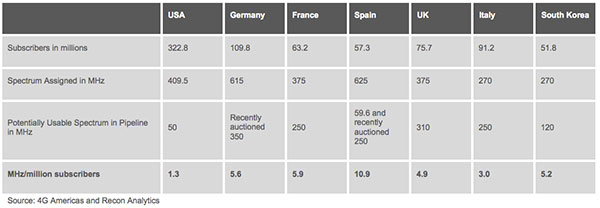
As one can see in the table above, United States mobile operators are facing a significantly more constrained supply of spectrum suitable to support wireless data as compared to their foreign counterparts. When we normalize the spectrum available per person, the United States consumer is by far in the worst position. It has per person, only 1/3 of the spectrum available than Italy where demand for wireless data is comparatively weak.  Other countries have assigned three to eight times as much spectrum per person to satisfy the demand for data.   Consider the impact on service prices if the FCC really opened up the spectrum spigot.  When spectrum was still plentiful in the United States, the wireless operators competed prices to the lowest in the industrialized world. The same competitive forces are at play with regard to wireless data pricing, but could take hold faster and more intensely if more spectrum were put into the marketplace and regulators allowed secondary markets to work more quickly and effectively.  Bravo to the FCC for making 30 MHz of WCS spectrum useable for supporting wireless broadband.  More and faster decisions like that will go a long way to accelerating the downward price trajectory for LTE based wireless services.
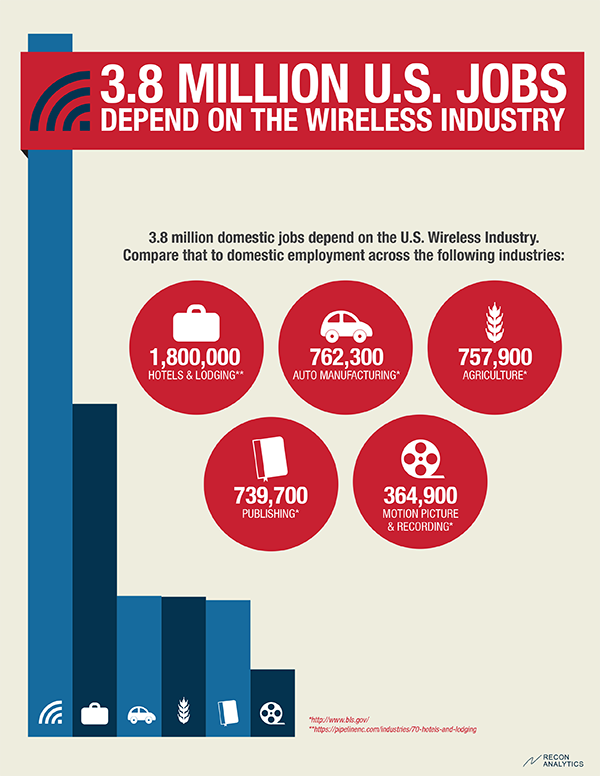
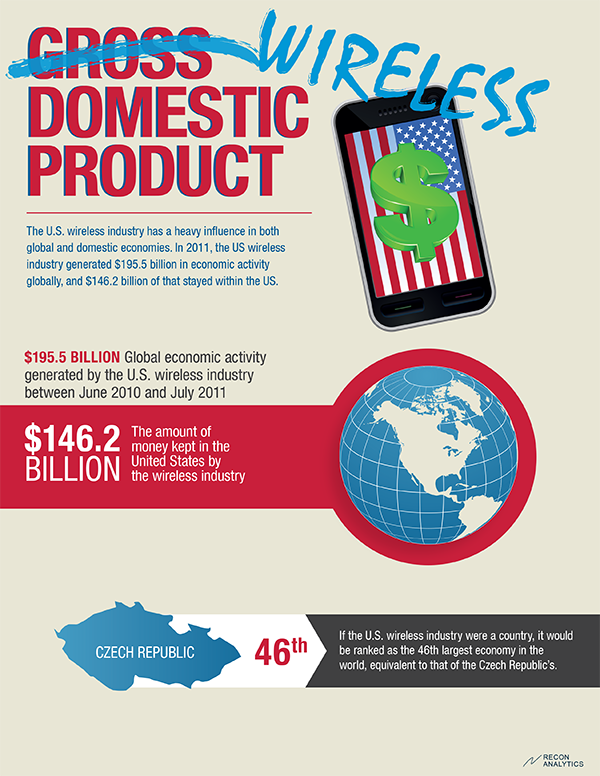
The wireless sector generates jobs for more than 3.8 million people. This is larger than the hotels and lodgings, auto manufacturing and agriculture sectors combined.

Due to its indisputable value to Americans, the US wireless industry has  grown into one of the largest sectors of the US economy. The US wireless industry generates as much economic activity as the Czech Republic, the 46th largest economy in the world.

While wireless is one of the most globally connected sectors of our economy, the US wireless industry keeps about three quarters of the economic activity in the United States, boosting business activity in the United States, keeping jobs in America, and generating tax revenues.

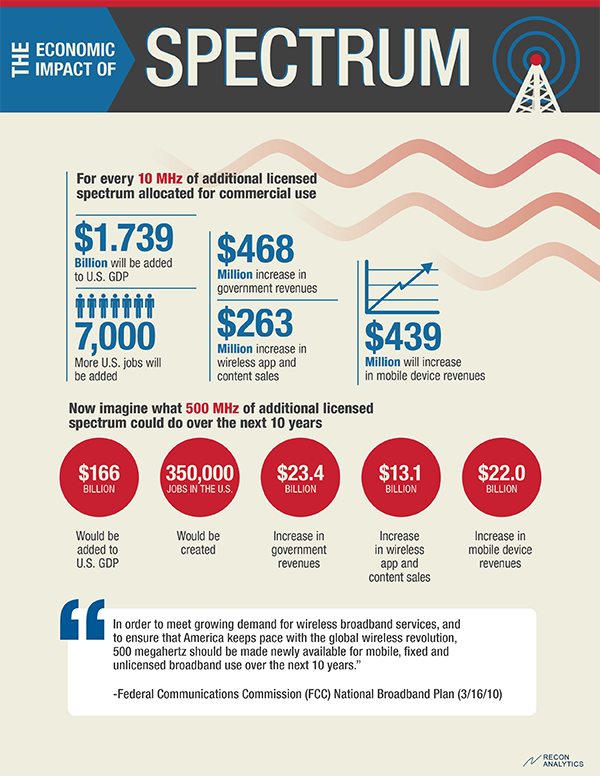
Spectrum is the fuel on which wireless communications runs. By looking at historic precedent, more spectrum generates more economic activity in the United States. The tremendous benefits are clear and wide-spread by increasing GDP, increasing employment, and increasing government revenues.

Without making more spectrum available swiftly, the United States will stifle economic growth and slow down one of the most powerful economic engines for the country.

The wireless industry is one of the biggest contributors to government revenues. It is larger in size than most government departments. In 2011, the wireless industry generated more tax revenues than the Department of Homeland Security and the Department of Justice spent combined or what was spent on the Department of Energy, the National Institutes of Health and the Department of Interior combined.