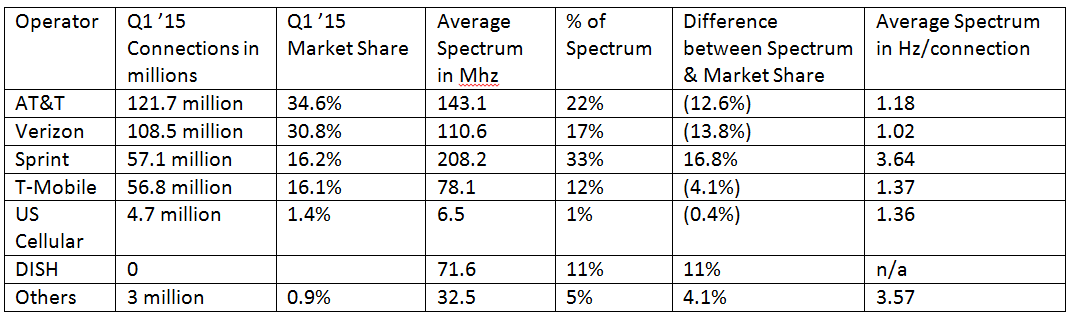
Another hot topic is the upcoming incentive auction. The amount of available spectrum per subscriber tells us how much capacity the carrier has to serve its customers and therefore what the theoretical upper limits of data speeds are. It also shows us how urgently the respective carrier needs more spectrum to serve its customers at par compared to their competitors.

The most spectrum constrained operators are Verizon Wireless with 1.02 Hertz per connection (Hz/c) and AT&T with 1.18 Hz/c. Verizon Wireless is definitely more constrained than 1.02 Hz/c as it only reports retail connections. Their per-connection stats do not reflect M2M or IoT connections that also use spectrum. T-Mobile, as it correctly boasts in its advertising, has more capacity per subscriber than Verizon and AT&T, with capacity per subscriber serving as a proxy for amount of spectrum the company has per subscriber. Specifically, T-Mobile has 34% more spectrum per subscriber than Verizon, and 16% more than AT&T. By comparison, Sprint has 2.6x to 3.6x times more than Verizon, AT&T or T-Mobile. Regional carrier US Cellular has 16% to 33% more spectrum per subscriber than AT&T and Verizon.

Exhibit 1: Q1 2015

Incentive Auction Exhibit 1

Source: The Companies and Recon Analytics analysis
Exhibit 1 helps us understand why Sprint and T-Mobile have decided not to participate in various auctions. Quite simply, neither company faced an immediate need for more capacity and could not make a business case for spending money to buy spectrum at the time various auctions were being held. Both companies’ share of spectrum ownership and market share are more closely aligned than that of their larger competitors. T-Mobile and Sprint famously sat out the 700 MHz auction for that reason and it was an eminently reasonable business decision; however, now comes both Sprint and T-Mobile asking the FCC to give them a guaranteed reduction in price for the spectrum the companies may be interested in buying in the upcoming incentive auctions. Despite Sprint’s comments on its fiscal first quarter 2015 investor call where it said it is still contemplating participating in the Incentive Auction, Sprint has little actual need for significantly more spectrum compared to its peers.Source: The Companies and Recon Analytics Analysis

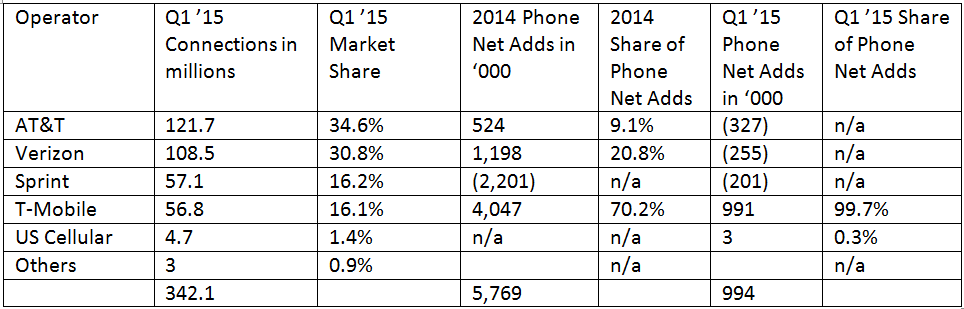
Analyzing the competitive forces in a market often looks at market share as an important metric. By its nature, market share is a description of the competitive results of the past. In the past, AT&T and Verizon Wireless executed their business plans substantially better than Sprint and T-Mobile, resulting in more customers choosing them over the competition. Now, T-Mobile and Sprint want to use the results of the past to restrict their larger competitors today. As we see in Exhibit 2, AT&T and Verizon could not stop T-Mobile from growing faster than the entire market combined for 2014 and Q1 2015. Hardly the result of a duopoly having a strangle-hold on the market. When just looking at the carriers that grew customers, T-Mobile captured 70.2% of the growth in 2014, twice as much as AT&T and Verizon Wireless combined, and 99.7% of the growth in Q1 2015. For a duopoly that is a remarkably poor showing exhibiting none of the supposed power that would need to be restricted.

Exhibit 2: Q1 2015

Incentive Auction Exhibit 2

Source: The Companies and Recon Analytics analysis

T-Mobile and Sprint are trying to convince the FCC that it’s just not fair that other companies spent more money to buy and deploy spectrum and now have a more diverse spectrum portfolio. The two companies are also claiming that a guaranteed price reduction for them in the upcoming auction will somehow resolve the reality of AT&T and Verizon being larger providers with more customers. If one takes the advocacy at face value, one could believe both companies are struggling to stay alive and American consumers are suffering from soaring prices and deteriorating service absent FCC action.Source: The Companies and Recon Analytics Analysis

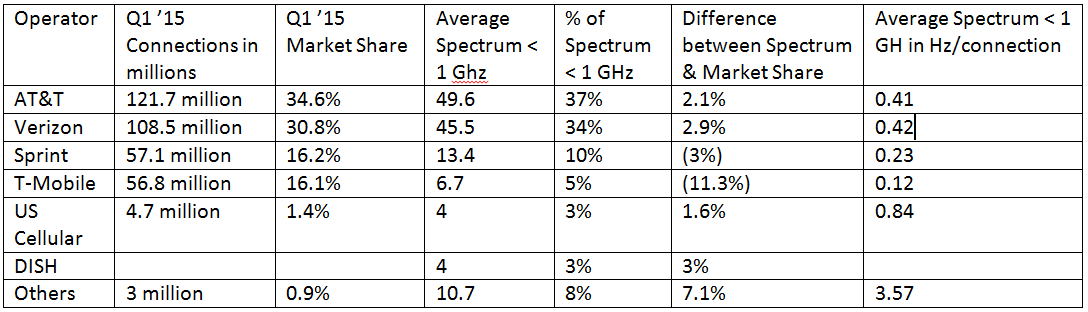
A key datapoint often used to convince regulators that the FCC should set aside spectrum for T-Mobile and Sprint in the upcoming incentive auctions is the amount of spectrum each major provider holds below 1 GHz. AT&T and Verizon, who bought most of their 1 GHz spectrum from other providers such as the successor of McCaw Wireless, US West and Alltel respectively, own roughly the same amount of spectrum as what one would expect considering their subscriber numbers. Sprint, largely through its acquisition of Nextel and the subsequent re-banding of the Nextel spectrum, owns slightly less than would be expected. T-Mobile, which chose not to participate in any low band spectrum auctions, now holds about 5% of the available low band spectrum through its acquisition of 700 Mhz A-band spectrum from Verizon. T-Mobile indicated that it would like to extend its 700 MHz spectrum holdings further. Interestingly, small rural telcos, which make up the Others category in Exhibit 3 below, control more low band spectrum than T-Mobile despite T-Mobile being 18-times larger.

Exhibit 3: Spectrum below 1 GHz

Incentive Auction Exhibit 3

Source: The Companies and Recon Analytics analysis

If the FCC is interested in having set-asides, perhaps a better idea than giving more spectrum to T-Mobile and Sprint at a discount, would be to make 20 MHz available for small rural operators. This would essentially triple the spectrum available to them and will allow them to be part of the same 600 MHz ecosphere as their larger brethren, while giving them approximately three to ten times more spectrum per subscriber than anyone else. When it comes to download speeds, US rural operators will be in a better position than anyone else to deliver the fastest possible speeds if the FCC were to set aside 20 MHz of spectrum.Source: The Companies and Recon Analytics Analysis

Whether the FCC should or should not grant T-Mobile’s and Sprint’s requests to be treated as special, protected entities just like small, rural operators is a matter of policy and politics but one should not be fooled into thinking that T-Mobile and Sprint are weak sisters who would not otherwise be able to compete. While Verizon, Sprint and AT&T are growing by selling more products and services to fewer customers, T-Mobile is growing by consistently adding new customers. T-Mobile has captured 99.7% of unique subscriber growth in the industry. Since it went public in May 2013, the stock price of T-Mobile USA has almost doubled, while its competitor’s share price has fallen. Sprint is not as successful as T-Mobile, but it is slowly working itself out of a disastrous network upgrade program that saw dead spots appear where there were none before. In a large number of markets, Sprint is now winning network accolades from third party measurement companies. Net Promoter Scores, a leading indicator, are improving, overall subscriber numbers and tablet sales to existing customers are increasing and phone customer losses are decreasing. Everything is pointing up as long as Sprint executes well.

There are various, competing priorities at play regarding the upcoming incentive auction. The stakes are particularly high because the auction was authorized by an Act of Congress without the option of a re-auction if it fails. Broadcasters want to be compensated, spectrum needs to be reallocated to use for wireless broadband, existing TV broadcaster operations need to be consolidated, and last but not least government revenues need to be maximized. The fewer the restrictions, the smaller the set-asides, the more revenue will be generated during the auction. This is a particularly important consideration for the incentive auction where the demands of the broadcasters will have to be met before the US Treasury will get its cut. The most recent government estimate of its revenue cut of the incentive auction is $10 billion to $40 billion. How the expected $80 billion auction total will be achievable from an industry that had 2014 operating income of just over $40 billion is difficult contemplate. The problems get compounded when roughly a third of the spectrum will be set aside for bidders claiming poverty and looking for a substantial discount but which already have vast amounts of spectrum in their portfolios. If the FCC decides to retain set-asides for the upcoming auction, it would be better served by making them available to small rural providers, not the large nationwide providers.

In 2014, roughly 143 million mobile phones were sold in the United States, approximately 90% of them smartphones. This is a decline of 25 million phones from 2013 when approximately 168 million phones were sold – and only half of them were smartphones. The decline in phone sales is predominately due to the rise of equipment financing plans, compounded by slower new subscriber additions. At the same time, consumers’ phone purchase habits have changed significantly. A growing number of American consumers delay their phone upgrades to take advantage of the lower monthly service prices carriers offer to consumers who wait to upgrade phones at the end of their two-year contracts.

Consumers who are purchasing replacement phones are focusing on newer, higher priced devices. Even though device sales declined by 15% year-over-year, device revenues increased by about 5%. In the short term, this flight to higher priced devices increases revenues and profitability for mobile carriers, but longer-term the trend is negative, as it takes longer for new devices to permeate the network. Device manufactures are cheering the higher revenues as the market has shifted heavily towards higher priced smartphones. Now that smartphones make up 90% of handsets sold, device manufactures can no longer cannibalize feature phones for significant revenue upside. We expect device sales to fall by 5% to 136 million in 2015 and to fall again by 4% to 131 million in 2016.

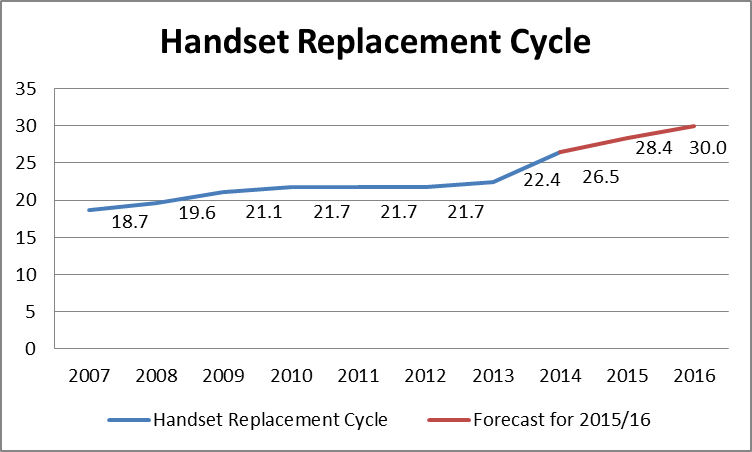
With device sales and new subscriber additions declining, the impact on the handset replacement cycle has been significant. Handset replacement has abruptly slowed to the lowest rate since we began calculating the metric. The introduction of Equipment Installment Plans (EIP) has made a significant impact on the handset replacement cycle by extending it to 26.5 months in 2014, an increase of 4.1 months compared to the previous year.


Handset replacement cycle 2014 - Replacement Cycle

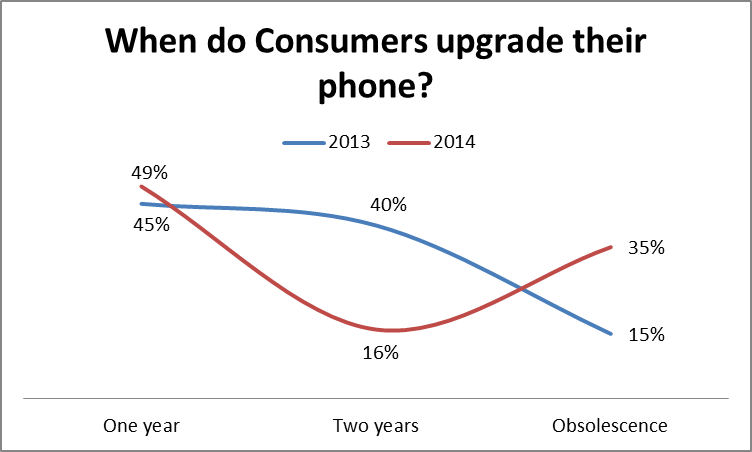
Americans typically upgraded their phone at three points in time: Roughly every year when a new generation device was launched; approximately every two years when the contract expired, causing customers to either change operators or became eligible for subsidized prices; or whenever their phones became obsolescent or stopped working. With the rise of EIP plans that incentivize both rapid upgrades every year and delayed phone upgrades through discounted service pricing, consumers have eschewed the traditional two-year service plan upgrade cycle.

Handset replacement cycle 2014 - When do people replace their device

The percentage of devices being replaced every year increased from 45% in 2013 to 49% in 2014, while the percentage of devices that replaced obsolete devices sky rocketed from 15% in 2013 to 35% in 2014. The percentage of devices being replaced at the traditional two year time point fell from 40% in 2013 to 16% in 2014, while they represented slightly more than 50% of replaced devices from 2010 to 2012. As As Americans bifurcate their purchasing behavior, we are observing the beginning of a capabilities gap between Americans who upgrade their phone every year and those who upgrade it when the device becomes obsolete or breaks.

The handset replacement cycle measures how often existing customers are upgrading their phones. It is an important measure of how close the average consumer’s device is to the technical state–of-the-art. Whereas most consumers used to upgrade after two years, today’s market sees an interesting dichotomy: Nearly half of consumers upgrade every year, but more than a third keep their devices until they become obsolete. A longer handset replacement cycle will have several ramifications on innovation throughout the mobile ecosystem:

  • Less innovation in applications: Application capabilities may be artificially restrained, as developers deal with an average consumer who is less able to take advantage of new technologies that improve the utility of the device and service. The introduction of EIP has created an earthquake-like, tectonic shift in when Americans are upgrading their mobile phones. Software developers face a new dilemma, as they must nowgrapple with the fact that a large percentage of smartphones in use won’t be able to run their new cutting edge apps. In order to run on the largest number of devices possible, some developers won’t build the latest-and-greatest capabilities into their apps, thereby slowing the pace of innovation in the mobile space.
  • Less competition from smaller handset providers. Most handset manufacturers – who are already struggling to remain profitable – will be under pressure to cut their research budgets as revenues decline, therefore reducing the amount of effort dedicated to making the next generation smartphones even better. Smaller handset providers are going to be disproportionally hit, making their devices less competitive compared to larger handset providers — leading to a shakeout.
  • Spectrum crunch in major markets. The spectrum crunch in major markets will be worse than otherwise as older devices cannot access new spectrum bands as they are lacking the necessary electronics for it. Device capabilities determine which network capabilities the phone can access. A six year old iPhone 3G will achieve download speeds of 2 Mbps with its first generation WCDMA chipsets, whereas a new iPhone 6 will be able to download the same content 25 times faster due to its new 4G LTE capabilities able to access newly licensed spectrum. As fewer people upgrade their devices, the pace with which consumers can use new unused parts of the networks on new spectrum slows down and consumers are stuck on congested legacy spectrum. This engineering reality is particularly important as mobile operators are currently spending more than $45 billion on new spectrum.
  • Delayed transition to next-generation services. The monumental transition to VoLTE — and therefore to a more efficient use of spectrum, with significantly better voice quality — will be slowed by an embedded base of older devices.

To be sure, despite the bifurcated market and all the problems caused by it, some positive developments could still increase revenue for manufacturers:

  • Speed boosts. Faster speeds mean access to better and more content and higher profits for web retailers and carriers alike. The faster the download speeds a device can support, the better the user experience as the consumer does not have to wait for video content to be buffered or web sites to be loaded. According to Akamai, a one second delay in page load results in a 7% decline of purchase conversion.
  • More power. Access to more advanced screens and processors allow more appealing graphics and more powerful applications to run on your phone. This begets more usage and more consumption of content which in turn generates more revenue and profits for multiple entities across the mobile broadband value chain.
  • Better batteries. Newer battery technology allows phones to run longer allowing them to be used to do more for a longer period of time. This too impacts the virtuous cycle of more use begets more revenues and profits.

Unfortunately, those longer-term developments could be largely offset in the short term by the slowed innovation and cramped spectrum caused by delayed handset replacement.

Who are short-term and long-term winners and losers in this change?

  • US Consumers: Short-term winner, long-term loser.
    Consumers get $20 per month more in their pocket for waiting to upgrade their phone. In the longer term, consumers will have fewer choices and delayed mobile phone innovations and fewer new apps taking advantage of new hardware features than they would have in a higher volume scenario with more device manufacturers.
  • The US (app) economy: Short-term winner, long-term loser.
    While an approximately $12 billion per year (50 million devices times $20 per month) in additional stimulus for other the rest of the economy is helping boost restaurant sales and reducing consumer debt, the economy will feel the long-term negative impact. As consumers and businesses alike are tempted to delay an upgrade, the beneficial impact between mobile and productivity in the US will weaken as new services that save us money, improve our lives, and make the economy more efficient take longer to be implemented. One especially poignant example is mobile payments. ApplePay is revolutionizing mobile payment with high attachment rates because people with the new iPhone 6 can take advantage of ApplePay. People who delay cannot, creating a barrier to adoption. The same is true for NFC (or not) enabled devices for other mobile payment platforms like PayPal or Google wallet.
  • Device manufacturers: Short-term winner, long-term loser.
    Device manufacturers benefitted handsomely as smartphones as a proportion of handset sales increased from roughly 50% in 2013 to 90% in 2014 and profits surged. In 2015 and onwards, profits will fall as the number of devices will continue to decline
  • T-Mobile: Short-term big winner, long-term loser.
    T-Mobile successfully reshaped the mobile industry through the introduction of its EIP, and has grown faster than all other carriers combined. At the same time, roughly 30% of its new customers did not buy a new handset, but brought their own. As a result, the handset base is aging and cannot take advantage of new bands like 700 MHz and VoLTE. The introduction of SCORE! has to be seen in the context that T-Mobile wants to speed up the handset replacement cycle, and is willing to incur a modest subsidy.
  • AT&T: Short-term winner, long-term loser.
    AT&T followed T-Mobile aggressively into the brave new EIP world. AT&T has been able to defend its base against lower priced T-Mobile and other operators who offer EIP financial benefits as device subsidy expenditures have declined significantly. AT&T will face the same problems as T-Mobile as the device universe of its customers ages.
  • Verizon: Short-term neutral, long-term neutral.
    Verizon is holding on as tightly as it can to the status quo, while offering customers who want it an option to do EIP. In the short term, Verizon benefits less than T-Mobile and AT&T from the changes, but will also not suffer as much from a lengthened handset replacement cycle.
  • Sprint: Short-term loser, long-term winner.
    Sprint, like every other company, dabbles in EIP offers, but only Sprint with its 24-month handset leasing program has a viable plan in place to keep the device upgrade cycle in place and reap the benefits from a customer base with newer devices.

Over the last two years, in addition to attracting new customers, most of the wireless industry has focused on better serving its existing consumers with products and services those consumers want. We all watch more mobile video and play mobile games. As a result, an unsung hero—in form of the tablet—has emerged. Launched only 4 years ago by Apple, the iPad was quickly imitated by others. Initially, the main focus was on Wi-Fi-only tablets, which are only connected close to a hotspot. But now, as Wi-Fi-only tablet sales slow, LTE-connected tablets have gained in popularity and have become a significant growth source for carriers as the traditional mobile phone business weakened and shifted considerably.

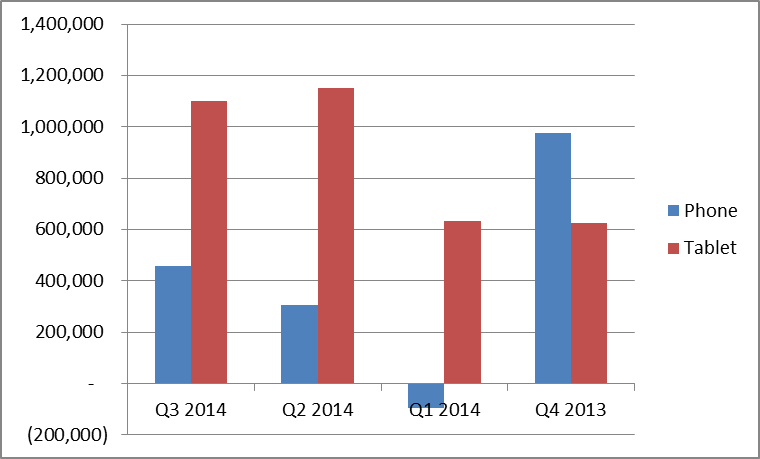
Exhibit 1: Postpaid branded net additions by device category, Q4 2013 to Q3 2014

2014-Tablet-Exhibit1

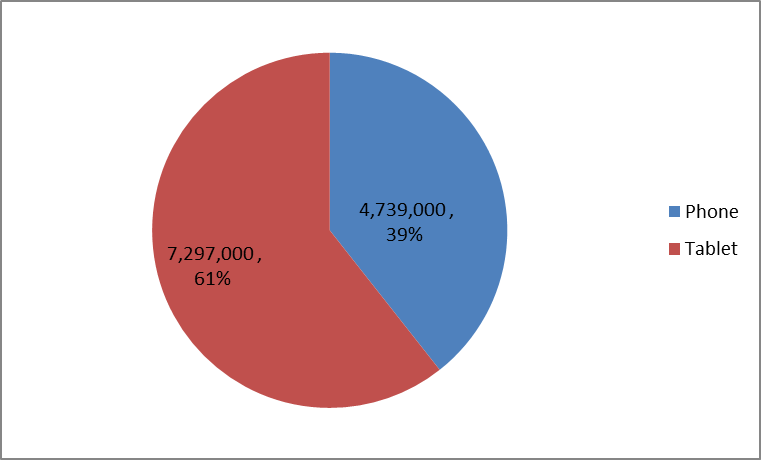
This trend culminated over the last four quarters, with 61% of the branded postpaid growth of the four nationwide operators coming from tablets. This development shows the tremendous change that the mobile industry is continuing to undergo and identifies a significant driver of the growth in data consumption by the most suitable device—tablets—for media consumption and gaming.

Why have consumers, who in years past mostly ignored tablets with wide-area connectivity, suddenly shifted their purchasing behavior? Three factors led to this significant change:

1)     The cost of service has declined: The introduction of mobile share plans has made tablets economically possible for consumers. Before mobile share plans, adding a tablet meant a separate data plan with a separate data allotment for $40 or more—in addition to paying $100 or more for the tablet with wide-area connectivity compared to a Wi-Fi only device. With mobile share plans, adding a tablet is typically only $10 per month, still within the realm of impulse buying or cheap enough justify it as a way to pacify a child in the back seat of the car or a husband needing to watch NFL Sunday games just about anywhere.

2)     The cost of tablets has declined: A substantial decrease in the cost of wide-area connected tablets from various manufacturers has made them more affordable. While wide-area Android tablets were as much as $500 when they were first introduced as a lower-cost alternative to Apple iPads, the unsubsidized retail cost has come down to roughly $250 without a contract or commitment. If a consumer enters a 2-year contract the cost of the device is $100, but even that is frequently discounted down to zero.

3)     Equipment installment plans have made devices even more affordable: A $250 tablet is generally about $12.50 per month on an installment plan offered by the nationwide operators. As many Americans generally prefer to pay over time instead of upfront, the addressable market for tablets increased substantially.

Not every operator is, or has been, equally dependent on tablets for their growth. Tablet promotions have become the operator’s weapon of choice to make their quarterly postpaid branded subscriber growth number. When we look at how dependent operators are on tablets for growth, quite an interesting picture emerges.


For Sprint, a Beacon of Hope

Even as Sprint went through a sea of troubles attracting new subscribers to their network, its success in tablets served as a beacon of hope for the company. The company jumped aggressively on the tablet trend and succeeded in satisfying customer demand.

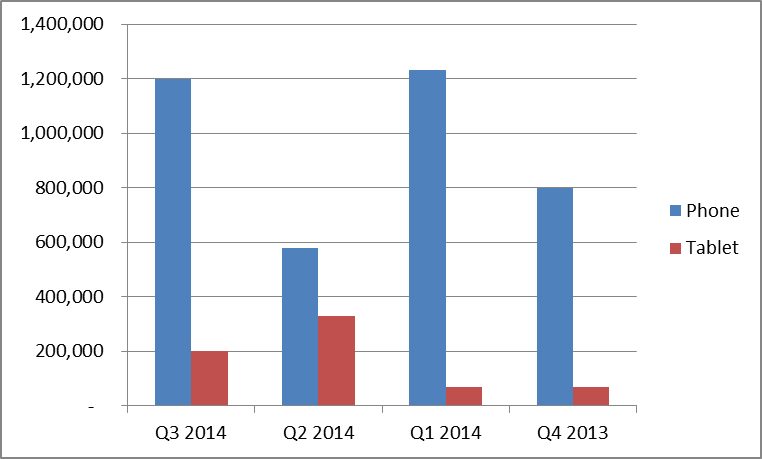
Exhibit 2: Sprint postpaid branded net additions by device category, Q4 2013 to Q3 2014

2014-Tablet-Exhibit2

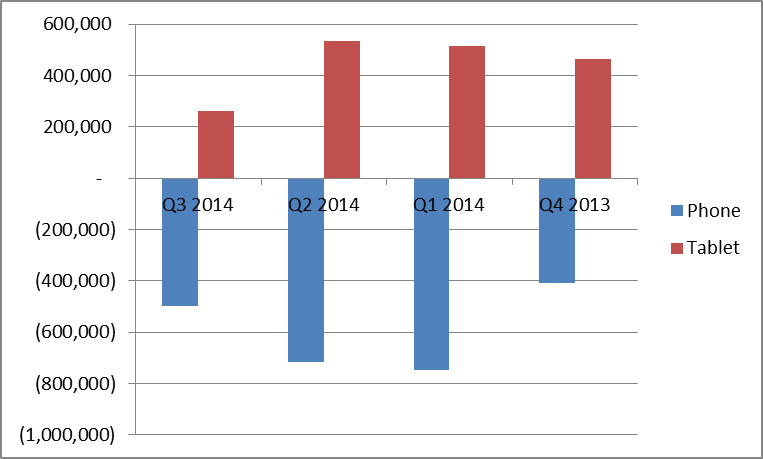
While Sprint lost almost 2.4 million branded phone connections in the last four quarters, it gained almost 1.8 million new tablet connections. Losing 600,000 postpaid branded connections is nothing to write home about, but without its tablet sales, results would have been even more devastating.


AT&T, the Balancing Pioneer

AT&T was at the forefront of meeting customer demand for tablets. Because it was ahead of the market and other carriers in satisfying consumer craving for entertainment on the go, it initially struggled with the profitability of selling subsidized tablets. After developing the market and volumes, the overall market moved in AT&T’s direction. As a result, other operators shared the efficiency gains that come from higher sales volumes.

 Exhibit 3: AT&T postpaid branded net additions by device category, Q4 2013 to Q3 2014

2014-Tablet-Exhibit3

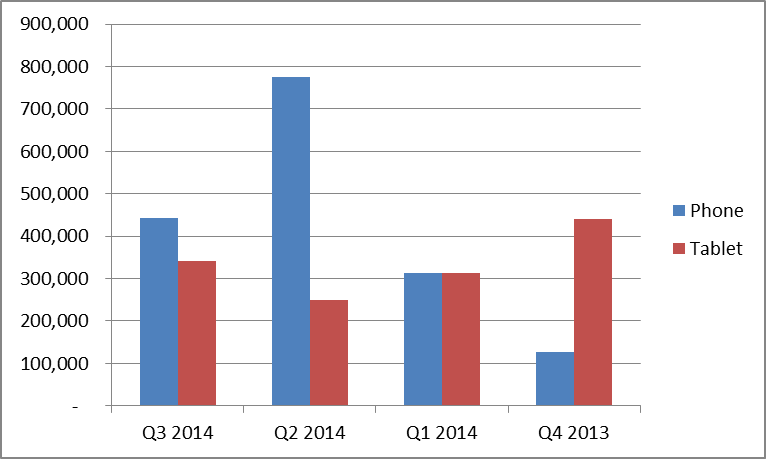
AT&T achieved the second most branded postpaid phone additions in the industry by capturing 1.65 million new phone customers, slightly ahead of Verizon Wireless but less than half of T-Mobile. It also added 1.45 million tablets, which represent 45% of its net additions for the last four quarters, giving AT&T the most balanced growth of the nationwide carriers. Slightly behind AT&T in recognizing the trend towards tablets, Verizon Wireless’ results show that more focus often leads to better results.


Verizon Adds Almost as Many Tablets as the Other Carriers Combined

With a slightly larger customer base and slightly less new phone customers (1.64 million), Verizon Wireless added twice as many new tablet connections as AT&T with 3.5 million, compared to AT&T’s 1.3 million.

Exhibit 4: Verizon postpaid branded net additions by device category, Q4 2013 to Q3 2014

2014-Tablet-Exhibit4

With more than two thirds of its postpaid branded net additions coming from tablets, Verizon Wireless had the highest net postpaid branded subscriber net additions. Since the majority of the growth was meeting the needs of current customers rather than new customers, it significantly overestimates the strength of the customer acquisition engine of Verizon Wireless. While Verizon Wireless can be satisfied that it added more connections than anyone else, being number three in branded postpaid additions in its core segment must be a wakeup call in Basking Ridge.


T-Mobile’s Lack of Tablet Focus Hides Future Growth Potential

T-Mobile’s relentless drive to innovate—sometimes more substantive than at other times, combined with a CEO that has almost become a Jesus-like figure to some—has yielded spectacular new branded postpaid customer growth. T-Mobile added more than 3.8 million new phone customers, growing faster than the rest of the industry in new phone customers combined. The operator was near death before John Legere arrived. He changed the rules of the game in wireless, revitalized the organization and took it to previously unknown heights.

Exhibit 5: T-Mobile postpaid branded net additions by device category, Q4 2013 to Q3 2014

2014-Tablet-Exhibit5

The only weakness in T-Mobile’s performance was its lackluster additions of tablets. Despite being the only operator that offers free data for life for tablets, T-Mobile added only a small fraction of tablets compared to its competitors. The company, which focused on new customer phone growth, largely ignored tablets as it added only 665,000 new postpaid branded tablets, a third of what Sprint achieved with roughly the same subscriber figures. But this apparent weakness in tablet sales now also gives T-Mobile the opportunity to go back to its current customers like its competitors and, with sufficient focus, add one to three million more tablets in future quarters.


All the while when we were trapped in the Title II News Blizzard that made any other topic seem small and irrelevant, the FCC has been conducting an auction of wireless spectrum. This wasn’t supposed to be the big auction – that honor was reserved for the incentive auction, in which broadcasters would sell spectrum they hadn’t deployed since the digital TV transition consolidated things. This was just an auction for “AWS-3” spectrum, Advanced Wireless Service frequencies in a high band that wasn’t expected to pique much carrier interest. The FCC had set a reserve price of $10.6 billion.

The auction has netted more than $43 billion and counting. Or, as the House Energy and Commerce leadership put it, “BOOM!”

The success of the AWS-3 auction has amazed the press and pundits alike. In fact, FCC Chairman Tom Wheeler has observed that “The AWS-3 auction is at these incredible levels … despite the fact that I’ve been talking about Title II all along.” While I don’t want to debate the FCC Chairman, it would seem a stretch to claim that the huge dollars being bid for AWS-3 spectrum are because the carriers embrace a particular regulatory framework. To the contrary, it appears the cold, hard reality of needing a key input for the business is driving the eye-popping bids. The auction seems to be exceeding everyone’s expectations in spite of the threats of extending Title II to wireless data (Title II currently applies to wireless voice, not data as some have alleged). The holiday season is a time of hope and clearly, the companies bidding in this AWS-3 auction are hoping that government regulation of wireless won’t render their investment null and void.

From a business perspective, the top reasons AWS-3 is blowing away its progeny are:

  • The AWS-3 band is used everywhere on earth. It’s the only band out of more than 50 that can make that claim. If you’re a carrier with customers that travel the world, and you want your customers to enjoy 4G LTE, this is the band to have. Without AWS-3 spectrum, carriers have to resort to guesswork to determine which three or four bands will be sufficient for their customers to have global coverage.
  • According to Mike Rollins at Citi Research, the 10×10 MHz J-block is trading at a 15% valuation premium compared to the average of the 5×5 MHz blocks. The valuation validates the engineers, industry analysts like me and international auction designers who have been saying that wider channelization and mid to high band spectrum combines to create the new beachfront spectrum. One can only hope that Auction 97 puts to rest the erroneous notion that lower band spectrum is somehow more valuable than higher band spectrum. The Mhz/pop values in Auction 97 are significantly higher than that in Auction 66, even adjusted for inflation. In a world where we have 99% 4G LTE coverage, the propagation advantages of lower band spectrum are being nullified by the need for smaller cells to provide more capacity. In an urban area, a 700 MHz network looks no different than 2500 MHz network – and a lot more people live in urban areas than in rural areas.
  • Operators are scared by the delay in the ultra-complicated, one-shot-only incentive auction. That delay is a decidedly mixed blessing, because when reading the tea leaves, it quickly becomes apparent that at this point in the process, there aren’t enough broadcasters willing to part with their licenses to make this auction a success. The NAB’s lawsuit delays the auction and gives FCC the opportunity to make the auction more attractive and provides more time to convince more broadcasters that it is actually in their best interest to put up their licenses for auction.
  • Historically low interest rates make the assumption of debt a viable means to pay for spectrum acquisitions. Just like home buyers can afford to spend more money on their new home due to lower mortgage rates, operators can afford to spend more on spectrum when they can borrow money to do so and do it cheaply.
  • Spectrum is a finite, essential resource that drives the business. This means that as long as there is an ongoing and increasing in demand for it, spectrum increases in value over time.
  • Auction 97 is here, it’s happening, and the frequencies are for real. The prospect of more spectrum in the foreseeable future is rather slim. The promised 500 MHz of spectrum for wireless is increasingly looking like a mirage in the desert. Contrary to what some people think, the bidding in Auction 97 seems to reflect the evaporated trust in the ability of the government to provide access to more spectrum in the future. They’re reflective of a flight into quality spectrum assets today, not a sign of trust in what the future will bring.

What is most exciting about the auction is yet to come – the build-out of the spectrum and expansion of existing networks. That will be the truly best outcome for American consumers and validation of the fact that spectrum auctions are the most efficient tool for allocating a scarce resource.

Recon Analytics recently completed an exhaustive study of the US mobile market and how it compares with its G7 peers (funded by CTIA). This article presents a summary of the study—the results of which are available here.

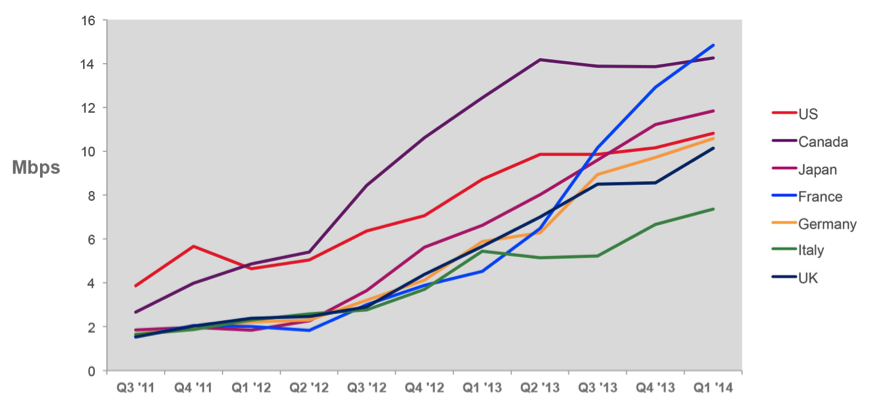
The US mobile broadband experience is the stuff of lore around the world, in part due to the smartphone revolution that started here, enabled by large, reliable wireless networks and innovative pricing strategies. The US was also the first to roll out fully commercial large-scale LTE networks that offered significantly higher speeds than ever before, and still leads the world in LTE subscribers and deployment. But America’s leadership is in danger. As we see in Exhibit 1, the US recently fell behind in wireless download speeds compared to three other countries in the G7, largely as a result of its own success. Immediate and targeted action by the US government to allocate more spectrum for 4G services is critical if the US is to retain its global leadership role. We are beginning to feel the consequences of a six-year gap between major FCC auctions.

Exhibit 1: Average Mobile Data Speed by Country

Exh-1

Source: Ookla; Capture Date June 13, 2014

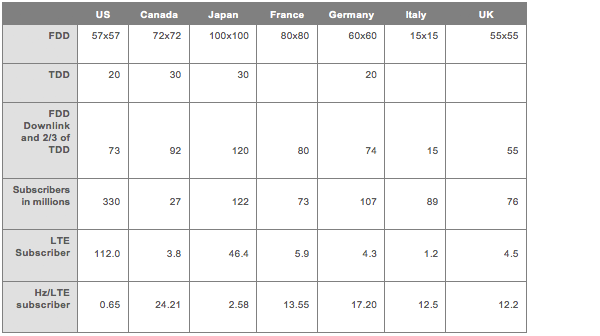
Spectrum is the oxygen that makes higher achievable speeds for LTE subscribers possible. At least on paper, the US seems to have a decent amount of spectrum, but it is generally already used for current services such as GSM, CDMA, and HSPA. Even with carriers in the other G7 countries also supporting earlier technology generations, the fact is that the US has utilized the least amount of spectrum for LTE compared to its peers in delivering great service to Americans (see Exhibit 2). In the simplest of terms (and all other things being equal), if there is less spectrum available per user, it will impact customers’ speeds.

Exhibit 2: Deployed LTE Spectrum

Exh-2Source: Recon Analytics and Q1 2014 operator reports, 2014

If spectrum is the oxygen, then capital expenditures are the fuel that accelerates wireless networks. Unsurprisingly, carriers in the United States, which has the most people among the G7 countries and a significantly larger area to cover than others, spend substantially more on capex than carriers in any other G7 member country. Japan, with the second most inhabitants, spends the second most. The smallest nation by population, Canada, spends the least. What is striking, though, is that in the midst of this technological transformation, only Italy and Canada have not continuously increased their capex. This compares to the more than $34 billion the US spent in 2013, which is an all-time industry high.

One impediment for the US is a considerably less concentrated population when compared to other G7 countries. Population density is an important part of the equation used to establish the Recon Analytics Urban Agglomeration Index, and it shows that the US is significantly more spread out. Moreover, the top urban agglomerations in the US add up to a much smaller slice of its overall population than the top urban agglomerations in its G7 peer countries. As a result, it’s more expensive for US carriers to deploy faster networks, and achieve the economies and efficiencies that may be attained in more densely populated countries. This makes the US lead in LTE deployment even more impressive.

Despite these challenges, overall, American smartphone owners are tied with Germany as the most satisfied.

The US pioneered bringing 4G LTE to a mass audience while continuously increasing average download speeds. And now it faces a challenge. Three of its G7 compatriots surpass its lead in download speeds.

What is at the root of this loss of speed leadership? In short, other G7 countries have made significantly more spectrum available for 4G than the United States. The influx of new spectrum, combined with fewer 4G subscribers, has resulted in data speeds skyrocketing in several countries. The only thing preventing the US from falling even further behind are the massive capital investments made by the US wireless providers, which are the largest in totality and second largest per person among the G7 countries.

Our international comparison shows that more spectrum results in faster download speeds. Faced with the convergence of limited spectrum, dispersed population and high usage, US operators are continuously and consistently pumping massive capital investments into their infrastructures to provide Americans with the best possible networks. As a result, data speeds are increasing. That increase in speed, combined with aggressive network management designed to ensure consumers have a robust mobile broadband experience, has driven customer satisfaction in the United States.

At the same time, other countries have accelerated their download speeds substantially faster because they have considerably more spectrum available and deployed for 4G, and because of their geographic and population density advantages. Another contributing factor is that 4G is treated like a premium service – with extra costs – in many countries, which reduces the adoption of 4G solutions and usage of LTE networks. Driven by strong competition, US providers pushed aggressively to transition the subscriber base to 4G solutions without extra fees or charges, producing greater traffic than in countries where download speeds are tied to premium pricing, and placing a greater strain on 4G networks.

It’s clear that the economic and social benefits from wireless technology and services are beyond anything we could have predicted even 20 years ago. Network infrastructure and commitment to capex spending are critical elements that are already in place for the US to achieve superiority once again. The missing piece is spectrum. To regain its lead, the United States should quickly allocate more licensed spectrum to wireless operators, in larger contiguous blocks. When that happens, download speeds will increase more rapidly and US consumers will benefit even more than they already have from the advanced wireless services they have available.

In our previous report, we established that policymakers must choose among competing outcomes when the agency makes spectrum allocation decisions, including the number of licenses the agency wants to award, the cost to build out the licenses, and network speeds based on channelization. In light of the FCC’s recent decisions in the AWS-3 and incentive auction proceedings, the agency appears to have decided that more narrow spectrum channels, allocated across smaller geographic areas, is the preferred outcome. Europe, on the other hand, has opted to allocate spectrum in wider channels. This note attempts to analyze whether the FCC’s spectrum allocation choices will put US wireless carriers at a disadvantage when it comes to the speed of their networks, as compared to providers in other countries using wider channelizations.

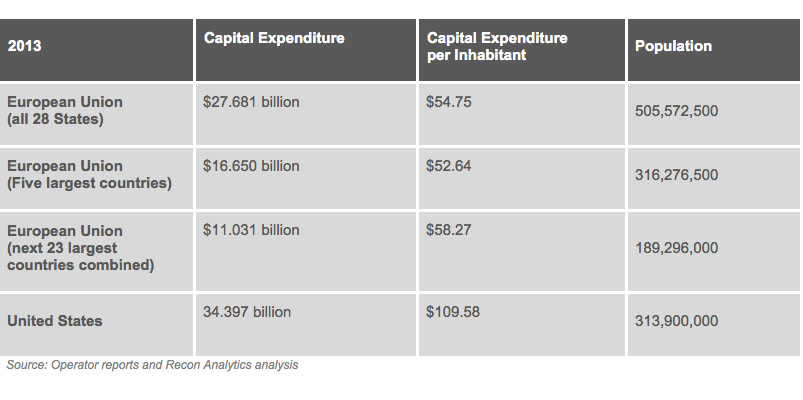
In 2013, US wireless capital expenditure spending hit an all-time high. AT&T’s attempt to overtake Verizon in network quality had the company spending roughly $11.5 billion on network improvements, while Verizon Wireless spent another $9.75 billion improving its network. Let me put this into context: AT&T and Verizon together spent more money improving their networks in 2013 than all 20 operators serving the five largest EU countries (EU5) combined. Once we add the capital expenditure of Sprint and T-Mobile, which both spent more on network improvements last year than they had in previous years, US operators spent more than twice as much as the EU5 operators did to improve their infrastructure covering roughly the same number of subscribers. Even when adding all 98 operators active in the EU together, their combined capital expenditures are only 80% of what the US operators are investing.

every-way-exhibit-1

Indeed, US wireless carriers spent roughly $109.58 per US citizen to upgrade wireless infrastructure in 2013 whereas the EU5 carriers that serve the more affluent European countries spent significantly less, at roughly $52.64 per citizen. Whether you look at the investment numbers on their own or in comparison with what non-US wireless companies are spending, America’s wireless companies appear to be at the upper bounds of investing in infrastructure. Why is this an important point? Current reports and research indicate that the cost to build out wide area mobile networks using more narrow channelizations is a more expensive proposition than building out wider channels as illustrated in Peter Rysavy’s Mobile Broadband Explosion white paper.

So, with US wireless carriers at the upper bounds of investing in infrastructure, is it reasonable to assume that they will spend even more money to deploy small channel networks that are slower and less efficient? Most investors will tell you that that is not a tenable outcome.

So what does this mean? In the US, the carriers that have the largest swaths of contiguous spectrum will be able to provide fast download speeds. Only Sprint is continuously in this fortuitous situation and in some markets T-Mobile, due to pure happenstances, also has 20×20 MHz contiguous spectrum. The other carriers will have to rely on costly and still unproven “carrier aggregation technology” to achieve results similar to what is possible with wider, contiguous spectrum blocks. The big question, then, is what the additional overhead will be to make it a reality and deploy it extensively. None of the vendors working on carrier aggregation technology are willing to publically state how much the overhead will be. That’s not a good omen. Compounding the issue is the fact that the appetite for carrier aggregation technologies has waned because European carriers have moved to wider channelizations, receiving 20×20 MHz licenses in their last spectrum auctions. Thus, the European operators do not need carrier aggregation technology for the foreseeable future, alleviating the pressure on vendors to quickly develop the standards and related equipment. That might explain why the vendors have quietly extended the timeline for when US carriers will be able to use two and three channel carrier aggregation.

Although it is doubtful the FCC intended to retard the proliferation of high speed wireless broadband networks when it made some of its more recent spectrum allocation decisions, the agency may have inadvertently created an environment where this very result will occur. The simple laws of physics (smaller spectrum channels + (higher traffic volumes * more users) = slower network speeds) combined with economic realities (US companies are already at the upper bounds of capital expenditures to build out wireless networks) portend a slower future for America’s wireless subscribers.


The US mobile broadband experience is the stuff of lore around the world, in part due to the smartphone revolution that first happened here, enabled by large, reliable wireless networks and innovative pricing strategies that made smartphones and Internet access a reality for hundreds of millions of Americans. But all is not well as they say. There are signals emanating from Washington DC these days that indicate the country may be going down a road of short-term compromises that will impact America’s wireless consumers for decades.

Recently the FCC announced the channel configuration for the AWS-3 band. The FCC divvied up 40 MHz of the 67 MHz of spectrum originally allocated for AWS-3 and made it available for auction to wireless carriers as a single 10×10 MHz license, three 5×5 MHz licenses, including one 5×5 MHz license allocated across each Cellular Market Areas (CMA), and the other licenses allocated across Economic Areas (EA). The FCC appears ready to continue the narrow channelization idea for the upcoming incentive auctions intended to reallocate up to 120 MHz of broadcast spectrum to wireless broadband. By embracing more narrow spectrum channels as a preferred policy, the FCC has set itself on a path that forces wireless operators to either accept slower network speeds or significantly higher capital expenditures in the US, an outcome that is out of sync with both technology innovation. This decision comes just as global trends in competing markets and America’s insatiable demand for video delivered to their mobile devices come to head.

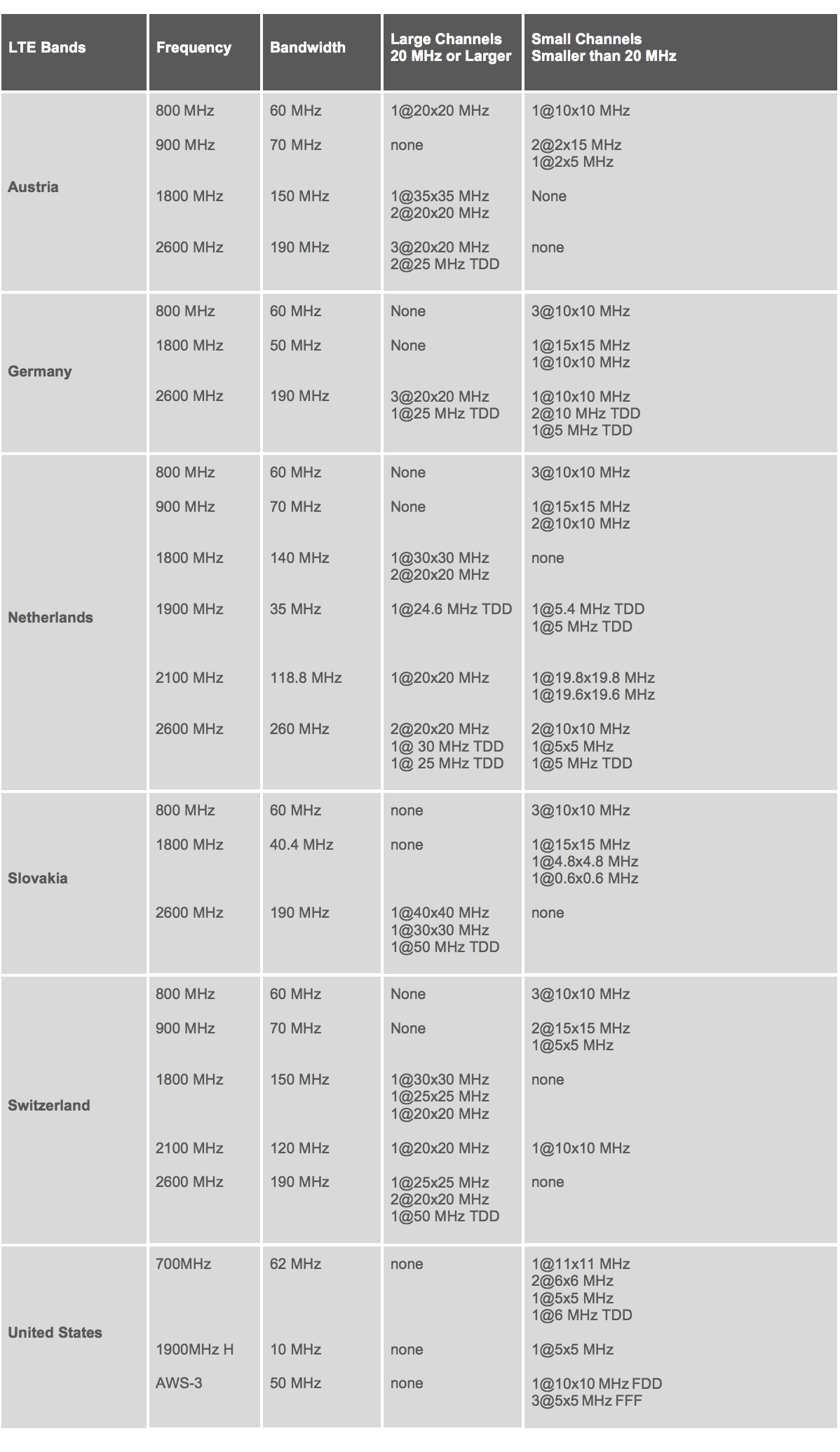
Europe, Asia and Latin America have been embracing wider channel sizes for a while. For example, for its most recent spectrum auction, Switzerland decided to use spectrum allocations of 20×20 MHz while refraining from dictating what technology the winner bidders could deploy. Below are additional examples of the global move towards wider channels, consistent with the evolution and deployment of LTE network technology.


april-21-2014-chart-one
[Click to enlarge chart.]

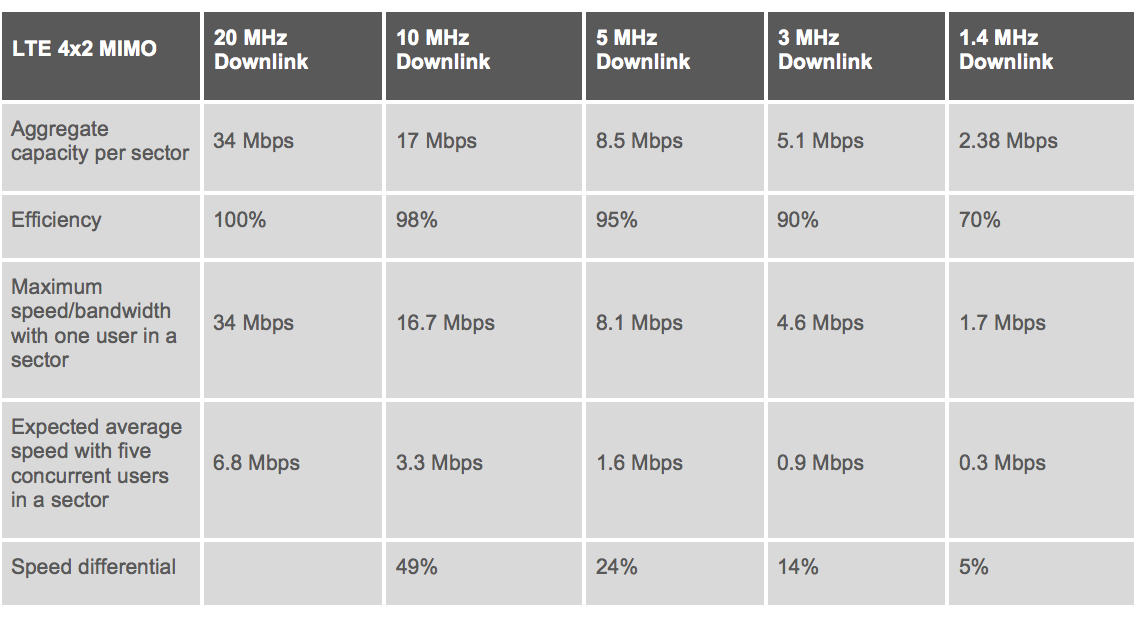
Why the global trend to embrace wider channels? It’s all about providing higher speeds at lower cost for the data hungry masses of smartphone users. The faster the network speed, the better the quality of video and data bits traversing the network. The lower the cost, the more people can actually enjoy wireless data services. And the impact that channel size has on network speed is quite direct. Because wireless bandwidth is a shared resource, the speed with which packets traverse a mobile network is the fraction of the total bandwidth available, divided by the number of concurrent users. Consider the following chart that explains the relationship between network speed and the size of the spectrum channel.


april-21-2014-chart-two
Data derived from Peter Rysavy’s Mobile Broadband Explosion Whitepaper for 4G Americas. http://www.rysavy.com/Articles/2013-08-4G-Americas-Mobile-Broadband-Explosion.pdf Individuals users with good radio signal will be able to achieve higher speeds than averages. [Click to enlarge chart.]

Wider spectrum channels make it easier to deliver faster speeds for accessing and downloading content as the wireless carriers have to manage just one contiguous channel. This is caused by what engineers called trunking efficiency, which means that resources from a single larger channel can be more efficiently allocated than from separate independent channels. In effect, channel sizes impact the design and cost of the network. The faster the speed, the more satisfying the experience which prompts more usage and so the cycle goes. The most obvious advantage for consumers is that videos, which represent more than half of all bandwidth consumed on mobile networks, can be viewed without interruptions and at a higher quality than video delivered over narrow spectrum channels. Small businesses can more easily use video conference services, healthcare providers can more effectively use video for instruction or treatment, schools and libraries can more cheaply use video-based instructional tools and companies relying on mobile ad revenue for their next billion in revenue will be well served.

While Europe, Asia and Latin America are embracing the technical benefits of innovation by licensing wide channel sizes, the US remains solidly grounded in the thinking of the 1990s – when small channel sizes were technically sufficient and politically appealing as a way to entice small companies into the wireless industry. Today the FCC is making a trade-off between allocating smaller bands of spectrum to more people, rather than allocating wider spectrum bands that will allow network operators to provide faster and/or cheaper data on average.

The fact that not only Europe, but also Asia and Latin America are making spectrum available with much wider channelization than their US counterparts is significant. It should come as no surprise then that wider spectrum channels are creating superior outcomes for the wireless broadband networks in these countries. Operators around the world will be able to provide their customers faster and/or cheaper wireless services while boosting the economic and productivity improvements that the proliferation of more and faster wireless service has been shown to produce. Putting the U.S. on a path away from this global trend makes it much harder to maintain the wireless data leadership that this country has enjoyed.

The best path to maintaining America’s global leadership in deploying LTE networks that offer the fastest speeds accessible by the greatest number of consumers at the lowest possible cost is to license spectrum consistent with how technology has progressed and in sync with global spectrum allocations. Today, the best quality of service for delivering mobile data is achieved with channels that are 20 MHz and larger. Ultimately, there we can have two out of three: higher number of licenses, faster speed, lower cost. If US policymakers only offer spectrum licenses with small channel sizes, like they have decided to do with AWS-3 and is rumored to be considering for the incentive auction, it should come as no surprise if other countries will enjoy faster data speeds and the United States increasingly falls behind in global wireless rankings.

The following is the second of a two-part series examining some of last year’s key developments in the mobile space and also projecting their impact into 2014. In this note, we focus on handsets, operating systems and the networks that support them.

As we consider handsets, OS and networks, a few bottom line conclusions spring to the fore:

  • Both the handset market and OS competition are characterized by a sharp divide between two winners and a batch of competitive also-rans. That is unlikely to change significantly this year for either handsets or OS.
  • In 2014, Apple and Samsung will continue to account for almost all profit in handsets; Android and iOS will remain the dominant operating systems. Wearables may be the best new growth area (a subject, along with tablets, we will address further in the near future).
  • Consumers, however, will continue to benefit from handset innovation, new pricing models for handsets and wireless service, and the opportunities that come with the continued expansion of U.S. carriers’ LTE networks.
  • Fierce competition for network supremacy will mean a continued American edge over Europe in mobile carriers’ capital expenditures and drive further innovation in applications and handsets.

Handset market share in holding pattern

By limiting the opportunity to sell to first-time purchasers who might consider a wide variety of brands, the high ownership levels of smartphones makes it difficult to significantly shift handset market share.

Smartphones now account for more than three-quarter of all U.S. device sales and roughly 90% of the handsets sold by the nationwide carriers. This shift reflects the devices’ astonishing utility combined with declining upfront costs to take a phone out of the store. While Americans upgrade to new devices at a rapid pace (about every 22.4 months in 2013), the data suggests they tend to stick with their current brand rather than switch.

Thus, the introduction of new models such as Samsung’s Galaxy S4, Apple iPhone 5S, HTC’s One and Google’s Moto X in 2013 provided consumers with outstanding new devices, but barely budged market share. The Galaxy S4 and iPhone 5S boosted sales over their predecessors, but because of natural limitations imposed by the law of big numbers the growth rates did not much impact share or impress Wall Street.

Samsung and Apple account for virtually all of the industry’s profits and will continue to slug it out for the championship belt. Everybody else is struggling to stay out of the red. This hierarchy is unlikely to change in 2014 – except for the possibility that some lesser players will exit the marketplace. Indeed, Google has already run up a white flag in handsets with the sale to Lenovo of Motorola Mobility’s handset division (although retaining most of Motorola’s patent trove). Overnight, the transaction makes Lenovo No. 3 in the battle for handset supremacy and endows it with an outstanding piece of hardware, the Moto X phone. A strong marketing effort and long-term commitment to the brand may give Lenovo a chance to make inroads – but it won’t happen suddenly this year.

Microsoft’s 2013 acquisition of Nokia represented a bid to replicate Apple’s integrated approach of keeping both its software and hardware in house. So far, the effort is lagging in the marketplace despite good quality. Things remain dire for BlackBerry, where device sales have imploded and the company is hemorrhaging cash in an unsustainable way. HTC, one of the other premier device brands, is continuing to lose money in its core device business in what looks increasingly like a race against time.

Feature phones headed for oblivion?

Nor is there much opportunity in feature phones. With fewer and fewer people shopping for these phones, the variety and innovation in this segment is on the decline – and so is its price advantage over more advanced phones. Slowly, but surely, feature phones are headed for near extinction in the United States. Even in emerging markets, feature phones are likely to yield the field as manufacturers produce a more diverse inventory of smartphones to fit a variety of individual budgets.

The demise of the feature phone is being accelerated by the emergence of handset financing and enticing trade-in options for smartphones. More and more consumers are taking advantage of phone financing offers or opting to trade up sooner in exchange for cash and/or credit toward new devices. While these programs actually include restrictions similar in kind to the subsidy model they are replacing, consumers are attracted to lower out-of-pocket costs. With a financing plan, consumers can walk out of the store with a high-end smartphone for zero down and between $24 and $27 per month – so they see little reason to settle for less than the best. Although they may pay more for their device in the long run under the new plans, consumers like the idea of paying in smaller increments compared to plunking down $200 up front for a subsidized device under the traditional service contract.

Minting a winner is increasingly a matter of marketing

Increasingly, the dividing line between the winners and losers in the handset business in the United States comes down to marketing. Apple and Samsung have been willing to make the necessary $150 million plus annual spend to create and sustain a consumer brand. The market laggards’ promotional efforts, on the other hand, have been episodic and underfunded. Instead of continuous year-round advertising to implant their brands in consumers’ psyches, competitors have largely run ads in short spurts or around specific events. As quickly as the ads appeared they disappeared, and so did public interest in their new offerings.

Microsoft, for one, certainly has the wherewithal to sustain prolonged campaigns, but has chosen not to do so for its mobile offers. Given the limited effect of its underfunded marketing efforts, it might have been better off skipping it altogether. Accelerating the device upgrade cycle might crack the door a bit for possible inroads because the more times a consumer goes to the store, the greater the chance he or she will decide to switch. But so far that has not happened even though Americans change their phones more often than consumers elsewhere around the world.

Still, this comparatively rapid handset upgrade cycle has propelled the United States to the leadership position in the global smartphone economy. New devices with new capabilities drive the demand for faster and better networks, which, in turn, make new applications feasible. That’s what keeps the mobile space in the United States so exciting. In contrast, consumers in continental Europe replace their devices every four to six years, which traps them in the digital past. Just imagine still using the first generation iPhone: magical, revolutionary, but oh so six years ago.

Aside from potentially opening the door to movement in market share among device makers, a shorter upgrade cycle matters because new, high quality devices boost customer satisfaction. That satisfaction spills over to network providers whose high-speed data networks open up new possibilities for mobile devices. Satisfaction reduces churn among carriers and supports a comparatively high average revenues per user as customers receive good value for their money. The result is a virtuous “win-win-win” circle that should hold even with changes in the way customers buy services and devices.

OS market looks steady

Stability is also likely for OS market share in 2014. The two OS leaders, Android and iOS, hold about 90% of the market between them and, will continue to jockey for position. Windows Mobile, a good if unloved system, has likely hit bottom and should gain slightly in 2014, especially in the prepaid market where it has done relatively better. BlackBerry is still trending down. Absent a game-changing device (which we do not expect), BlackBerry could slide further this year. Other systems are little more than background noise.

Google’s decision to sell its handset business may boost Android by removing handset makers’ concerns about competing with a Google phone even as they embrace Google’s flagship OS. In that sense, its deal with Lenovo may be seen as a renewed commitment to a multi-vendor Android ecosystem. By contrast and absent a change in direction under its new leadership, Microsoft appears committed to both its Nokia handsets and its Windows Mobile OS.

The usefulness of these devices and operating systems are contingent on strong networks with the capacity to handle rising demand. As noted in part one, U.S. carriers are locked in a feverish race to expand their LTE footprints and also increase speeds. Among the key questions is whether Sprint, which is spending lavishly with new money from Softbank, can make it a four-way competition. In our view, 2015 is the year that Sprint’s networks will match or exceed its rivals by taking advantage of its huge spectrum holdings.

Devices and the networks that make them work

The United States is home to more than half of all LTE subscribers in the world and carriers continue to pour money into their networks. In 2013, AT&T and Verizon Wireless combined easily outspent all 58 European wireless carriers combined. The U.S.-Europe gap is even greater when increased investment by T-Mobile US and Sprint is toted up.

Verizon Wireless has the largest LTE network, covering more than 90% of the U.S. population. But the company’s competitors are challenging its supremacy and increasingly claim to exceed Verizon Wireless in speed, reliability or both. Those claims have gained credibility because of several nationwide LTE outages that have hurt Verizon Wireless’ reputation. But the carrier is bringing additional spectrum online, which should boost performance and help it hang on to its reputation as number one.

AT&T is catching up through its multi-year Velocity IP initiative. AT&T is spending more than $10 billion a year on its wireless network and now reaches about 280 million consumers with LTE. By mid to late 2014, AT&T Mobility should match Verizon Wireless’ network in coverage. AT&T Mobility will get a capacity boost in 2015 as it deploys additional 2.3 GHz (WCS) spectrum.

T-Mobile US has put the pedal to the metal and now covers 200 million consumers with LTE. It’s also claiming the fastest speeds in half of the top 20 markets and points to a Speedtest.net study to claim the overall crown for fastest downloading. Backhaul upgrades in 2012 and 2013 and new spectrum acquired from MetroPCS have positioned T-Mobile US with 40 megahertz of spectrum to support LTE. The company cleverly minimized zoning hurdles by reusing existing antennas and focusing only on existing sites to optimize the beefed up network. The company faces a bit of a catch-22 going forward, however. Its comparatively lower number of customers per-megahertz of spectrum provides higher speeds, but download speeds will drop as its customer base expands and puts greater demand on share resources. One way to mitigate that trend is a quicker shift of former MetroPCS customers from that company’s legacy CDMA network to T-Mobile US’ GSM/HSPA/LTE network, so we expect speedy migration will be an operational priority in 2014.

Sprint’s network upgrade is not going as well. Sprint now covers about 200 million consumers with LTE, but quality has declined because of disruptions created by the longer-term network upgrade. The company is replacing all of its base stations and antennas, creating a massive local zoning and permitting nightmare and knocking the effort off schedule. Once past these obstacles, however, Sprint should be better positioned. Sprint Spark will aggregate several 20-megahertz contiguous channels to achieve initially industry leading speeds. The company has launched a few markets and expects 100 million pops covered for Spark by 2015. Given the potential competitive benefits from Spark’s speeds, we’re disappointed that it’s projected to cover only 100 million consumers in 2015. Finding some way to accelerate deployment would provide a major boost for the company’s competitive position.

Even regional carriers are investing in LTE to remain competitive. U.S. Cellular is currently covering 80 million pops with LTE, which is 87% of its footprint. C Spire also has aggressively expanded its LTE footprint.

The future of the various networks is, of course, tied to spectrum and how efficiently carriers put it to work. Given the continued growth in data demand, which is now climbing about 50% annually, putting more spectrum in the hands of wireless carriers is now a Federal Communications Commission priority. Curiously, the big winner from Auction 96, which began in January, is almost certain to be Dish Network rather than one of the national wireless carriers – none of which is bidding for the 10 megahertz of 1.9 GHz (PCS) spectrum now available. As of right now the bids for Auction 96 are coming in at $1 billion, still well shy of the $1.56 billion Dish Network has promised to pay for the nationwide license.

The big action in spectrum is the voluntary auction of TV broadcast spectrum that the FCC will shift to wireless broadband providers in 2015. The outcome of that auction may depend on the commission’s bidding rules, which is now the focus of a fierce debate among the national carriers. A successful auction also would provide critical funding for the planned public safety network, FirstNet. The usability of the 700 MHz A-Block also is at stake as the incentive auction will remove the Channel 51 interference.

 

According to Report Change in Administrator Would Jeopardize Launch of Next Gen Wireless Services

Recon Analytics, an independent data analytics and consulting firm, today released a report finding that a change in the nation’s local number portability administrator (LNPA) could severely impact efforts by wireless providers to introduce innovative new services, such as voice over LTE (VoLTE), Web Real-Time Communication, Wideband Audio and Machine-to-Machine.  The report, titled “LNPA Transfer Would Cause Significant Industry Conflicts,” comes as the industry is considering the future of local number portability, currently administered by Neustar.

The LNPA manages more than 650 million telephone numbers, updates information in its registry over 1.5 million times per day and broadcasts that change to hundreds to network elements across the country in real time.

Report author Roger Entner, founder and lead analyst of Recon Analytics, said, “As a part of the underlying fabric of the US wireless market, LNP is vital to the evolution and protection of wireless networks.”  He explained, “a decommissioning and replacement of this infrastructure presents challenges and pitfalls for any service provider looking to maintain a superior customer experience while simultaneously undertaking disruptive innovations, such as VoLTE, within their own networks.”

The report explains that the work being done to expand and enhance wireless networks will keep engineering and IT organizations at full capacity, but a shift to a new LNPA provider will take resources aware from these projects – potentially delaying or derailing the projects outright.

The report’s key conclusions include the following:

  • LNPA transition could jeopardize the wireless industry’s move to VoLTE and next generation services.  These innovative new services require equally revolutionary changes in back office systems.
  • LNPA transition will probably not be smooth.  As we saw with healthcare.gov and Ericsson’s migration of O2’s central user database where seven million customers experienced a 20-hour outage, large database migrations are difficult and fraught with problems.
  • LNPA transition will likely be a costly mess.  According to research by Hal Singer, principal at Economists Incorporated , the transition cost will come to $719 million, which comes as a time when most carriers are tightening their belts.
  • LNPA transition could devalue carrier brands.  The negative impact the transition would have on wireless consumers would damage and devalue all brands.
  • LNPA transition could impede and increase the costs of M&A activity.  LNP infrastructure is critical to ensure that telecom mergers and acquisitions are seamless in the eyes of consumers.  Problems with a transition would slow mergers and acquisitions to a crawl or stop them entirely.

The full report, “LNPA Transfer Would Cause Significant Industry Conflicts,” which was funded by Neustar, is available on Recon Analytics’ site.

About Recon Analytics

The mission of Recon Analytics is to clear the clutter, help focus executives and policymakers on what is actually happening in the marketplace and what really matters, and make a positive impact on business and policy decisions. Founded and led by leading telecom analyst Roger Entner, Recon Analytics’ approach is bolstered by its industry-first executive advisory board, which helps us hone our strategy, improve our research, and provide unparalleled insights into the matters most relevant to the business and the public policies impacting it. With this foundation, Recon Analytics focuses on three core areas: Syndicated research, custom consulting, policy related data analysis, as well as white papers.

CONTACT:
Roger Entner
February 11, 2014
617.823.3363
[email protected]

The following Note is the first of a two-part series assessing some of last year’s key market developments and projecting their impact into 2014. We also offer our thoughts on the challenges and opportunities for wireless carriers this year and consider how competition will unfold in the months ahead. Part Two will look at what the year ahead may hold for devices, networks and spectrum.


Looking back, 2013 was a year of transformation in which several major transactions enabled the carriers to reshape and reinforce themselves for a Final Four competition for leadership in the U.S. market. Looking ahead, 2014 shapes up as a year of intensified competition in which carriers test a host of new options for relations with their customers and also step up a fierce contest to establish the superiority of their LTE network. Already, just weeks into the new year, AT&T and T-Mobile have raised and counter-raised with competing offers of cash to convince customers to ditch their current carrier and switch. And, Sprint has revised its plan for accelerated handset upgrades and launched a new Framilies plan to let larger numbers of customers come together and qualify for lower group rates.

Hanging over this continuing tussle to attract and retain customers is a parallel battle over the terms of the 2015 spectrum auctions as well as renewed speculation about a possible merger of a revitalized T-Mobile and spectrum-rich Sprint. The potential entry of DISH and the fate of LightSquared are wildcards that have the potential to reshape the current wireless market depending on how the two companies decide to proceed. The pre-paid market, roiled in 2013 by forced deactivations because of questionable Lifeline signups, bears watching as well. We expect Tracfone will help lead this segment back up in 2014.

As we gaze through the crystal ball, we see a landscape greatly altered from 12 months before. Repositioned as the snarky “uncarrier”, T-Mobile has pushed the market in new directions by decoupling the handset and service components of customer contracts. It also has repeatedly compelled competitors to respond to its redesigned service plans with new offerings of their own. As we open 2014, T-Mobile, Verizon, and AT&T are in the market with plans that could signal the beginning of the end for the handset subsidies that have fueled consumers’ enthusiasm for high-end, but pricey smartphones.

Among the open questions for 2014 is whether consumers would rather pay full price for their handsets, likely financed over time, in exchange for lower monthly service costs or do they prefer the longstanding subsidy model. We wait to see the degree to which each carrier will work to move consumers to a financing-model.


Changed Landscape

As it is, the restructured T-Mobile and Sprint are strategically better positioned than a year ago. After their own talks about a possible merger flamed out to start 2013, the two companies found other partners. T-Mobile struck first in a “reverse acquisition” of Metro PCS. The transaction shifted 9 million Metro PCS customers to T-Mobile, providing an immediate boost in revenues, and also bolstered T-Mobile’s company’s spectrum inventory. The reverse acquisition mechanism, which enables a previously private company (T-Mobile, in this case) to quickly list its stock on public exchanges by acquiring a publicly-held company, also created new financial flexibility and liquidity for T-Mobile and its parent, Deutsche Telekom.

Bolstered by new assets and under the in-your-face leadership style of CEO John Legere, the company shook up the competitive landscape with a host of new offerings and recorded substantial gains in customers. The company’s image has been transformed into that of a feisty and effective challenger, the brand looks fresh, and Mr. Legere has a knack for grabbing headlines. The company has now launched four iterations of “uncarrier” to continually stoke new enthusiasm. The solid investment in its network as well as the media spot light has brought T-Mobile back into consideration for a growing number of consumers. T-Mobile will continue to play the “uncarrier” tune until it no longer works; the difficulty will be to keep finding things that upset consumers and can be profitably recast by T-Mobile.

Sprint also moved in a new direction, ceding its independent status by selling a majority stake to Softbank to get the financial backing it needed to build out of its LTE network. Bankrolled by Softbank, Sprint added to its spectrum holdings by winning a bidding war against Charlie Ergen and DISH Network and acquiring the half of Clearwire it did not already own. With the two moves, Sprint eliminated the ongoing distraction of dealing with an independent Clearwire and emerged a spectrum powerhouse with twice as much spectrum as any other carrier. Toward the end of the year, Sprint acquired yet more spectrum by buying licenses from Revol Wireless, which closed up shop on January 16, 2014. Sprint has since targeted Revol’s customers with special offers from its prepaid brand Boost Mobile. Tactically, however, Sprint is in a difficult situation as its Network Vision project is woefully behind schedule and network quality has suffered.

AT&T and Verizon also moved to shore up their competitive positions. AT&T snapped up Leap Wireless, which sells the Cricket Brand, for $1.2 billion to add key spectrum and expand its position in the prepaid, non-contract market niche. After ten years of on-and-off talks with Vodafone, Verizon spent $130 billion to buy out the British company’s 45 percent share in Verizon Wireless and capture the efficiencies from running its wireline and wireless businesses as an integrated company in which strategies are set solely by Verizon management.

Tracfone also beefed up last year, acquiring a number of prepaid carriers in a market niche troubled by some overzealous carriers’ abuse of the Lifeline program. The acquisitions should pay off for Tracfone this year as it digests last year’s feast.

2014 should see fewer transactions – the opportunities simply do not exist for a repeat of last year. But one big deal is possible as Sprint continues to eye T-Mobile and news reports indicate it has lined up bank financing just in case. However, regulatory approval would not be a sure thing. Both the FCC and the Justice Department have previously suggested a desire for four or more national competitors in the marketplace and the resurgence of T-Mobile as a market driver –as DOJ hoped in opposing the AT&T/T-Mobile transaction in 2011 – would seem to raise an additional barrier to approval. Also, given the recent performance of the two companies, the issue of leadership could complicate talks. It’s possible that Softbank might prefer Legere over current Sprint CEO Dan Hesse to lead a combined company.


Competition Intensifying

The story for last year was T-Mobile’s customer gains after years of net losses. This year, we wait to see whether T-Mobile can maintain its momentum and if Sprint can begin adding to its customer list. Also worth watching is whether Verizon can retain its reputation for having the “best” network, a claim that is increasingly challenged and coveted by all three of its national rivals.

T-Mobile, which got a boost from finally adding the iPhone to its inventory, was the clear 2013 leader in offering new options to consumers. The initial uncarrier program cut monthly charges by $20 and introduced handset financing. The company also shifted most of its customers from service contracts to handset financing contracts that ties them to the carrier until they have paid off the handset, a clever switch that is the virtual equivalent of an early termination fee – but without the complaints. T-Mobile followed with JUMP!, which combines a rapid device trade-in and upgrade plan with traditional handset insurance for a lower rate. A few months later, it added free low-speed international data and texting plus lower-cost international roaming. This rapid-fire innovative pace forced its competitors into catch-up mode, trying to match many of T-Mobile’s innovations. Current indications are that T-Mobile should continue to grow for at least the next six months even without any new uncarrier announcements.

AT&T took aim at T-Mobile and Verizon by lowering its monthly recurring charge by $15 for customers who finance their device, own it outright, or who have had it for more than two years while on contract. Traditionally, AT&T has priced at parity with Verizon Wireless, but the new program drops its prices below Verizon’s for longer-tenured customers and should inhibit churn. The initiative also reduced the price differential with T-Mobile for customers who are not bound by a device financing or service contract. AT&T’s reduction for out-of-contract customers is its best idea so far for keeping its vulnerable feature phone base with the company. It should have help improve their feature phone retention rate, but we doubt it will entirely close that seeping wound.

Though tarnished by a number of large-scale outages of its 4G LTE service, the strength of Verizon’s network has helped it remain the fastest growing contract carrier as the Verizon halo of best network is still intact in the consumer’s mind. Network strength is Verizon’s most significant differentiator and retaining the lead in consumer perceptions about its reliability is vital to its growth strategy. But some metrics suggest the advantage has been slipping.

Recent data from RootMetrics, for example, suggests that AT&T’s LTE is faster than Verizon’s in a majority of markets. The company says, however, that Verizon still has an edge on reliability. When combining those two elements, RootMetrics’ gives AT&T the edge for “combined performance.” The fight for network bragging rights is likely to grow fiercer still as Sprint begins to roll out its super-speed Sprint Spark service. For its part, T-Mobile claims to be the top speed provider in half of its 20 LTE markets based on findings from Speedtest.net and has dramatically expanded its 4G LTE network to cover more than 200 million customers, surpassing Sprint. In the end, the consumers cannot help but be confused by all the contradictory claims.

The increasing capabilities of LTE networks also raises the possibility that one or more wireless providers might aggressively turn to current wireline users as a growth area and pitch them to switch to wireless for all of their broadband needs. AT&T has already announced such a vision and Verizon executives have publically contemplated it. Sprint has more than enough spectrum to make such a pitch and T-Mobile’s recent purchase of 700 MHz spectrum from Verizon brings wireline customers within its reach as well.

AT&T meanwhile must cope with weaker contract growth for handsets, perhaps by building on gains it recorded in tablets last year. During 2013, the company successfully upsold its existing customer base with additional devices. The company also entered the home security and automation business with Digital Life in a significantly more comprehensive and expansive way than any other company. The home security market is notoriously tough to enter due to the difficult approval process in every market it is offered. The company launched 57 markets in 2013 and started doing nationwide broadcast television, setting itself up for growth in 2014.

Sprint spent 2013 in almost perpetual turmoil – making its deal with Softbank, fighting DISH for Clearwire, shutting down its iDEN network and feeding other carrier’s subscriber counts. Network Vision has slowly turned into a nightmare with slow implementation and service degradation, which in turn has led to a reversal in customer opinions of Sprint and contributed to subscriber losses. These losses will continue at least through the remainder of 2014. While Softbank is now on the hunt for T-Mobile and is eager to purchase its smaller rival, it is unlikely that this pursuit will bring Softbank the salvation it apparently is looking for. The odds of winning an approval of such a merger are slim under the current administration, which views the revival of T-Mobile as one of its crowning achievements in promoting wireless competition.

In our view, Sprint might be better advised to get its own house in working order after last year’s tumult and put off a run at T-Mobile for a few years. Longer term, Sprint is pouring Softbank’s money into an upgrade of its LTE network with the intention of overtaking its rivals by 2015 or sooner and touting the newly-claimed technological edge to attract customers. If it can convert that plan to reality, Sprint would be better positioned for a future transaction as the power of two effective challengers combined would have greater upside than a slow mover trying to buy its way to better performance.

On the pre-paid front we see strong growth this year, led by an enlarged Tracfone. The segment started strong in 2013, outpacing post-paid by 10-1 in the early part of the year. But those too-good-to-be-true numbers were inflated by excessive Lifeline signups that the FCC later rolled back. In the end, prepaid net adds went negative as forcible deactivations were higher than adds and contract lines grew again.


Innovation and a desire to compete is the basis of success. After years of languishing, T-Mobile has regained its competitive vigor with the reverse acquisition of Metro PCS. The secret of T-Mobile’s success is three pronged:

  • First, the company went ahead and put the $3 billion and spectrum they got from AT&T when that merger went awry and combined it with the Metro PCS spectrum to rapidly build an LTE network in their existing footprint on their existing towers, covering 180 million POPs by September 2013.
  • Simultaneously, T-Mobile announced the Un-Carrier strategy, which was a refresh of the Value Price Plan initiative, to great fanfare. The first phase of Un-Carrier does away with handset subsidies and replaces them with a device installment plan. In essence, for the first 24 months of the plan, a consumer won’t see a change in what they pay. After 24 months, however, the payment goes down to a device-free price, which is about $20 lower—assuming the consumer does not chose to purchase a new device. Considering that Americans purchase on average a new device every 21.7 months, only a few consumers will likely see the lower payment.
  • Third, on July 14, 2013, T-Mobile launched the JUMP program, which allows the consumer to upgrade their device every six months by resetting their device purchase program when they trade-in their device with at no charge. The program, which costs $10 per month, also includes a device insurance program, which previously cost $12 per month. This makes the JUMP program a no-brainer for T-Mobile customers who would have taken the device insurance program anyway. Within days, AT&T and Verizon announced similar programs. Sprint announced its rapid handset program more than two months later, on September 20th.

To gauge the success of T-Mobile’s JUMP program, Recon Analytics conducted a detailed survey using Google Custom Surveys between August 26 and August 30, 2013. Results were immediately accessible to our advisory members.

We found that six weeks after the launch of the program on July 14, 2013, 28.4% of 4,183 respondents were aware of the JUMP program. This is a substantial level of awareness considering the short time the JUMP program was being promoted and the relatively low share of voice that T-Mobile advertising represents in the advertising world. We followed up this question with second multiple-choice question to the 1,002 respondents who were aware of the JUMP program asking them how interested they are in the JUMP program.

Top Line JUMP Survey Results

T-Mobile JUMPs to growth

A couple of things are interesting here. Among the respondents, 28.5% claim they already have JUMP. This percentage is a rough match for the percentage of wireless subscribers who have a device insurance plan. If, indeed, everyone who said they would sign up for JUMP will take up the JUMP plan, then more than half of T-Mobile’s subscribers (50.4%) will be on the JUMP plan. Considering that the JUMP plan is 16% cheaper than the traditional handset insurance plan with is part of JUMP, one has to be concerned about potential impact of the JUMP plan on T-Mobile’s profitability.

Because the device can be traded-in for a device of the same price after six months without additional payments, one can only wonder who is paying for the value decline of the traded-in device. Similar to a new car, which loses most of its value the moment it drives off the lot, mobile phone see their value decline even faster because the replacement cycle is much more rapid. Someone has to pay for the decline in the device’s value and it’s not the consumer. It is almost inevitable that the JUMP program will need to get adjusted.

The other interesting result is that 4.6% of the respondents want to switch from their current carrier to T-Mobile for the JUMP service. Part of the 4.6% were Sprint customers who had no comparable choice until a few days ago. Sprint probably saw early indications of switchers to T-Mobile and scrambled to get their own program out the door.

AT&T’s and Verizon’s programs are different than T-Mobile’s. Most notably, neither AT&T’s and Verizon’s plan charge a program fee and neither include an insurance program for the fee or a discount to monthly charge. Regardless of which carrier they choose, consumers that frequently upgrade their devices will pay less in the long-term.

While the Un-Carrier campaign, JUMP, and LTE are driving growth in the customer acquisition, T-Mobile has also been able to reduce churn significantly. A little known fact is that roughly half of total gross adds in markets where T-Mobile and Metro PCS were competing against each went between those two carriers. The companies were competing against each other to a greater degree than any other carrier pair. When the two carriers merged, suddenly the external churn that was counted in both carrier’s metric was internalized. Logically, the churn dropped. As a result, net additions for T-Mobile increased substantially without increasing churn among the surviving carriers in the market place.

T-Mobile’s turnaround has been impressive, built by focusing on innovation, “investment” and a fortuitous choice in merger partners. The fundamentals of T-Mobile’s growth should stay intact for at least another two quarters if no competitor makes a significant change, but we are all waiting for Sprint to unveil their new plans under new ownership. One can only hope for Sprint that they will be unveiled this year because it now faces three formidable competitors.