During the last week of September, GSMA, along with its partner CTIA, held their annual North America conference in Las Vegas. Given the regional focus of the conference, the news and activity coming from it pales in comparison to the Barcelona version. However, that does not mean MWC Las Vegas is without value. We had several meetings that alone made the event worth attending. Plus, some companies still use the conference as a platform for announcements, while the exhibit floor provides guidance on the state of mobile communications in North America.
Of the major U.S. mobile network service providers only T-Mobile and AT&T had a show floor presence this year, but that did not mean other mobile providers didn’t make their presence know. Some of the operator highlights and messages from MWC Las Vegas 2023 are as follows:
AT&T: The company’s booth was dedicated to enterprise solutions, with connected vehicles occupying significant space. This is fitting given that Hardmon Williams, SVP, Connected Solutions for AT&T, used his keynote session to announce the company is now the connectivity provider for electric car manufacturer Rivian. Hardmon also discussed the frequent software updates of electric cars, which in turn increases the importance of network connectivity to support those updates.
MobileX: The competitive outlook for the U.S. prepaid market should intensify with the announcement by MobileX that it will launch a prepaid service exclusively through a retail partnership with Walmart. The driving force behind MobileX is Peter Adderton who has a track record of launching successful prepaid brands with Boost in the U.S. and Australia. Walmart’s interest in working with MobileX appears to be a competitive move against its online rival Amazon and its recently announced sales partnership with Dish’s Boost offering.
NTT DoCoMo: On the first day of the show the Japanese mobile operator announced it will be deploying an Open vRAN solution using NVIDIA GPU for hardware acceleration. NVIDIA will be supporting both the X86 and the ARM architecture. This is significant, as it not only gives NVIDIA a major Open RAN win, but will help overall create more Open RAN deployment options.
T-Mobile: The established U.S. mobile operator T-Mobile captured the most attention at the show with its announcement of a SIM based SASE offering using network slicing. This marks the first commercial service offering using 5G network slicing in the U.S. T-Mobile’s slicing will go commercial later this year. This is an important step in 5G evolution, helping to prove commercial viability of slicing. To help grow slicing, T-Mobile CTO John Saw announced that the company has made network slicing available nationwide to application developers. T-Mobile also took full advantage of the exhibit floor to show multiple wireless enterprise solutions and to host public sessions inside its booth. It was one of the liveliest spots on the floor.
Verizon: Verizon did not make any specific service announcements at MWC Las Vegas, but it did release a statement at the start of the conference highlighting its progress in transforming its network and the subsequent benefits. Those highlights included fiber network investments, mid-band and mmWave spectrum coverage, 5G fixed wireless access, and cloud-native network transformation. Verizon Business CEO Kyle Malady used his time on stage at MWC to push back against FCC’s plan to reintroduce Net Neutrality, as a solution looking for a problem that does not exist. b
Of the three largest RAN suppliers in the region, only Nokia was on the floor. However, that doesn’t mean the conference lacked an infrastructure presence. Some of our vendor observations from the conference are as follows:
AWS: The company had a substantial presence on the show floor. Booth space was primarily dedicated to meetings and educational conversations regarding AWS’ telecom service provider and enterprise solutions. Digital transformation, and the role AWS can play in helping mobile operators with their transformation remains a strategic interest. Supporting that strategy, Sameer Vuyyuru, head of WW business development for communication service providers, gave a keynote presentation about how mobile operators are using GenAI to improve operations and customer experience.
Dell Technologies: From Dell’s hospitality suite overlooking the show floor the company promoted itself as the best option for operators looking for an IT hardware partner for building cloud-native networks. This includes servers to support Open RAN. Dell also participated in a private network demonstration with Airspan, Dish Networks, and Druid.
Nokia: As a sign of the shifting nature of network infrastructure, hardware specialist Nokia used its time at MWC Las Vegas to talk about software. Its message at the conference was “Network as Code” and participated in the open developer gateway conference held at the show. Nokia was also found at the GSMA booth demoing virtual reality to help drive interest in the mobile API opportunities.
Pivotal Commware: Pivotal Commware continues to focus on how to improve 5G mmWave economics through coverage extension and network planning and management tools. The company continues to make progress in this area indicating an increase in its U.S. deployments and that it is seeing its commercial opportunities expanding beyond the U.S.
Qualcomm: The company showed together with Quectel a 5G cellular module for laptops that can aggregate cellular and Wi-Fi signals. This is a nifty capability that focuses on the best performing link. In addition, Qualcomm continued its tradition of educating analysts about new market developments and technological innovations.
Beyond the specific vendors listed above, a significant percentage of vendor booth space remains dedicated to IoT, FWA, private networks, and indoor coverage solutions.
Realistically the U.S. version of MWC will never rival the Barcelona one. The U.S. version is mainly for North American operators and vendors while the one in Spain is global. That focus reduces participation. Vendors can bypass the show and still meet with customers and prospects. However, this does not mean the show should be written off. It remains a good source for one-on-one interactions and as a mid-year gauge of industry growth since Barcelona.
The world’s largest retailer created a unique partnership with Peter Adderton’s MobileX, making the new mobile provider an instant player in the prepaid business.
Walmart is the largest distribution channel for prepaid in the United States. At a minimum, due to its unique partnership, one would expect that MobileX will get appropriate exposure in Walmart stores and placement on Walmart+.
MobileX comes in two flavors: It is using AI to create a personalized plan for every customer or they can sign up for a very competitively priced unlimited plan. The AI plan starts at $4.08 per month with 1 GB of high-speed data, making it the lowest priced plan in the market. The $14.88 5G high-speed data plan is aimed at Mint Mobile, whereas the $24.88 30 GB plan – including Canada and Mexico – is aimed at Straight Talk and Boost Infinite.
The rivalry between Amazon and Walmart is as intense as it gets. Both companies – one being the largest online retailer, the other the largest physical retailer – are colliding. Amazon pushes into physical stores with Whole Foods, Walmart pushes into online retail with Walmart+. Both are eying the mobile market as a market of critical importance.
After Amazon struck a deal with Dish for Boost Infinite for Prime customers, it was only a matter of time – two months to be exact – before Walmart struck back with its exclusive MobileX deal.
Furthermore, one can imagine that Walmart, as the largest prepaid retailer in the United States, needed to broaden its product portfolio. Walmart’s long-standing partner TracFone has languished ever since the legendary FJ Pollak got sick and passed away. Now that Verizon has acquired TracFone, things have gone from okay to worse. TracFone’s share has shrunk and Total, a brand that was launched in Walmart, has been repurposed to be a standalone brand with more than 2,000 retail stores.
Mint Mobile, another up and coming prepaid brand with more than 1.5 million customers, is being acquired by T-Mobile. Boost Mobile, due to Dish’s close relationship with Amazon, has a sudden onset of the bubonic plague in the eyes of the folks from Bentonville, Arkansas. This makes the prepaid market suddenly a consolidated market whereas Walmart is looking for a large number of independent choices for their customers to choose from.
Just in time, Australian maverick Peter Adderton enters the stage with a new way of offering wireless and creating a new choice that is not owned by one of the three mobile network operators. Getting an independent brand like MobileX is a smart move from Walmart as it gives its customers more choice and strengthens its bargaining position vis-à-vis all other partners.
Adderton rose to fame in the United States by launching Boost Mobile. While he sold Boost Mobile in the U.S. to Sprint, he kept Boost Mobile in Australia, where it is the largest MVNO. Being a loud and boisterous voice gives him an outsized social media presence and his operational chops give him the credibility to successfully launch another mobile brand – if he’s done it twice before, he can also do it a third time.
When scouring for hints in the press release the word “unique” stands out. Knowing the players in a market personally allows us to better understand the motivations and actions. Numbers and facts tell you some of the guard rails, but they don’t make decisions; people do with their idiosyncrasies and personal values.
I am finding it hard to believe that Adderton would give up exclusivity, even to Walmart, for a distribution partnership. Such an exclusive retail partnership created an almost 10 million subscriber Straight Talk brand and was the backbone for the remaining 11 million TracFone customers. I personally believe there is more to the story than what is in the press release, but only time will tell the exact terms of the deal between Walmart and MobileX.
With all three mobile network operators increasing prices for their legacy customers, with Verizon and T-Mobile even increasing headline prices, there is an opening for lower price options. The success of Charter and Comcast taking significant share in postpaid is a testament that price is the largest purchase decision factor. Not everyone is willing or able to pay $95 per month for a single line.
At the same time, not everyone lives in the Charter or Comcast territory or has persistent heartburn from past exposure to their customer service on the fixed side. This creates significant opening for independent fighter brands like MobileX, especially when they have the backing of a large retail organization like Walmart. Ninety percent of the U.S. population is within 10 miles of a Walmart store. It instantly solves the physical distribution problem that most wireless brands have as online is just not enough.
Despite a more than a decade push by the carriers, the share of online sales of wireless stubbornly stays below 20%. The percentage of online sales of mattresses is roughly twice as high. At the same time, physical retail is expensive, with the average store costing between $1 million and $2 million to open. When you multiply that by a thousand or more stores, you suddenly are talking about real money.
Recon Analytics recently conducted the largest survey run to date to assess whether consumers eligible for the Affordable Connectivity Program (ACP) are actually enrolling and if so, what they are using their ACP funds for.
We conducted nationwide consumer surveys among ACP-eligible Americans from April 28 – May 5, and August 18 – 27, 2023. We asked 29,141 ACP eligible Americans if they use ACP, and if so for what.
We were not at all surprised with our survey findings, but some policymakers might be.
Recall that ACP is a program that provides “eligible” Americans $30 per household for internet connectivity. Who is eligible? Figure 1 sets forth the categories of citizens eligible for ACP. These “categories” of low income individuals are from existing federal government subsidy programs.
Figure 1
Of the almost 53 million ACP-eligible households, more than 20 million have signed up. The states with the highest number of consumers receiving ACP subsidies are “red” states Louisiana, Ohio, Kentucky, and North Carolina.
The program is currently set to expire in early 2024 absent additional funding by Congress.The big question inside the Beltway is whether funding the ACP is a good use of taxpayer dollars. The ReconAnalytics survey indicates that if Congress is interested in seeing itself reelected, extending the ACP funding might be a good idea.
The Data Says ACP is Working to Close the Digital Divide … Among Republican Voters
When we compare ACP enrollment across red states and blue states (defined by the party who won the last senatorial election in the state) , we observe that the percentage of households which would lose access to the internet is higher in red states than in blue. 39% of ACP enrollees live in Red States and 34% live in blue states. Members of Congress ignore this reality at their peril.
But what about the enrollees, what are they using their ACP subsidy for? Consider that the largest proportion of households at risk of losing ACP are ones with school-age children. No surprise then that our survey reveals that these same households use their ACP subsidy for school work online.
In aggregate, about 55% of respondents who told us they would be unable to access the internet without ACP were white, 16% Hispanic, 12% black, 9% Asian, 6% Native American or Pacific Islanders and 2% were of another race.
Figure 2 – ACP Enrollees by Race, Ethnicity, Age and Income Distribution
Full Time Period
Income
$0-10k
$10-25k
$25-50k
$50-75k
Total
Not able to access the internet w/o ACP
36.2%
39.2%
34.8%
28.4%
36.2%
Race & Ethnicity Distribution
White
47.9%
59.2%
57.5%
48.9%
54.5%
Hispanic
18.8%
14.1%
17.5%
15.3%
16.3%
Black
15.8%
10.6%
11.0%
13.4%
12.3%
Asian
9.2%
7.4%
6.7%
15.3%
9.1%
Native American & Pacific Islander
5.4%
6.9%
4.4%
5.3%
5.5%
Other
2.9%
1.9%
3.0%
1.9%
2.4%
Age Distribution
18-29
31.0%
15.9%
20.5%
22.5%
21.5%
30-44
26.4%
21.2%
33.6%
45.0%
31.0%
45-60
34.3%
40.5%
32.9%
25.6%
33.9%
>60
8.3%
22.5%
13.0%
6.9%
13.6%
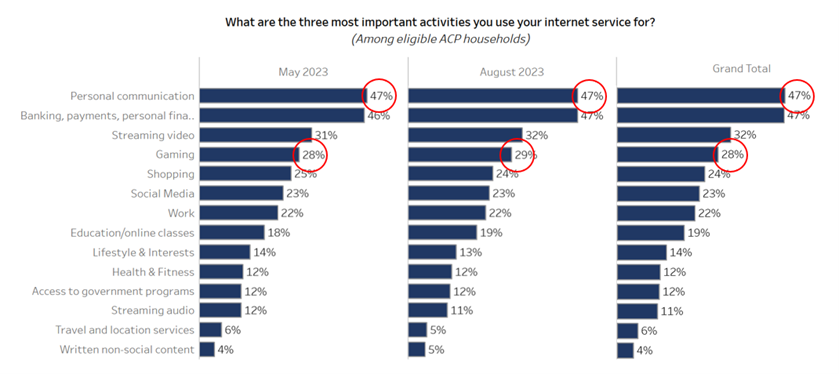
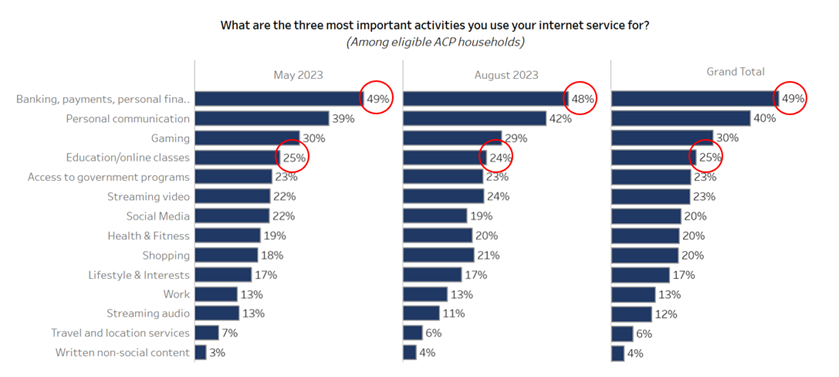
In Figure 3, we are looking at the activities that ACP households in general and in Figure 5, ACP households that would lose internet access but for ACP, are engaged in.
We show the data for both survey waves to highlight the consistency of the results over time. The two most used applications for their ACP connections are personal communications and banking, payments, investments and personal finance. In other words, ACP subscribers are using their subsidy to allow them to connect to the Internet and engage in the digital economy, whether it’s paying their bills or buying school supplies for their children. Almost a quarter of ACP recipients use their internet connection for purchases, more than one in five (22%) need their internet connection for work, one in five (19%) for online education, and one in 8 (12%) to access government programs.
Figure 3: Behavior pattern of ACP-eligible Americans regardless of ACP participation
Figure 5 shows the impact of losing ACP. It also shows what applications really matter to people who critically depend on ACP for their broadband connection. Banking and financial transactions, education and access to government programs are priorities for these citizens.
Almost half of ACP recipients would lose internet access altogether if ACP were to go away.
This potential outcome presents a Catch-22: the government has pushed many programs online as a cheaper way to deliver services to low-income Americans. Due to ACP, 22% of the targeted beneficiaries of this policy are receiving those services. If ACP goes unfunded, 22% of the the very Americans Congress says it wants to help out of poverty will be stranded.
Seems like ACP is working but perhaps will be so effective, Congress will kill it, but at their peril.
Sometimes old album titles say it best. Today, AT&T marks the start of the expansion of AT&T’s fixed wireless home internet service called AT&T Internet Air. After offering it in its DSL footprint for the last few months, it is now becoming the third nationwide mobile network operator (MNO) to launch a 5G (where available) internet offer.
AT&T is starting in Los Angeles, Philadelphia, Cincinnati, Harrisburg/Lancaster/Lebanon, PA; Pittsburgh, Chicago, Detroit, Flint-Saginaw-Bay City, MI; Las Vegas, Minneapolis-St. Paul, Phoenix (Prescott), AZ; Portland, OR; Salt Lake City, Seattle-Tacoma, Tampa-St. Petersburg (Sarasota), and Hartford-New-Haven, CT. Notably, Los Angeles is Charter’s largest market and a T-Mobile FWA stronghold, Philadelphia is Comcast’s home market, and Seattle is T-Mobile’s home market. If the carriers are looking for attention, these launch markets are certainly going to attract it. Another very interesting market is Phoenix. Gigapower, a joint venture in which AT&T is involved, is building out fiber in Mesa, AZ. While the two are about 100 miles apart, it will be interesting to see how the two technologies will be adopted in the same market.
With nationwide combined 3.45 GHz and C-Band of 120 MHz on average, and with at least 100 MHz in every market, AT&T can put significant bandwidth behind its FWA offer. The theoretical maximum speed achievable with 100 MHz of spectrum is 2.3 Gbit/s. It is important to keep in mind that what is possible in theory is also possible in reality – and that wireless is a shared resource. Will someone sitting next to a tower be the only person on the cell to get 2.3 Gbit/s? Possibly, but even though quite a few wireless speed testers have reported wireless download speeds of 600 to 800 Mbit/s, it is far from certain on a loaded network. Even half the theoretical speed is still more than respectable. Quieter than its competitors, AT&T has rolled out its mid-band network to more than 175 million pops.
AT&T Mid-Band Spectrum Depth of 3.45 GHz and C-Band
Qualcomm is the quintessential American tech company steeped it engineering excellence. Its genesis was the development of a new wireless standard called CDMA. Initially, it was written off as a failure, often ridiculed by its larger global rivals. It created a niche by getting American mobile providers like Verizon, Sprint and South Korean mobile providers like SK Telecom to adopt its technology. Qualcomm found redemption as the mobile providers often had the best networks in their respective countries, better than the globally dominant GSM standard. It found salvation when a variant of its CDMA standard was adopted as the global 3G standard called Wideband CDMA or to those who still harbored old animosities UMTS. It then became the global leader in 4G by holding most of the patents on the OFDM technology that underlies LTE.
By the late 2010s, Qualcomm that engineered itself through superior technology to unprecedented success was faced with five major problems that no engineering solution could easily fix.
Despite being the premier mobile technology company growth had slowed down as upstarts like MediaTek was gaining market share, first in the entry level, highly price sensitive segment but was closing the performance gap between the solutions of the two companies. Qualcomm still dominated the flagship segment, but MediaTek dominated the entry level.
Broadcom launched a hostile takeover to buy Qualcomm as investors were frustrated with low stock returns. Broadcom was only thwarted through the intervention of the US government.
Qualcomm’s largest customer Apple with the support of the Department of Justice was using the courts as a price negotiation tool.
The Android smartphone market was increasingly concentrating with Samsung and Chinese providers driving other manufacturers out of the market. Former mobile phone giants like LG and HTC exited the market.
The relationship between the United States and China was becoming increasingly hostile. The US government instituted unprecedented sanctions against Huawei and imposed trade restrictions on semi-conductors.
Qualcomm CEOs are engineers at heart, Irwin Jacobs, the legendary founder; his son Paul, and Steve Mollenkopf. While Cristiano Amon is also an engineer has cut his chops as President of Qualcomm by spearheading the diversification of Qualcomm into more business segments and therefore to enable Qualcomm to participate in more growth sectors.
Under Cristiano Amon the company is continuing to focus on mobile and IoT but is expanding into computing and automotive. By doing so Qualcomm has expanded its addressable market from $15 billion to over $700 billion. The impact has been almost immediate. Qualcomm has now a $30 billion design win pipeline until 2030.
How did he do this? Qualcomm purchased several companies to strengthen its position in the respective sectors. It bought Cellwize and Augmented Pixels to improve its positioning in mobile, Clair AIR to strengthen its capabilities in the AR/VR area. But most importantly, Qualcomm bought Nuvia, a company focusing on ARM-based computing solutions and Arriver, a company with particular strength in advanced driver assistance software and hardware. And just a last week, Qualcomm acquired Autotalks, a fabless chipmaker making silicon and systems-on-chip for automotive safety.
The Nuvia acquisition is laying the ground work to strengthen Qualcomm’s core base of computing, just like the acquisition of P.A. Semi in 2008 did for Apple. P.A. Semi focused on low power processors and brought to Apple the expertise to build first the A-series chips that have powered iPhones since 2010 and now the M-series chips that were launched in 2020. If Apple’s success is any indication then ARM-based processors are going to be the processors of the foreseeable future. The power envelope of compute power, electric power consumption and heat generation are not on the side of x86 processors, but ARM-based processors. It could also help Qualcomm to close the mobile processor speed gap between itself and Apple A-series processors and increase the gap between Qualcomm and MediaTek processors. Faster, more powerful processors will also help in Qualcomm’s greatest growth market: automobiles.
Where Qualcomm is most likely to replicate the strong position it has in mobility is in electric vehicles. Qualcomm has created a comprehensive solution for automobile manufacturers called Snapdragon Digital Chassis. It combines safety and connectivity with entertainment, customization and upgradability. It takes the basic lessons of a smartphone and takes it to the automobile. The parallels and similarities as the car becomes essentially a mobile server are striking. Qualcomm is coming into this market at the right time when other’s have laid a foundation for the demand, but Qualcomm has the more comprehensive and elegant solution. Qualcomm has also the opportunity to provide a solution that rivals that of Apple. Apple’s Carplay service is viewed by many car manufacturers as a bear-hug take-over of a large part of the user interface between the drivers and passengers of the car most of the navigation and entertainment interface. Automobile manufacturers are especially sensitive due to the long-rumored Apple project to build their own electric car and Google’s Waymo autonomous car company. The car manufacturers know Apple and Google do not come in peace and do mean harm to them. Car manufacturers have to own the user interface between the vehicle and the customer, but know their solution has to be on-par if not better than that of Apple and Google. Working with Qualcomm gives them a chance to do that and so much more. In addition, while there exists significant brand loyalty for traditional car buyers with more than 50% of owners of one car brand to own a car from the same car brand, this loyalty does not exist when it comes to the switch to an electric vehicle. This levels the playing field and is an incredible threat to incumbents and opportunity for new market entrants. Tesla is the embodiment of this new generation of automobile manufacturers. While Tesla had to pioneer a lot of the systems themselves, the next generation electric vehicles can rely on integrated solutions from a company like Qualcomm. Car manufacturers like General Motors, Cadillac, Stellantis, and Mercedes-Benz as well as BMW, Hyundai, Nio and Volvo are in varying degrees of partnership with Qualcomm. Such an array of car manufacturers and a solution that offers breadth and depth gives Qualcomm critical mass to win the automotive market. Who would have thought three years ago?
Inflation has become a top-of-mind concern for everyone, leaving consumers, businesses, and the investment community on the edge of their seats. How are consumers reacting to the largest increase in prices of the last four decades? Which businesses get impacted and does Wall Street come to the correct conclusions?
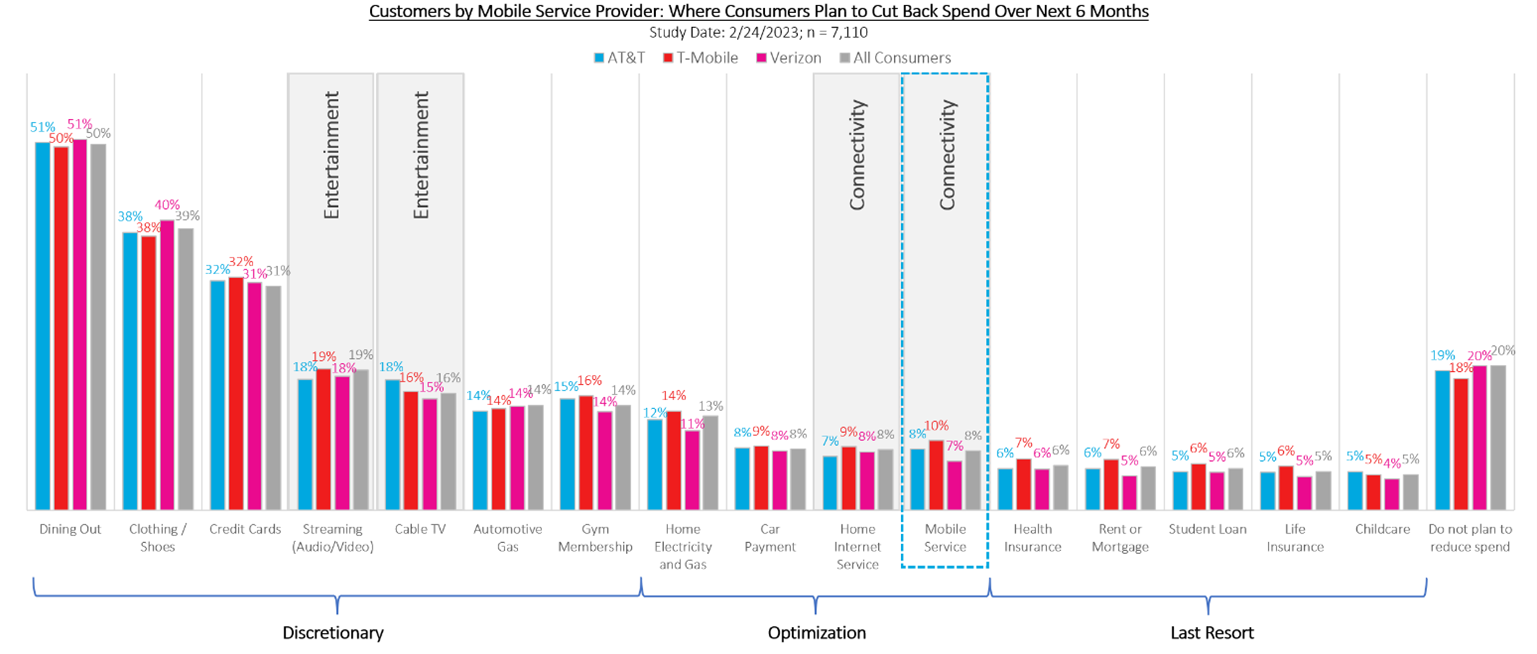
At the end of February 2023, we ran a module as part of our weekly Mobile Consumer and Home Internet Pulse surveys with 7,110 respondents telling us in which spending areas they would cut back. In a nutshell, people would rather cut back on electricity, heating or car payments than home internet or mobile service.
By far the number one category where consumers are cutting back is dining out. A whopping 50% of consumers are expected to increase their at-home dining and reduce their spending at restaurants. It’s the easiest way to cut back as consumers, now trained in the art of cooking due to the Pandemic, can easily replace an expensive meal with home cooking. At the same time McDonalds is at an all-time high stock price based on cutting their regional sales structure. You can’t cut yourself to growth. Verizon is a cautionary tale of what happens when you cut your regional sales structure and take away the ability to build a deep and wide management bench by having a large number of P&Ls where people can learn the business. Dining out is followed by clothes shopping where 39% of respondents are curbing their spending. It’s not that people will walk around in rags, but the pace of clothing purchases is going down, especially hurting the fast fashion segment. General consumer spending through credit cards was mentioned by almost one-third of consumers as a means to address increasing prices.
Scaling back on streaming services is the fourth most popular expenditure reduction segment among consumers, with 19% planning to reduce their spending on streaming video and audio services. We run a monthly Streaming Content Module that receives over 90,000 respondents annually, in which we explore the streaming habits of Americans. According to our April 2023 Streaming Content Module based on 7,642 respondents, on average, consumers have access to 3.6 subscriptions – 2.5 subscriptions for which they pay out of pocket, 0.6 subscriptions received through a mobile service or home internet bundle and 0.5 subscriptions they get access to through password sharing. In addition, 16% of consumers are planning to cut their cable TV bundle ensuring that cord cutting continues and making the looming death of linear television ever more likely. We are not sure if the TV writer’s guild calling for a strike realizes that fewer and fewer people will realize that no new content is being produced. Some people might even use the lack of new content as a sign that it is time to cancel it all together.
Fourteen percent of respondents were planning to cut back on gas for their cars and on gym membership. Although many people rely on their cars to drive to work, there is a car-use component that is optional and can be reduced as a cost-saving measure.
Only eight percent of respondents are planning to cut back on their home internet and mobile service expenditures due to inflationary pressure, barely more than the number of people who will cut back on health insurance and housing. The difference between subscribers at MNOs is nominal with only 7% of AT&T customers at the low end and 9% of Verizon customers at the high end looking to reduce their spending on home internet services. The numbers on average are even lower for mobile service, with only 7% of T-Mobile customers and 8% of AT&T customers looking to reduce their mobile costs.
For the eight percent looking to reduce their mobile service expenses, their preferred route is to switch to a new provider that offers a similar plan to what they’re currently receiving but at a lower price point. Their secondary choice is to downgrade to a more affordable plan with their current provider. Savings via device discounts also play a significant role among this subset, with more than half willing to switch to a new provider to obtain the best deal on a new device to find further cost savings.
As a last cost-cutting resort, 6% of consumers would scale down their health insurance, rent or mortgage or student loan payments in response to inflationary pressure. Life insurance and childcare costs have the greatest inflationary-resistance, with only 5% of people looking to cut back costs within each category.
Lastly, despite inflation concerns throughout the economy, roughly 20% of respondents have indicated they do not plan to decrease their financial spending. With percentages this low, telecom has essentially become recession proof.
AST Spacemobile (AST) and AT&T just completed the first call between a regular smartphones using just the electronics and antennas that are common for decades in mobile devices using a satellite as the cell site. AST has talked about its technology for years, laid out its plans to investors and received only the scantest of interests. Unlike Apple’s technology that uses special chips in Apple’s new iPhone 14 smartphones to send text messages through a satellite connection the AST solution works with any phone. While T-Mobile and SpaceX’s announcement last year of bringing satellite connectivity to any phone was a vision statement, AT&T and AST’s call was the proof of concept. We know now that it works not only on paper but also in the field.
The first part of the feasibility study was the reverse of the actual proof of concept. AST put a cell phone on a satellite and built a base station on the ground. With this ingenious way, AST could exactly dimension the size of the antennas, the strength of the signal amplifiers, processing power requirements and the power consumption that the satellite would have in order to work in space and make the connections to smartphones from there. It is much easier to tinker with and faster to interate the hardware when it is on the ground than hundreds of miles in space.
The hard work begins now. Until now, the FCC has been a lot less accommodating to AST than the other innovative satellite providers. The FCC needs to allow AST to use regular terrestrial frequencies that have been exclusive to mobile service also for satellite service. Historically, the FCC has been very accommodating to satellite providers like Lightsquared to use their satellite frequencies for terrestrial communications, but this resulted in basically no usage for several reasons. The satellite to mobile spectrum conversion players forgot for the longest time to include their spectrum in mobile standards. If you are not in the standard, nobody will build devices that have your band in them. The next hurdle is to get devices that include a band that nobody is yet using for mobile communications as it costs money to include a new frequency band. This problem does not exist with the AST solution as all devices that have a cellular connection can connect to the satellite. What is needed from the FCC to move from a proof of concept to mass adopted reality is the permission to use regular cellular frequencies with satellites and the permission for AST to launch enough satellites. Then AST has to raise more money to build and launch the satellites.
Where AST and AT&T differentiate themselves is the data throughput they promise: Speeds of up to 50 Mbit/s and the ability for streaming video. While this is certainly handy when fighting wild fires in a remote part of a state or recovering victims from a plane crash in a remote part of the state, it becomes down right indispensable for people documenting on a live stream when they have climbed a mountain and then call first responders because they are too tired to climb back down.
While initially mentioned that the smartphone to satellite connections would be used just for FirstNet, it is almost inconceivable to stay restricted to first responders. The ability to eliminate outdoor dead spots and to provide full geographic coverage is huge. Based on our Recon Analytics Mobile Pulse data the ability to “make a calls anywhere” is the third most important purchase decision factor based on 161,976 respondents. From May 2022 to end of March 2023, 10.9% of respondents ranked it their most important decision factor choosing a mobile provider, 10.5% chose it number 2 and 10.9% as their third most important factor.
AT&T has a very promising solution on its hand. Bring ubiquitous outdoor coverage to first responders everywhere in the United States, something that has not been done before. But not only with text messaging with a long time delay like Apple does now and got a lot of accolades for, but with streaming video. This is a real game changer for first responders. It is also a game changer for consumers in areas with low signal strength or coverage holes outdoors. With AST’s technology they are gone. Consumers will still have to content with issues when being indoors as they do not have direct line of sight to the satellite and the buildings they are in are potentially interfering with the signal.
Now that we know this is possible, how quickly will regulators pull out all the stop signs that are preventing the real world application for it? How quickly can these satellite get into space and who will be the first to deliver ubiquitous outdoor coverage to first responders and consumers with what real world speeds?
The converged communications industry is undergoing significant change. It has been well reported that fixed wireless access has captured most of the broadband industry’s growth, followed by fiber, with cable not adding customers, while DSL gets rapidly replaced. Recon Analytics’ research also shows that a substantial number of fixed wireless access subscribers did not have dedicated home internet access before; hence, it is not a zero-sum game.
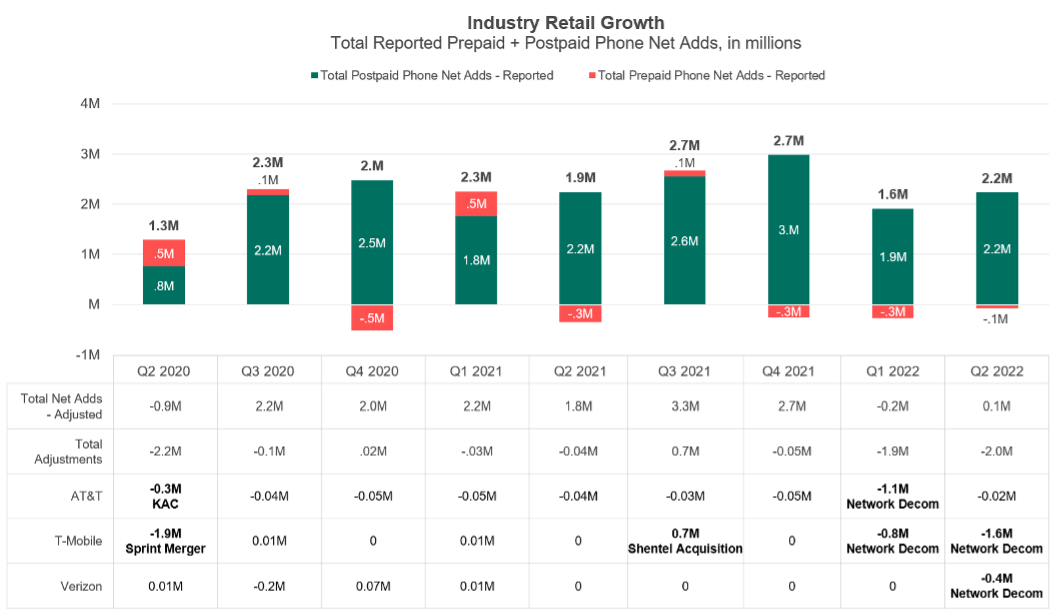
Adjustments are common in the wireless industry. An operator buys another operator, customers switch from prepaid to postpaid or vice-versa, new rules on what it takes to continue to be a customer get implemented – essentially, a cleanup of the subscriber base. These changes are typically in the low hundreds of thousands, important but not earthshattering. With the shutdown of 3G networks, we are entering another period where these changes are significant. No matter what we call these disconnections and whether they are included in the churn statistics or not, they still represent a reduction of subscribers in the industry. These adjustments to what is and is not a subscriber and where that gets counted provide valuable insights into the health of the wireless industry.
In the chart below, we are looking at the overall phone universe and see that the two segments have more overlap than what many people want to acknowledge. The orthodox, adjustment-free view shows us solid growth over the last two years and creates the perception that industry growth exceeds population growth followed by exasperated questions of “Where are they all coming from?”
When we look at the impact of the adjustments, a different view emerges. For example, in Q2 2020 there were two significant adjustments: a clean-up of the Keep America Connected disconnects by AT&T and, more importantly, a large adjustment by T-Mobile as part of the Sprint merger. Sprint had created a bit of a mess ahead of the merger and counted people as customers who might really live up to that moniker. It counted some connected devices as phones, didn’t disconnect people even though they were significantly in arrears, and counted prepaid Boost customers who financed a device as postpaid. As a result, 1.9 million subscribers disappeared from the books. The total subscriber numbers actually show a reduction of 900k subscribers despite an “official” 1.3 million subscriber gain. We saw a similar trend due to the 3G network shutdown at AT&T and T-Mobile. What looked like strong subscriber gain quarters were actually flat quarters due to the disconnects of 1.9 million and 2 million 3G subscribers. We will see further adjustments when Verizon shuts down its 3G later in the year.
The interesting implication of the adjustments and their use to net out the official numbers is that the three mobile network operators did not add subscribers in the first half of 2022. The entire growth of the wireless sector comes from the cable industry in the form of Charter and Comcast.
In 2011, Verizon was in a pickle as it could project when it would run out of spectrum and needed to maintain its strategy of being the network leader in the United States. The deal was straightforward: get spectrum from the cable companies in exchange for an MVNO agreement and hope that the cable companies will be as successful as they were in their previous attempts with Sprint, which is not at all. This premise held up until 2017, when Comcast started offering service, followed shortly thereafter by Charter. The two cable operators went to market by positing that they could offer the best network experience for combined mobile and home internet for roughly the price of a premium wireless subscription. Customers liked the premise, and cable providers have consistently been between a quarter and a third of industry postpaid net adds, taking a healthy bite of the wireless industry growth. Examining Comcast’s and Charter’s total market flow share performance, which includes prepaid and postpaid, it becomes clear that Verizon is coming out ahead. For example, during July 2022, based on our Recon Analytics Data services, only 27% Comcast’s and Charter’s customers have come from Verizon. Tracking Verizon’s revenue components for many years, we estimate that Verizon gets an average of $13.13 from its MVNOs per customer, which include providers like US Mobile, Red Pocket Mobile, Lively, Affinity Cellular to mention only a few. A comparison between Verizon’s $18.35 EBITDA contribution and its $13.13 MVNO revenue per customer, which is almost pure profit, shows that Verizon is coming out significantly ahead. For every Verizon customer that moves to Comcast and Charter, three join the Verizon network from other providers, both postpaid and prepaid. The 661,000 Comcast and Charter net adds in Q2 2022 contributed an incremental $41.4 million in overall annualized revenue. If Verizon would disclose more numbers and be more transparent, it could easily dispel the erroneous notion that its wholesale business is a negative for the overall business when it is clearly not. While Verizon’s branded subscriber base which it reports quarterly is under pressure, its unreported network share is performing substantially better. More people are using the Verizon network today than ever before, and its wholesale partners are an underappreciated part of the story.
The headwinds that Verizon is facing are coming from its two main rivals T-Mobile and AT&T. T-Mobile continues to perform well with a “have your cake and eat it too” positioning by marketing a superior network at a lower price value proposition. Considering that it trails AT&T in postpaid phone net adds, we can only conclude that the message could be resonating better. AT&T is leading the industry with a straight-forward consistent promotion strategy for new and existing customers. The lack of fading-in and fading-out promotions that the two other operators are offering is paying off for AT&T. The new AT&T leadership has transformed the company from being the source of everyone else’s growth to being the fastest growing postpaid phone provider in the United States.
To take the fight back to the cable providers and utilize fallow spectrum, T-Mobile and Verizon have launched fixed wireless internet access to compete against traditional home internet providers. With 2.1 million fixed wireless customers between them, they have captured the buzz of the telecom market. With easy to set up wireless routers, straight forward pricing, and speeds around 100 to 300 Mbps, FWA providers are on top of Recon Analytics’ net promoter score list in every one of the 14 metrics we are tracking. What we see in our FWA flow share analysis is that FWA is currently a threat to every other technology, as it captures many disgruntled home internet subscribers who are looking for a different, attractively priced option. The questions are: How long can this last? and From where geographically do these customers come?
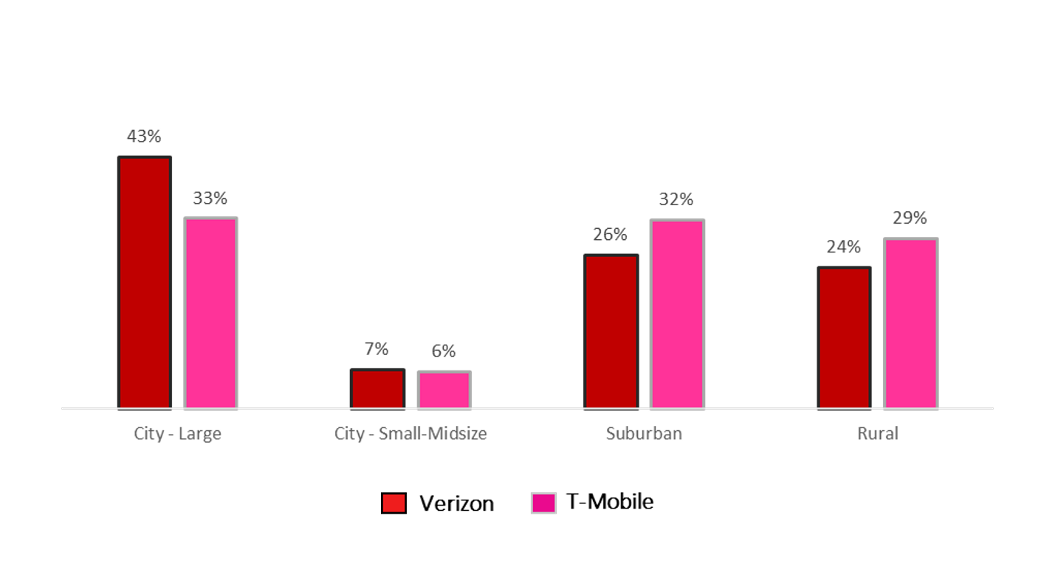
The main constraining factor is the availability of fallow spectrum and the usage profile of home internet users. It is not uncommon that home internet users use 500 to 800 GB per month compared to approximately 15 GB for a mobile user, while paying around less than $50 per month for their subscription. In urban and suburban areas, due to the much higher population density and approximately the same amount of spectrum, the maximum amount of fixed wireless customers before they impact wireless user experience is much more limited than in rural areas. In rural markets, fixed wireless access performance is much more driven by cell site density rather than the availability of spectrum. At the same time, rural America has the problem of being by definition rural, which means not a lot of people live there.
Fixed Wireless Subscriber by Urbanicity
Source: Recon Analytics Data, April to August 2022
Both Verizon and T-Mobile have been a lot more successful in urban and suburban markets than in rural markets, which is both an opportunity and limiting factor at the same time. The much-touted transformation of rural connectivity is still a lot more talk than reality. T-Mobile’s new Home Internet Lite plan demonstrates the strain on the network from unlimited plans. It introduces usage-capped price plans in the name of being customer friendly and allowing to be available everywhere. The positioning will be that not everyone needs unlimited data and with a fixed amount of data rather than unlimited data these customers and it allows T-Mobile to charge a higher price per GB in constraint areas. At the same time, it makes T-Mobile closer to the cable companies it derided in the past that have usage caps. It also proves AT&T’s argument that fixed wireless is not a fiber replacement in many places.
The competitive intensity is greater than ever before and the battle ground is larger than before. The battle for market share in this new converged communications provider world has just begun, with the tides of the battle swinging back and forth.
There is broad agreement in the United States that we need to increase broadband coverage and make broadband more affordable for low income Americans. To arrive to that conclusion, it is unnecessary and actually is counter-productive to use less than reliable data to make this point.
Thomas Philippon recently authored a paper entitled, “How Expensive are U.S. Broadband and Wireless Services.” In it he concludes the American consumers pay more for broadband and wireless services than consumers in other industrialized nations. Unfortunately, these conclusions appear to be based on data that are dated, incorrect, omitted or misinterpreted. The findings are actually a disservice to the goal of closing the digital divide that exists both in coverage and affordability.
Fixed broadband prices
To compare U.S. with European prices, the paper uses data collected by cable.co.uk, an advertising website in the UK that tries to convince UK customers to buy UK broadband services rather than relying on unbiased sources. It is not clear what expertise this company has at determining U.S. broadband prices (or interest in showing them to be economical) and conducting proper apples-to-apples international price comparisons. In particular, there are no data contained within cable.co.uk’s currently provided spreadsheet that allow a reviewer to ascertain that similar quality plans were sampled in each country. Indeed, this seems in doubt as in its most recent study, cable.co.uk reports that the plans it sampled from the U.S. had an average price of $59.99, with a minimum price of $29.99 and a maximum of $299.95. The magnitude of this variation suggests that the sampled plans varied widely in quality (i.e., offered speeds), and it is especially curious that cable.Co.UK’s computed average speed should be $59.99. For an average from 26 observations to arrive at this archetypical retail price number seems improbable.
Indeed, it is highly likely that the quality of broadband services that cable.co.uk compares are quite different. In its current report on prices, cable.co.uk suggests that readers should also examine cable.co.uk’s study of worldwide broadband speeds. It is more than a little revealing that in the provided spreadsheet, cable.co.uk finds U.S. average speeds to be nearly twice as fast as UK speeds (71.20 Mbps vs. 37.82 Mbps). Furthermore, the only listed European countries or dependencies that exceed the U.S. in speed are:
Liechtenstein (population of 38,747)
Jersey (A British crown dependency of population of 107,800)
Andorra (77,142 people)
Gibraltar (a British Overseas Territory with 33,701 people),
Luxembourg (590,667 people)
Iceland (population 356,991),
Switzerland (8.5 million inhabitants),
Monaco (population of 38,964),
Hungary, (9.7 million people)
Netherlands (population of 17.2 million)
Malta, (460,297 inhabitants)
Denmark, (5.7 million people)
Aland Islands, (Swedish-speaking semi-autonomous region of Finland of 27,929 people)
Sweden, (10 million populations)
Slovakia (5.4 million people).
As you can easily see someone tried really hard to increase the count of geographies that have faster speeds than the US by including parts of countries, dependencies, and dutchies into the mix. Nearly all of these are small countries or semi-autonomous regions with populations less than a typical U.S. city or state. It is notable that no European country with a population larger than that of the Netherlands makes the list of countries with faster average services than the U.S. Given that U.S. broadband speeds exceed significantly those in Europe, and the U.S. generally has much lower population densities, higher wages, and thus, significantly higher per-home network deployment costs, it is unremarkable that U.S. prices might exceed European prices as it costs substantially more to deploy these networks.
The scatterplot of cable.co.uk’s collected prices appears to be consistent with 2017 prices reported by the OECD. But four-year-old prices don’t seem terribly apposite to debates about the current price and quality performance of broadband in the U.S. As demonstrated by USTelecom, broadband prices in the U.S. have been dropping significantly over the past six years even as their service quality has increased dramatically.
After noting that “some of the data measures presented above [in the paper about pricing] are a few years old,” the paper turns his concern to USTelecom’s recent report detailing that deployment of advanced networks is further along in the U.S., and subscription to these high speed U.S. networks exceeds European subscription to similar networks. The paper retort to these findings, that derive directly from data and official statistics collected for the U.S. by the FCC, and for Europe by the European Commission (EC)is to reference a 247-slide presentation published on internet that claims that in 2019, 87% percent of people in the U.S. use the internet, but in Western Europe and Northern Europe, the figures are 92% and 95%, respectively.[1]
There are at least two problems with this response. First, even if these data were valid, they focus on geographic subsections.[2] Why not compare these most-developed areas of Europe against U.S. figures strictly for the Northeast or the Pacific Coast? But aside from needing to slice and dice European data in order to adduce a favorable comparison, the biggest problem is that even if Europeans are using the internet, EC DESI data on connectivity show that many are not using it via a fixed broadband connection. This is because the EC finds that only 78% of European households subscribed to fixed broadband in 2019. So it is more than likely that the slide presentation the paper cites to on usage includes people who use the internet via mobile wireless broadband connections, satellite connections and dial-up internet connections, in addition to fixed line broadband connections.[3] In any event, one year earlier, in 2018, 84% of U.S. households had fixed broadband subscriptions – and the U.S. advantage over Europe widens as only 30+ Mbps broadband speeds and 100+ Mbps speeds are considered.
Fixed broadband speeds
The next topic specifically addressed by the paper is fixed broadband connection speeds. For this, the paper refers to slide 52 in the 247-slide presentation. This slide, he says, “shows the US is close to the EU median, and slightly below France, in terms of speed.” The first statement appears to be false, the second is immaterial. Let’s unpack.
The European countries listed (in terms of speed) on the slide are: Romania, Switzerland, France, Sweden, Spain, Denmark, Netherlands, Portugal, Poland, Belgium, Germany, Ireland, U.K., Italy and Austria.[4] The U.S.A. slots between Sweden and Spain. Now even assuming that the paper meant these comparisons to be against European countries rather than EU countries as he states in the paper, the median European country is Portugal – which lies four positions below the U.S. If only EU countries are considered, the median position drops another half slot to be between Portugal and Poland.[5] While the paper may consider the U.S.’ positioning in these lists to be “close” to the median, he could also have noted that the only major EU country ahead of the U.S. was France, with a miniscule (and likely statistically meaningless) speed advantage of 500 Kbps (131.3 Mbps for France versus 130.8 Mbps for the U.S.).
Thus, rather than showing the U.S. to be a laggard in fixed broadband speeds, the paper’s analysis appears to show it significantly in the lead.
Lightning round
ARPU: The paper then claims to look at broadband ARPU for Altice and Comcast in the U.S., and pronounces it significantly above that in France. The validity of his data is highly questionable, though. For example, Philippon claims (without citation) that Altice’s ARPU is $90/month.[6] Reference to Altice’s SEC 10-K report (at p. 3) indicates that its residential broadband ARPU is $70.52, a figure substantially less than Philippon’s unreferenced figure of $90. Further, Altice is a cable company with a very substantial FTTH footprint. It reports that the average speed purchased by its customers exceeds 300 Mbps – over twice the average speed experienced by French customers.
Prices of comparable contracts: A chart is displayed suggesting that prices for triple-play services in the U.S. exceed significantly those in European countries. This statistic is likely meaningless because it is well known that the cost of television services in U.S. triple-plays is vastly above similar charges in Europe. This is due to many factors, including: U.S. bundles typically include many more channels, especially HD channels, than European bundles; fees paid by U.S. triple-play operators to acquire local broadcast channels, sports channels and other cable television networks exceed greatly those paid in Europe. Indeed, in many European countries, local broadcast channels are paid for via television license fees that are paid separately by customers and are not included in their triple-play bills; U.S. bundles also commonly allow the subscriber to watch several simultaneous programs on multiple television sets – in contrast to European bundles that may be restricted to a single TV set stream.
Labor cost adjustment: Here the paper argues that because “wages are about 20% higher in America than in the main EU countries” and “since compensation of employees accounts for half of the value added in private industries, one might expect [U.S.] price to be [only] 10% higher” than in Europe. This analysis is not compelling. Even if these national-level statistics are specifically applicable to the U.S. broadband industry, there is no need for wage differences to account for the entire amount of any putative elevation in U.S. broadband prices over European ones. That is, they are only a contributor. The fact that the U.S. is much less densely populated than Europe and U.S. networks provide much higher speeds and carry much more data per household than European ones are also likely contributors.
Profits and investment: This section contains a mishmash of data that purport to suggest that U.S. capital investment is not impressive. But, the data presented for “Comcast, AT&T, and other Telecom companies,” not an appropriate basis for analysis because many of these companies are diversified into businesses other than broadband. Comcast and AT&T offer television services and own movie studios. Comcast owns theme parks and AT&T owns legacy copper telephone networks and DBS satellite systems. Consolidated capex figures from these companies are inadequate to discern broadband-specific investments.
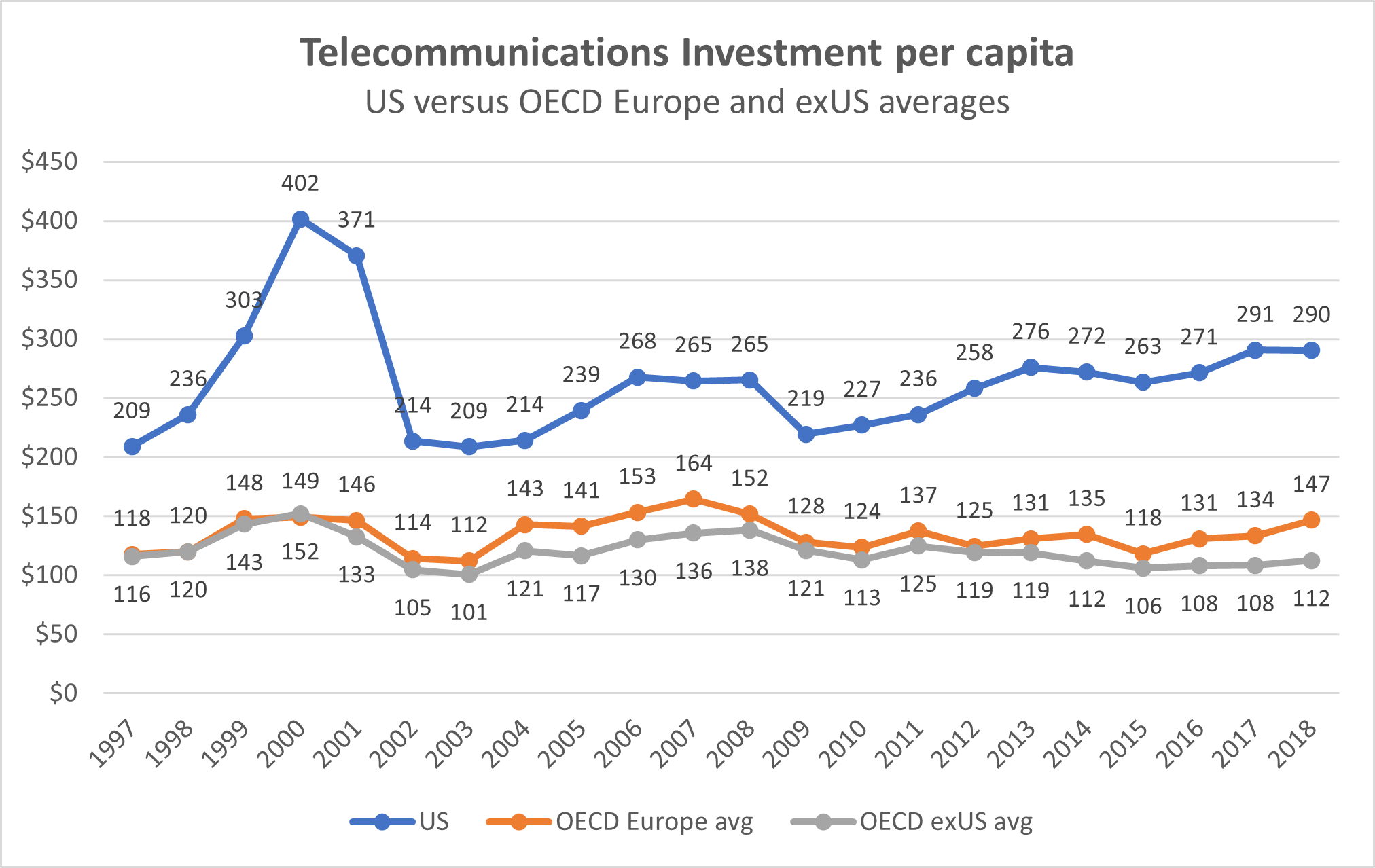
But in any event, discussion of the above is probably intended to divert attention away from the best available investment comparator for telecommunications, the data collected by the OECD from national statistical agencies or regulators.[7]
All that the paper appears to say in response to the investment history presented in above chart is to note that since 2015, “investment by the main Telecom operators in Europe has grown rather quickly.” So it has; but so has investment grown in the U.S. – and U.S. per capita investment levels remain at nearly twice those in Europe.
Coda
It is odd that the paper should resort to such a strange mix of data that are old, wrong, or misinterpreted to try to support his claim that U.S. broadband is too expensive, and that this can only be the result of a lack of competition. Only by ignoring the fact that broadband networks are more widely deployed in the U.S. than in Europe, offer higher speeds, carry more data, and are more heavily subscribed to can the paper conclude that the European model is to be preferred. But while that may be the paper’s conclusion, it is not that of the European Commission which has studied these issues directly. In Table 7 of Annex 3 in its International Digital Economy and Society Index specifically for connectivity finds the U.S. to score higher than all but the top EU country (Denmark) and to tie in score with the next two highest EU countries (Finland and Malta).[8] All other EU countries score lower.
So the real truth is that U.S. fixed broadband leads, and does not lag Europe’s performance. This does not take away that there are Americans that cannot get broadband internet or cannot afford broadband. We need to help these people and do not need to trump up the differences to come to that conclusion.
[1] Curiously, the paper ascribes his data source’s stated figure of 87% usage for North America to be the usage figure specific to the U.S. This, of course, neglects the fact that roughly 10% of North America’s inhabitants are Canadians.
[2] The sources cited for this agglomeration of statistics (slide 34 of 247) are not traceable. They include: ITU, Global Web Index, GSMA Intelligence, Eurostat, Social Media Platforms’ Self-Service Advertising Tools, Local Government Bodies and Regulatory Authorities, APJ۩, and United Nations. Indeed, this same boilerplate list of sources appears on several other slides in the presentation.
[4] Turkey (which is below Austria in speed) is possibly another European country on the slide, but out of conservatism, we will not include it in our analysis.
[5] The EU countries contained in the slide’s list are: Romania, France, Sweden, Spain, Denmark, Netherlands, Portugal, Poland, Belgium, Germany, Ireland, U.K., Italy and Austria. Switzerland in not an EU country. Note that the U.K. was still a member of the EU when these data were collected.
[6] We assume this is intended to be residential ARPU because the paper compares it against a French statistic for residential broadband prices.
Americans overwhelmingly support that broadband should be available to every American and that the funding base to achieve that should be broadened to every company that makes money through the internet.
More than 78% of respondents agreed that broadband internet should be available to every American showing broad support from large parts of the population. When looking a bit closer at the answers given by respondents who say they have broadband versus the people who said they didn’t have broadband, the support of those respondents who do not have what they consider broadband (26%) for everyone having access to broadband drops to 64%. This indicates that there is not only an availability and affordability gap but also an educational gap. Many people who don’t have broadband internet access either do not want it or do not understand why they should have it. These findings, which are mirrored in other studies, indicate that any broadband infrastructure program should include an educational component to increase the number of broadband subscribers. Otherwise, broadband penetration will never reach its full potential.
As we found in previous surveys on the topic, around 54% of respondents use the internet for work purposes from home. This is equal to the number of employees that are classified as white-collar employees by the U.S. Department of Labor. This number highlights the importance of broadband for the functioning of American businesses and enterprises during the continuing pandemic. It is likely that the added agility and flexibility to work from home will continue to be utilized after the country has emerged from the pandemic restrictions. We also found similar opinions around what Americans consider broadband. The median American considers 50/5 MBits as broadband whereas the most answered response was Gigabit speed with 29% of respondents.
The high percentage of Americans who think broadband should be available to everyone is probably based on the intensive usage and the need of many Americans to use it from home to work. Using the weighted average of the responses, Americans spend around six hours every day on the internet.
How many hours do you spend on the internet with a mobile device or computer?
Use the internet from home for work
Does not use the internet from home for work
Combined Response
Less than an hour
4.8%
18.0%
10.9%
Two to four hours
18.1%
36.0%
26.4%
Four to six hours
15.2%
26.3%
20.4%
Six to eight hours
25.2%
8.8%
17.6%
Eight to twelve hours
25.7%
4.8%
16.0%
More than twelve hours
11.0%
6.0%
8.7%
When looking at those who also use the internet from to work from home, unsurprisingly the usage pattern is significantly heavier as their usage pattern includes both business and leisure activities.
While only 37% of respondents knew that the Lifeline Program provides low-income Americans with basic phone and internet service, they were open to new funding sources to close the digital divide. More than 71% of Americans are in favor that companies with business models that rely solely on the internet to exist and who also generate revenue from those businesses, like Google and Facebook, also contributing to provide access to Americans who currently do not have access to the internet. Such a move would dramatically expand the funding sources for a broadband access plan and include companies that have exerted the most valuable and profits from the internet.
What is really interesting, the survey also found support to extend net neutrality rules to websites and ecommerce companies. We framed questions around the net neutrality principles of no blocking, no throttling speeds, and no paid prioritization by asking Americans if websites like Google, Facebook or Amazon should be allowed to restrict access to legal sites, give preference to their own products and services over others and change the search results based on how much money they receive from others.
More than 72% of Americans are against companies like Facebook or Google restricting access to legal sites for any reason. This is exactly the behavior that Facebook showed when it made it impossible to link from Facebook to news sites in Australia (and for a short time to itself) to avoid having to compensate news sites linked to. In essence, it was a commercial and legislative conflict where Facebook wanted to use its customer base as a bargaining chip in its negotiations. This is the essence of the “No Blocking” rule in net neutrality.
More than 55% of Americans believe companies like Amazon, Google, or Facebook should not be allowed to give preference to their own products and services over that of others, a self-dealing practice that has cost Google more than $10 billion in fines by the European Union. Search engines like Amazon, Google, and Facebook, all of which provide you with what you are looking for, are increasingly the prism through which we see the world. They have incredible power over our perception of what it is we are actually looking for. By pushing competing products into the obscurity of lower-ranked results, they, in essence, throttle the success of other products that are better but do not fit the commercial objective of the search engine provider.
In terms of pay-to-play result manipulation, more than 80% of Americans say they are against search engines altering results based on how much websites and advertisers pay for preferential positioning. It is common that the first view search results for a given term are occupied by responses that are marked by the easily missed word “Ad” in front of the link. This effectively operates as paid prioritization, something the ISPs are not allowed to do under California’s net neutrality law, nor under earlier versions of net neutrality that the Democrats might be considering reinstating.
The results of our survey showcase two key points: Americans are open to reigning in tech giants, who solely rely on the internet to generate revenue, and curbing their ongoing uncompetitive behavior, and having these companies contribute part of said revenues to subsidize access to broadband for low-income Americans. While the Biden Administration focuses on proposing ideas that have been tried and tested, perhaps it should take a step back and listen to consumers, who are those who the administration ought to serve and prioritize.
While we all agree that the United States needs more broadband and net neutrality, most Americans do not support the Biden administration’s plan. The majority of Americans want internet companies to pay their share to build the broadband network that these companies are profiting from. They also want to be protected from the demonstrated behavior of internet-based companies that violate the net neutrality rules that these companies want to impose on other companies but not themselves. Net neutrality rules need to protect consumers and not one set of companies that want to prevent other companies to effectively compete with them. Any net neutrality rules that do not apply to internet service providers and internet companies like search engines, social media companies, and e-commerce providers is just cleverly disguised corporate welfare with the government picking winners and losers.
Between March 16 and March 26, 2021, Recon Analytics conducted a demographically representative survey of 1,000 Americans using the internet and cell phones, asking them about their opinions and attitudes around universal access, funding mechanisms, conduct, and usage.
Do you believe that access to broadband internet should be available to every American?
Yes 78.2% No 21.8%
Did you know that the government requires a small portion of your phone bill to be used to fund phone service for low-income Americans aka lifeline service?
No 62.9% Yes 37.1%
Do you think companies like Google and Facebook that make money through the internet should contribute to the provide access for Americans who do not have the internet?
Yes 71.4% No 28.6%
Should companies like Google or Facebook be allowed to restrict access to legal sites for any reason?
No 72.7% Yes 27.3%
Should companies like Amazon, Google, or Facebook be allowed to give preference to their own products and services?
No 55.8% Yes 44.2%
Should search engines be allowed to alter search results based on how much money they receive from websites or advertisers?
No 80.6% Yes 19.4%
How would you define broadband internet access?
3/1 9.3% 10/1 9%
25/3 14.8% 50/5 17.3%
100/10 20.9% Gigabit 28.8%
Do you currently have broadband internet access?
Yes 74.2% No 25.8%
Does your job require internet access at home?
Yes 53.4% No 46.6%
How much time per day do you spend on the internet (via your mobile device or on your computer?)