Sowmyanarayan Sampath is out as CEO of Verizon Consumer Group, effective March 31. Dan Schulman announced the departure this morning in an internal letter layered with corporate gratitude and strategic intent. Alfonso Villanueva, Schulman’s former PayPal colleague who joined Verizon barely ten weeks ago as Chief Transformation Officer, takes the interim role. The word interim is doing a lot of work in that sentence.
I wrote in October that Sampath was “the undisputed heir apparent” and that Schulman’s appointment was a “special mission with a defined timeline” designed to set the stage for Sampath to inherit the company. I was wrong. So was most of Wall Street. When you’re wrong, you say so, explain why, and recalibrate.
The $4 Million Tell
The signs were in the SEC filings. The 8-K/A filed on October 14, nine days after Schulman took the CEO job, disclosed a $4 million one-time retention RSU award for Sampath, vesting December 31, 2027. You don’t pay someone $4 million to stay unless you think they might leave, and you don’t think they might leave unless the succession conversation went badly. That retention award was designed to keep Sampath in place while Schulman assessed the team. It was a bridge, and it led nowhere.
Schulman came in with his own vision and his own people. Villanueva arrived from PayPal on November 20. Within two months, he had absorbed strategy, corporate development, data/analytics/AI, and supply chain under his Transformation Organization. Now he runs the consumer business too. This wasn’t a performance termination. Sampath was most likely told he would not succeed Schulman as Verizon CEO. Once that became clear, his departure was inevitable. An executive of his caliber with multiple offers wasn’t going to stay as a subordinate with no path to the top job.
The Q4 Numbers: Schulman’s Plan, Sampath’s Execution
The Q4 results need proper attribution. Verizon added 551,000 consumer postpaid phone subscribers in Q4, the best quarter since 2019. For the full year, consumer postpaid phone net adds came to positive 137,000 after losses of 356,000 in Q1, 51,000 in Q2, and 7,000 in Q3. Add the Business segment’s 225,000 phone net adds and total retail postpaid phone connections grew by roughly 362,000 in 2025. Verizon broke even on its most important subscriber metric after years of persistent losses.
That Q4 turnaround was Schulman’s strategy. He directed the spend-to-grow posture during his October earnings call. Sampath executed the plan, delivering 2,679,000 consumer postpaid phone gross additions in Q4, up 15% year-over-year. The gross add performance was strong. The churn problem remains: 0.95% in Q4 versus 0.88% a year ago, part of a steady climb from 0.83% in Q1 2024 across every single quarter. That 12-basis-point churn increase on a base of 75 million consumer postpaid phones translates to roughly 90,000 additional lost subscribers per quarter, or about $540 million in annualized revenue walking out the door that wasn’t leaving two years ago. Stopping that escalation is the unresolved challenge.
The financial profile tells the story of what aggressive growth costs. Consumer segment EBITDA for full year 2025 was $43.8 billion on revenue of $106.8 billion, a margin of 41.0% versus 41.8% in 2024. The Q4 consumer EBITDA margin compressed to 36.5% from 37.5% a year ago, and wireless equipment revenue jumped to $8.2 billion from $7.5 billion as Verizon spent heavily on device subsidies to drive those gross adds. The fundamental tension Schulman is navigating: buy growth now, restructure costs to fund it, and find the right permanent leader to sustain both without destroying the margin structure that supports a $11.5 billion annual dividend.
Where the October Analysis Broke Down
The October analysis underestimated Schulman’s intensity. He cut 13,000 jobs within weeks, began franchising 179 retail stores, and brought in his own transformation chief from PayPal. That’s not bridge management. It also underestimated the depth of the board’s frustration. Verizon’s consumer postpaid phone base was essentially flat for three consecutive years. ARPA kept climbing, from $141.31 in Q1 2024 to $147.36 in Q4 2025, but extracting more revenue from a stagnant base is a finite strategy. Most simply, Sampath was told he wouldn’t get the CEO job. Stay and execute someone else’s vision with no upside, or leave and run something. He chose correctly.
The Rescue Team Has an Expiration Date
Schulman and his team are a rescue operation, not a long-term management structure. Schulman is 67. His contract runs through December 2027. Villanueva is from the same professional generation. It’s very likely that they will be gone in two years but the timeline might be slipping due to operational necessities.
The Consumer Group CEO hire isn’t just about filling Sampath’s seat. It’s an audition for the person who will eventually run all of Verizon. Whoever takes this job permanently is being positioned for the corner office. That changes the candidate profile: Verizon isn’t looking for a division head. It’s looking for a future CEO who starts in the consumer role, with the operational depth to run a $107 billion revenue business and the strategic vision to navigate convergence across wireless, fiber, and FWA.
It also changes the competitive dynamics of the U.S. wireless market. A Consumer CEO who is auditioning for the overall CEO job cannot tread water. Treading water gets you passed over. Going backward is unthinkable. The person in that seat will have every incentive to compete aggressively, because their personal career trajectory depends on delivering visible, measurable wins on a compressed timeline. Whoever lands in this role will be the most motivated competitor Verizon has fielded in years.
Why Europe
The permanent replacement will most likely come from outside the United States. The reason is structural: non-compete agreements. Any senior executive at AT&T, T-Mobile, or a major cable operator is almost certainly bound by non-compete clauses. International candidates, particularly from European operators, don’t carry that baggage. European non-competes are weaker by law, and the competitive overlap with Verizon’s U.S. consumer business is zero.
Verizon’s one unambiguous success in the Consumer Group CEO role was Ronan Dunne, recruited from O2 in the UK. He ran O2 for eight years, grew its base from 18 million to 25 million, and served five productive years at Verizon. The one failure, Manon Brouillette from Canada’s Videotron, proves that scale matters, not that international hires are risky. O2 was the right weight class. Videotron was not.
T-Mobile’s succession provides a useful contrast. Srini Gopalan wasn’t an outside hire. He was an inside-the-family transfer from Deutsche Telekom, moved from running Germany to COO at T-Mobile US with the explicit understanding he was the successor. Verizon doesn’t have a European parent to draw from, so it has to recruit externally from that same talent pool. Given the CEO audition dynamic, the candidate needs to be someone who has already won competitive battles at scale. There’s no time for on-the-job learning. The FT reported headhunters are already active. Schulman needs that person in the consumer seat by mid-2026. Identifying and onboarding such a high caliber candidate in such a compressed time is extremely difficult.
The Immediate Math
Near-term operational risk is manageable. Villanueva owns both the transformation portfolio and the consumer P&L, eliminating finger-pointing during restructuring. The new value proposition launches in H1 2026. The longer-term risk is strategic: the $20 billion Frontier acquisition needs consumer-side integration, FWA grew to 5.7 million combined subscribers, Fios internet hit 7.3 million, and total broadband topped 13.6 million. Each growth vector requires a permanent consumer leader with deep telecom operating experience. Villanueva was hired for transformation, not operations.
Verizon’s Consumer Group has turned over its leader four times in seven years. Dunne served five years and built the 5G consumer strategy. Brouillette lasted less than one. Sampath stabilized the business over two years but wasn’t Schulman’s pick. Villanueva is holding the seat with ten weeks of Verizon experience. Every transition resets institutional momentum, disrupts middle management, and gives competitors a window. The revolving door is itself a competitive disadvantage, and it compounds: each new leader inherits not just the business challenges but the organizational scar tissue from the last transition.
Schulman and Villanueva are the rescue team. They’ll stabilize and restructure. But they’re not the long-term answer, even as timelines will be slipping. The next Consumer Group CEO hire is the most consequential personnel decision Verizon will make this year, because that person is almost certainly being positioned to eventually run the whole company, and because an executive auditioning for that job will compete with an intensity Verizon hasn’t shown in years. The non-compete constraints, the Dunne precedent, and the active headhunter outreach all point to Europe. Get it right, and Verizon’s competitors face a newly dangerous opponent backed by the largest network in the country. Get it wrong, and the revolving door spins again.
Numbers and facts are important because they define ultimate limits and capabilities, but numbers and facts don’t make decisions: People make decisions. Nowhere is this truer than in the United States satellite broadband market of late 2025. If we look strictly at the operational scoreboard, the game is over. Starlink has achieved a scale that no competitor can mathematically replicate within the relevant investment horizon. While the data based on now a bit over one million respondents from our Recon Analytics Telecom Pulse Service shows that Starlink holding a massive customer satisfaction lead in rural America over terrestrial as well as satellite legacy providers like HughesNet, dwelling on this gap is an exercise in archaeological irrelevance. HughesNet is effectively liquidating its business model, and ViaSat is pivoting away from it. Both are implicitly acknowledging that the laws of physics have rendered them obsolete. Rural telcos stuck with DSL are holding on for dear life in an era that is rapidly coming to an end. The war against legacy GEO is not just over; the battlefield has been cleared. When the last remnants of rural DSL are being swept away by its skyborne replacement is only a matter of a few years.
The real narrative is not about Starlink beating zombies; it is about the politically engineered survival of its future competitors. The industry is bifurcating into two distinct realities: SpaceX’s operational “rout” and the strategic mandates sustaining Amazon Leo and AST SpaceMobile. These companies matter not because they are currently beating Starlink on metrics—they aren’t—but because the U.S. government and the nation’s largest wireless carriers have decided that a Musk monopoly is strategically unacceptable. Consequently, we are witnessing the creation of a managed market where strategic intervention and corporate hedging sustain competitors that market forces alone would eliminate.
The Carrier Insurgency: The “Never Musk” Wager
While T-Mobile grabbed headlines by pairing with an iconic inventor and a proven technology years ahead of the competition, the most consequential satellite-communications decision of recent years happened quietly in AT&T’s and Verizon’s boardrooms in 2024. Their commitments of capital and spectrum to AST SpaceMobile weren’t bets on the best technology available: they were bets on strategic independence. Even in 2024, it was clear that AST was operationally behind, struggling with a single-digit satellite count while Starlink was deploying thousands. The carriers knew that AST’s service would likely launch later and offer less initial capacity than the vertically integrated juggernaut of SpaceX. They looked at the spreadsheets, saw the performance gap, and decided to stomach it.
This was a calculated strategic sacrifice. AT&T’s decision to lock into a binding agreement with AST through 2030 represents a deliberate strategy to preserve network sovereignty rather than a forced reaction to market constraints. Management feared, and correctly so, that utilizing Starlink would ultimately accelerate Elon Musk’s ambition to become a full-fledged service provider, leading to their own disintermediation as network operators. If they partnered with Starlink, they risked becoming mere resellers in a Musk-controlled ecosystem, effectively funding their own future competitor. Consequently, AT&T was willing to endure the short-term pain of AST’s operational delays to nurture a competitor that preserves their control, calculating that the cost of funding a future Starlink monopoly far exceeds the risks of supporting a slower, inferior alternative.
Verizon followed a similar, albeit more hedged, logic. Their $100 million investment in AST was a coldly calculated but necessary option premium. Verizon leadership recognized that T-Mobile’s exclusivity with SpaceX was temporary, but they also recognized that a world with only one satellite provider gives that provider infinite pricing power. By propping up AST, Verizon keeps a non-SpaceX option alive to discipline the market. They are funding AST not because the tech is currently better—the gap between AST’s 5 satellites and Starlink’s 660 D2C satellites is 100-to-1—but because the contract isn’t with Musk. AST has effectively become a compliance cost for the wireless industry, a tax paid by carriers to ensure they never have to bend the knee to SpaceX.
This “Not-Musk” imperative explains why the investment thesis for AST remains robust despite the fact that its primary differentiator—broadband to the phone—has been neutralized. SpaceX’s confirmed Q1 2026 rollout of full data and voice capabilities has effectively evaporated AST’s unique value proposition. Yet, the carriers cannot waver. The 2025 rupture between Donald Trump and Elon Musk only validated the carriers’ 2024 foresight: relying on a single, politically volatile billionaire for critical infrastructure is a fiduciary hazard. AT&T and Verizon are stuck with AST, and they are happy to be stuck, because the alternative is captivity.
Amazon Leo: The “Too Big to Fail” Regulatory Gamble
If the carriers are engineering AST’s survival through capital, the federal government is engineering Amazon Leo’s survival through regulation. Amazon Leo is not a standard growth story; it is a binary derivative trade on regulatory relief. The scale of Amazon’s deployment deficit is staggering. As of late 2025, Amazon has managed to place only 153 satellites into orbit, leaving a gap of 1,465 satellites against the FCC’s deadline requiring 1,618 by July 2026. This gap is mathematically uncloseable through launch cadence alone. Consequently, Amazon requires a waiver that would typically invite withering scrutiny.
However, Amazon has successfully constructed a regulatory shield by securing BEAD awards for 211,194 locations across 33 states. These awards create a government interest in Amazon’s success. State broadband offices, desperate to show competition, accepted Amazon’s paper promises over SpaceX’s operational reality, effectively making Amazon too big to fail without collapsing a critical federal program. If Amazon cannot illuminate these locations, states face clawbacks and the administration faces a failure of its signature infrastructure project.
The most dominant policy force in the market today is the BEAD program. Amazon Leo’s dominance of the BEAD program was achieved by aggressively buying the market with average bids of just $560 per location, effectively undercutting Starlink by a factor of three. This secures a guaranteed revenue floor estimated at $177 million annually, which exists independent of consumer preference. Regulators are expected to grant the accommodation to avoid entrenching a SpaceX monopoly, using the waiver to provide political cover while maintaining the appearance of regulatory neutrality. The Trump administration increasingly favors Jeff Bezos over the volatile Elon Musk in this context, rendering regulatory accommodation probable. Amazon Leo survives not because it executed, but because the government cannot afford to let it die.
The Political Overlay: 2025 as an Accelerant
While the carriers made their anti-monopoly decisions in 2024, the political volatility of 2025 acted as a powerful accelerant, hardening the “Not-Musk” resolve across the ecosystem. The alliance between Donald Trump and Elon Musk collapsed in June 2025 due to disputes over fiscal policy and devolved into name calling. Although a pragmatic reconciliation began in November, the era of automatic regulatory preference for SpaceX is finished. The relationship has stabilized at “neutral,” a significant downgrade from the “favored” status Musk enjoyed early in the year.
This political oscillation drives strategic positioning. The Pentagon, seeking to hedge political risk rather than simply improve capability, directed “Golden Dome” defense planners to diversify away from exclusive reliance on SpaceX in favor of Amazon. This directive to “diversify” is now embedded in procurement logic, creating a permanent, protected market for a “second source” regardless of the headlines. Just as AT&T and Verizon funded AST to avoid commercial captivity, the Department of Defense is funding Amazon and AST to avoid strategic captivity.
The Reality of Market Bifurcation
The satellite internet industry has organized into four distinct competitive segments, and understanding this structure is essential because winners in one segment do not necessarily dominate the others. While Starlink dominates the LEO consumer broadband market with a +42 Net Promoter Score, the government and carriers have effectively decided to subsidize competitors to ensure market health. This creates a floor for Amazon and AST, and a ceiling on Starlink’s monopoly power.
The numbers are definitive: Starlink’s operational dominance provides a shield that regulation cannot easily penetrate. Its satisfaction lead creates a political asset, insulating the company because no administration can politically afford to disconnect rural American voters. However, the strategic landscape proves that performance is not the only metric that matters. Amazon Leo’s 211,194 committed BEAD locations provide a survival path even if the FCC denies a consumer waiver, converting it into a government-subsidized utility. AST SpaceMobile’s binding contracts with AT&T and Verizon ensure it remains a viable entity, serving as the industry’s indispensable “Plan B”.
Ultimately, the satellite industry acts as a mirror for the broader political economy. The “SpaceX Paradox” defines Amazon’s desperate position: to compete with Starlink, Amazon was forced to contract launches from its primary competitor, implicitly admitting that SpaceX’s capacity was necessary for its own survival. Yet, Jeff Bezos has successfully positioned himself as a “responsible” alternative, securing a vital revenue lifeline to sustain Amazon Leo. The market has bifurcated: Starlink wins on physics and performance in the consumer zone, while Amazon and AST win on politics and diversity mandates in the regulatory and carrier zones.
For investors and executives, the lesson is clear: The narrative of “failure” surrounding legacy providers is simply the sound of the past dying; ignore it. The real signal is the deliberate, expensive, and strategic effort by the world’s largest telecom companies to prevent a SpaceX monopoly. AT&T and Verizon knew exactly what they were buying in 2024: an inferior product that offered the superior benefit of independence. They decided to stomach the lag, the risk, and the cost because the alternative was a future where Elon Musk held the keys to their network. The data tells us who has the best product, but the strategy tells us who will be allowed to survive.
If you want to read more about the interplay between the satellite and broadband industry have a look here. https://www.reconanalytics.com/products/2027-november-satellite-report-vf/
The prevailing discourse on Artificial Intelligence adoption and internet access has been fundamentally flawed. It posits a simple correlation: technologically savvy users who adopt AI also happen to choose better internet. This observation is not incorrect, but it is dangerously incomplete. Recon Analytics data and a rigorous analysis of the underlying technical requirements reveal that the relationship is not one of correlation but of a powerful, bidirectional, and reinforcing causal loop. This “Connectivity-Cognition Flywheel” is the single most important dynamic reshaping the competitive landscape for broadband providers, the valuation of their network assets, and the future of digital productivity.
With our new Recon Analytics AI Pulse service, complementing its sister services, the Consumer and Business Telecom Pulse services, we deliver near-real-time customer insights into one of the most dynamic markets based on 6,000 weekly new respondents. The analysis below is based on approximately 35,000 respondents over the last 3 months.
This is the third research note in a series that is skimming the surface on the interplay between AI and connectivity. Well, maybe this one is going a bit deeper and is providing a glimpse into the not-free-tier of our actionable insights.
A New Causal Relationship Redefining Network Value
The flywheel operates on two primary causal vectors. First, superior network performance—defined by low latency and high symmetrical bandwidth—is a direct causal enabler of high-frequency, high-intensity AI adoption. It removes the friction that stifles the experimentation and deep workflow integration of advanced AI tools. Second, once a user has integrated AI into their daily personal and professional lives, the resulting productivity gains create an uncompromising demand for superior network performance. The high latency and anemic upload speeds of legacy cable and DSL connections become intolerable, acting as a powerful new catalyst for churn and technology upgrades.
This dynamic creates a self-reinforcing cycle: better networks drive deeper AI use, which in turn solidifies the demand for even better networks. This flywheel is spinning fastest among the most commercially valuable customer segments, creating an accelerated bifurcation of the market that will leave unprepared incumbents competitively exposed.
This new reality renders traditional marketing metrics obsolete. The long-standing competitive battleground of peak download speed is a relic of the streaming video era. The new determinant of network value is “network responsiveness”: a composite metric of low latency, high symmetrical bandwidth, and unwavering reliability. This is the critical enabler for the interactive, real-time, and multimodal AI applications that define the next wave of the digital economy. The market is rapidly shifting from text-based queries to more demanding use cases: multimodal AI that processes images, video, and audio; real-time generative video; and autonomous AI agents that require constant, rapid, two-way data exchange. For these applications, latency is not a minor inconvenience; it is a functional barrier. Internet Service Providers (ISPs) competing solely on download speed are fighting yesterday’s war. The providers who can deliver and market superior network responsiveness will capture the emerging high-value AI user base, commanding higher average revenue per user (ARPU) and lower churn.
The Enabling Infrastructure: Fiber as the Gateway to High-Intensity AI
The first direction of causality is unambiguous: a superior network is a prerequisite for, and a direct driver of, meaningful AI adoption. Analysis of proprietary Recon Analytics survey data from August 2025 reveals a stark divergence in AI usage patterns across different network technologies. Fiber users are not just incrementally more engaged; they represent a fundamentally different class of AI user, validating that the technical characteristics of the connection directly shape user behavior.
This is not a simple case of self-selection bias where early adopters happen to choose fiber. While that is a contributing factor, the technology itself is a behavioral catalyst. The low-friction experience of a fiber connection—characterized by near-instantaneous responses—encourages deeper and more frequent interaction. A user on a high-latency cable or DSL connection who must wait seconds for a complex query to return is behaviorally conditioned to use the tool less often and for simpler tasks. In contrast, a fiber user is encouraged to integrate AI into every facet of their workflow, making it an indispensable tool rather than a novelty. The data makes this distinction clear.
Table 1: AI Usage Intensity by Primary Internet Technology (Q3 2025)
Metric
Fiber Users
Cable Users
FWA Users
DSL Users
Use AI Daily
48%
31%
29%
15%
Use Paid AI Subscription
35%
22%
19%
8%
AI Usage Increased in Last 3 Mos.
62%
45%
41%
25%
Primary Use is Multimodal (Image/Video/Data)
28%
15%
12%
5%
Source: Recon Analytics AI Pulse, August 2025
The technical imperatives behind this data are clear. While AI workloads are bandwidth-intensive, especially for training models and handling multimodal inputs like video, the interactive nature of AI inference makes low latency paramount. The critical distinction lies in the user experience of AI as a real-time conversational partner versus a slow, batch-processing tool. Furthermore, the rise of multimodal AI means users are increasingly sending large inputs – high-resolution images, multi-page documents, data files, and video clips – to be processed. This makes the symmetrical upload/download speeds of fiber a critical advantage over the asymmetrical design of legacy cable networks, where upload capacity is a fraction of download. A typical round-trip latency of 50-150 ms on a wide area network is a significant bottleneck when ultra-low latency AI workloads, such as real-time conversational agents or interactive image generation, require response times in the 1-10 ms range to feel seamless. Only fiber-based architectures, particularly those incorporating Multi-access Edge Computing (MEC), can consistently deliver this level of performance.
This dynamic creates a bifurcated future for Fixed Wireless Access (FWA). FWA has been a potent disruptor to legacy DSL and a price-competitive alternative to cable, driving significant subscriber growth. Recon Analytics data confirms FWA users exhibit higher AI adoption rates than their DSL counterparts. However, FWA is not a direct substitute for fiber in the context of high-intensity AI. It is subject to higher latency and potential network congestion compared to a dedicated, unshared fiber line. For basic, text-based AI, this performance is sufficient. But for the emerging class of real-time, multimodal, and agentic AI applications, FWA’s latency will become a noticeable friction point. The highest-value AI “super-users,” whose productivity depends on seamless interaction, will inevitably churn from FWA to fiber as their usage matures and their tolerance for delay diminishes. FWA’s strategic role will solidify as a “better-than-cable” mass-market service, while fiber cements its position as the undisputed premium, “AI-native” connectivity solution. This has profound implications for the terminal value and long-term ARPU trajectory of FWA-centric operators.
The Demand-Pull Effect: AI as the New Catalyst for Cord-Cutting 2.0
The second, and arguably more powerful, causal vector of the flywheel is the demand-pull effect. Deep AI adoption creates a user base that is intolerant of inferior network technologies, creating a new and potent churn driver that legacy providers are unprepared to counter. The productivity gains from AI are tangible and compelling; Recon Analytics data shows that users who integrate AI into their work save multiple hours each week. This transforms AI from a “nice-to-have” novelty into an essential tool for professional competitiveness and personal efficiency.
Once a user’s workflow becomes dependent on AI, the network connection is no longer a passive utility but an active component of their productivity infrastructure. A slow, high-latency connection becomes a direct impediment to their performance and, by extension, their income. The frustration of waiting for responses, dealing with failed uploads of large documents, or experiencing jitter during a real-time AI-assisted collaboration creates a powerful and urgent motivation to upgrade. This marks the beginning of “Cord-Cutting 2.0.” The first wave was driven by consumers abandoning linear video bundles for the flexibility of on-demand streaming. This second, more economically significant wave will be driven by prosumers and professionals abandoning inferior data connections for networks that can power the AI-driven economy. For cable and DSL providers, their most engaged, technologically advanced, and potentially highest-value customers are now their biggest flight risks.
Table 2: Intent to Switch ISP in Next 12 Months by AI Usage and Technology
Primary Internet
Heavy AI Users (Daily)
Light AI Users (Weekly/Monthly)
Non-Users
DSL
65%
35%
20%
Cable
48%
22%
15%
FWA
35%
18%
12%
Fiber
8%
7%
6%
Source: Recon Analytics AI Pulse, August 2025
The data is unequivocal: heavy AI users on legacy networks are aggressively seeking alternatives. The low churn rate among fiber users, regardless of AI intensity, indicates that once a user is on a sufficiently performant network, the primary motivation for switching evaporates. This demonstrates that fiber is not just a better technology; it is the end-state network for the AI era.
Mediating Factors: The High-Value Segments Driving the Flywheel
The Connectivity-Cognition Flywheel is not spinning at the same rate across all market segments. It is being driven by the most lucrative and influential customer cohorts, whose behavior serves as a leading indicator for the mass market. Recon Analytics data allows for the isolation of users who self-identify as “early adopters” of technology. This segment exhibits a disproportionately high adoption of both fiber connectivity and daily AI usage. Their clear and demonstrated preference for fiber is a preview of where the broader market will inevitably head as AI tools become more integrated into everyday applications. Their behavior validates that those most attuned to technological value are making a definitive and rational choice for superior fiber infrastructure.
This trend is magnified when viewed through the lens of household income. High-income households are far ahead on the AI adoption curve. Their professional lives are more likely to benefit from AI’s analytical and productivity-enhancing capabilities, and they have the disposable income to pay for both premium AI services and the premium broadband required to run them effectively. The convergence of these two segments—early adopters and high-income households—creates a powerful leading edge of the market that has already made its choice: fiber is the network for AI, and AI is the tool for productivity.
Table 3: The AI Early Adopter & High-Income Segments: A Profile (Q3 2025)
Metric
Early Adopters
Households >$150k
General Population
Primary Connection is Fiber
52%
49%
28%
Use AI Daily
55%
51%
29%
Use Paid AI Subscription
45%
48%
21%
Source: Recon Analytics AI Pulse, August 2025
This dynamic is forging a new, more pernicious digital divide. The gap is no longer simply between those with and without internet access; it is between those with performant access and those with non-performant access. Individuals and businesses with fiber will be able to fully leverage AI to accelerate their productivity, learning, and economic standing. Those on legacy networks will be left behind, competitively disadvantaged by a connection that cannot keep pace. They will face a “latency tax” on every interaction, a small but cumulative friction that hinders their ability to compete in the AI-driven economy. This creates a feedback loop where economic advantage accrues to those with the best digital infrastructure, widening the gap between the fiber “haves” and “have-nots.” This has significant long-term implications for economic policy, corporate location strategy, and social equity.
Strategic Imperatives and Market Forecasts
This causal relationship between connectivity and AI adoption dictates a clear set of strategic imperatives for all players in the digital ecosystem.
For Internet Service Providers (ISPs)
The primary imperative is to accelerate fiber deployment. Fiber is no longer a long-term upgrade path; it is an immediate strategic necessity for retaining high-value customers and ensuring future revenue growth. Every non-fiber customer must now be viewed as a significant churn risk. Providers heavily invested in copper (DSL) and coax (Cable) face an accelerated decline in both subscribers and ARPU as their most valuable customers flee to fiber-based competitors. FWA offers a temporary shield against the worst of DSL’s decline but is not a permanent defense against the technical superiority of fiber. The revenue opportunity lies in repositioning marketing away from “speed” and toward “AI-Readiness” and “Network Responsiveness.” Creating and marketing premium tiers specifically for AI super-users is the clear path to ARPU growth.
For AI and Technology Firms
Network performance must be treated as a core component of the user experience. A brilliant AI model that feels sluggish due to network latency will be perceived as a poor product. The strategic path forward involves forging deep partnerships with fiber-rich carriers to guarantee optimal performance. This includes a massive investment in edge computing infrastructure, co-locating AI inference nodes within or near telco edge data centers (MECs) to slash latency for the most critical, interactive applications.
For Strategic Investors
Valuation models for all telecommunications and digital infrastructure assets must be recalibrated. The AI revolution is a powerful accelerant for the divergence in value between fiber and legacy network assets. A provider’s fiber footprint and its pace of fiber expansion are now the single most important leading indicators of future revenue growth, ARPU potential, and competitive durability. Assets heavy with copper and coax must be re-priced to reflect a significantly higher churn risk and a sharply lower terminal value. The future value of an ISP is not in its total subscriber count, but in the quality and performance of the connections to those subscribers.
The market is at an inflection point. The next five years will see a dramatic restructuring of the broadband market around fiber-centric providers. By 2030, providers without a significant fiber-to-the-premise strategy will either be acquired for their rights-of-way or relegated to serving the lowest-value segments of the market with stagnant or declining revenues. The AI-driven demand for performance networks is another catalyst for this inevitable market transformation that is upon us.
For senior executives and investors in the telecommunications and technology sectors, identifying the next wave of growth is a matter of survival. The prevailing narrative has focused on Artificial Intelligence as a standalone revolution. This is a dangerously incomplete picture. My firm’s latest research reveals a more fundamental truth: the AI revolution is inextricably linked to the quality of the network it runs on, creating a powerful, self-reinforcing cycle of demand and revenue. The strong correlation between fiber-optic internet and intensive AI usage is not a passive observation; it is the single most important strategic indicator for identifying high-value customers, justifying infrastructure investment, and securing market leadership for the next decade.
The relationship is not a simple causal arrow but a potent feedback loop. Superior, low-latency fiber infrastructure enables the frictionless, high-intensity AI engagement that transforms casual users into power users. In turn, this deep engagement with AI applications, from generative video to real-time coding assistants, creates an urgent, application-driven demand for network upgrades, pulling customers away from inferior cable, DSL, and fixed wireless access (FWA) connections. For strategists, the question is not if this is happening, but how to position their companies to exploit this dynamic for maximum competitive and financial advantage.
This is the second research note in a series that is skimming the surface on the interplay between AI and connectivity.
The Data Doesn’t Lie: Profiling the New AI Power User
To shape competitive strategy, we must first understand the customer. As a sister service to our Recon Analytics Consumer and Business Pulse services, Recon Analytics’ AI Pulse provides an unparalleled, data-driven profile of the emerging AI user, mapping their engagement patterns directly against their home internet infrastructure. With 6,000 weekly new respondents we deliver near-real-time customer insights into one of the most dynamic markets. The analysis below is based on approximately 35,000 respondents over the last 3 months.
The findings are unequivocal: a user’s choice of internet technology is a powerful predictor of their AI usage intensity.
We measure AI engagement across two axes: frequency (how often) and intensity (how many queries per session). Our data shows that users on fiber-optic connections are not just using AI more often; they are using it for more complex, demanding tasks.
Table 1: AI Usage Frequency vs. Primary Internet Connection Type
Primary Internet Connection Type
Multiple times a day
Daily
A few times a week
A few times a month
Fiber Internet
45%
30%
15%
10%
Cable Internet
25%
35%
25%
15%
Fixed Wireless
10%
20%
40%
30%
DSL Internet
5%
15%
30%
50%
Satellite/Other
2%
8%
25%
65%
Source: Recon Analytics AI Pulse, August 2025. Percentages are illustrative estimates derived from trends in the survey data.
The competitive implications are stark. Nearly half of all fiber users engage with AI multiple times a day, a rate almost double that of cable users and over four times that of FWA users. Conversely, users on legacy DSL and satellite connections are overwhelmingly infrequent users. This demonstrates that fiber is the habitat of the AI “power user,” the most engaged and strategically valuable customer segment.
The intensity data paints an even clearer picture of fiber’s strategic importance. We calculated a weighted average of questions asked per AI session, revealing the depth of user engagement.
Table 2: Average AI Usage Intensity (Questions Asked) vs. Primary Internet Connection Type
Primary Internet Connection Type
Estimated Average Questions per Session
Fiber Internet
28.5
Cable Internet
19.2
Fixed Wireless
12.0
DSL Internet
8.5
Satellite/Other
6.1
Source: Recon Analytics AI Pulse, August 2025. Averages are weighted estimates based on categorical ranges.
Fiber users are conducting AI sessions that are nearly 50% more intensive than those on cable and 135% more intensive than those on FWA. This is not a marginal difference; it is a chasm. It signifies that fiber users are leveraging AI for substantive, value-creating tasks that are simply too frustrating or impractical on higher-latency networks. This high-intensity usage is the leading indicator of a customer’s willingness to pay a premium for performance, making the fiber subscriber base the primary target for both ISP upselling and AI service monetization.
Deconstructing the Virtuous Cycle: Enablement, Demand, and Demographics
Understanding the data is the first step; acting on it requires deconstructing the underlying market dynamics. The link between fiber and AI is a reinforcing cycle, driven by technology, consumer behavior, and socio-economics.
1. The Performance Floor: Fiber as the Enabler
For interactive applications like generative AI, latency—the delay in data transmission—is a more critical performance metric than raw bandwidth. High latency creates a frustrating lag that kills the user experience and discourages deep engagement. Fiber-optic technology, which transmits data as light, offers the lowest latency and highest reliability of any mass-market technology. Its symmetrical upload and download speeds are another critical, and often overlooked, advantage. AI is a two-way conversation; users must upload prompts as often as they download responses. The asymmetrical nature of cable and FWA creates a performance bottleneck that fiber eliminates. A frictionless experience on fiber acts as a powerful adoption enabler, creating the positive feedback loop necessary to build user habits and dependency.
2. The Application Trigger: AI as the Upgrade Catalyst
As users move from simple queries to more complex AI tasks generating high-resolution images, analyzing documents, or using real-time AI coding assistants. They inevitably hit the performance ceiling of their existing connection. This frustration is a powerful upgrade trigger. Our analysis of consumer behavior shows that dissatisfaction with performance on high-demand activities is a primary driver for switching providers or upgrading service tiers. ISPs have successfully used a “future-proofing” narrative for years to upsell gigabit plans for 4K streaming and gaming; AI is the next, and most potent, catalyst in this established marketing framework. It provides a tangible, productivity-based reason for consumers to abandon “good enough” connections and invest in premium fiber service.
3. The High-Value Segment: The Affluent Early Adopter
Underlying this entire dynamic is a critical socio-economic driver. Recon Analytics data confirms that the AI power user is also a high-value consumer: younger, more educated, and with a significantly higher household income. This demographic is predisposed to be an early adopter of both premium technologies; they have the financial means to afford fiber and the professional or personal incentive to leverage advanced AI tools. This is not a statistical confounder to be dismissed; it is the core of the business strategy. This segment represents the most profitable customers for both ISPs and AI companies, and they are actively self-selecting onto fiber networks.
Strategic Mandates for Telecom and AI Leadership
This analysis is not academic. It provides a clear, data-driven roadmap for competitive strategy and capital allocation.
For Internet Service Providers (ISPs): The mission is to stop selling speed and start selling the AI experience. Your marketing must pivot from abstract gigabits to tangible outcomes: “Generate your next marketing campaign’s images without lag,” or “Collaborate in real-time with an AI coding partner, seamlessly.” Fiber’s low latency and symmetrical speeds are your key strategic differentiators against cable and FWA. Use them to justify premium pricing and drive upgrades, directly boosting Average Revenue Per User (ARPU). The multi-billion-dollar CAPEX for fiber deployment finds its ROI in enabling these next-generation, high-value applications that your competitors cannot reliably support.
For AI Developers and Hyperscalers: Your Total Addressable Market (TAM) is constrained by the quality of last-mile infrastructure. A brilliant AI service delivered over a high-latency connection will result in a poor user experience, reduced engagement, and ultimately, lower revenue. Your growth is directly tethered to the expansion of high-performance networks. Strategic partnerships with fiber providers to bundle services or ensure quality-of-service are no longer optional; they are essential for market penetration and user retention. You must view fiber ISPs not as passive carriers, but as critical channel partners in delivering your product.
For Investors: The long-held view of broadband as a commoditized utility is now obsolete. The AI revolution has created a new, distinct premium tier in the connectivity market, fundamentally altering the valuation models for infrastructure assets. Capital should flow to entities building and controlling the fiber networks that form the bedrock of the AI economy. The long-term financial upside is not just in the AI models themselves, but in the indispensable infrastructure that delivers their value to the end user. The Fiber-AI nexus is the most durable and predictable driver of value in the TMT sector for the foreseeable future.
The evidence is clear, and the strategic path is illuminated. The companies that recognize and act upon the symbiotic relationship between fiber infrastructure and AI adoption will not just participate in the next wave of technological growth—they will lead it.
The New Competitive Divide: Connectivity as the AI Gatekeeper
The competitive narrative in the U.S. telecommunications and cable industry will be fundamentally shifting. The long-standing battle for broadband supremacy, once defined by headline download speeds for video streaming, will be fought on a new, more demanding front: the enablement of artificial intelligence. The quality, capacity, and latency of a user’s network connection have become the primary determinants of their ability to leverage advanced AI, creating a decisive chasm between empowered, high-value users and a constrained mass market. Consequently, multi-billion-dollar capital expenditures in fiber and mid-band 5G are no longer just network upgrades; they have to be calculated, strategic investments to capture the emerging, high-ARPU, AI-adopter segment whose productivity and loyalty are inextricably linked to network performance.
This pivot redefines the core product. Carriers are no longer selling mere internet access; they are selling the essential infrastructure for the next wave of economic productivity. This is a fundamental repositioning that reshapes the calculus of customer lifetime value, churn risk, and market positioning. The fight is no longer for the casual browser but for the power user, the creator, and the enterprise whose workflows are increasingly dependent on the network’s ability to handle the symmetrical, low-latency demands of generative AI workloads.
Findings from Recon Analytics’ AI Pulse Service are based on the largest commercially available dataset tracking American, usage, attitudes, intentions and perspectives on AI. We continuously survey 6,000 people weekly, 52 weeks a year, and have collected over 35,000 responses as of August 16, 2025. Our service operates on a proven weekly research cycle modeled after our established telecom practice. Each Thursday, clients provide proprietary questions. In response, we deliver interactive Tableau dashboards on Monday, a 10-20 page PowerPoint analysis on Tuesday, and a formal presentation of the findings on Wednesday before the next cycle begins.
Having the luxury of a 35,000 plus respondent dataset that is growing by 6000 respondents a week allows us to look at the details, patterns appear and connections can be tested that are not possible in small datasets. In telecom, some of our dataset we look at have now 1.2 million respondents, growing by 15,000 per week, and allows us to analyze through advanced AI models really deep. While small datasets of 4,000 to 6,000 respondents is a good size data set for weekly tactical questions of what a company should do next, our industry-leading large dataset is where fundamental research shines. We only started analyzing the dataset when we had 30,000 respondents for that very reason. Small data analysis gives poor results for big questions. That’s why we have these massively large sample sizes. In small datasets what we can show is correlation, in large datasets we can show causality. Not only is temporal precedence easy to show, but also exogenous events become causal indicators. When the same large cohort of people, same age, same socio-economic background, same jobs behave differently when everything, but one dimension is different, then it is highly likely causality. For example, when one person living in an area where there is fiber and she is using fiber displays a heavily focused video AI driven use case and her clone using FWA shows another usage behavior then this is correlation. Now if it is she and a few thousands like her, then it becomes causality.
This is the first research note in a series on that is skimming the surface about the interplay between AI and connectivity.
Competitive Analysis of Network Strategies
The industry’s major players are beginning to become aware of this shift, and their strategic announcements and capital allocation plans reflect a clear alignment toward capturing the AI-enabled future.
AT&T’s Fiber-First Mandate is the most aggressive play to seize the premium AI user base. Bolstered by favorable tax provisions, AT&T’s Q2 2025 earnings announcements confirm an accelerated fiber deployment to 4 million new locations per year, with a target of reaching over 60 million fiber locations by 2030. This is a direct assault on cable’s historical dominance and a strategic move to build the definitive network for AI power users. The company’s emphasis on the “fusion of 5G and artificial intelligence” and its internal development of the “Ask AT&T” generative AI platform prove that it understands the operational and network demands of AI firsthand, positioning its network as the premier choice for AI-centric consumers and businesses.
Verizon’s “AI Connect” Ecosystem represents the most explicit branding of this new strategy. Unveiled in early 2025, AI Connect is a dedicated suite of solutions designed for AI workloads, leveraging Verizon’s “ultra-fast metro fiber U.S. network” and robust edge computing capabilities. This is not a consumer-grade offering; it is a direct appeal to the B2B and prosumer markets that require high-performance infrastructure. Strategic partnerships with NVIDIA for GPU-based edge platforms and Google Cloud for network optimization underscore this focus. The strategy is already yielding financial results, with Verizon reporting a sales funnel for AI Connect that has surged to $2 billion as of its Q2 2025 earnings call, validating the immediate revenue opportunity in enabling the AI economy.
T-Mobile’s Fiber, 5G and AI-CX Play leverages its leadership in 5G network performance as a platform for AI innovation. The company’s strategy is twofold: enable third-party AI applications through superior mobile connectivity and build its own AI-native services. The groundbreaking partnership with OpenAI to create the “IntentCX” platform is a transformative move to embed AI into the core of its customer experience, using its vast network and customer data as a competitive moat. This creates a powerful virtuous cycle: a superior 5G network enables better AI services, which in turn enhances customer loyalty, reduces churn, and drives adoption of higher-tier plans that can fully utilize the network’s capabilities.
Comcast’s and Charter’s DOCSIS 4.0 Counter-Offensive shows the cable incumbents are not ceding the high-performance market. Comcast’s “Janus” initiative, a collaboration with Broadcom, aims to create an AI-powered access network by embedding AI and machine learning directly into network nodes and modems based on DOCSIS 4.0. This is both a defensive and offensive maneuver. Defensively, it is designed to deliver the multi-gigabit symmetrical speeds necessary to compete with fiber. Offensively, it leverages AI for network automation and self-healing capabilities, which Comcast will market as a key reliability advantage. Similarly, Charter’s Q2 2025 earnings call detailed a phased DOCSIS 4.0 rollout to deliver 10×1 gigabit-per-second service, emphasizing its strategy of “converged connectivity” to retain customers by bundling best-in-class wireline and wireless services.
The Anatomy of the AI User: A Tale of Two Networks
Our Recon Analytics survey data shows that a user’s connectivity is the primary enabler of their AI usage patterns, creating a clear chasm between those empowered by superior networks and those constrained by legacy infrastructure.
Fiber connectivity is not merely another broadband technology; it is an AI adoption accelerator. The data is unequivocal: users with fiber-to-the-home connections are far more likely to be heavy, daily users of AI tools than their counterparts on cable, and especially those on DSL or satellite. The superior bandwidth, critically low latency, and symmetrical upload/download speeds inherent to fiber remove the performance friction that discourages experimentation and integration of advanced AI. A user on a high-latency connection who waits a minute for an image to generate will abandon the tool; a fiber user who receives a result in seconds will iterate, innovate, and integrate that tool into their daily workflow. This creates a powerful feedback loop where superior connectivity drives usage, which in turn drives perceived value and dependency.
Furthermore, the type of AI application a user engages with is directly correlated to their network’s capability. Analysis of Recon Analytics data shows that users with fiber and high-speed cable connections are disproportionately represented in bandwidth-intensive use cases, such as ‘Generating images’ and ‘Video editing / generation’. Conversely, users on DSL and satellite connections are clustered around lightweight tasks like ‘Web search’ and basic ‘Writing assistance / editing’. This network-defined behavior creates a new, actionable market segmentation. Operators can now identify and target “High-Bandwidth AI Creators” versus “Low-Bandwidth AI Consumers,” a distinction with profound implications for product bundling, marketing, and tiered pricing strategies.
While the smartphone is the universal access point for AI, the heavy lifting and more complex AI work is predominantly performed on desktops connected to high-quality fixed networks. This reinforces the strategic necessity of a converged offering. A customer requires both a leading 5G network for on-the-go AI queries and a powerful home or business fiber network for deep, creative, and professional work. Selling one without the other is an incomplete solution in the AI era. The table below, derived from Recon Analytics research, quantifies this emerging chasm.
Connection Type
% of ‘Daily’ AI Users
Top 3 Primary AI Use Cases
Primary Access Method (% Mobile vs. Desktop)
Fiber
45%
1. Generating Images 2. Data Analysis 3. Writing Assistance
55% Mobile / 45% Desktop
Cable
32%
1. Writing Assistance 2. Topical Research 3. Web Search
65% Mobile / 35% Desktop
FWA
28%
1. Web Search 2. Topical Research 3. Writing Assistance
70% Mobile / 30% Desktop
DSL
11%
1. Web Search 2. Topical Research 3. Social Media Posts
85% Mobile / 15% Desktop
Satellite
8%
1. Web Search 2. Topical Research 3. Social Media Posts
90% Mobile / 10% Desktop
Source: Recon Analytics, AI Pulse Service, August 2025
Network Readiness for the AI Onslaught: A Reality Check
The term “AI” has become a monolith, yet the network demands of AI applications exist on a vast spectrum. A nuanced understanding of these requirements is critical to assessing network readiness and identifying competitive vulnerabilities. Lightweight AI, primarily generative text and simple search queries, imposes minimal strain and is manageable by nearly all connection types. However, the market is rapidly moving toward more demanding applications.
Medium-weight AI—including image generation, analysis of uploaded documents, and complex software coding assistance—requires substantial and consistent bandwidth that pushes the limits of slower cable plans and legacy Fixed Wireless Access (FWA). Heavyweight AI represents the true network stress test. Generative video, real-time AI-powered collaboration, and the transfer of large datasets for analysis are the applications that will define the next generation of productivity tools. Using 4K video streaming as a baseline proxy, these applications will require sustained, symmetrical speeds of at least 25 Mbps, and likely much more, particularly on the upload path, which is the Achilles’ heel of traditional cable networks.
Beyond bandwidth, latency is the critical differentiator for interactive and real-time AI. Applications such as autonomous systems, advanced voice assistants, and edge computing demand network latency below 100 milliseconds, with many requiring sub-50ms response times for a seamless experience. This is a domain where the physics of fiber optics and 5G network architecture provide an insurmountable advantage over the higher latency inherent in cable, DSL, and satellite technologies.
This technical reality means that inadequate connectivity is actively suppressing latent demand for advanced AI. Recon Analytics data indicates a segment of users, particularly on DSL and satellite, who abandon or avoid advanced AI tools because they perceive them as “too slow,” a direct result of their network’s inability to process queries in a timely manner. This user frustration is a primary trigger for churn and represents a significant, untapped market for providers who can deliver and effectively market an upgraded, AI-capable connection.
Mobile’s Central Role in the AI Future
The AI revolution will be mobilized. While complex, deep-work AI tasks will continue to rely on powerful desktops and fixed broadband, the vast majority of daily AI interactions will occur on smartphones. Recon Analytics data shows conclusively that mobile apps and mobile web browsers are the most common access points for AI across all user segments. The prevalence of high-end, AI-capable devices like the Apple iPhone 16 and and Google Pixel 7,8 and 9 in the survey data further underscores this trend. This places the mobile network at the absolute center of the AI ecosystem.
The quality of the mobile network is therefore paramount. As AI becomes deeply integrated into everyday applications—from real-time language translation to visual search and augmented reality—the performance of these features will be a direct reflection of the underlying network. A user experiencing lag or unreliability with an AI feature will not blame the app developer; they will blame their mobile carrier. This makes 5G network performance a direct and powerful driver of customer satisfaction, brand perception, and ultimately, retention.
The technical characteristics of 5G—specifically its high bandwidth and ultra-low latency—are the key enablers of this mobile AI future. T-Mobile’s use of its 5G Advanced Network Solutions to power predictive AI and real-time data streaming for the SailGP racing league is a potent, real-world demonstration of this capability. It proves that a superior 5G network can support applications that are simply impossible on older technologies or competitors’ less-developed networks. This transforms the network from a simple utility into a platform for AI innovation, a core tenet of T-Mobile’s strategy. The carrier with the best 5G network will possess a decisive competitive advantage, able to offer a superior experience for all AI applications and develop exclusive services that lock in high-value customers.
Uncovering Latent Demand: Mapping the Next Wave of Growth
The intersection of AI interest and connectivity deficiency creates clear, actionable market opportunities. A critical underserved segment is the “Rural AI Enthusiast.” Recon Analytics data identifies a cohort of users in rural and exurban areas who exhibit high interest in AI-powered tools but are trapped on legacy DSL or unreliable satellite connections. These users—often small business owners, remote professionals, and tech-savvy individuals—are acutely aware that their productivity and creative potential are being capped by their connectivity. This segment is not primarily price-sensitive; it is performance-desperate. They represent the lowest-hanging fruit for fiber overbuilders and high-capacity FWA providers. A targeted marketing campaign in these specific ZIP codes, promising to “Unleash Your AI Potential,” would yield a significant return on investment.
FWA is perfectly positioned as the bridge technology to serve these markets. While fiber remains the gold standard, FWA from AT&T, T-Mobile and Verizon can be deployed more rapidly and cost-effectively to deliver the 100+ Mbps speeds required to unlock the majority of medium-weight AI applications. This poses a direct and immediate competitive threat to incumbent DSL and cable providers in these regions, siphoning off their most valuable and dissatisfied customers.
Strategic Imperatives and Financial Implications
The emergence of the AI Connectivity Chasm mandates decisive strategic action. The financial stakes are immense, and inaction is the greatest risk.
For AT&T and Verizon:
The strategy is clear: double down on fiber. Every dollar of capital allocated to accelerating fiber deployment is a direct investment in capturing and retaining the highest-value customers of the next decade. Marketing must evolve beyond megabits per second to focus on outcomes: AI enablement, enhanced productivity, and creative empowerment. Verizon’s early success with its $2 billion AI Connect sales funnel validates the B2B opportunity, while AT&T’s aggressive fiber build targets the high-end consumer and prosumer markets. This must be paired with a converged strategy that leverages their 5G networks to offer a seamless connectivity fabric that cable companies cannot replicate.
For T-Mobile:
The imperative is to press the 5G network advantage relentlessly and supplement it with a solid fiber strategy, but recognize that FWA lives on borrowed time (more to this in a later research note.) Leadership in 5G is the key to owning the mobile AI experience. The partnership with OpenAI is a template for the future and must be expanded upon to create a suite of AI-native services that leverage the network’s unique low-latency and high-bandwidth capabilities. FWA must be used as a strategic weapon to aggressively poach dissatisfied DSL and cable customers in underserved rural and suburban markets where the AI-readiness gap is widest.
For Comcast, Charter and other cable providers:
The threat from fiber is real and requires an urgent response. The acceleration of DOCSIS 4.0 deployment is not optional; it is a matter of survival. Symmetrical speed is no longer a niche requirement for a handful of users; it is a baseline necessity for the growing segment of AI power users who must upload large files and datasets. Failure to match fiber’s upload capabilities will result in a catastrophic exodus of their most profitable customers. Concurrently, initiatives like Comcast’s Janus project must be prioritized to leverage AI for internal operational efficiency, thereby lowering costs to help fund the critical network upgrades.
The financial implications are stark. Revenue growth will be driven by the acquisition and retention of high-ARPU customers willing to pay a premium for AI-capable networks. While the capital expenditures for these network upgrades are substantial—AT&T projects $22 to $22.5 billion in capital investment for 2025 —the long-term operational costs of fiber and modernized 5G networks are lower than legacy systems. The market is bifurcating into networks that can power the future and those that cannot. Being on the wrong side of the AI Connectivity Chasm will be financially ruinous, relegating providers to a shrinking, low-margin segment of the market and ensuring long-term decline.
Americans love the internet, accessing it from home and on the road. Until 2007, Americans essentially had two choices when it came to home internet: cable internet or DSL. To the cable industries great credit, they were the first to provide high speed internet access to most Americans with DSL, a slow “other choice” if cable was not available or was too expensive. But beginning in 2007, the telecom companies began to build out fiber, first with Verizon FiOS, and then by AT&T launching fiber service in 2013. By launching fiber networks, telecom companies brought competition to cable in the home broadband market and offered Americans more choices for connecting to the Internet.
In the last three years, the competitive landscape has changed again, for the benefit of American consumers of all stripes. The mobile network operators have launched Fixed Wireless Access (FWA) and, as we saw during Hurricane Helene, satellite provider Starlink proved its prowess in rural, hard to reach geographies.
FWA has become such a popular choice that the cable companies are losing home internet customers to FWA providers, a trend that has thumped the cablecos market cap. Since launch, Verizon, T-Mobile and AT&T added 10.675 million customers to their FWA service. And almost all of those subscribers came from cable companies.
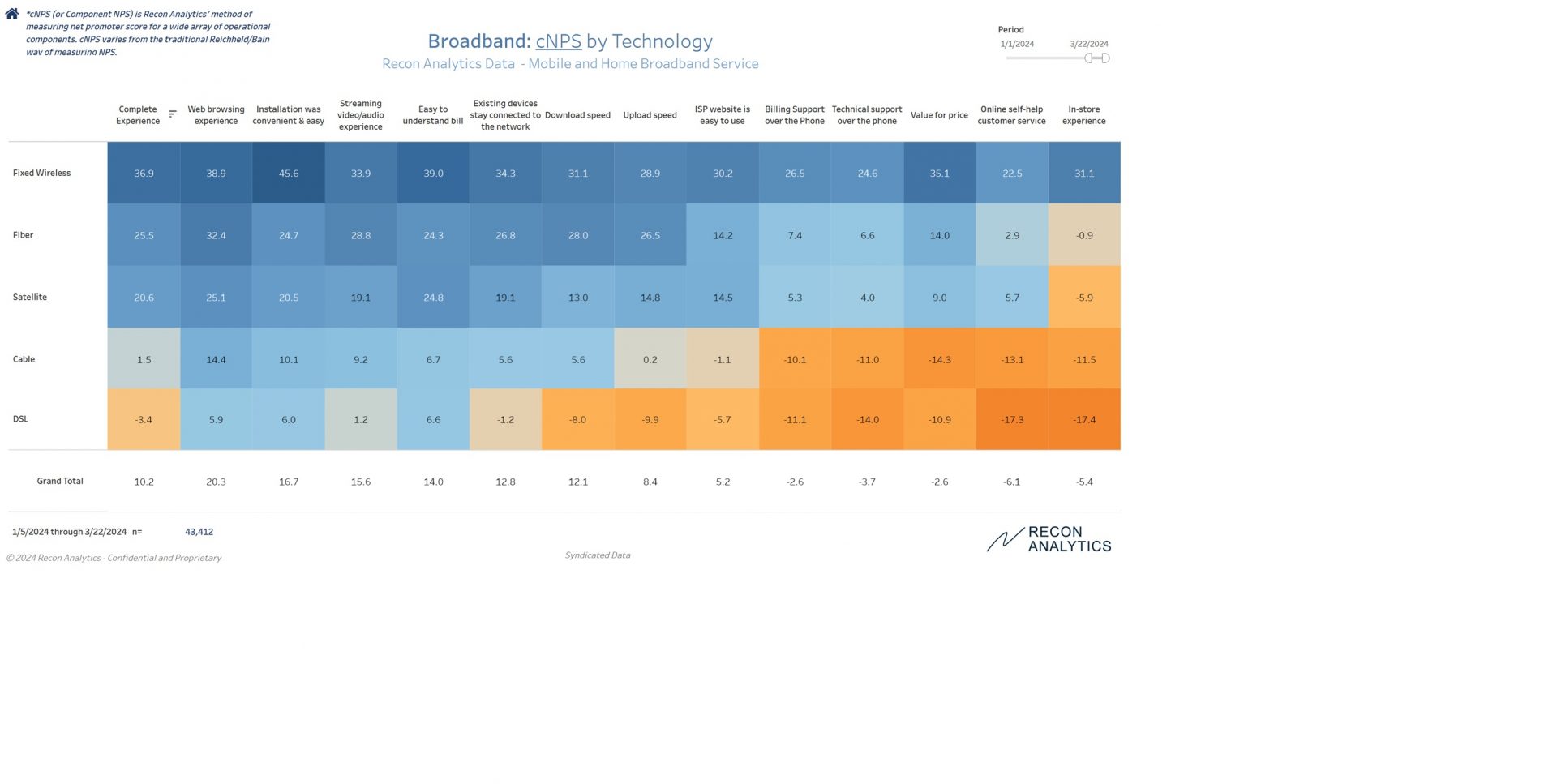
FWA service is typically slightly less expensive that fiber or cable home internet, but its satisfaction scores across all 16 cNPS categories is higher.
Part of the reason for the superior cNPS scores are a better purchasing and installation experience for consumers, lower price points and the ability to easily return the product if it does not meet the customer’s satisfaction. This leads to the customers who use the service to be happy with it, while the unhappy customers cancel the service, return the router and continue service with their existing provider and continue to be less than happy with them.
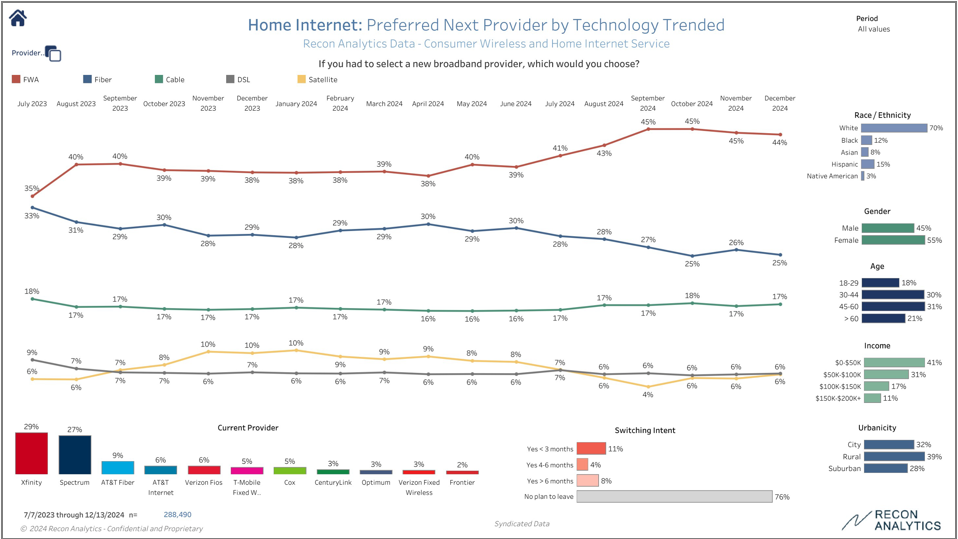
The high satisfaction and lower price for FWA and the dissatisfaction with the other choices available has led FWA to become the preferred next home internet provider of choice for Americans.
Based on interviews with 288,490 Americans conducted between July 2023 and December 2024, 44% of Americans would choose an FWA as their next provider if they would have to make a choice other than their existing provider, 25% would choose a fiber provider, 17% a cable provider, and 6% each would choose DSL or a satellite provider (predominantly Starlink.)
The change in customer preferences is also an opportunity. FWA is the first home internet offer that is being advertised on a nationwide basis, both on a standalone and converged basis. More than 70% of FWA customers are using the mobile solution of the same provider. We are also increasingly seeing a remarkable amount of customers who are switching from one FWA provider to another indicating both a preference for FWA as well as a high aversion to the available wired solutions available. It is also a wakeup call for existing providers, especially cable, to improve their service, both on a technical basis with DOCSIS 4.0 and a relational basis in how they interact with their customers. We are full of hope as some cable providers are introducing NPS as a metric they look at and full of dismay as FWA is being described as CPI or Cell Phone Internet. By describing FWA as cell phone internet, these cable providers do themselves a disservice as cell phones have nothing to do with FWA other than the network they use and shows a blindness to the real threat FWA provides to them. As long as cable views FWA as CPI it will continue to lose as it lives in its own world disconnected from the preferences of everyday Americans.
This has interesting implications for the spectrum policy world. Cable, understandably, is trying to prevent new licensed, full power spectrum to be authorized for cellular use. Why would they? That additional spectrum will enable the mobile operators to offer even more FWA options. While the wireless industry is pushing hard for more full power, commercial spectrum, it is not a done deal. In 2024, we have seen FWA speeds and the availability to sign up with FWA in urban market decline indicating that the growth of FWA is becoming more of a supply issue than a lack of demand. Hence the need for more full power spectrum to amp up network capacity to support more FWA.
The outgoing 118th Congress failed to provide Americans with a spectrum pipeline and the FCC with general spectrum authority (Congress provided for temporary spectrum authority to reauction the returned AWS-3 licenses.) The chances that the incoming 119th Congress that takes over in 2025 will provide a spectrum pipeline with licensed, full-powered spectrum is much higher. The last Trump White House leaned much more heavily on the Department of Defense and was able to clear the 3.45 GHz spectrum for commercial use in a record one-year time period. The incoming Senate Commerce Committee Chairman, Senator Cruz (R-TX), has also traditionally been less accommodating to Department of Defense preferences and FCC failure to live up to its congressionally mandated requirements.
In a nutshell, FWA has higher satisfaction scores than any other technology and more Americans want FWA as the way they connect to the internet than any other choice. It is up to Congress to decide if Americans get their wish.
AI Adoption Will Impact Corporate Storage Requirements
By Mitch Klaassen
AI adoption is expected to drive exponential growth in data storage demand through 2028. In response to a Recon Analytics survey, commissioned by Seagate Technology and conducted in November 2024 on this topic, 61% of infrastructure buyers who predominately use cloud storage for AI data management said they expect storage requirements to at least double by 2028, coming from longer retention times of 6 months to forever, 73% using daily or weekly LLM checkpointing, and 80% deem data replication for AI very or moderately important. 95% of storage buyers, using AI or planning to, say they are taking measures to accommodate the growing storage requirements, including 61% adopting more scalable storage, 56% implementing data management software, 49% using compression techniques and 55% upgrading existing storage infrastructure. Recon Analytics’ research finds that wherever AI is adopted, existing storage practices will need to be upgraded to realize the full potential of AI.
Adapting Beyond Traditional Storage
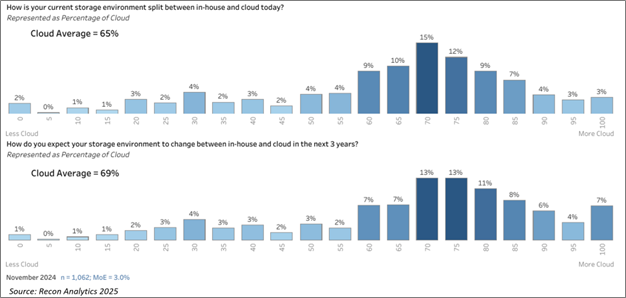
As storage requirements grow, expect both cloud and on-premises storage to continue to grow. According to the 1,062 respondents surveyed, cloud storage is expected to remain the main storage vehicle for AI with 65% of data stored in the cloud versus in-house in 2024 and increasing to 69% by 2028 [see figure 1]. 61% of respondents who predominately use cloud storage say their storage requirements will increase by over 100% over the next 3 years.
Figure 1: Cloud Usage as Percent of Customer’s Storage Current vs Future
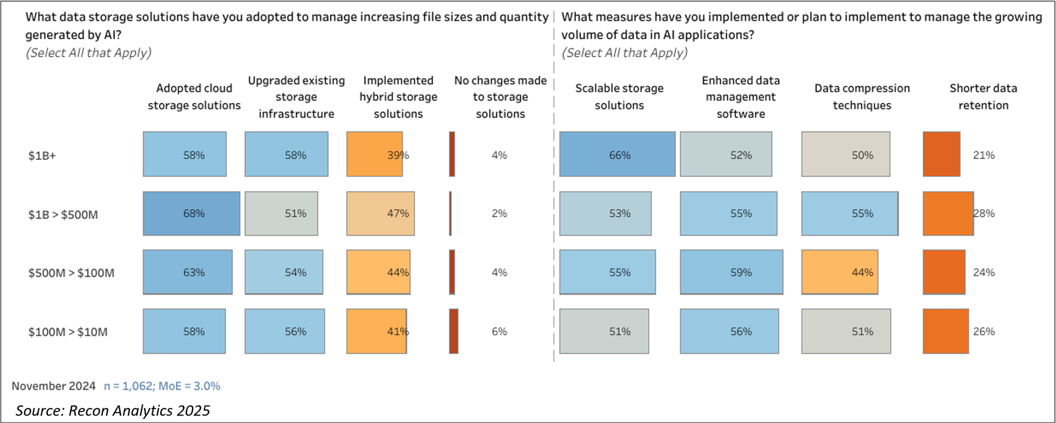
46% of respondents believe that existing data storage methods will not be enough to keep up with demand. Additional data storage solutions are being adopted to manage the increasing file sizes and quantity generated by AI [see figure 2], including 61% expanding usage of cloud storage solutions, 55% upgrading existing infrastructure, 56% adopting enhanced data management software and 49% implementing data compression techniques.
Figure 2: Measures Companies Take to Adapt to Growing Data Needs from AI
AI Infrastructure Components
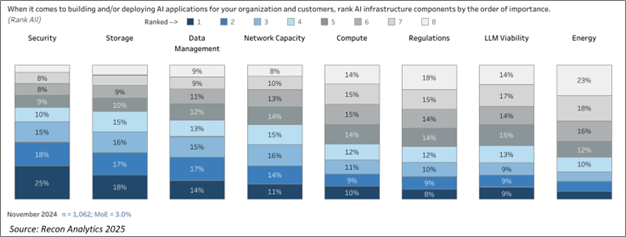
Storage ranks as the second most important component of AI infrastructure per the survey respondents, only following security in importance [see figure 3]. 25% of respondents said security was the most important components followed by 18% saying storage. Sixty-six percent of respondents ranked storage amongst their four most important infrastructure concerns, while 68% ranked security in the top four. Compute and energy have been the hot topics of the AI conversation over the past few years, but storage and security are ranked higher when looking from the storage infrastructure buyer perspective.
Figure 3: AI Infrastructure Component Importance
Storage Growth from AI Model Retention
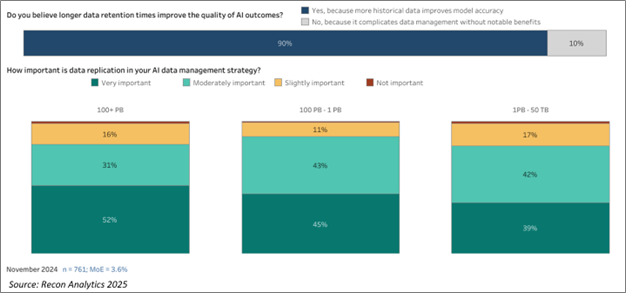
90% of respondents who have adopted AI believe longer data retention improves the quality of AI outcomes [see figure 4]. Of which 93% claim data retention requirements have changed due to the implementation of AI and the ability to refine models including checkpoints. The more data storage a company utilizes the more they see that longer retention times improve the quality of AI outcomes [see figure 4]. The importance of data replication to a company’s AI data management strategy also increases the amount of storage a company uses [see figure 4]. 52% of respondents who are currently using AI and who are also using more than 100 PB of storage, deem data replication improves AI outcomes as very important.
Figure 4: Longer Data Retention Times Improve AI Outcomes by Current Storage Usage
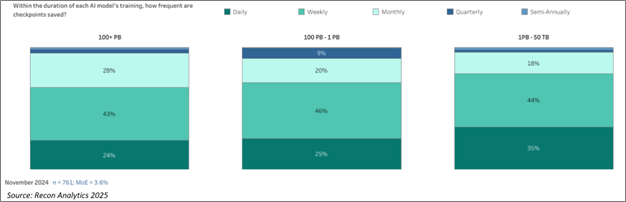
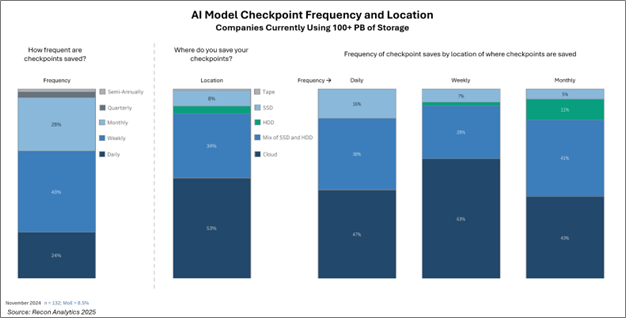
73% of respondents say AI training is driving increased data storage as they are backing up their previously saved checkpointing data on a daily to weekly basis [see figure 5]. Compounding the storage impact of saving AI checkpoints, infrastructure buyers also need to factor in how long they will save each checkpoint as part of the LLM training. Of those respondents saving checkpoints daily (28% of respondents), 32% are retaining data for more than 12 months while 29% are retaining for six to 12 months. Companies already using 100+PB of storage are saving and backing up checkpoints on a daily to weekly basis with 87% of them storing these checkpoints in the cloud or in a mix of HDD and SDD [see figure 6].
Figure 5: Frequency of AI Model Training Checkpoints by Current Storage Usage
Figure 6: Checkpoint Backup Frequency and Location for Companies with 100+ PB of Storage
AI Adoption will Drive Future Storage Growth
As AI use cases and adoption becomes more pervasive, Recon Analytics forecasts companies will see exponential growth in their storage requirements. This will become even more evident when businesses move from their early AI trialing phase to being active AI users. Training LLMs, data replication and longer data retention periods, all key elements of an AI strategy, will require increased storage investments to be successful.
Study Background: In November of 2024, Recon Analytics surveyed 1,062 storage infrastructure buyers and decision makers from companies reporting greater than $10 million in annual revenues and in excess of 50 TB of current storage capacity across 10 counties. Each respondent included in the survey had to have already adopted AI or have plans to adopt AI in the next 3 years. Of those 1,062 respondents 72% are currently using AI and 28% plan to use AI in the next 3 years. This study was commissioned by Seagate.
During the week of September 22nd, Amdocs hosted a two-day North America Analyst Event at its Plano Texas location, just north of Dallas. Approximately 20 analysts attended from the leading North American research firms, including two from Recon Analytics. Amdocs shared its market vision, corporate strategy, and solutions and services aimed at enhancing efficiencies and boosting revenue growth for communication service providers (CSPs).
During the two-day event, Recon Analytics saw three themes emerge that are key to Amdocs’ ongoing success: Amdocs’ focus on helping CSPs enable network monetization; commitment to GenAI to power its future success; and the desire to move beyond the telecommunications vertical. All three of these themes complement or are in line with Amdocs’ number one strategic goal of maintaining its revenue growth by providing its customers with the tools needed to ensure their own ongoing success.
Enabling network monetization
Amdocs made it clear during the analyst event that its go-to-market approach is based on providing solutions that solve its customers’ problems rather than on out-of-the-box products. Currently, when it comes to its mobile operator partners, one of the biggest challenges those partners face is generating ROI from their 5G network investments. Only 6% of the 100 mobile operators that Recon Analytics surveyed at the end of 2023 said that revenue growth was the biggest benefit they experienced from deploying 5G. Rather, the most common response to the question was increased network capacity. Amdocs is very much aware of this challenge and is committed to solving it in two distinct ways – thought leadership and its portfolio of solutions……
GenAI powering Amdocs’ solutions
Amdocs used the second day of its event to talk about what it is doing with GenAI and how the technology is working its way across its solutions portfolio. Anthony Goonetilleke, Group President – Technology and Head of Strategy, got the discussion going by sharing his vision of how GenAI can improve the lives of its CSP partners by creating greater efficiencies that will help both lower the costs of doing business and make network monetization easier……
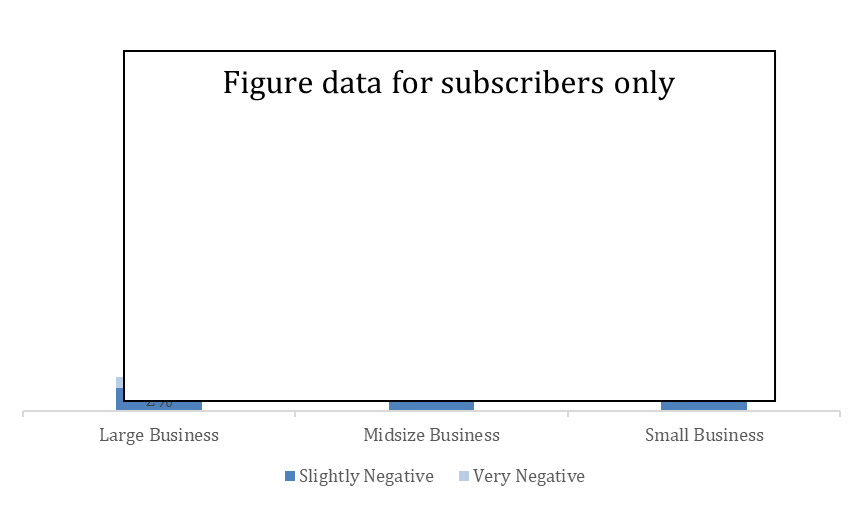
Figure 1: Percent of respondents, by size segment, who said AI bot would negatively impact their perception of a customer service experience
Source: Recon Analytics; Study date: 08/28/2024-09/18/2024; n=1,424; MoE = 2.6%
Creating pathways into new verticals
Amdocs has historically been telco-focused, working with some of the largest CSPs globally. While telco remains the company’s core focus, it is looking for growth opportunities within other industry verticals. Company acquisitions, such as Astradia for mainframe to cloud conversion, play a role in supporting this strategy. Astradia gives Amdocs a way to get its “foot in the door”, so to speak, with other industries that are still utilizing legacy mainframe computers. This growth strategy makes sense, but it does come with its own challenges……
The full research-note on Amdocs’ analyst conference is reserved for clients. If you are interested in learning how to access the complete research-note, please contact Daryl Schoolar at [email protected]
As you are likely aware, Recon Analytics runs the fastest, largest, most flexible customer insights service in the market. We survey over 200,000 mobile consumers, over 200,000 home internet consumers, and more than 20,000 businesses every year about their experiences and intentions. With our consistent set of questions and our massive sample size, we do not only pick up on small nuances in the changes around how large operators are perceived. Over time, we also pick up enough data to get a read even on the smaller providers.
Starlink has grown significantly over the last few years, and we now have enough respondents on a regular basis to report on this growth as part of our comprehensive data set. Over the last year, we found over 1,300 Starlink respondents who tell us with robust statistical significance about their experiences. *
What do customers tell us?
85% of the respondents are in rural areas, 5% live in suburbs, and 10% in zip codes classified as urban areas. They are mostly white, as we would expect from a predominantly rural population.
Who did they use before Starlink?
Unsurprisingly, the largest groups of customers for Starlink are either coming from small rural providers or have never had an internet provider before.
A full 11% of Starlink’s customers are new to home internet, as they often live in very rural areas. The largest individual contributors to Starlink’s growth are CenturyLink, Spectrum, and Frontier.
How about service issues?
Starlink customers tell us that they experience fewer service outages than cable customers, but more than fiber customers. Starlink customers also tell us that they experience near industry-leading speed consistency with the most reliable router.
Customer-reported Issues in the last 90 Days (arithmetic average of providers)
Considering that Starlink is a service that requires a direct line of sight to a passing satellite, these metrics are impressive. Starlink has been able to get 6,146 working satellites into orbit, providing significant capacity and reliability to its subscribers. It has also been able to manage bandwidth, even during peak hours. It is also clear that Starlink’s router is among the most stable in the market.
How satisfied are Starlink customers with their service?
We are also collecting component net promoter scores (cNPS)* by looking at the customer experience in 16 different dimensions. Starlink’s cNPS scores for all the metrics that do not involve interacting with a person are among the best we are seeing in our data.
Starlink provides excellent scores when it comes to the technical delivery of the service. It is very similar to Fixed Wireless Access, in that when it works, it works very well and when it does not work, the service provider makes it easy to return the product within 30 days with either a total refund or only having to pay for services rendered. Furthermore, especially with Starlink, the rural alternatives are generally underwhelming. Most Starlink customers come from DSL providers or other satellite providers that are just not competitive when it comes to speeds and latency. Even though Starlink is $99 per month after $499 plus cost for the equipment, value for price cNPS is a very healthy +19. When you have no other options, even pricey internet looks like it’s worth it.
In all of our technical categories, we see constant year over year improvements of aggregate cNPS scores. The service providers are trying to provide a better service, and customers recognize it.
Starlink needs to improve in three categories: Billing support over the phone, technical support over the phone, and in-store experience.
Fixed Wireless is the benchmark: Great in-store experience where customers can get the box, generally without an upfront cost, and take it home. Starlink’s in-store experience numbers are very similar to those of the mobile providers that predominantly sell through Best Buy, Target, and Walmart. It’s a channel where salespeople are not that educated about the product and its ins and outs. Fiber providers with a store are doing a much better job. The challenge for Starlink is that due to the heavily rural customer base, which implies a low population density, it is not cost effective to open its own stores. One solution is to invest in having its own salespeople in its third-party retail stores. The other challenge is support. While Starlink has a similarly great cNPS number for having an easy-to-understand bill like FWA, the billing support numbers are radically different. Generally, an easy-to-understand bill is correlated to billing support satisfaction, and while correlation does not imply causation, it is a necessary prerequisite.
Overall, Starlink’s mostly rural customer base is very satisfied. Customers like it despite the above average monthly cost and the high cost to purchase the satellite dish and router. Where things get interesting is that Comcast for Business just came to an agreement with Starlink to offer Starlink nationwide to businesses. In our business survey, where we speak with up to 800 businesses of all sizes, we find that fixed wireless access is making significant inroads with cNPS metrics that are similar to what we see in the consumer space. We are actively looking at the impact that the Starlink/Comcast for Business has on the market.
*We ask if they would recommend component elements of a product or service on a scale from 0 to 10 as a battery of questions and then calculate a net promoter score from it. We subtract the percentage of people who rate it 9 and 10 from the percentage of people who rate it 0 to 6, which gives us the net promoter score for this component.
5G fixed wireless access (FWA) is transforming how Americans are accessing the internet. In less than three years, 7.9 million customers signed up with FWA as their preferred internet solution. Recon Analytics interviewed more than 40,000 home internet customers in the first 12 weeks of the year and the results are clear: FWA customers are happier with their service than with service through any other technology. The only thing standing in the way of greater success is more capacity, which is why mobile operators are clamoring for more licensed full-power spectrum.
Chart 1:
FWA is the clear winner across the board
The ranking in Chart 1 makes sense, but is surprising at the same time. The mobile network operators built a very robust offering. FWA is not the fastest service, but under the current usage parameters it satisfies its customers not only on the traditional product side such as easy and convenient installation, a superior router experience, delivering an easy-to-understand bill, and online self-help customer service that people actually like, but also on the service side, ranging from the internet usage categories, to support over the phone and, most importantly, value for money.
It is important to keep in mind that there is a double bias going on with FWA customers. First, the vast majority of FWA customers have the same provider for their mobile service. Customers who are unhappy with their mobile service do not select the same provider and network for their home internet service. Second, there is a survivorship bias. Customers who sign up with FWA typically do this while they are still using a previous service with which they are unhappy. It is very easy and convenient to install and, if necessary, to return the FWA router and cancel the service, so prospective customers give it a try and take advantage of the cancellation poicy if it doesn’t work. We have a hard time finding customers who try the service and are unhappy with it, but have not returned it yet.
Customer service and connectivity
Chart 1 also reiterates what we have known for a long time: cable companies have poor customer service and need to improve. Telecom providers who are phasing out DSL networks and focusing on fiber provide substantially better customer service. What might surprise people is the strong performance of satellite service. This is mostly driven by Starlink, which is getting successively better over time, as a provider of last resort for many of its customers.
Recon Analytics also asks its home internet respondents every week what kind of issues they experienced with their internet connection. Chart 2 is ordered top to bottom with how often respondents experienced an outage. The most common issue, which was internet connection going down, is at the bottom. Furthermore, it is also ordered from left to right by how often they experienced their internet connection going down.
Chart 2:
As we can see in Chart 2, most of the issues are in one of two groups: internet connection going down or slowing down, and router issues forcing people to reset their router or having devices disconnect from the network.
Cable providers had the most issues in all four categories. Up to 43% of respondents reported that their internet connection has been interrupted, while fiber and FWA customers reported the least problems in this category. The newer, better routers provided by fiber and FWA providers also caused fewer problems compared to the routers from cable companies and DSL providers. One fiber and DSL provider told me that once they went away from sourcing the cheapest router to providing an excellent router, it was a game changer for them. The change reduced customer service calls and churn and improved customer satisfaction, more than offsetting the cost of the better router.
How to create more and better home internet choices
As of right now, the Congress and the FCC have created meaningful competition through up to three new providers with up to four brands in the markets where mobile network operators have been able to launch their service. It is incredible that even though we have seen network speeds for some providers decrease from 200 and more Mbps to low 100s Mbps, cNPS scores have not declined. MNOs still have enough capacity to provide their customers with sufficient bandwidth for what customers describe as a superior experience. Verizon and T-Mobile said that they have enough capacity for 5 and 7 million customers respectively with their initial FWA build. They are two thirds to that goal and will probably reach it by the end of 2024. After that, it will become more difficult and expensive to find the necessary capacity to compete with cable and DSL providers as vigorously as they do today. FWA is the fastest growing segment of the home internet market, while cable subscriptions are decreasing.
The government has three options, but the choice is pretty clear: It can spend $80 billion on various fiber incentive programs (BEAD, RDOF, etc) to bring another provider to markets where there is no provider offering more than 100 Mbps speed. It can take $80 billion from the wireless carriers for more spectrum (C-Band Auction for 240 MHz yielded $81 billion) and get three new broadband competitors in the form of FWA providers. Or, it can do both and create more and better home internet choices for Americans with a net zero cost.
The launch of a new iPhone is still the most significant event in the wireless year. When consumers prepare to get their next iPhone, they are also undertaking a major financial decision and are often using that opportunity to evaluate new mobile service provider options. The different wireless carriers are engaging in different strategies for retaining and attracting customers who are getting a new iPhone. AT&T is offering the same deals for new and existing customers with almost every plan. T-Mobile requires customers to either add a line, upgrade their plan or be on their most expensive plan. Verizon is targeting only their best customers and new customers with the best offers.
The results are telling: AT&T’s John Stankey said during AT&T’s Q3 earnings call that AT&T “saw the strongest iPhone preorders we’ve had in many years.” Meanwhile, Verizon’s Hans Vestberg said during Verizon’s Q3 earnings call that “we continue to see muted upgrade levels.” T-Mobile’s Mike Sievert said customers don’t feel they need to take advantage of the device upgrades.
We can see in near real time how the respective carrier strategies materialize in the marketplace. We collected around 30,000 respondents between the iPhone 15 launch and last weekend, giving us faster and more in-depth data on what is happening than anyone else. Based on our data ending, 10/22/23 AT&T has the most iPhone 15 upgrades of any carrier despite being the smallest of the nationwide mobile network operators (MNO). Followed by T-Mobile, who had the lowest upgrade rate in the industry but it’s iPhone sales were buoyed by the highest net adds. They were trailed by Verizon, who is the largest MNO, with the second lowest upgrade rate and the lowest net adds. As one would expect, Xfinity and Spectrum are trailing the MNOs as they are offering significantly less generous device promotions.
iPhone Model Distribution by Carrier
Mobile Make Model
AT&T
T-Mobile
Verizon
Xfinity / Comcast
Spectrum / Charter
Other
Total
iPhone 15
3%
4%
6%
<1%
1%
1%
16%
iPhone 15 Plus
3%
1%
3%
<1%
<1%
<1%
8%
iPhone 15 Pro
11%
10%
8%
2%
<1%
1%
33%
iPhone 15 Pro Max
15%
14%
10%
1%
1%
2%
43%
Total
33%
29%
27%
4%
3%
5%
100%
Source: Recon Analytics Device Pulse
The premium iPhone is becoming a super-premium product. We can see this with the heavy skew towards the iPhone 15 Pro and Pro Max, Apple’s most premium products. More than three quarters of all iPhone 15s are the two premium versions of the iPhone, with the Pro Max outselling the Pro. This shows the pricing power that Apple possesses as the cheapest iPhone 15 Pro Max was $100 more expensive than the iPhone 14 Pro Max but received a storage upgrade.