As you are likely aware, Recon Analytics runs the fastest, largest, most flexible customer insights service in the market. We survey over 200,000 mobile consumers, over 200,000 home internet consumers, and more than 20,000 businesses every year about their experiences and intentions. With our consistent set of questions and our massive sample size, we do not only pick up on small nuances in the changes around how large operators are perceived. Over time, we also pick up enough data to get a read even on the smaller providers.
Starlink has grown significantly over the last few years, and we now have enough respondents on a regular basis to report on this growth as part of our comprehensive data set. Over the last year, we found over 1,300 Starlink respondents who tell us with robust statistical significance about their experiences. *
What do customers tell us?
85% of the respondents are in rural areas, 5% live in suburbs, and 10% in zip codes classified as urban areas. They are mostly white, as we would expect from a predominantly rural population.
Who did they use before Starlink?
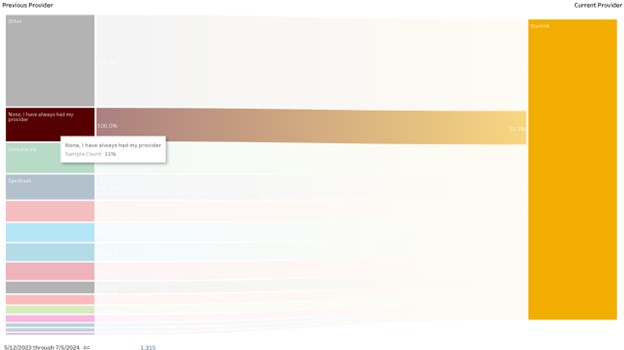
Unsurprisingly, the largest groups of customers for Starlink are either coming from small rural providers or have never had an internet provider before.
A full 11% of Starlink’s customers are new to home internet, as they often live in very rural areas. The largest individual contributors to Starlink’s growth are CenturyLink, Spectrum, and Frontier.
How about service issues?
Starlink customers tell us that they experience fewer service outages than cable customers, but more than fiber customers. Starlink customers also tell us that they experience near industry-leading speed consistency with the most reliable router.
Customer-reported Issues in the last 90 Days (arithmetic average of providers)
Considering that Starlink is a service that requires a direct line of sight to a passing satellite, these metrics are impressive. Starlink has been able to get 6,146 working satellites into orbit, providing significant capacity and reliability to its subscribers. It has also been able to manage bandwidth, even during peak hours. It is also clear that Starlink’s router is among the most stable in the market.
How satisfied are Starlink customers with their service?
We are also collecting component net promoter scores (cNPS)* by looking at the customer experience in 16 different dimensions. Starlink’s cNPS scores for all the metrics that do not involve interacting with a person are among the best we are seeing in our data.
Starlink provides excellent scores when it comes to the technical delivery of the service. It is very similar to Fixed Wireless Access, in that when it works, it works very well and when it does not work, the service provider makes it easy to return the product within 30 days with either a total refund or only having to pay for services rendered. Furthermore, especially with Starlink, the rural alternatives are generally underwhelming. Most Starlink customers come from DSL providers or other satellite providers that are just not competitive when it comes to speeds and latency. Even though Starlink is $99 per month after $499 plus cost for the equipment, value for price cNPS is a very healthy +19. When you have no other options, even pricey internet looks like it’s worth it.
In all of our technical categories, we see constant year over year improvements of aggregate cNPS scores. The service providers are trying to provide a better service, and customers recognize it.
Starlink needs to improve in three categories: Billing support over the phone, technical support over the phone, and in-store experience.
Fixed Wireless is the benchmark: Great in-store experience where customers can get the box, generally without an upfront cost, and take it home. Starlink’s in-store experience numbers are very similar to those of the mobile providers that predominantly sell through Best Buy, Target, and Walmart. It’s a channel where salespeople are not that educated about the product and its ins and outs. Fiber providers with a store are doing a much better job. The challenge for Starlink is that due to the heavily rural customer base, which implies a low population density, it is not cost effective to open its own stores. One solution is to invest in having its own salespeople in its third-party retail stores. The other challenge is support. While Starlink has a similarly great cNPS number for having an easy-to-understand bill like FWA, the billing support numbers are radically different. Generally, an easy-to-understand bill is correlated to billing support satisfaction, and while correlation does not imply causation, it is a necessary prerequisite.
Overall, Starlink’s mostly rural customer base is very satisfied. Customers like it despite the above average monthly cost and the high cost to purchase the satellite dish and router. Where things get interesting is that Comcast for Business just came to an agreement with Starlink to offer Starlink nationwide to businesses. In our business survey, where we speak with up to 800 businesses of all sizes, we find that fixed wireless access is making significant inroads with cNPS metrics that are similar to what we see in the consumer space. We are actively looking at the impact that the Starlink/Comcast for Business has on the market.
*We ask if they would recommend component elements of a product or service on a scale from 0 to 10 as a battery of questions and then calculate a net promoter score from it. We subtract the percentage of people who rate it 9 and 10 from the percentage of people who rate it 0 to 6, which gives us the net promoter score for this component.
Recon Analytics recently conducted the largest survey run to date to assess whether consumers eligible for the Affordable Connectivity Program (ACP) are actually enrolling and if so, what they are using their ACP funds for.
We conducted nationwide consumer surveys among ACP-eligible Americans from April 28 – May 5, and August 18 – 27, 2023. We asked 29,141 ACP eligible Americans if they use ACP, and if so for what.
We were not at all surprised with our survey findings, but some policymakers might be.
Recall that ACP is a program that provides “eligible” Americans $30 per household for internet connectivity. Who is eligible? Figure 1 sets forth the categories of citizens eligible for ACP. These “categories” of low income individuals are from existing federal government subsidy programs.
Figure 1
Of the almost 53 million ACP-eligible households, more than 20 million have signed up. The states with the highest number of consumers receiving ACP subsidies are “red” states Louisiana, Ohio, Kentucky, and North Carolina.
The program is currently set to expire in early 2024 absent additional funding by Congress.The big question inside the Beltway is whether funding the ACP is a good use of taxpayer dollars. The ReconAnalytics survey indicates that if Congress is interested in seeing itself reelected, extending the ACP funding might be a good idea.
The Data Says ACP is Working to Close the Digital Divide … Among Republican Voters
When we compare ACP enrollment across red states and blue states (defined by the party who won the last senatorial election in the state) , we observe that the percentage of households which would lose access to the internet is higher in red states than in blue. 39% of ACP enrollees live in Red States and 34% live in blue states. Members of Congress ignore this reality at their peril.
But what about the enrollees, what are they using their ACP subsidy for? Consider that the largest proportion of households at risk of losing ACP are ones with school-age children. No surprise then that our survey reveals that these same households use their ACP subsidy for school work online.
In aggregate, about 55% of respondents who told us they would be unable to access the internet without ACP were white, 16% Hispanic, 12% black, 9% Asian, 6% Native American or Pacific Islanders and 2% were of another race.
Figure 2 – ACP Enrollees by Race, Ethnicity, Age and Income Distribution
Full Time Period
Income
$0-10k
$10-25k
$25-50k
$50-75k
Total
Not able to access the internet w/o ACP
36.2%
39.2%
34.8%
28.4%
36.2%
Race & Ethnicity Distribution
White
47.9%
59.2%
57.5%
48.9%
54.5%
Hispanic
18.8%
14.1%
17.5%
15.3%
16.3%
Black
15.8%
10.6%
11.0%
13.4%
12.3%
Asian
9.2%
7.4%
6.7%
15.3%
9.1%
Native American & Pacific Islander
5.4%
6.9%
4.4%
5.3%
5.5%
Other
2.9%
1.9%
3.0%
1.9%
2.4%
Age Distribution
18-29
31.0%
15.9%
20.5%
22.5%
21.5%
30-44
26.4%
21.2%
33.6%
45.0%
31.0%
45-60
34.3%
40.5%
32.9%
25.6%
33.9%
>60
8.3%
22.5%
13.0%
6.9%
13.6%
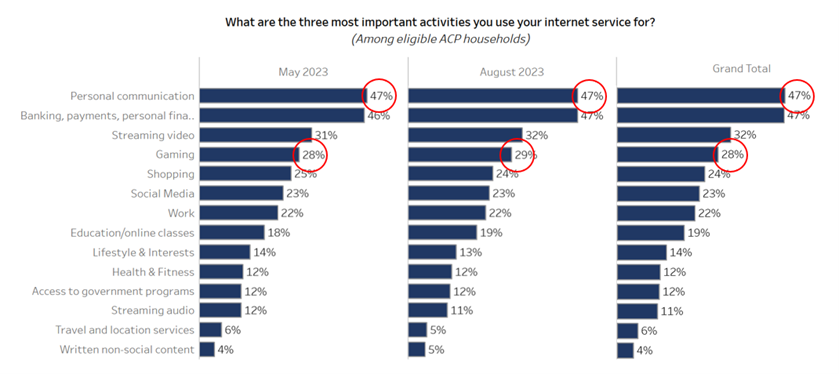
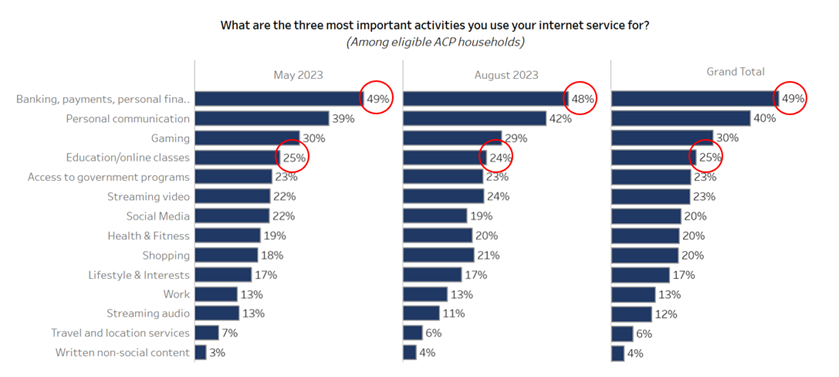
In Figure 3, we are looking at the activities that ACP households in general and in Figure 5, ACP households that would lose internet access but for ACP, are engaged in.
We show the data for both survey waves to highlight the consistency of the results over time. The two most used applications for their ACP connections are personal communications and banking, payments, investments and personal finance. In other words, ACP subscribers are using their subsidy to allow them to connect to the Internet and engage in the digital economy, whether it’s paying their bills or buying school supplies for their children. Almost a quarter of ACP recipients use their internet connection for purchases, more than one in five (22%) need their internet connection for work, one in five (19%) for online education, and one in 8 (12%) to access government programs.
Figure 3: Behavior pattern of ACP-eligible Americans regardless of ACP participation
Figure 5 shows the impact of losing ACP. It also shows what applications really matter to people who critically depend on ACP for their broadband connection. Banking and financial transactions, education and access to government programs are priorities for these citizens.
Almost half of ACP recipients would lose internet access altogether if ACP were to go away.
This potential outcome presents a Catch-22: the government has pushed many programs online as a cheaper way to deliver services to low-income Americans. Due to ACP, 22% of the targeted beneficiaries of this policy are receiving those services. If ACP goes unfunded, 22% of the the very Americans Congress says it wants to help out of poverty will be stranded.
Seems like ACP is working but perhaps will be so effective, Congress will kill it, but at their peril.
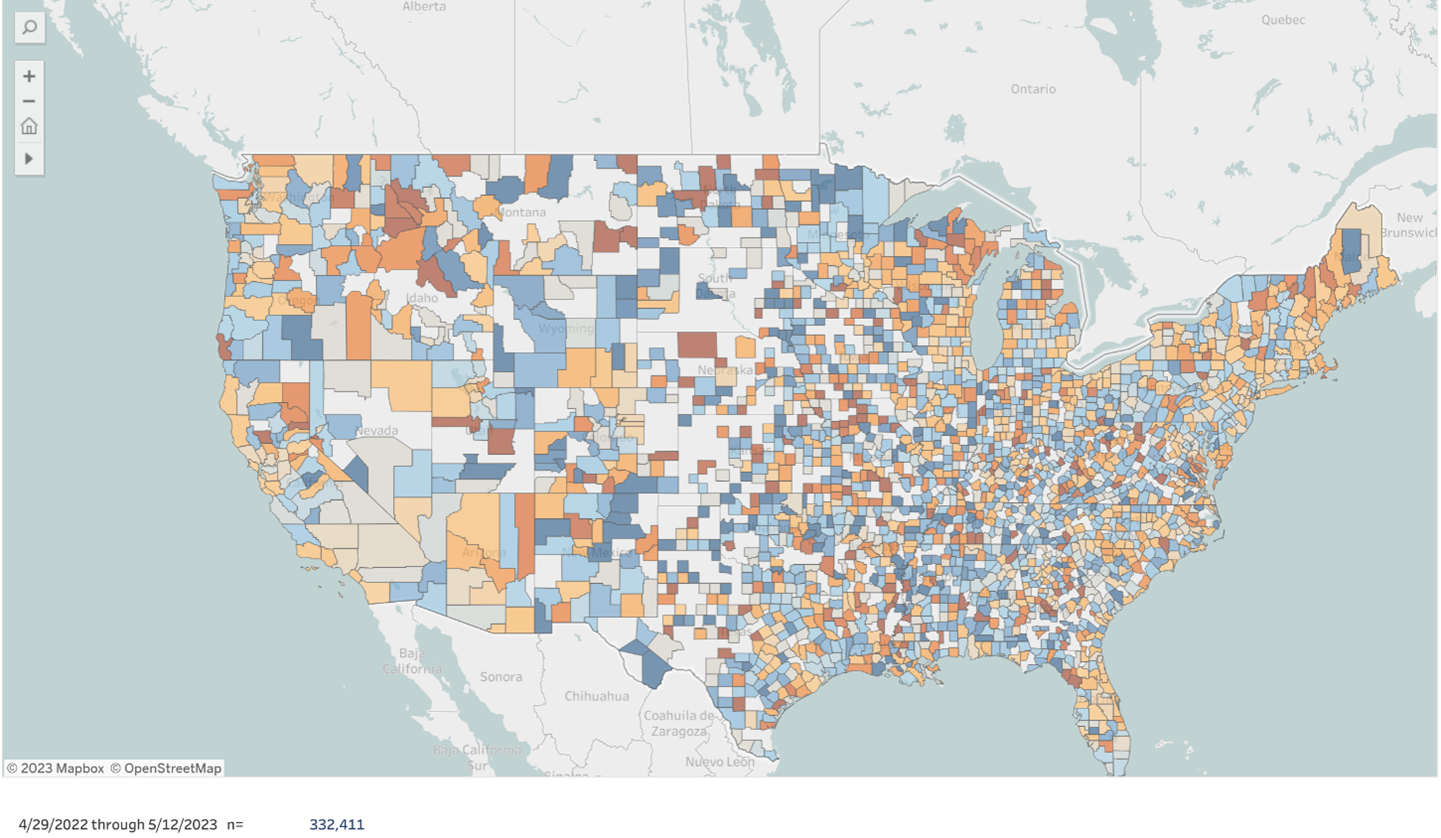
One of the key questions around the happiest and unhappiest home internet counties is where they are and what the driver is behind the happiness and unhappiness. Every week, we ask our respondents a battery of questions around how satisfied they are with the service they receive. After surveying more than three hundred and thirty thousand respondents later, we have respondents from 2,368 counties out of 3,142 in the United States telling us are telling us where the happiest and unhappiest broadband customers in the United States and allows us to determine the root cause behind their experience.
Questions that we aim to answer include: Why is home internet service in some places better than in others? Will the famous opening lines of Leo Tolstoy’s book Anna Karenina – “All happy families are alike; each unhappy family is unhappy in its own way” – be applicable here? Are the larger observable trends, where fixed wireless NPS outperforms Fiber – which outperforms cable, which beats DSL and WISPs – be consistent in a granular county-by-county perspective? Does it matter if a county is in a blue state or a red state? Is the size of a provider any indication that the home internet customers in a county are happier or unhappier? Let’s just say that counties do not show the same behavior as Tolstoy’s families: it all comes down to local execution.
Let’s get politics out of the way first: Five of the ten unhappiest and five of the ten happiest counties are in states that are considered “Republican” and “Democratic”, respectively. Neither party’s approach to how they interact with home internet providers has had an impact on the distribution of the ten happiest and unhappiest counties.
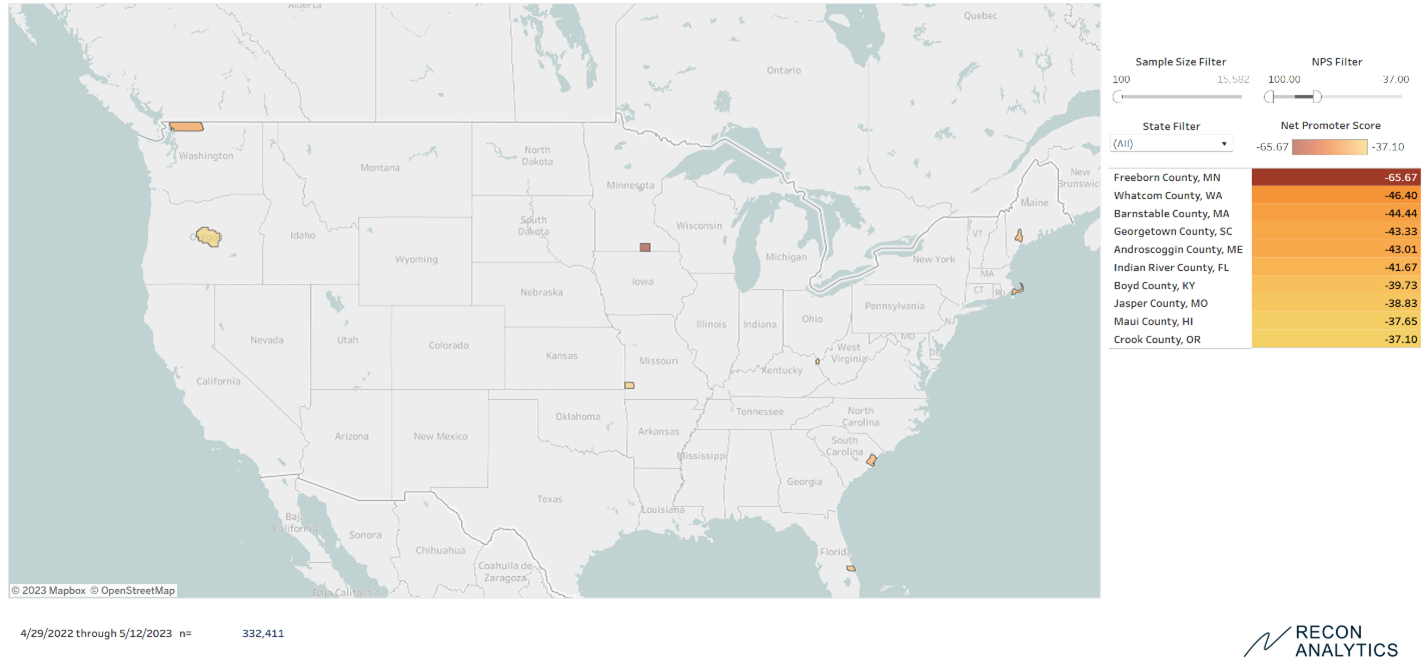
Below is a map of the ten unhappiest home broadband counties in the United States with at least 100 respondents to ensure statistical veracity.
Interestingly, all the counties where the unhappiest home broadband customers are residing are rural counties with one exception: Indian River County, FL, the home of Vero Beach. This county, which is largely suburban, has the fourth highest concentration of millionaires on the United States. The population range per county is between 25,000 and 180,000 people. They are being served by between two providers in Barnstable County, MA and 14 providers in Jasper County, MO, which tells us that limited or significant choice is not a driver of unhappiness, especially when all of the counties are served by all technologies from fiber to DSL. Even if we controlled for coverage, we had some counties where there was fiber coverage in every ZIP-code (we did not check if every physical address was covered) like Georgetown County, South Carolina, Indian River County, FL, or Crook County, OR to where almost none of the ZIP-codes in a county, like Barnstable County, MA, were covered by fiber. These type of systemic, technology-driven or industry structural reasons are not providing the answer, despite being commonly accepted truths. In four of the ten unhappiest counties, membered own co-operatives which are typically non-profits were active.
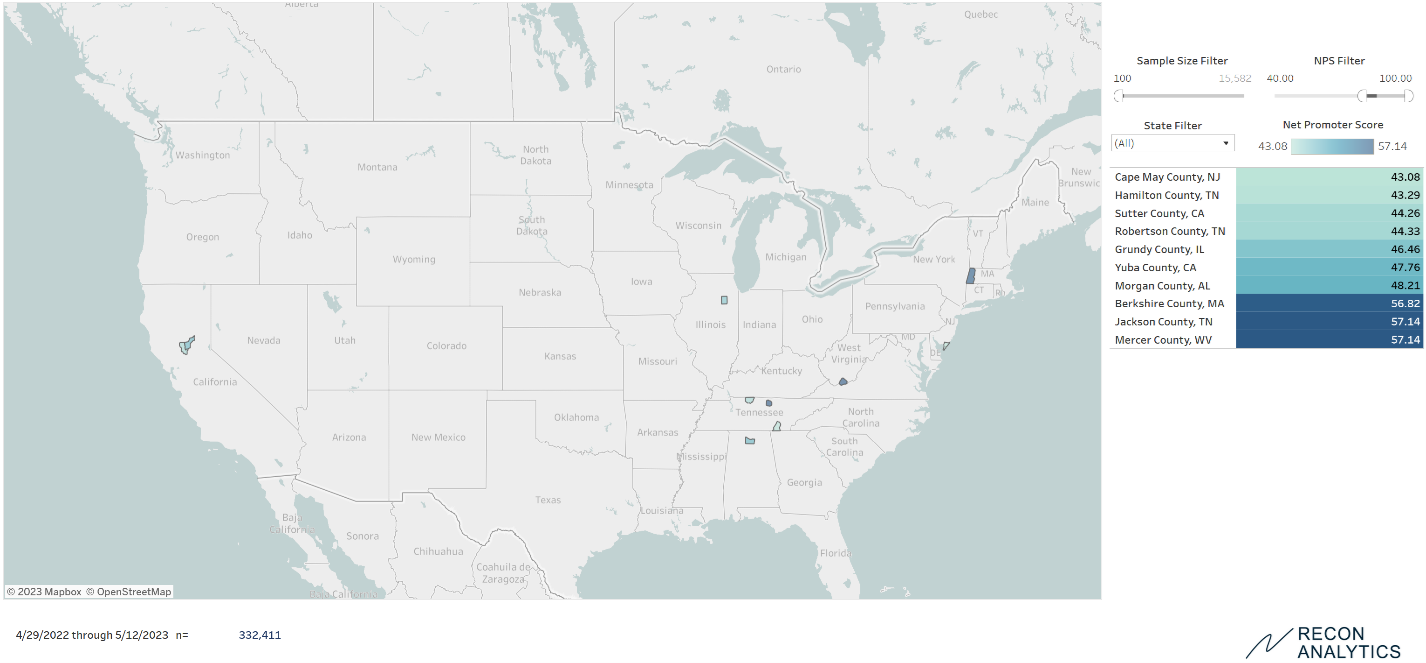
We then looked at the happiest home broadband counties in the United States. The map confounds the expectations of many.
Who would have thought that four of the happiest broadband counties are in the rural South of Tennessee, Alabama and West Virginia? Nine of the ten happiest counties are rural. In six of the ten happiest counties, coops are active, but not in the happiest broadband county, Mercer County, WV. The poster child for municipal broadband, Chattanooga, TN, comes in as the 9th happiest home internet place in the country. The happiest county, Mercer County, WV does not have any coops providing telecom services there. In six of the happiest and four of the unhappiest broadband counties, coops are providing service. The mere presence of coops is providing better services, as the feedback we receive from customers ranges from terrific to terrible. Fiber or Cable coverage is also not playing a determining role.
The other fascinating insight is what is missing from the list: major urban markets. The idea that urban markets get all the investment because they are densely populated and cheaper to service, and therefore have the happiest broadband customers, is just not reflected in the data. At the same time, the rival argument that urban areas are dystopic wastelands with horrible broadband service is equally not supported by the data.
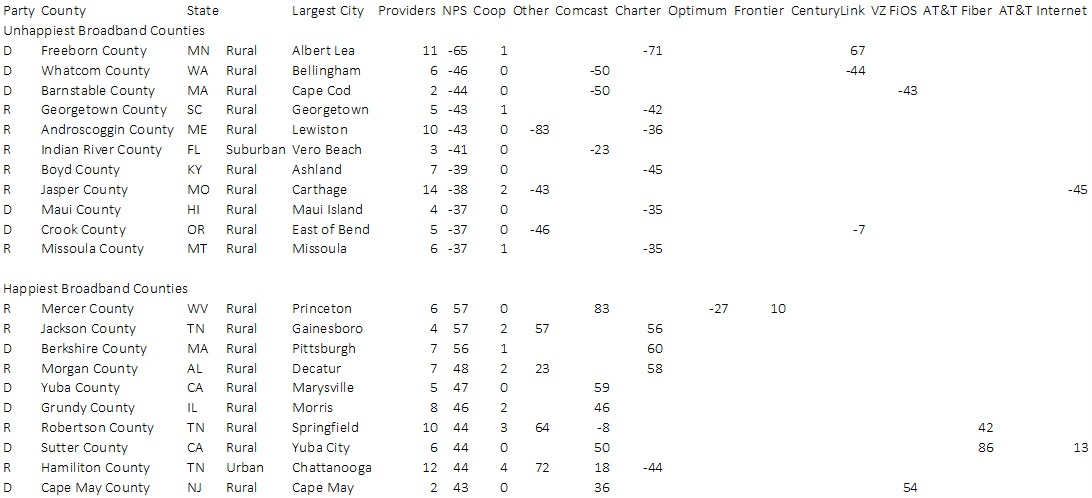
In the end, we found that what really matters is the individual performance of a provider in a given county. Below are the NPS scores for the providers with at least 20 respondents in each county where we had at least 100 respondents overall.
Almost all the providers displayed uneven performance. The same provider that performed very well in some counties performed poorly in others. Cable providers like Comcast and Charter performed very well in some counties. Comcast’s exceptionally good performance made Mercer County, WV the happiest broadband county. Equally, its poor performance in Barnstable County, MA and Whatcom County, WA made them the second and third unhappiest broadband counties. Only AT&T Fiber performed consistently well in the ten happiest counties and was not present in the unhappiest.
Additionally, 5G fixed wireless service did not make an impact on the happiest and unhappiest broadband counties. While in some of the counties there is 5G fixed wireless service, the adoption numbers were so low that they didn’t make an impact on the overall happiness of broadband customers.
Our research shows that every provider is able to do excellent work and make their customers happy. Considering that the nationwide providers engage in nationwide standard pricing, the satisfaction score differences are not driven by low price, but by actual performance. Technology helps, but the key is local execution. Providers could improve their performance in markets by internally benchmarking their performance and extending best practices throughout the entire organization. Regulators should look at how satisfied the customers of applicants are before the allocate their broadband subsidies to expand services. If they have multiple applicants for subsidies, they should be given to the providers who deliver for the taxpayers, who provided the funds through taxes in the first place.
There is broad agreement in the United States that we need to increase broadband coverage and make broadband more affordable for low income Americans. To arrive to that conclusion, it is unnecessary and actually is counter-productive to use less than reliable data to make this point.
Thomas Philippon recently authored a paper entitled, “How Expensive are U.S. Broadband and Wireless Services.” In it he concludes the American consumers pay more for broadband and wireless services than consumers in other industrialized nations. Unfortunately, these conclusions appear to be based on data that are dated, incorrect, omitted or misinterpreted. The findings are actually a disservice to the goal of closing the digital divide that exists both in coverage and affordability.
Fixed broadband prices
To compare U.S. with European prices, the paper uses data collected by cable.co.uk, an advertising website in the UK that tries to convince UK customers to buy UK broadband services rather than relying on unbiased sources. It is not clear what expertise this company has at determining U.S. broadband prices (or interest in showing them to be economical) and conducting proper apples-to-apples international price comparisons. In particular, there are no data contained within cable.co.uk’s currently provided spreadsheet that allow a reviewer to ascertain that similar quality plans were sampled in each country. Indeed, this seems in doubt as in its most recent study, cable.co.uk reports that the plans it sampled from the U.S. had an average price of $59.99, with a minimum price of $29.99 and a maximum of $299.95. The magnitude of this variation suggests that the sampled plans varied widely in quality (i.e., offered speeds), and it is especially curious that cable.Co.UK’s computed average speed should be $59.99. For an average from 26 observations to arrive at this archetypical retail price number seems improbable.
Indeed, it is highly likely that the quality of broadband services that cable.co.uk compares are quite different. In its current report on prices, cable.co.uk suggests that readers should also examine cable.co.uk’s study of worldwide broadband speeds. It is more than a little revealing that in the provided spreadsheet, cable.co.uk finds U.S. average speeds to be nearly twice as fast as UK speeds (71.20 Mbps vs. 37.82 Mbps). Furthermore, the only listed European countries or dependencies that exceed the U.S. in speed are:
Liechtenstein (population of 38,747)
Jersey (A British crown dependency of population of 107,800)
Andorra (77,142 people)
Gibraltar (a British Overseas Territory with 33,701 people),
Luxembourg (590,667 people)
Iceland (population 356,991),
Switzerland (8.5 million inhabitants),
Monaco (population of 38,964),
Hungary, (9.7 million people)
Netherlands (population of 17.2 million)
Malta, (460,297 inhabitants)
Denmark, (5.7 million people)
Aland Islands, (Swedish-speaking semi-autonomous region of Finland of 27,929 people)
Sweden, (10 million populations)
Slovakia (5.4 million people).
As you can easily see someone tried really hard to increase the count of geographies that have faster speeds than the US by including parts of countries, dependencies, and dutchies into the mix. Nearly all of these are small countries or semi-autonomous regions with populations less than a typical U.S. city or state. It is notable that no European country with a population larger than that of the Netherlands makes the list of countries with faster average services than the U.S. Given that U.S. broadband speeds exceed significantly those in Europe, and the U.S. generally has much lower population densities, higher wages, and thus, significantly higher per-home network deployment costs, it is unremarkable that U.S. prices might exceed European prices as it costs substantially more to deploy these networks.
The scatterplot of cable.co.uk’s collected prices appears to be consistent with 2017 prices reported by the OECD. But four-year-old prices don’t seem terribly apposite to debates about the current price and quality performance of broadband in the U.S. As demonstrated by USTelecom, broadband prices in the U.S. have been dropping significantly over the past six years even as their service quality has increased dramatically.
After noting that “some of the data measures presented above [in the paper about pricing] are a few years old,” the paper turns his concern to USTelecom’s recent report detailing that deployment of advanced networks is further along in the U.S., and subscription to these high speed U.S. networks exceeds European subscription to similar networks. The paper retort to these findings, that derive directly from data and official statistics collected for the U.S. by the FCC, and for Europe by the European Commission (EC)is to reference a 247-slide presentation published on internet that claims that in 2019, 87% percent of people in the U.S. use the internet, but in Western Europe and Northern Europe, the figures are 92% and 95%, respectively.[1]
There are at least two problems with this response. First, even if these data were valid, they focus on geographic subsections.[2] Why not compare these most-developed areas of Europe against U.S. figures strictly for the Northeast or the Pacific Coast? But aside from needing to slice and dice European data in order to adduce a favorable comparison, the biggest problem is that even if Europeans are using the internet, EC DESI data on connectivity show that many are not using it via a fixed broadband connection. This is because the EC finds that only 78% of European households subscribed to fixed broadband in 2019. So it is more than likely that the slide presentation the paper cites to on usage includes people who use the internet via mobile wireless broadband connections, satellite connections and dial-up internet connections, in addition to fixed line broadband connections.[3] In any event, one year earlier, in 2018, 84% of U.S. households had fixed broadband subscriptions – and the U.S. advantage over Europe widens as only 30+ Mbps broadband speeds and 100+ Mbps speeds are considered.
Fixed broadband speeds
The next topic specifically addressed by the paper is fixed broadband connection speeds. For this, the paper refers to slide 52 in the 247-slide presentation. This slide, he says, “shows the US is close to the EU median, and slightly below France, in terms of speed.” The first statement appears to be false, the second is immaterial. Let’s unpack.
The European countries listed (in terms of speed) on the slide are: Romania, Switzerland, France, Sweden, Spain, Denmark, Netherlands, Portugal, Poland, Belgium, Germany, Ireland, U.K., Italy and Austria.[4] The U.S.A. slots between Sweden and Spain. Now even assuming that the paper meant these comparisons to be against European countries rather than EU countries as he states in the paper, the median European country is Portugal – which lies four positions below the U.S. If only EU countries are considered, the median position drops another half slot to be between Portugal and Poland.[5] While the paper may consider the U.S.’ positioning in these lists to be “close” to the median, he could also have noted that the only major EU country ahead of the U.S. was France, with a miniscule (and likely statistically meaningless) speed advantage of 500 Kbps (131.3 Mbps for France versus 130.8 Mbps for the U.S.).
Thus, rather than showing the U.S. to be a laggard in fixed broadband speeds, the paper’s analysis appears to show it significantly in the lead.
Lightning round
ARPU: The paper then claims to look at broadband ARPU for Altice and Comcast in the U.S., and pronounces it significantly above that in France. The validity of his data is highly questionable, though. For example, Philippon claims (without citation) that Altice’s ARPU is $90/month.[6] Reference to Altice’s SEC 10-K report (at p. 3) indicates that its residential broadband ARPU is $70.52, a figure substantially less than Philippon’s unreferenced figure of $90. Further, Altice is a cable company with a very substantial FTTH footprint. It reports that the average speed purchased by its customers exceeds 300 Mbps – over twice the average speed experienced by French customers.
Prices of comparable contracts: A chart is displayed suggesting that prices for triple-play services in the U.S. exceed significantly those in European countries. This statistic is likely meaningless because it is well known that the cost of television services in U.S. triple-plays is vastly above similar charges in Europe. This is due to many factors, including: U.S. bundles typically include many more channels, especially HD channels, than European bundles; fees paid by U.S. triple-play operators to acquire local broadcast channels, sports channels and other cable television networks exceed greatly those paid in Europe. Indeed, in many European countries, local broadcast channels are paid for via television license fees that are paid separately by customers and are not included in their triple-play bills; U.S. bundles also commonly allow the subscriber to watch several simultaneous programs on multiple television sets – in contrast to European bundles that may be restricted to a single TV set stream.
Labor cost adjustment: Here the paper argues that because “wages are about 20% higher in America than in the main EU countries” and “since compensation of employees accounts for half of the value added in private industries, one might expect [U.S.] price to be [only] 10% higher” than in Europe. This analysis is not compelling. Even if these national-level statistics are specifically applicable to the U.S. broadband industry, there is no need for wage differences to account for the entire amount of any putative elevation in U.S. broadband prices over European ones. That is, they are only a contributor. The fact that the U.S. is much less densely populated than Europe and U.S. networks provide much higher speeds and carry much more data per household than European ones are also likely contributors.
Profits and investment: This section contains a mishmash of data that purport to suggest that U.S. capital investment is not impressive. But, the data presented for “Comcast, AT&T, and other Telecom companies,” not an appropriate basis for analysis because many of these companies are diversified into businesses other than broadband. Comcast and AT&T offer television services and own movie studios. Comcast owns theme parks and AT&T owns legacy copper telephone networks and DBS satellite systems. Consolidated capex figures from these companies are inadequate to discern broadband-specific investments.
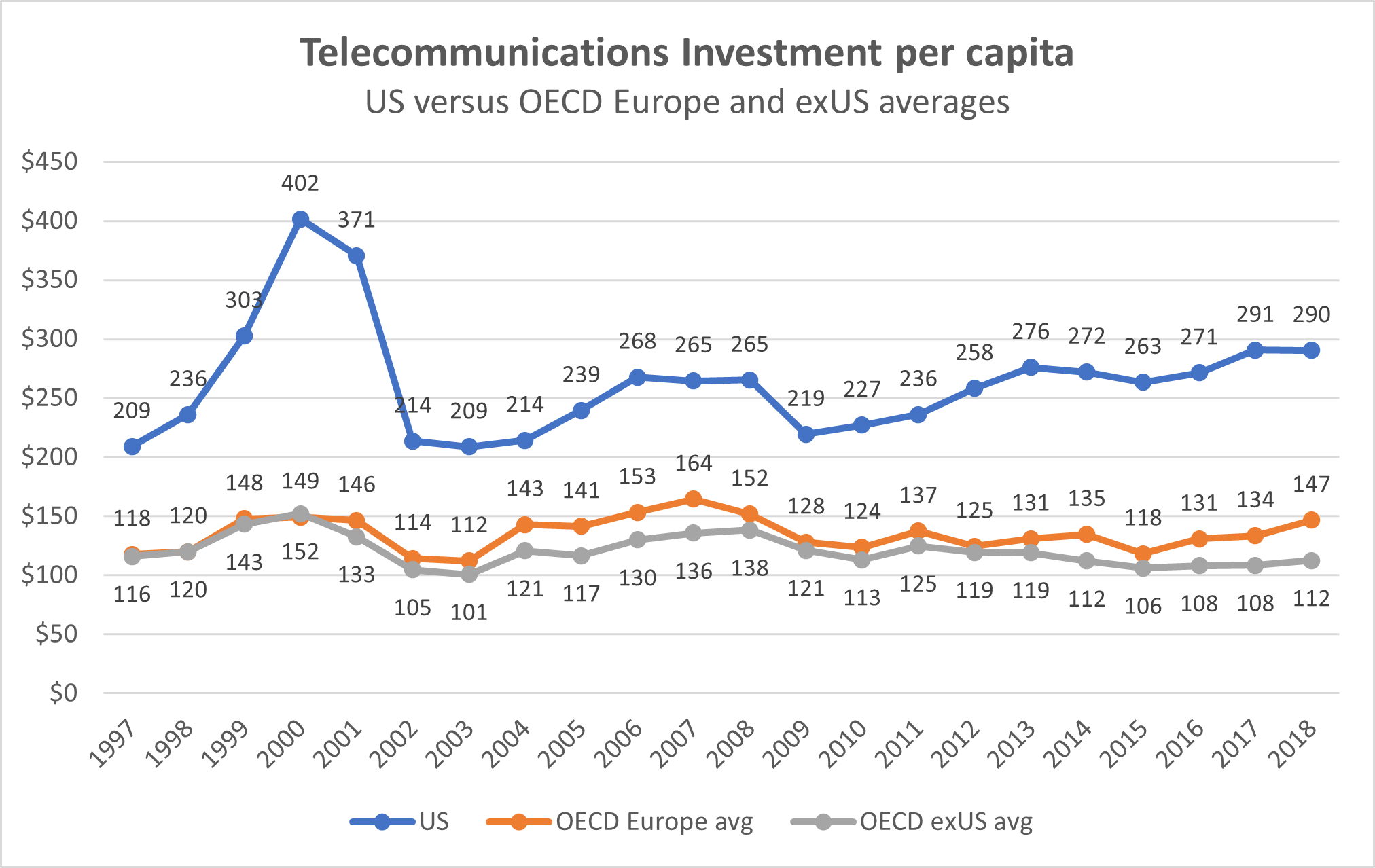
But in any event, discussion of the above is probably intended to divert attention away from the best available investment comparator for telecommunications, the data collected by the OECD from national statistical agencies or regulators.[7]
All that the paper appears to say in response to the investment history presented in above chart is to note that since 2015, “investment by the main Telecom operators in Europe has grown rather quickly.” So it has; but so has investment grown in the U.S. – and U.S. per capita investment levels remain at nearly twice those in Europe.
Coda
It is odd that the paper should resort to such a strange mix of data that are old, wrong, or misinterpreted to try to support his claim that U.S. broadband is too expensive, and that this can only be the result of a lack of competition. Only by ignoring the fact that broadband networks are more widely deployed in the U.S. than in Europe, offer higher speeds, carry more data, and are more heavily subscribed to can the paper conclude that the European model is to be preferred. But while that may be the paper’s conclusion, it is not that of the European Commission which has studied these issues directly. In Table 7 of Annex 3 in its International Digital Economy and Society Index specifically for connectivity finds the U.S. to score higher than all but the top EU country (Denmark) and to tie in score with the next two highest EU countries (Finland and Malta).[8] All other EU countries score lower.
So the real truth is that U.S. fixed broadband leads, and does not lag Europe’s performance. This does not take away that there are Americans that cannot get broadband internet or cannot afford broadband. We need to help these people and do not need to trump up the differences to come to that conclusion.
[1] Curiously, the paper ascribes his data source’s stated figure of 87% usage for North America to be the usage figure specific to the U.S. This, of course, neglects the fact that roughly 10% of North America’s inhabitants are Canadians.
[2] The sources cited for this agglomeration of statistics (slide 34 of 247) are not traceable. They include: ITU, Global Web Index, GSMA Intelligence, Eurostat, Social Media Platforms’ Self-Service Advertising Tools, Local Government Bodies and Regulatory Authorities, APJ۩, and United Nations. Indeed, this same boilerplate list of sources appears on several other slides in the presentation.
[4] Turkey (which is below Austria in speed) is possibly another European country on the slide, but out of conservatism, we will not include it in our analysis.
[5] The EU countries contained in the slide’s list are: Romania, France, Sweden, Spain, Denmark, Netherlands, Portugal, Poland, Belgium, Germany, Ireland, U.K., Italy and Austria. Switzerland in not an EU country. Note that the U.K. was still a member of the EU when these data were collected.
[6] We assume this is intended to be residential ARPU because the paper compares it against a French statistic for residential broadband prices.
Americans overwhelmingly support that broadband should be available to every American and that the funding base to achieve that should be broadened to every company that makes money through the internet.
More than 78% of respondents agreed that broadband internet should be available to every American showing broad support from large parts of the population. When looking a bit closer at the answers given by respondents who say they have broadband versus the people who said they didn’t have broadband, the support of those respondents who do not have what they consider broadband (26%) for everyone having access to broadband drops to 64%. This indicates that there is not only an availability and affordability gap but also an educational gap. Many people who don’t have broadband internet access either do not want it or do not understand why they should have it. These findings, which are mirrored in other studies, indicate that any broadband infrastructure program should include an educational component to increase the number of broadband subscribers. Otherwise, broadband penetration will never reach its full potential.
As we found in previous surveys on the topic, around 54% of respondents use the internet for work purposes from home. This is equal to the number of employees that are classified as white-collar employees by the U.S. Department of Labor. This number highlights the importance of broadband for the functioning of American businesses and enterprises during the continuing pandemic. It is likely that the added agility and flexibility to work from home will continue to be utilized after the country has emerged from the pandemic restrictions. We also found similar opinions around what Americans consider broadband. The median American considers 50/5 MBits as broadband whereas the most answered response was Gigabit speed with 29% of respondents.
The high percentage of Americans who think broadband should be available to everyone is probably based on the intensive usage and the need of many Americans to use it from home to work. Using the weighted average of the responses, Americans spend around six hours every day on the internet.
How many hours do you spend on the internet with a mobile device or computer?
Use the internet from home for work
Does not use the internet from home for work
Combined Response
Less than an hour
4.8%
18.0%
10.9%
Two to four hours
18.1%
36.0%
26.4%
Four to six hours
15.2%
26.3%
20.4%
Six to eight hours
25.2%
8.8%
17.6%
Eight to twelve hours
25.7%
4.8%
16.0%
More than twelve hours
11.0%
6.0%
8.7%
When looking at those who also use the internet from to work from home, unsurprisingly the usage pattern is significantly heavier as their usage pattern includes both business and leisure activities.
While only 37% of respondents knew that the Lifeline Program provides low-income Americans with basic phone and internet service, they were open to new funding sources to close the digital divide. More than 71% of Americans are in favor that companies with business models that rely solely on the internet to exist and who also generate revenue from those businesses, like Google and Facebook, also contributing to provide access to Americans who currently do not have access to the internet. Such a move would dramatically expand the funding sources for a broadband access plan and include companies that have exerted the most valuable and profits from the internet.
What is really interesting, the survey also found support to extend net neutrality rules to websites and ecommerce companies. We framed questions around the net neutrality principles of no blocking, no throttling speeds, and no paid prioritization by asking Americans if websites like Google, Facebook or Amazon should be allowed to restrict access to legal sites, give preference to their own products and services over others and change the search results based on how much money they receive from others.
More than 72% of Americans are against companies like Facebook or Google restricting access to legal sites for any reason. This is exactly the behavior that Facebook showed when it made it impossible to link from Facebook to news sites in Australia (and for a short time to itself) to avoid having to compensate news sites linked to. In essence, it was a commercial and legislative conflict where Facebook wanted to use its customer base as a bargaining chip in its negotiations. This is the essence of the “No Blocking” rule in net neutrality.
More than 55% of Americans believe companies like Amazon, Google, or Facebook should not be allowed to give preference to their own products and services over that of others, a self-dealing practice that has cost Google more than $10 billion in fines by the European Union. Search engines like Amazon, Google, and Facebook, all of which provide you with what you are looking for, are increasingly the prism through which we see the world. They have incredible power over our perception of what it is we are actually looking for. By pushing competing products into the obscurity of lower-ranked results, they, in essence, throttle the success of other products that are better but do not fit the commercial objective of the search engine provider.
In terms of pay-to-play result manipulation, more than 80% of Americans say they are against search engines altering results based on how much websites and advertisers pay for preferential positioning. It is common that the first view search results for a given term are occupied by responses that are marked by the easily missed word “Ad” in front of the link. This effectively operates as paid prioritization, something the ISPs are not allowed to do under California’s net neutrality law, nor under earlier versions of net neutrality that the Democrats might be considering reinstating.
The results of our survey showcase two key points: Americans are open to reigning in tech giants, who solely rely on the internet to generate revenue, and curbing their ongoing uncompetitive behavior, and having these companies contribute part of said revenues to subsidize access to broadband for low-income Americans. While the Biden Administration focuses on proposing ideas that have been tried and tested, perhaps it should take a step back and listen to consumers, who are those who the administration ought to serve and prioritize.
While we all agree that the United States needs more broadband and net neutrality, most Americans do not support the Biden administration’s plan. The majority of Americans want internet companies to pay their share to build the broadband network that these companies are profiting from. They also want to be protected from the demonstrated behavior of internet-based companies that violate the net neutrality rules that these companies want to impose on other companies but not themselves. Net neutrality rules need to protect consumers and not one set of companies that want to prevent other companies to effectively compete with them. Any net neutrality rules that do not apply to internet service providers and internet companies like search engines, social media companies, and e-commerce providers is just cleverly disguised corporate welfare with the government picking winners and losers.
Between March 16 and March 26, 2021, Recon Analytics conducted a demographically representative survey of 1,000 Americans using the internet and cell phones, asking them about their opinions and attitudes around universal access, funding mechanisms, conduct, and usage.
Do you believe that access to broadband internet should be available to every American?
Yes 78.2% No 21.8%
Did you know that the government requires a small portion of your phone bill to be used to fund phone service for low-income Americans aka lifeline service?
No 62.9% Yes 37.1%
Do you think companies like Google and Facebook that make money through the internet should contribute to the provide access for Americans who do not have the internet?
Yes 71.4% No 28.6%
Should companies like Google or Facebook be allowed to restrict access to legal sites for any reason?
No 72.7% Yes 27.3%
Should companies like Amazon, Google, or Facebook be allowed to give preference to their own products and services?
No 55.8% Yes 44.2%
Should search engines be allowed to alter search results based on how much money they receive from websites or advertisers?
No 80.6% Yes 19.4%
How would you define broadband internet access?
3/1 9.3% 10/1 9%
25/3 14.8% 50/5 17.3%
100/10 20.9% Gigabit 28.8%
Do you currently have broadband internet access?
Yes 74.2% No 25.8%
Does your job require internet access at home?
Yes 53.4% No 46.6%
How much time per day do you spend on the internet (via your mobile device or on your computer?)
Over the past 15 years, there have been several government initiatives to expand the adoption of broadband in the United States. At the same time, industry has been busily focused on extending the reach and capacity of both fixed and mobile broadband networks. Yet, a digital divide still exists. Why? Let’s review the history here.
Since xxx, the cable and telecom industry have successfully provided broadband connectivity to more than 110.8 million households, adding about 2.4 million households per year. Gigabit speeds are now available to 85% of households. The broadband companies expand their footprint in an economically responsible way as they are accountable to their shareholders. Regardless, this leaves us with 17.7 million households left to cover. With the number of households increasing by roughly one million per year, at the current pace this would take us around 13 years. The current pandemic, with its work and study from home demands, shows us that we do not have 13 years to close this digital divide. In order to make the best possible decision on how to solve the problem, we should look at what has and has not worked in the past.
One of the most hotly debated solutions being proposed to close the digital divide is to have the government support municipal broadband, a catch-all term for providers of broadband that includes telephone and electric cooperatives. The general caveat of government entering what is a private business market is what economists call crowding out. A for-profit company typically has no chance of competing against a government entity. The latter does not have a profit goal and can provide service at a loss for an infinite period of time, as it has access to government revenue in the form of taxes or bonds to cover the losses. At the same time, the government has a poor record of innovating adjustments to a rapidly changing technological environment. The pro-municipal broadband argument holds that if for-profit companies are not offering services in a particular geographic location, they cannot be crowded out.
Electric cooperatives were founded in the 1930s to solve the 20th century equivalent of the broadband problem, and the solution is instructive for our current situation. The Institute of Local Self-Reliance, an organization in favor dispersing economic power and ownership, identified eight municipal networks that failed in the United States. The common thread of failure was inexperience in running customer-facing organizations as a neophytes struggled to learn a new skill set. This highlights the gap between running a relatively small number of government services and running much larger and more technically complicated broadband network and the problems recruiting the people with the right existing skill sets.
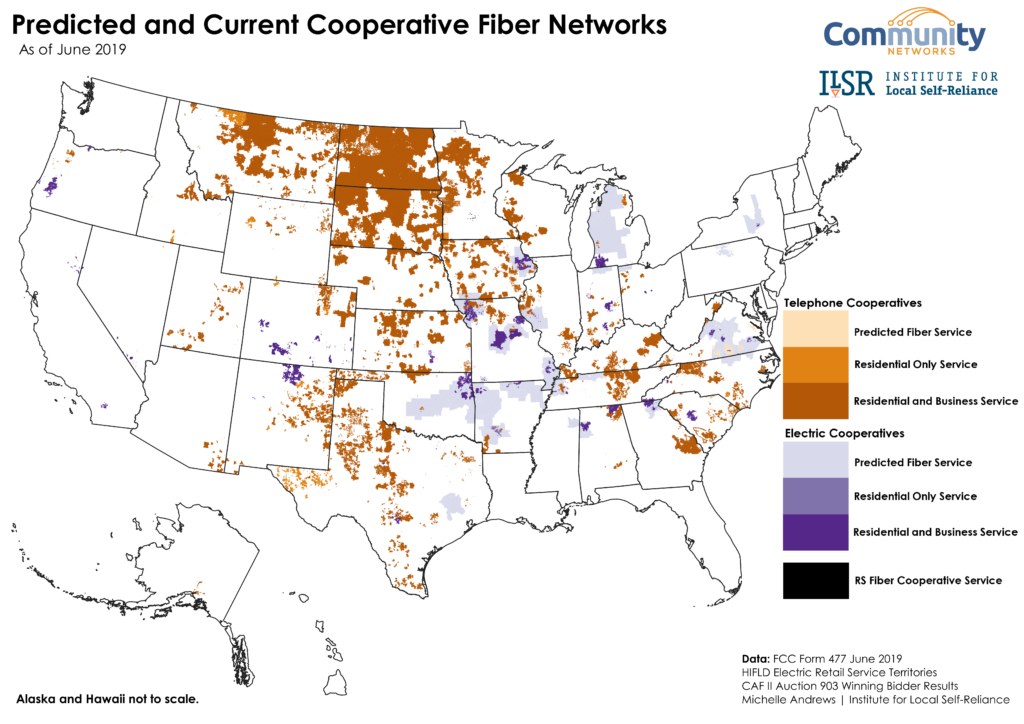
The most likely scenario for success is the addition of broadband service to an existing electric or telephone cooperative’s portfolio. In this case, an entity with experience in running a customer-facing operation and network for decades simply expands its service. The cooperatives are already serving mostly rural customers and do not crowd out for-profit cable and telecom providers. The FCC has recognized this and has explicitly included electric cooperatives in the Connect America Fund II initiative (which we will discuss later)
As we can see from the map above, the opportunity for rural broadband coverage from cooperatives is significant as rural areas often in the South and the Great Plains have low population density. Perhaps engaging both electric and telephone cooperatives in rural areas is an effective way to close the digital divide in some areas. These could take the form of public private partnerships and potentially avoid the pitfalls of muni-broadband.
Muni-Broadband has failed for different reasons. Research shows that most of the failed entities are urban, often engaging in direct competition with incumbent providers. Examples such as Monticello, MN, Salisbury NC, and Tacoma, WA come to mind. In other cases, the municipal broadband networks such as in Muscatine, IA, Utopia, UT had to be bailed out by taxpayers or the electric cooperative because it could not stay afloat. We also have Provo, UT and Groton, CT, which ended up selling to private companies at a great loss to tax payers, and Burlington, VT where the lack of oversight and cover-up of incompetence lead to failure to Bristol, VA where corruption meant the end of the network.
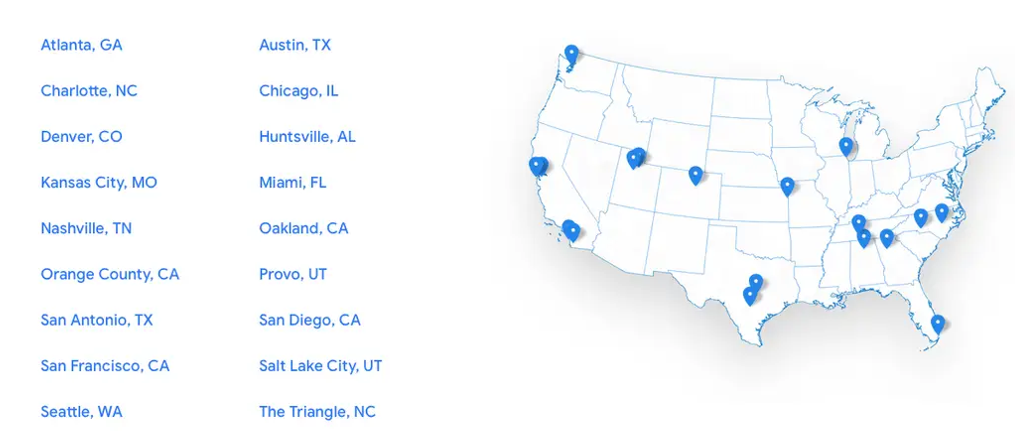
In 2010, Google announced that it would start providing broadband fiber connectivity in a number of cities to between 50,000 and 500,000 households. Cleverly, Google put out a request for information asking municipalities to apply to have Google offer fiber in their city or town. This reversed the traditional relationship between provider and municipality. Traditionally, the provider asks the municipality if it can provide service in the area. The municipality responds with what they ask for in terms of fees and extra services. Ever wondered why so many pools, parks, and sports areas are sponsored by telecom and cable companies? It was one of the demands of the city in order to allow the service provider to offer service in the town. By inverting the relationship and asking towns to apply to Google for consideration, Google shifted the power relationship, and was able to receive such favorable terms that telecom and cable providers went to cities and demanded the same terms and conditions that Google got, but they were never able to get by themselves. Under equal treatment rules, these cities had to extend the favorable Google terms and conditions to every other provider. Kansas City was the first city Google Fiber launched followed by Austin, Provo, and fifteen more cities. The Provo network was a defunct municipal network that was built for $39 million and then sold to Google for one dollar. After realizing the high cost to build a fiber network and the long delay of a payback to themselves, Google first halted further network expansions after it had deployed in five cities, and then switched to a private public partnership (PPP) model where the municipality builds the network and incurs the cost and Google sells the service. In addition, Google made an acquisition in the fixed wireless broadband space to also provide broadband wirelessly. This has slowed down the expansion significantly, but the scope has increased beyond what can be called a trial – as Google likes to call every endeavor they get into – as Google now covers 18 cities.
The 19th market for Google Fiber will be West Des Moines, Iowa. Similarly to Huntsville, Alabama, the city will build a fiber network for $39 million, in exchange Google will pay the city $2.25 for each household that connects to the network. Over the 20-year agreement, Google will pay at least $4.5 million to the city. The project will be completed by the end of 2023. By entering PPPs, Google gets the various cities to pay for the expensive built out and make money by providing the service. Google’s experience highlights that even one of the largest companies in the world does not have the focus, wherewithal and patience to actually build out a nationwide system, but relies on the government to pay for the physical buildout.
When the government helps in areas with adverse circumstances, either through low population density or low income, a business case can be made that allows the deployment of broadband services. The societal good that comes from broadband in the form of access to online learning for students, job resources for adults and an overall increase in computer skills will create greater long-term benefits than long-term costs.
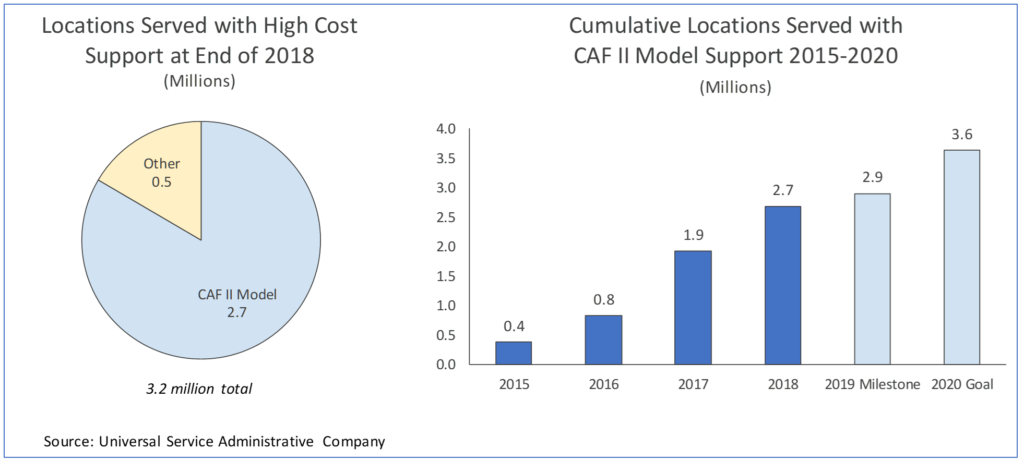
On the government side of the equation, the FCC has been very focused on allocating monies (and spectrum) for broadband. The FCC’s Connect America Fund (CAF) was born out of the National Broadband Plan from 2010 aiming to broaden the availability of broadband. Now in its second iteration, CAF II, the fund is a reverse auction subsidy for broadband providers, satellite companies and electric cooperatives to provide coverage in underserved areas.
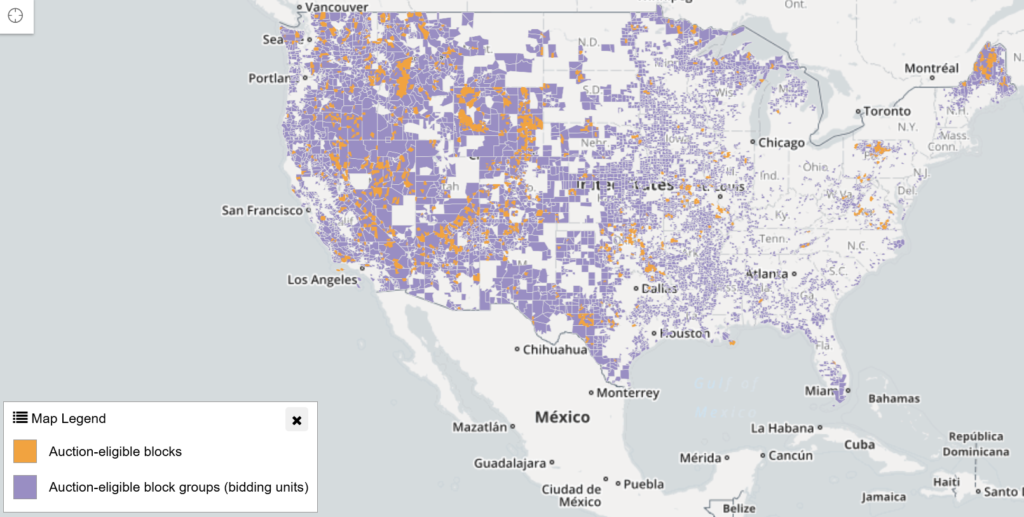
At the end of the CAF II auction, $1.49 billion of subsidies over ten years were awarded to provide broadband and voice services to 700,000 locations in 45 states highlighted in the map above. Prospective providers successively bid on who would cover the underserved market for less and less subsidy. This ensures that the area is covered for the least cost to taxpayers.
The CAF II and other government programs are increasingly closing the gap more than $20.4 billion over the next 10 years. The US Department of Agriculture has been one of the longest standing sources of support to bring broadband to rural America with $600 million per year from the ReConnect program. In October 2020, the FCC will launch the auction for the Rural Development Opportunity Fund (RDOF), a 10-year $20.4 billion program to bring broadband to areas that do not have broadband defined at 25 Mbit/ss download speed and 3 Mbit/s upload speed.
The biggest controversy around CAF II is the mapping issues. In a nutshell, if only one location in a census track has access to broadband, it is assumed that all locations have broadband. This is in a significant number of cases is not true and some locations have access when others do not. This is especially true in urban areas where we still have some high population pockets that lack access to broadband. Parts of the FCC Commission wanted to delay additional projects until the mapping problem was solved, whereas the majority voted to release the fund and work at the problem concurrently as the underserved markets are underserved even with a tighter requirement. While being criticized for its complexity and lack of clarity of how overachievement of the target goals gets recognized and impacts winning the subsidy, the program has been overall lauded a success.
When we look at what has worked and what hasn’t worked, it becomes apparent that the for-profit system has worked for 90% of Americans to have access to at least one broadband provider. The problem becomes the hard to reach, both in urban and rural environments. No matter how we look at the issue, it becomes clear that government and cooperatives plays a role to alleviate the problem as we need to fix a societal problem.
Since Silicon Valley giants like Google with almost infinite resources have balked at building out fiber in many urban areas and are relying on cooperatives or municipalities to foot the bill, the economics of building out hard to reach parts of the United States are even more difficult.
The broadband industry is investing between $70 billion and $80 billion per year to connect Americans, the wireless industry investing another $25 to $30 billion just shows that the industry can’t shoulder it alone.
Electric cooperatives as non-profits have a longer time horizon, which makes their investment in underserved rural areas easier, as they have an already established customer relationship with the prospective customers and an established connection to the location.
The CAF and other funds have worked by providing the minimal subsidy to cover underserved markets, but we just need more. Even though some have complained that it provides for only one choice ignoring that 85% of households have a choice of two wireline providers and 99% of Americans can chose between at least three mobile service providers. The counter argument for very rural parts of the United States is that one choice in an economically unprofitable market is better than no choice. Also, one has to consider that requiring every location to have two choices roughly doubles the cost of deployment and half of the infrastructure being idle.
The program will work even better with more accurate mapping of underserved areas and through that broaden its scope from mainly rural to also urban areas and become location agnostic. If a follow-up program not only wants to bring access but also competition to an underserved area, the government would have to not only double but probably quadruple if not quintuple the subsidy due to the doubling the cost of deployment while halving the expected revenue.
The consequences of not building out areas that do not have broadband access today – regardless if urban or rural – perpetuates the current trends where we have parts of society that cannot participate in the economic and social life of our country. As 2020 has shown us, broadband internet has become the lifeline of businesses and video conferencing has become a necessity for employees to work remotely. This means that many better paid jobs are closed to people depending on where they live regardless if it is an area without broadband in the urban or rural place. Unsolved this will force a further depopulation of rural America, a flight from unserved urban areas as critical employees and business owners are effectively prevented from earning a living there. At least as important is the equal access to education. Student homework and tests cannot be counted for grading unless every student in the class is able to participate. Without broadband access, not only children who live in these unserved areas are affected but also their classmates who have access.
For a country that is known for being as efficient, organized, and technologically advanced as Germany, its state of mobile networks constitutes a rare black mark. Germany is the third largest economy in the world with 82 million inhabitants (double that of California in half of the area) with a highly efficient and advanced high-tech manufacturing industry. Where it is struggling is with the digitalization of the economy and both fixed and wireless networks. Germany’s wireless networks are ranked 32nd out of 34 countries, ahead only of Ireland and Belarus. Yet no other European country has a larger share of 3G users than Germany, and it is not uncommon to fall back to EDGE networks both in urban and rural areas. The reasons for this atypical performance lie with the actions of regulators and companies alike.
In 2010, Germany auctioned 4G licenses with the requirement that within 5 years 97% of the population would be covered by 4G. However, even by 2020, every operator has failed to meet the 2015 buildout requirement. How could this happen in a country that prides itself on following the rules?
With every new generation, German mobile operators suffer from low technology adoption because they use the same playbook over and over again (3G, 4G and now 5G), resulting in the same poor outcome. Wireless licenses in Germany and most of Europe are tied to a specific technology, whereas US licenses can be used with any technology that allows a more efficient transition from one generation to the next. Regardless, German operators rightfully realize the high value of new spectrum for next generation technology and bid more money per capita for next generational licenses than anywhere else in Europe. As a result of the significant investment in licenses, German operators position the next generation product as a premium product with a significant price premium. For this reason, consumers and businesses are reluctant to adopt next generation service plans and devices, leading to suppressed next generation revenues and profits. These low profits are then used as a justification limit capital investment in next generation technologies. Consequently, German wireless networks cover less area than they can and should. This self-fulfilling prophesy is now in its third iteration. We have seen it in 3G, 4G, and now 5G in Germany.
US carriers start from the same point of recognizing the value of next generation technology and spectrum, and US spectrum auctions have yielded the highest values globally. Unlike Germany, US mobile operators make the new technology available for the same price point as the last generation technology, creating greater profitability through a significantly lower cost structure given that next generation technology typically lowers the cost per gigabyte by 90% over the previous generation. As a result, US mobile operators see a rapid shift from the old generation to the next generation network usage as customers upgrade their devices to be able to take advantage of the new networks. By holding the price points steady for next generation networks with their faster speeds, US operators are under less price pressure than European operators, allowing operators to invest heavily in their networks and differentiate on coverage. As a result, the US ranks fifth in the world for 4G availability, behind South Korea, Japan, Norway and Hong Kong, which make up a combined 9.3% of the areas of the United States. As a result, everyone wins in the US approach: customers have faster access to next generation technology, and operators make a higher profit.
Germany’s cost problem is compounded by a legal and regulatory regime that does not favor the building of cell sites similar to Section 332 of the Telecom Act. German building permits are notoriously lengthy endeavors that take a long time. Frequent lawsuits against many cell sites lead to drawn-out legal reviews which slows down network buildout. All of these policies are not friendly for capital investment in wireless networks.
The problem of how to cover thinly populated rural areas in Germany persists. Mobile operators complain that it is unprofitable to cover many rural areas. During the 2018 Mobilfunkgipfel (Mobile Summit) between the German government and mobile operators, the government committed to share part of the cost of covering rural parts of Germany.
Coverage issues in rural parts of a country are not unique. Germany’s neighbor France – roughly the size of Texas – has tackled the issue in three different ways. For the 2G rollout mobile operators, the central government, and the departments (provinces) with coverage gaps in the rural parts of France split the cost three ways between the parties. In 2015, the French government set aside $1 billion to close the 3G coverage gaps. In 2018, the French government came to an agreement with the four incumbent operators to extend the license term in exchange for closing coverage gaps and to install jointly more than 5,000 masts and antennas.
There are four key lessons that we can take away from the German and French examples:
The business model matters. American operators are providing world class service, especially considering the size of the country. The US operator model of capturing profit through cost reduction rather than price increases is the superior model. It results in faster and higher adoption of next generation technology and greater capital investment. The one US carrier who tried to charge a premium for 5G, Verizon, has two European executives at the helm. Customer pressure quickly forced Verizon to abandon its European model of a price premium and revert back to the US model.
A mobile-friendly regulatory regime that enables the rapid building of new cell sites makes a positive difference. It is a no-brainer that when it is difficult for operators build new sites, coverage suffers.
Even medium-size economically prosperous countries like France and Germany have similar problems to economically build out mobile networks. While it is more cost effective to build out rural areas with wireless rather than fixed technology, the business case is far from a foregone conclusion.
The comparison between the US and more tightly regulated countries shows that incentives and support for wireless networks without red tape and strings attached are creating better results.
Stay-at-home orders, school closings, and social distancing have raised the issue of the digital divide in the United States. While the availability and affordability of connectivity is important, owning a device to access the internet is equally important. Broadband without a device is even less useful than a device without a network. A government program that tries to close to digital divide needs to pay attention to where a digital device gap does and does not exist.
Nielsen just published its Total Audience Report 2020 which also provides insights on device ownership by race. This allows us to glean important insights from the data and how it should inform policy makers, as there are similarities and significant differences when it comes to device ownership.
The most owned device in the United States is the smartphone. Ninety-three percent of all Americans own one. Contrary to common stereotypes, there is no significant difference when it comes to smartphone ownership – mobile is colorblind. White Americans are actually the laggards with 93% ownership when it comes to smartphone ownership as Blacks (95%), Hispanics (97%) and Asians (97%) are all reporting higher smartphone ownership. The high ownership is driven by the significant utility of smartphones – the Swiss Army Knives of the connected world. It fits in your pocket, allows people to talk, text and use the internet, and is readily financed through mobile operators or device manufacturers, bringing down the cost of the device to a manageable monthly installment.
Where we are seeing substantial differences is in computer and tablet ownership. As of March 2020, an average of 78% of Americans owned a computer. Eighty-nine percent of Asian Americans own a computer, followed by 80% of whites, but only 68% of Blacks. Similarly, 63% of Americans own a tablet. Again, Asian Americans have the highest device ownership with 72%, followed by white Americans with 64%, but only 55% of Black Americans own a tablet. Tablet and Computers are essential to closing the homework gap and, even more importantly, the testing gap. Unless every child and student has access and is able to participate in online learning and testing, the progress and grades for every child in the class cannot be counted in their official school record. This makes universal access critical for all, regardless of income and access. We need to make the ownership of computers and tablets as color blind as the ownership of smartphones.
While smartphone ownership has increased from March 2019 to March 2020, computer and tablet ownership has declined, together with ownership of other, increasingly obsolete technology hardware like Blue-Ray DVD Players, DVRs, and game consoles.
Blue-Ray DVD players and VCRs have been supplanted by video-on-demand services, which have seen a significant increase in adoption. Game consoles have also suffered from the shift to mobile gaming on smartphones and the lack of the introduction of new consoles. Both the Microsoft Xbox and the Sony Playstation 4 are seven years old and technologically obsolete, with both devices receiving a next-generation model at the end of 2020. Computers, including laptops, as well as tablets have also been struggling as they have been lacking the sorts of new features that have consumers chomping at their bits to buy a new one.
Any stimulus plan that is genuinely interested in closing the digital divide and the resulting homework and testing gaps needs to address the device gap as well. Broadband networks without the right devices are like one-handed clapping. To improve learning and to raise and broaden the standard of digital economy skills, every student should have a device that can access broadband networks. If a student’s family cannot afford such a device, the government should provide aid to acquire one. If the government is serious in bringing the high-tech device supply chain back to the United States, it can require that the devices are being manufactured in the United States and have a proportion of the component come from the United States as well so that the stimulus money actually stimulates the US economy.
The proliferation of 5G launches offers a significant opportunity for the government to stimulate innovation akin to President Franklin D. Roosevelt’s Arsenal of Freedom initiative or the space program’s myriad of spin-off innovations that have made our lives better.
5G-capable devices should be at the core of such a program with both x86 and ARM processors. American companies like Intel, AMD, and Qualcomm would provide the technology that is at the heart of these devices – the processor – and sell them to any device manufacturer. Apple would build ARM processors for its own devices. Such a device stimulus plan could be the important accelerant for ARM processors in computers and laptops. ARM processors are at the heart of smartphone and tablets as ARM processors are very energy and heat efficient, but they only slowly make an entry into the computer world as their compute power is approaching and in some cases overtaking x86 processors. Qualcomm together with Microsoft has launched an ARM laptop and Apple is rumored to use its A-series processors in upcoming MacBooks. China’s Huawei has designed its entire AI, called Ascend, and a general computer program called Kunpeng on ARM technology and plans to build an entire ecosphere around it with a $1.5 billion investment over the next five years. The United States should at least be able to match a similar kind of investment to make sure it does not fall behind if there is a significant shift to ARM computing.
With the country on the brink of a slow and painful recovery from the pandemic, the time is now for Congress to direct money where it will have the biggest economic and societal impact. Right now, closing the digital divide and the homework gaps is precisely such an opportunity. Enabling more Americans to afford an Internet-capable device is critical to the country’s recovery, and one of the fastest ways to give a voice to more black and brown Americans who are otherwise being left out of the country’s economic and other successes.