Device OEMs and carriers spent much of 2025 positioning AI as the defining reason to upgrade. On-device intelligence, Smarter cameras, Conversational assistants baked into the operating system. The marketing spending behind those messages was substantial. The consumer response, measured in actual purchase decisions, was not.

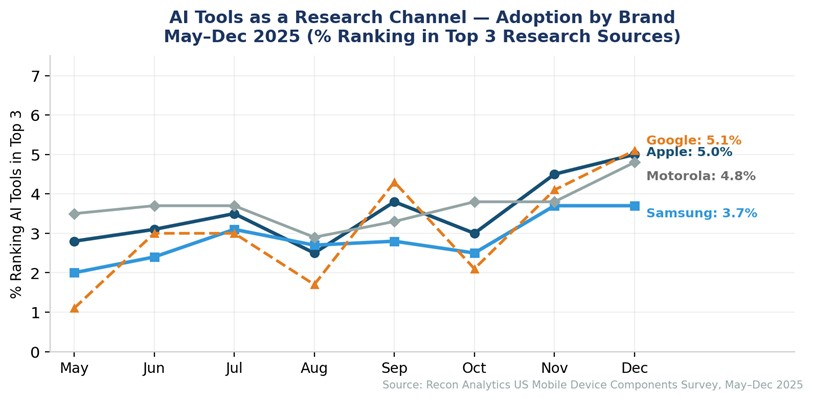
According to Recon Analytics’ US Consumer Device Purchase Journey — Part 2: Purchase Drivers and Feature Priorities, which tracked purchase behavior across more than 104,000 US respondents from May through December 2025, hardware failure was the single largest purchase driver for every brand tier in every single month of the tracking period. The range ran from 5.6 percent to 13.2 percent across brands, depending on the month. AI feature priority, by contrast, peaked at 5.1 percent for Motorola in December, with Samsung Non-Flagship nearly tied at 5.0 percent in the same month, while Apple and Samsung Flagship were at 4.5 percent and 2.8 percent, respectively. Performance and battery life combined accounted for 27 to 30 percent of feature selections throughout the period. The industry’s marketing story and consumers’ actual motivation have rarely been further apart.

Broken Phones Drive More Sales Than New Ones Do

The report’s most structurally important finding is also its simplest: new model launches do not generate demand. The ‘new model available’ driver accounted for just 1.1-4.6 percent of purchase decisions across brand tiers, the smallest driver in the entire dataset. Hardware failure drove purchases at rates typically two to six times higher across most brand-month combinations, with the gap widest among value-tier brands. Consumers replace devices primarily because their current one no longer functions, not because a shinier one arrived in a press release.

That distinction matters enormously for how carriers and OEMs plan their promotional calendars. Forced-replacement buyers cannot defer. They accept the best available offer when they need a device, not when a manufacturer wants them to buy one. Treating that demand pool as if it were promotion-responsive misreads its urgency structure, and likely leaves margin on the table.

Table 1.1: Device Stopped Working — Forced Replacement Cycle, May–Dec 2025

Source: Recon Analytics US Mobile Device Components Survey.

The data also reveals a counterintuitive finding about hardware quality that runs counter to the value-segment narrative. Budget devices do not just cost less; they wear out faster. As Table 1.1a shows, Motorola users hold their phones for an average of 1.88 years, the shortest tenure in the dataset, yet their average failure rate is 10.7 percent. Samsung Flagship users hold their devices for an average of 2.62 years, the longest tenure of any tracked brand, and register a failure rate of just 8.1 percent.

Table 1.1a: Estimated Average Device Tenure by Brand, Q4 2025

Source: Recon Analytics US Mobile Device Components Survey.

Premium hardware withstands extended ownership better than budget hardware, consistent with patterns observed throughout the study period. Apple users average 2.24 years of device tenure and register the lowest failure rate in the dataset at 7.9 percent, confirming that the tenure-failure inversion holds across both premium tiers. Motorola’s 9.2 percent fresh-acquisition rate, the highest among tracked brands, is not evidence of strong organic demand. It is the downstream consequence of a replacement cycle that restarts sooner due to the original hardware degrading faster. That is a structural ceiling on how much margin any promotional strategy can recover in the value segment.

The Carrier Calendar Runs the Market

If hardware failure drives those who replace their device, carrier promotional calendars drive when they do it. The seasonal signature for promotional offers—July peaks for back-to-school, August troughs as campaigns close, and November-December rebounds around Black Friday —appeared in lockstep across all five brand tiers tracked in the study: Apple, Samsung Flagship, Samsung Non-Flagship, Google/Pixel, and Motorola. Five tiers with entirely different products, price points, launch windows, and marketing strategies, all moving in the same seasonal rhythm.

The most parsimonious interpretation is that OEM launch timing does not govern purchase decisions at the market level. It is the carrier promotional calendar operating as a shared timing mechanism across the entire industry. OEMs that plan demand forecasts primarily around their own launch events are possibly treating a secondary driver as the primary one.

Software update obsolescence is the one driver that offers a genuine structural advantage to carriers and OEMs willing to exploit it. Running at roughly half the rate of hardware failure, 2.6 to 6.2 percent across the period, update-obsolescence buyers are the most forecastable pool in the market. End-of-support dates are published in advance. The affected device population is identifiable by model. The replacement decision, once support expires, is non-discretionary. Carriers with visibility into device models on their networks can reach those buyers three to six months before the end-of-support date, ahead of competitive search, with an offer calibrated to urgency. No other driver in the dataset offers that combination of predictability and addressability.

Google’s Numbers Tell a Different Story Than They Appear To

The Pixel data in this report is the most analytically complex and the most instructive for understanding how launch-dependent demand differs from organic demand.

Google’s purchase driver and feature priority metrics exhibit a consistent trough pattern in May and August, which appears in every table in the report. May’s lower readings reflect Pixel 9a launch dynamics: a-series buyers who purchased at general availability are newer-device holders with less accumulated hardware frustration and weaker brand motivation than the core Pixel base. Their inclusion in the May survey pool dilutes urgency metrics across the board. Google’s May failure rate of 6.8 percent and August reading of 5.9 percent are the two lowest in the Google series for exactly these reasons.

August is more complicated. The buyers who responded most urgently to July’s concentrated promotional activity had already converted by the time August surveys ran. Google’s July failure rate hit 13.2 percent, the highest reading for any brand in any month, as long-tenure Pixel 9-era holders reached their breaking point. Then it collapsed to 5.9 percent in August. The 95 percent confidence intervals for those two months, July [11.6%, 14.8%] and August [3.9%, 7.9%], are non-overlapping (z = -5.61), confirming that this is a compositional shift rather than sampling noise. On top of that, the Pixel 10 launched on August 28, meaning brand-motivated upgrade buyers were in a pre-purchase holding pattern for 28 of August’s 31 days. They showed up in September.

The result is that Google’s battery priority dropped by 9.9 percentage points from July to August, the largest confirmed metric swing across all ten feature categories in the dataset. Google’s brand reputation reading hit 2.9 percent in August, the series nadir, then recovered to 7.4 percent in December, the highest reading in the Google series and among the highest readings of any brand in any month during the study period. Both numbers are real. Neither is representative of Pixel’s underlying demand dynamics. Carriers and analysts reading Google’s monthly metrics without accounting for these structural troughs will systematically misread the brand’s actual competitive position.

What the Replacement Pipeline Looks Like Entering 2026

The demand picture for 2026 is governed less by any specific promotional campaign or AI feature rollout than by tenure and hardware degradation operating across a large installed base.

Samsung Flagship enters 2026 with 64.4 percent of its installed base in the two-plus-year upgrade window, the highest upgrade-eligible share of any brand, consistent with its 2.62-year average tenure. Apple’s 51.8 percent upgrade-eligible share, applied to its 55.9 percent installed-base share, produces the largest absolute pool of replacement-ready consumers in the market. Both pools are motivated primarily by performance and battery urgency, with carrier promotional offers providing the timing trigger rather than the underlying motivation.

Feature priorities tell a consistent story across the entire study period. Performance and battery lead every brand tier every month. Camera and storage form a durable secondary tier. AI feature priority, despite 12 months of industry marketing, remains below display quality and well below the hardware fundamentals that have driven replacement decisions for the better part of a decade. That gap may narrow as on-device AI capabilities mature and differentiate more visibly in daily use. Whether AI features will drive purchases in subsequent cycles as consumer familiarity grows is beyond the scope of this study, but nothing in the 2025 data suggests an inflection point is near. In 2025, according to the data, it had not narrowed yet.

The consumers replacing their phones in 2026 will mostly be doing it because something stopped working, or because a carrier made them a deal they could not ignore, or because their three-year-old Motorola finally gave up. This pipeline estimate assumes carrier promotional intensity and consumer credit conditions remain broadly consistent with 2025; a meaningful macro contraction or carrier subsidy reallocation toward broadband convergence rather than device promotions would compress conversion from the replacement-ready pool. The AI pitch may be the reason they choose one device over another at the moment of purchase. It is almost certainly not the reason they walked into the store.


Note: This report tracks completed purchase journeys. The survey captures US consumers who completed a device purchase during the study period. Consumers who considered upgrading but did not purchase are not represented in the data. The finding that AI features did not drive completed purchases is robust; whether AI features contributed to purchase deferrals cannot be determined from this dataset. This analysis covers US consumer purchases only. Enterprise procurement, trade-in program dynamics, and international markets are outside the scope of this dataset and may differ materially. Carrier-switching dynamics, including switching rates by brand tier and the role of competitive offers in driving net additions, are tracked separately and will be published in a forthcoming report in this series.

Recon Analytics’ US Consumer Device Purchase Journey report series, based on the Recon Analytics US Mobile Device Components Survey, covers more than 104,000 US respondents across five consecutive quarters from Q4 2024 through Q4 2025. You can find it here: US Consumer Device Purchase Journey – Part 2: Purchase Drivers and Feature Priorities

ANALYSIS | US SMARTPHONE MARKET

The US smartphone market loves good narratives. Apple versus Samsung. Premium versus value. Loyal fans versus deal-hungry switchers. A new deep dive from Recon Analytics, based on 104,408 US consumers tracked over five quarters, is here to complicate every one of those stories.

The headline is blunt: Apple ended 2025 with 55.9 percent of the US installed base, up 5.9 points in a single year. Samsung fell 4.9 points to 27.8 percent. The gap between the two brands, 28.1 points, is now 62 percent wider than it was twelve months ago. Five consecutive quarters of directional movement, with share gains accelerating rather than moderating, is consistent with a structural realignment rather than a cyclical fluctuation. The 2026 upgrade data will be the definitive test. The market share here is the installed base of over 104,000 US consumers, whose device information was passively collected during the survey. While we believe the data is robust, with a 0.3% margin of error (95% CI), the market share may still differ from the traditional shipments-based market share. The quarterly market-share trends based on the installed base provide a more directional analysis of the market than an absolute one.

Table 1.1: Quarterly Market Share Trends (% of Installed Base)

Note: *Others include OnePlus, LG, TCL, Xiaomi, Nokia, BLU, and remaining brands. Source: Recon Analytics US Mobile Device Components survey, Q4 2024–Q4 2025.

The Ecosystem Trap Nobody Can Escape

Apple is not winning on specs. The iPhone 17 series ships with a smaller battery than leading Android rivals. Its camera array does not top the industry benchmarks. What Apple has built instead is a gravitational field: iMessage, AirDrop, FaceTime, and the seamless handoff between iPhone, iPad, Mac, and Watch. Switching away from Apple does not just mean buying a new phone; it means abandoning a digital life. No hardware specification can compete against that.

The data confirms what Apple’s own marketing has long implied: its best salesperson is a current iPhone user. Friends and family recommendations ranked as the top research source for Apple buyers every single month across the May–December 2025 tracking period. No paid media budget can replicate a word-of-mouth engine that runs entirely within an installed base of 150 million-plus American consumers.

Samsung’s Two-Brand Problem

Here is the part of the Samsung story that most competitive analyses get wrong: there is no single Samsung. There are two, and blending them together produces numbers that are wrong for both.

Samsung Flagship, the Galaxy S, Z Fold, and Z Flip series, averaged $1,056 per device in Q4 2025 (Recon Analytics US Mobile Device Components survey, Q4 2024 – Q5 2025). That is $69 above Apple’s average of $987. Samsung’s premium users are paying more than iPhone users. The Galaxy S and Ultra command high customer satisfaction, with a flagship satisfaction score (cNPS) of 32.4 (n=37,302, May-Dec 2025), compared to Apple’s 30.4 (n=107,406, May-Dec 2025). Note: the 2.0-point gap between these scores sits at the cNPS noise threshold; confirm subgroup-level margin of error before asserting a directional lead. The component net promoter score (cNPS) is Recon Analytics’ proprietary version of the NPS. Recon Analytics’ cNPS covers smartphones from 22 dimensions. Also, 64.4 percent of the Samsung flagship installed base is now in the 2-plus-year upgrade-eligible window. That is the most financially concentrated upgrade opportunity in Android heading into 2026.

Then there is Samsung Non-Flagship, the Galaxy A-series, averaging $243 per device in Q4 2025, down sharply from $316 a year ago (Recon Analytics US Mobile Device Components survey, Q4 2024–Q4 2025). Its satisfaction score (cNPS) sits at 22.3, with 26.9 percent of users actively detracting from the brand. The A-series does not just underperform; it creates potential brand-perception drag that shadows every Samsung consumer evaluation. The $813 gap between Samsung’s two tiers is the starkest within-brand pricing divide in the market.

The consideration data makes the structural problem concrete. Samsung Non-Flagship buyers cross-shop Apple at a higher rate than Samsung Flagship buyers, 23.1 percent versus 20.5 percent (Recon Analytics US Mobile Device Components survey, May-Dec 2025; Samsung Non-Flagship, n= 32,263, and Flagship n=37,302 respectively), and that gap widened through the second half of 2025. Whether this reflects an aspirational pull toward Apple specifically or the generally higher brand fluidity among value-tier buyers is a distinction the consideration data raises but does not fully resolve; both mechanisms likely contribute.

Google Ran an Experiment. The Results Were Not Encouraging.

Google’s 2025 is a case study in the difference between rented share and owned share. Pixel climbed from 2.6 percent of the US installed base in Q4 2024 to 5.3 percent in Q3 2025, driven by carrier promotions and the launch of the Pixel 10. By Q4 2025, it was back at exactly 2.6 percent. Exactly where it started. The precision of that reversion is striking.

The hardware was not the problem. Google Pixel Pro earned the highest device-level satisfaction score (cNPS) in the entire dataset, 33.2 cNPS, with the lowest detractor rate among all flagship-tier devices. The product genuinely converts buyers into advocates. The challenge is that Pixel advocacy operates largely outside the physical environment where most purchase decisions are finalized. Pixel devices appear on carrier websites, but are underrepresented in the physical store, according to Recon Analytics’ survey data (see upcoming Consumer Device Purchase Journey – Part 3 report), 53 to 55 percent of US device sales through carrier and big-box channels are driven by in-store staff recommendations, floor placement, and promotional subsidies — not web listings. A phone can be available online and still be invisible at the point of conversion. That is Google’s distribution problem: not absence from the catalog, but absence from the moment that matters.

Google’s 2025 trajectory is the reference point every brand strategist in this market should keep close to. A promotion without a plan for what happens when it ends is a subsidy, not a growth strategy.

Motorola Does Not Get Enough Credit

While the industry fixates on the premium tier, Motorola has quietly done something harder than it looks: hold ground. The brand maintained 11.0 to 11.4 percent share across all five tracked quarters, with a consistent Q4 seasonal lift driven by holiday gift purchases. Its average device price runs around $313 to $333, flat across the year, with no pretensions toward premiumization. Motorola’s franchise is built on carrier placement and price discipline, and it executes that positioning with a consistency that belies its unglamorous reputation.

The satisfaction picture is mixed: non-flagship CNPS at 20.7 (cNPS), with 28.6 percent detractors, suggests elevated hardware quality friction at the low end, but the brand’s structural stability in a year when Samsung shed nearly 5 points is nothing.

The Upgrade Pipeline That Will Define 2026

Here is the question that makes 2025’s data genuinely consequential: what happens to the upgrade cycle next year?

Apple’s 51.9 percent upgrade-eligible rate, applied to its dominant installed base, produces the largest absolute pool of upgrade-ready consumers in the market. Samsung Flagship’s 64.4 percent eligible rate, though applied to a smaller base, represents the single most financially concentrated upgrade opportunity in Android. The two pools together define the 2026 replacement market.

Samsung’s most immediate strategic decision is whether it converts that aging flagship base before Apple does. Galaxy S users are holding devices longer than any other tracked segment and are currently cross-shopping Pixel as their primary Android reference point rather than iPhone. That is a narrower competitive window than most Samsung strategists probably assume. If Samsung can capture the upgrade cycle with its own flagship base, the share-loss story changes. If Apple absorbs another wave of premium converts, the 28-point gap could widen further.

The data does not predict outcomes. But it tells you exactly where the pressure points are, which side has the momentum, and which brand’s growth is real. Right now, Apple has the momentum. Google has the product but not the shelf. Samsung has two businesses that need two strategies. And Motorola has quietly survived a year that was much rougher than the headline numbers suggest.

The 2026 upgrade cycle is loaded. Whoever takes it may well determine whether this is a structural realignment or a temporary gap. The thesis that this is a structural shift, not a cycle, has three observable tests. First: if Samsung Galaxy S26 captures more than 55 percent of its own upgrade-eligible base in Q1-Q2 2026, the share-loss momentum is arrestable. Second: if Apple’s installed base reaches 58 percent by Q2 2026, the shift is accelerating past Samsung’s realistic recovery window. Third: if Google’s share holds above 3.5 percent through Q2 2026 without a promotional event, it has converted rented share into owned share for the first time. Any one of these outcomes materially changes the 2026 forecast.

Note: This analysis covers the US smartphone installed base from Q4 2024 through Q4 2025. It does not address global market dynamics where Samsung’s competitive position differs materially; carrier incentive structures that drive short-term share movements independent of brand preference; or price elasticity effects that may account for some portion of Apple’s installed base growth. These variables are available for analysis in subsequent phases of the device-purchase-journey study. If you want to find out more about the Recon Analytics’ US Consumer Device Purchase Journey Part 1: Market Landscape, Brand Performance & Consumer Satisfaction report, which is based on 104,408 US respondents tracked from Q4 2024 through Q4 2025, please visit here: US Consumer Device Purchase Journey – Part 1: Market Landscape, Brand Performance & Consumer Satisfaction – Digital Product Reports

Verizon’s nationwide wireless outage on January 14, 2026, was the kind of event that doesn’t just disrupt a Tuesday: it hands every competitor field rep a talking point they’ll use for the next 18 months. Recon Analytics surveyed 1,702 business decision-makers between January 21 and February 25, 2026, capturing reactions in the immediate aftermath. The results tell a story that is both better and worse for Verizon than the company probably wants to hear.

The Outage Was Not Felt Equally

The January 14 outage was not a uniform experience across the business market. Impact scaled with company size, and the 23-percentage-point spread between large and small business is the first structural finding.

Large businesses reported the highest direct impact: 44% said the outage affected their company. Midsize companies came in at 33%. Small businesses sat at 21%. The remaining respondents in each segment indicated either no impact or were unsure. The gradient makes operational sense. Large organizations run more lines, more devices, more mission-critical workflows over wireless. A national field service operation or a distributed retail chain has thousands of points of exposure. A five-person shop has a handful. The outage hit large businesses hardest because they have the largest surface area. Large enterprises also operate more redundancy infrastructure, dedicated IT, secondary carrier contracts, Wi-Fi fallback. Whether the 44% figure reflects greater network dependency or greater issue-reporting sensitivity is not separable from this data.

The awareness data runs in the opposite direction. Among small businesses, 12% said they weren’t even aware an outage had occurred, compared to 3% of large enterprises and 7% of midsize. Small businesses run lean. If the phones worked well enough that day, or if the outage was brief enough in their geography, it didn’t register as a business event. Large enterprises have someone whose job is to know when the carrier goes down.

This awareness asymmetry matters for Verizon’s sales team. The enterprise segment felt the outage acutely and paid attention. That’s also the segment where Verizon has historically leaned on network reliability as its core value proposition. The pitch is that you pay more because the network doesn’t go down. January 14 complicated that pitch in the accounts where it matters most.

Figure 1: Was anyone in your company impacted by the Verizon Wireless outage of January 14th, 2026?

Source: Recon Analytics B2B Pulse, January 21st-February 25th, 2026. Percentages based on business respondents. Total n = 1,702, MoE = 2.4%; Large Business (1,000+ employees) n = 561, MoE = 4.1%; Midsize (20-999 employees) n = 538, MoE = 4.2%; Small Business (<20 employees) n = 603, MoE = 4.0%

Opinion Change Was Contained, Not Neutral

Among business customers who were aware of the outage, stated opinion change was limited. Across all size segments, roughly two-thirds said the outage did not change their opinion of Verizon. Opinion stability was statistically consistent regardless of company size.

The more operationally significant data is among those whose opinions did shift. Roughly 5-6% across segments said, “much more negative” and 27-29% said “somewhat more negative.” Combined negative sentiment ran approximately 32-35% across all segments. For an event that hit on a single day lasting about 10 hours, generating negative opinion change in roughly a third of aware business customers is a credibility problem if the narrative isn’t actively managed.

One caveat on the “no change” majority: it captures two distinct customer types that the data cannot separate. The first is the genuinely loyal customer who considers this within the bounds of acceptable carrier performance and has no intention of changing anything. The second is the customer who already held a neutral or negative opinion of Verizon before January 14, who are already at risk of leaving. Both sit in the same response bucket. The data cannot tell you how large each population is.

 Figure 2: (only if impacted by outage) How has the network outage changed your opinion of Verizon Wireless?

Source: Recon Analytics B2B Pulse, January 21st-February 25th, 2026. Percentages based on business respondents who indicated they were impacted by the outage. Total n = 551, MoE = 4.2%; Large Business n = 246, MoE = 6.2%; Midsize n = 179, MoE = 7.3%; Small Business n = 126, MoE = 8.7%

The Loyalty Question Is Where the Size Gap Becomes a Revenue Conversation

Because no pre-outage baseline is available for switching intent in this sample, the figures below represent a post-event snapshot, not a measured change from prior intent levels.

Among current Verizon Wireless business customers asked how the outage affected their likelihood of staying after their current agreement, small businesses were the most forgiving: 65% said the outage had not increased their likelihood of changing providers, 28% said they were more likely to shop around, and 7% were unsure or did not respond. Large businesses showed a different picture, with 39% saying the outage had not increased their likelihood of switching, 59% said they were more likely to evaluate alternatives, and 2% were unsure. Midsize was a statistical tie.

Among large business Verizon customers, 59% said the January 14 outage made them more likely to evaluate alternatives when their contract comes up. Remember, intent to shop is different from switching. Contract lock-in, device payoff schedules, multi-line complexity, and the operational headache of migrating a large business all create meaningful friction between stated intent and revealed behavior. Enterprise switching intent historically overstates eventual switching behavior. Even accounting for that gap, a post-event snapshot where 59% of large business Verizon customers express elevated interest in alternatives is a leading indicator that the competitive pipeline has expanded.

Enterprise wireless agreements typically run one to three years. The cohort of large accounts whose contracts expire in 2026 and 2027 is now at elevated churn risk compared to January 13. Verizon’s enterprise sales team should be in front of those accounts before AT&T and T-Mobile arrive with a pitch deck that opens on January 14.

 Figure 3: (currently using Verizon) How did the outage impact the likelihood of you staying with Verizon Wireless at your next renewal?

Source: Recon Analytics B2B Pulse, January 21st-February 25th, 2026. Percentages based on business respondents who self-reported current Verizon Wireless use. Total n = 510, MoE = 4.3%; Large Business n = 201, MoE = 6.9%; Midsize n = 167, MoE = 7.6%; Small Business n = 142, MoE = 8.2%

The Non-Verizon Market: Enterprise Forgives, Small Business Does Not

Among business customers not currently on Verizon, the outage produced differentiated responses that also track with company size.

Large businesses remained the most open to Verizon despite the outage: 81% said they would still consider Verizon when their current agreement expires. One bad day doesn’t remove a major carrier from consideration. Enterprise procurement decisions involve pricing, coverage, device ecosystems, and account support infrastructure. Small businesses reacted more negatively to the outage, even though they did not experience the outage directly. 24% of small businesses said they would no longer consider Verizon, while 26% said they were unsure. A single outage is a data point, not a disqualifier, but can unbalance customers that are on the fence.

Figure 4: (Not currently using Verizon) How did the outage impact the likelihood of you considering Verizon Wireless next?

Source: Recon Analytics B2B Pulse, January 21st-February 25th, 2026. Percentages based on business respondents who do not use Verizon Wireless (self-reported). Total n = 1,064, MoE = 3.0%; Large Business n = 341, MoE = 5.3%; Midsize n = 334, MoE = 5.4%; Small Business n = 389, MoE = 5.0%

What Verizon Has to Do Now

The January 14 outage created a two-front problem. In the existing base, large business accounts are at elevated renewal risk. In the prospect market, small businesses have partially written Verizon off. But both are addressable.

Verizon’s enterprise team should prioritize proactive outreach to its large account base before those contracts expire. Generic reliability commitments won’t land. The message needs to be specific: what failed, what was fixed, what redundancy was added, what the SLA improvement looks like going forward. Enterprises don’t need apologies. They need engineering answers.

On the prospect side, the small business perception problem is harder because it’s driven partly by information Verizon doesn’t control. The counter-narrative has to reach small business decision-makers through channels they trust: peer networks, trade media, and the resellers and agents who carry Verizon’s products into that segment.

The January 14 outage was one bad day, which must be addressed with customers to protect accounts that could take years to win back if lost.


RECON ANALYTICS ACQUIRES ATOM INSIGHTS, EXPANDING GLOBAL DEVICE INTELLIGENCE

Boston, MA and Montreal, Canada — March 16, 2026 — Recon Analytics has acquired Atom Insights, a device market intelligence firm with operations in Canada and India. Terms were not disclosed.

Hanish Bhatia, Founder of Atom Insights, joins Recon Analytics as Vice President of Device Intelligence. Bhatia previously served as Associate Director at Counterpoint Research, where he covered global smartphone and device markets for seven years. All employees of Recon Analytics Canada, Recon’s U.S.-based device intelligence group, and its India operations will report to Bhatia.

The acquisition integrates Atom Insights’ global device shipment, sell-through, and component-level intelligence into Recon’s customer research platform, creating the industry’s first end-to-end intelligence service from silicon to subscriber sentiment. Atom Insights tracks device sell-through at the model level across 40-plus countries, covering 400-plus device OEMs and 25-plus semiconductor vendors across smartphones, tablets, wearables and PCs.

“We have spent four years building the customer insights infrastructure that the U.S. telecommunications industry runs on. We built this platform deliberately, like a puzzle, with a connector piece already designed for exactly this moment. We can measure what subscribers experience across 22 dimensions of satisfaction matched to their specific handset hardware, and we know what is inside those devices. What we needed was someone who could tell us how many of them shipped, through which channels, and across which markets. Atom Insights and Hanish Bhatia are the piece we built the that connector for,” said Roger Entner, Analyst and Founder of Recon Analytics.

“Recon is the only firm that can show how a specific handset performs on customer satisfaction matched to real hardware IDs, and tell clients what to do about it,” said Bhatia. “Combining that with Atom Insights’ supply-side data creates a device analytics capability that does not exist anywhere else.”

“Atom Insights lets us answer which device configurations drive satisfaction, which component choices create churn risk, and how OEM decisions ripple through carrier economics,” said Brett Clark, Analyst and COO of Recon Analytics.

Atom Insights’ device intelligence integrates alongside Recon’s Pulse service, on which the largest U.S. telecommunications companies rely for competitive decision-making. Pulse fields more than 15,000 U.S. telecom consumers and up to 1,200 telecom businesses weekly in English and Spanish. Beyond telecom, Pulse reaches 6,000 consumer and business AI respondents, the largest AI customer insights service in the world, and up to 6,000 airline travelers weekly.

Atom Insights’ data will also be available across all three tiers of Recon’s AI platform: Ghost Lab for outside-the-firewall analytics across Recon’s insights and 150-plus third-party databases including speed test data, spectrum data as well as government databases; Recon Enclave deployed inside the client’s firewall; and the Reconnaissance Platform, Recon’s autonomous intelligence system for scenario simulation and decision-ready recommendations.

“The analytical frameworks we have built over four years transfer across industries and geographies,” said Entner. “The device value chain is the natural next frontier, and we intend to keep building.”

About Recon Analytics

Recon Analytics is the largest telecom operator-centric market research provider in the United States, with active verticals spanning AI consumer behavior and commercial aviation. The firm’s dataset includes almost a million device-matched respondents and a historical repository of 2 million-plus total respondents. Our Pulse service delivers near real-time customer insights on a weekly basis answering the specific questions our clients are looking for. Recon delivers intelligence through a three-tier AI architecture: Ghost Lab, Recon Enclave, and the Reconnaissance Platform. www.reconanalytics.com


About Atom Insights

Atom Insights provides model-level device sell-through, shipment tracking, semiconductor market analysis across 40-plus countries and 400-plus OEMs. www.atom-insights.com

Media Contact

Sarah Leggett | [email protected]

By Sanjay Mewada, Analyst and Chief Research Officer

The monthly bill is the most frequent touchpoint between the carrier and the customer. More consistent than network usage, more personal than advertising, more consequential than store visits. Yet billing systems remain among the oldest technologies in most operator portfolios. Platforms deployed a decade ago still generate millions of bills monthly, and that legacy shows up directly in customer satisfaction scores and churn rates.

Recon Analytics analyzed 1.47 million US consumer and business survey responses collected from Q3 2022 through Q4 2025 to quantify the billing experience gap. The findings are stark: billing issues drive churn at a 2.5x multiplier, and the carriers with the oldest billing platforms bleed customers to competitors running modern systems. At industry-average lifetime values, billing-related churn costs the Big Three wireless carriers an estimated $2 to $3 billion annually.

T-Mobile’s Platform Advantage Is Real and Persistent

T-Mobile leads wireless bill clarity with a component Net Promoter Score (cNPS) of +17.7, a 10-point advantage over Verizon at +7.1, and a 12-point advantage over AT&T at +5.5. This gap has held steady across 14 consecutive quarters of survey data. The consistency is not coincidental. T-Mobile completed its post-Sprint billing integration on Amdocs’s cloud-native platform in 2021. AT&T and Verizon continue to run hybrid stacks with legacy components dating back to the previous decade.

The quarterly trend data tells the story. AT&T moved from -6.8 in Q4 2022 to +11.9 in Q4 2024, an 18.7-point improvement over two years. Verizon climbed from -0.9 to +13.4, a 14.3-point gain. T-Mobile advanced from +8.8 to +24.0 over the same period. All three carriers improved substantially, suggesting industry-wide investment in billing transparency driven by competitive pressure and regulatory scrutiny. Yet the rank order never changed. T-Mobile’s platform advantage persisted through every quarter.

The prepaid and value-oriented carriers demonstrate what billing simplicity can achieve. Consumer Cellular leads the industry at +44.3 cNPS, followed by Straight Talk at +35.7 and Cricket at +31.5. These carriers benefit from simpler pricing structures with fewer promotional bundles, no multi-line complexity, and straightforward monthly charges. The gap between Cricket at +31.5 and its parent, AT&T, at +5.5 shows that pricing architecture matters more than operational capability. Both run on AT&T systems; only Cricket delivers billing simplicity.

Fixed Wireless Delivers the Best Billing Experience in the Market

The technology hierarchy in billing satisfaction is unambiguous. Fixed wireless customers rate their billing experience 33 points higher than cable broadband customers. T-Mobile FWA leads at +40.6 cNPS, followed by Verizon FWA at +35.0, then a steep drop to AT&T Fiber at +21.6. The cable operators cluster in the low double digits: Spectrum at +13.9, Cox at +12.6, and Xfinity at +7.4.

The fixed wireless advantage stems from greenfield billing deployments. These services launched in 2021 and 2022 on modern BSS platforms with single-price, all-inclusive monthly charges. No promotional layering, no equipment rental fees, no bundled discount complexity. Cable operators manage decades of accumulated pricing structures with promotional rates that expire, bundled discounts across video, internet, and phone, equipment rentals, and regional rate variations.

The 33-point gap between the highest performer, T-Mobile FWA at +40.6, and Xfinity broadband at +7.4 represents the full span of billing experience differentiation in the market. This is the measurable outcome of greenfield billing deployments on modern BSS platforms versus decades of accumulated complexity on legacy systems.

Billing Problems Create a Churn Multiplier Effect

Customers who experience billing problems show 32.5% churn intent, compared with 13.2% for those without billing issues. That 2.5x multiplier directly translates into revenue risk. The carrier-specific data make the exposure concrete.

AT&T customers report the highest incidence of billing problems: 12.0% experienced confusing bills, and 12.1% reported billing errors in the past 90 days. When those AT&T customers have billing issues, 41.3% plan to leave their carrier. Compare that to T-Mobile, where 8.0% experience confusing bills and 33.3% of those plan to leave. Verizon sits in the middle at 8.2% billing confusion incidence with 26.7% churn intent among affected customers.

AT&T faces the worst combination: highest billing issue incidence and highest churn sensitivity among those affected. The 12% incidence rate combined with 41.3% churn sensitivity means roughly 5% of AT&T’s customer base is simultaneously experiencing billing friction and actively planning to leave.

Cricket’s prepaid model delivers meaningfully lower billing friction. At 5.5% bill confusion and 7.0% billing errors, Cricket outperforms its parent AT&T by roughly 50%. The prepaid pricing model — with fixed monthly charges, no promotional layering, no multi-line complexity, and no surprise fees — eliminates most sources of billing confusion.

ISP Billing Support: Technology Determines Everything

Home internet billing support satisfaction varies dramatically by technology type, and the pattern is consistent enough to consider it structural. Fixed wireless customers rate billing support at +9.6 cNPS aggregate. Fiber customers rate it at +3.3. Cable customers rate it at -12.8. DSL customers rate it at -16.4.

The 26-point gap between the best and worst technology categories reflects decades of accumulated billing complexity in legacy systems versus the clean-slate simplicity of FWA platforms. Verizon Fixed Wireless leads individual providers at +13.8 cNPS for billing support, followed by T-Mobile Fixed Wireless at +11.4. AT&T Fiber sits at +3.6, still positive but well below the FWA leaders. Below the line, Spectrum sits at -9.4, Cox at -12.0, Xfinity at -14.1, and CenturyLink at -21.4.

ISP customers who call for billing questions show dramatically elevated churn intent. Among those who called, 35.8% plan to leave their provider, compared to 18.8% of those who did not need to call. The 17-point gap represents a 1.9x churn multiplier. Every billing support call signals a customer at elevated flight risk.

The Business Segment Shows What Good Support Can Achieve

Business billing support scores substantially exceed consumer scores across all carriers. T-Mobile leads business mobile billing support at +17.7 cNPS, followed closely by AT&T at +17.2 and Verizon at +14.5. The 15 to 20-point premium over consumer scores reflects dedicated account management, enterprise support channels, and business customers’ lower tolerance for poor service.

The narrow spread among carriers — just 3.2 points from top to bottom — indicates that competition in B2B billing support has converged toward a common standard. Elements of the business support model, including dedicated contacts, case ownership, and proactive outreach, could be selectively applied to high-value consumer segments. Premium unlimited plan customers paying $90 or more per month warrant support investment that matches their revenue contribution.

What This Means for the Market

The correlation between BSS platform age and billing cNPS is too consistent to ignore. Carriers running systems deployed before 2020 face structural disadvantage that incremental improvements cannot overcome. AT&T’s 10.7-point improvement in billing support cNPS over three years suggests that platform migration delivers measurable results, but current levels remain negative for most legacy providers.

Competitive exposure intensifies as FWA scales. Fixed wireless providers deliver 25 to 35-point cNPS advantages on billing clarity and support. As FWA expands beyond rural markets into suburban cable footprints, the billing experience gap becomes a competitive weapon. Cable operators face a structural dilemma: their bundled service model creates billing complexity that FWA’s simple pricing avoids.

Price dominates stated churn reasons across both wireless and ISP categories. Verizon intenders cite “too expensive” at 25.6%, significantly higher than AT&T at 18.2% and T-Mobile at 15.2%. Among ISP customers planning to leave, Spectrum customers cite price at 40.6%, followed by Cox at 38.5%, Xfinity at 37.7%, and Verizon Fios at 34.8%. The dominance of price as a churn driver reinforces the importance of billing clarity. Customers who perceive their bills as unpredictable or confusing experience price as a larger pain point than those who understand exactly what they’re paying for.

Regulatory and reputational risks compound the financial exposure. The FCC’s billing transparency requirements continue to tighten. State attorneys general pursue billing practice investigations. Consumer advocacy groups amplify complaints through social media. Operators with high billing complaint volumes face reputational damage beyond the direct customer impact.

The carriers and ISPs that invest in platform modernization, pricing simplification, and support excellence will capture disproportionate share of customer loyalty and lifetime value. Those that treat billing as a cost center will continue bleeding customers to competitors who understand that every bill is a moment of truth.

The comprehensive report providing deeper analysis, conclusions, and recommendations is available on ReconAnalytics.com.

Methodology: Recon Analytics surveyed 1.47 million US consumer respondents and 53,000 business respondents from Q3 2022 through Q4 2025. Component NPS (cNPS) calculated using standard methodology: percentage of promoters (9-10 scores) minus percentage of detractors (0-6 scores). Current as of December 28, 2025.

Contact: [email protected]

Sowmyanarayan Sampath is out as CEO of Verizon Consumer Group, effective March 31. Dan Schulman announced the departure this morning in an internal letter layered with corporate gratitude and strategic intent. Alfonso Villanueva, Schulman’s former PayPal colleague who joined Verizon barely ten weeks ago as Chief Transformation Officer, takes the interim role. The word interim is doing a lot of work in that sentence.

I wrote in October that Sampath was “the undisputed heir apparent” and that Schulman’s appointment was a “special mission with a defined timeline” designed to set the stage for Sampath to inherit the company. I was wrong. So was most of Wall Street. When you’re wrong, you say so, explain why, and recalibrate.

The $4 Million Tell

The signs were in the SEC filings. The 8-K/A filed on October 14, nine days after Schulman took the CEO job, disclosed a $4 million one-time retention RSU award for Sampath, vesting December 31, 2027. You don’t pay someone $4 million to stay unless you think they might leave, and you don’t think they might leave unless the succession conversation went badly. That retention award was designed to keep Sampath in place while Schulman assessed the team. It was a bridge, and it led nowhere.

Schulman came in with his own vision and his own people. Villanueva arrived from PayPal on November 20. Within two months, he had absorbed strategy, corporate development, data/analytics/AI, and supply chain under his Transformation Organization. Now he runs the consumer business too. This wasn’t a performance termination. Sampath was most likely told he would not succeed Schulman as Verizon CEO. Once that became clear, his departure was inevitable. An executive of his caliber with multiple offers wasn’t going to stay as a subordinate with no path to the top job.

The Q4 Numbers: Schulman’s Plan, Sampath’s Execution

The Q4 results need proper attribution. Verizon added 551,000 consumer postpaid phone subscribers in Q4, the best quarter since 2019. For the full year, consumer postpaid phone net adds came to positive 137,000 after losses of 356,000 in Q1, 51,000 in Q2, and 7,000 in Q3. Add the Business segment’s 225,000 phone net adds and total retail postpaid phone connections grew by roughly 362,000 in 2025. Verizon broke even on its most important subscriber metric after years of persistent losses.

That Q4 turnaround was Schulman’s strategy. He directed the spend-to-grow posture during his October earnings call. Sampath executed the plan, delivering 2,679,000 consumer postpaid phone gross additions in Q4, up 15% year-over-year. The gross add performance was strong. The churn problem remains: 0.95% in Q4 versus 0.88% a year ago, part of a steady climb from 0.83% in Q1 2024 across every single quarter. That 12-basis-point churn increase on a base of 75 million consumer postpaid phones translates to roughly 90,000 additional lost subscribers per quarter, or about $540 million in annualized revenue walking out the door that wasn’t leaving two years ago. Stopping that escalation is the unresolved challenge.

The financial profile tells the story of what aggressive growth costs. Consumer segment EBITDA for full year 2025 was $43.8 billion on revenue of $106.8 billion, a margin of 41.0% versus 41.8% in 2024. The Q4 consumer EBITDA margin compressed to 36.5% from 37.5% a year ago, and wireless equipment revenue jumped to $8.2 billion from $7.5 billion as Verizon spent heavily on device subsidies to drive those gross adds. The fundamental tension Schulman is navigating: buy growth now, restructure costs to fund it, and find the right permanent leader to sustain both without destroying the margin structure that supports a $11.5 billion annual dividend.

Where the October Analysis Broke Down

The October analysis underestimated Schulman’s intensity. He cut 13,000 jobs within weeks, began franchising 179 retail stores, and brought in his own transformation chief from PayPal. That’s not bridge management. It also underestimated the depth of the board’s frustration. Verizon’s consumer postpaid phone base was essentially flat for three consecutive years. ARPA kept climbing, from $141.31 in Q1 2024 to $147.36 in Q4 2025, but extracting more revenue from a stagnant base is a finite strategy. Most simply, Sampath was told he wouldn’t get the CEO job. Stay and execute someone else’s vision with no upside, or leave and run something. He chose correctly.

The Rescue Team Has an Expiration Date

Schulman and his team are a rescue operation, not a long-term management structure. Schulman is 67. His contract runs through December 2027. Villanueva is from the same professional generation. It’s very likely that they will be gone in two years but the timeline might be slipping due to operational necessities.

The Consumer Group CEO hire isn’t just about filling Sampath’s seat. It’s an audition for the person who will eventually run all of Verizon. Whoever takes this job permanently is being positioned for the corner office. That changes the candidate profile: Verizon isn’t looking for a division head. It’s looking for a future CEO who starts in the consumer role, with the operational depth to run a $107 billion revenue business and the strategic vision to navigate convergence across wireless, fiber, and FWA.

It also changes the competitive dynamics of the U.S. wireless market. A Consumer CEO who is auditioning for the overall CEO job cannot tread water. Treading water gets you passed over. Going backward is unthinkable. The person in that seat will have every incentive to compete aggressively, because their personal career trajectory depends on delivering visible, measurable wins on a compressed timeline. Whoever lands in this role will be the most motivated competitor Verizon has fielded in years.

Why Europe

The permanent replacement will most likely come from outside the United States. The reason is structural: non-compete agreements. Any senior executive at AT&T, T-Mobile, or a major cable operator is almost certainly bound by non-compete clauses. International candidates, particularly from European operators, don’t carry that baggage. European non-competes are weaker by law, and the competitive overlap with Verizon’s U.S. consumer business is zero.

Verizon’s one unambiguous success in the Consumer Group CEO role was Ronan Dunne, recruited from O2 in the UK. He ran O2 for eight years, grew its base from 18 million to 25 million, and served five productive years at Verizon. The one failure, Manon Brouillette from Canada’s Videotron, proves that scale matters, not that international hires are risky. O2 was the right weight class. Videotron was not.

T-Mobile’s succession provides a useful contrast. Srini Gopalan wasn’t an outside hire. He was an inside-the-family transfer from Deutsche Telekom, moved from running Germany to COO at T-Mobile US with the explicit understanding he was the successor. Verizon doesn’t have a European parent to draw from, so it has to recruit externally from that same talent pool. Given the CEO audition dynamic, the candidate needs to be someone who has already won competitive battles at scale. There’s no time for on-the-job learning. The FT reported headhunters are already active. Schulman needs that person in the consumer seat by mid-2026. Identifying and onboarding such a high caliber candidate in such a compressed time is extremely difficult.

The Immediate Math

Near-term operational risk is manageable. Villanueva owns both the transformation portfolio and the consumer P&L, eliminating finger-pointing during restructuring. The new value proposition launches in H1 2026. The longer-term risk is strategic: the $20 billion Frontier acquisition needs consumer-side integration, FWA grew to 5.7 million combined subscribers, Fios internet hit 7.3 million, and total broadband topped 13.6 million. Each growth vector requires a permanent consumer leader with deep telecom operating experience. Villanueva was hired for transformation, not operations.

Verizon’s Consumer Group has turned over its leader four times in seven years. Dunne served five years and built the 5G consumer strategy. Brouillette lasted less than one. Sampath stabilized the business over two years but wasn’t Schulman’s pick. Villanueva is holding the seat with ten weeks of Verizon experience. Every transition resets institutional momentum, disrupts middle management, and gives competitors a window. The revolving door is itself a competitive disadvantage, and it compounds: each new leader inherits not just the business challenges but the organizational scar tissue from the last transition.

Schulman and Villanueva are the rescue team. They’ll stabilize and restructure. But they’re not the long-term answer, even as timelines will be slipping. The next Consumer Group CEO hire is the most consequential personnel decision Verizon will make this year, because that person is almost certainly being positioned to eventually run the whole company, and because an executive auditioning for that job will compete with an intensity Verizon hasn’t shown in years. The non-compete constraints, the Dunne precedent, and the active headhunter outreach all point to Europe. Get it right, and Verizon’s competitors face a newly dangerous opponent backed by the largest network in the country. Get it wrong, and the revolving door spins again.


Numbers and facts are important because they define ultimate limits and capabilities, but numbers and facts don’t make decisions: People make decisions. Nowhere is this truer than in the United States satellite broadband market of late 2025. If we look strictly at the operational scoreboard, the game is over. Starlink has achieved a scale that no competitor can mathematically replicate within the relevant investment horizon. While the data based on now a bit over one million respondents from our Recon Analytics Telecom Pulse Service shows that Starlink holding a massive customer satisfaction lead in rural America over terrestrial as well as satellite legacy providers like HughesNet, dwelling on this gap is an exercise in archaeological irrelevance. HughesNet is effectively liquidating its business model, and ViaSat is pivoting away from it. Both are implicitly acknowledging that the laws of physics have rendered them obsolete. Rural telcos stuck with DSL are holding on for dear life in an era that is rapidly coming to an end. The war against legacy GEO is not just over; the battlefield has been cleared. When the last remnants of rural DSL are being swept away by its skyborne replacement is only a matter of a few years.

The real narrative is not about Starlink beating zombies; it is about the politically engineered survival of its future competitors. The industry is bifurcating into two distinct realities: SpaceX’s operational “rout” and the strategic mandates sustaining Amazon Leo and AST SpaceMobile. These companies matter not because they are currently beating Starlink on metrics—they aren’t—but because the U.S. government and the nation’s largest wireless carriers have decided that a Musk monopoly is strategically unacceptable. Consequently, we are witnessing the creation of a managed market where strategic intervention and corporate hedging sustain competitors that market forces alone would eliminate.

The Carrier Insurgency: The “Never Musk” Wager

While T-Mobile grabbed headlines by pairing with an iconic inventor and a proven technology years ahead of the competition, the most consequential satellite-communications decision of recent years happened quietly in AT&T’s and Verizon’s boardrooms in 2024. Their commitments of capital and spectrum to AST SpaceMobile weren’t bets on the best technology available: they were bets on strategic independence. Even in 2024, it was clear that AST was operationally behind, struggling with a single-digit satellite count while Starlink was deploying thousands. The carriers knew that AST’s service would likely launch later and offer less initial capacity than the vertically integrated juggernaut of SpaceX. They looked at the spreadsheets, saw the performance gap, and decided to stomach it.

This was a calculated strategic sacrifice. AT&T’s decision to lock into a binding agreement with AST through 2030 represents a deliberate strategy to preserve network sovereignty rather than a forced reaction to market constraints. Management feared, and correctly so, that utilizing Starlink would ultimately accelerate Elon Musk’s ambition to become a full-fledged service provider, leading to their own disintermediation as network operators. If they partnered with Starlink, they risked becoming mere resellers in a Musk-controlled ecosystem, effectively funding their own future competitor. Consequently, AT&T was willing to endure the short-term pain of AST’s operational delays to nurture a competitor that preserves their control, calculating that the cost of funding a future Starlink monopoly far exceeds the risks of supporting a slower, inferior alternative.

Verizon followed a similar, albeit more hedged, logic. Their $100 million investment in AST was a coldly calculated but necessary option premium. Verizon leadership recognized that T-Mobile’s exclusivity with SpaceX was temporary, but they also recognized that a world with only one satellite provider gives that provider infinite pricing power. By propping up AST, Verizon keeps a non-SpaceX option alive to discipline the market. They are funding AST not because the tech is currently better—the gap between AST’s 5 satellites and Starlink’s 660 D2C satellites is 100-to-1—but because the contract isn’t with Musk. AST has effectively become a compliance cost for the wireless industry, a tax paid by carriers to ensure they never have to bend the knee to SpaceX.

This “Not-Musk” imperative explains why the investment thesis for AST remains robust despite the fact that its primary differentiator—broadband to the phone—has been neutralized. SpaceX’s confirmed Q1 2026 rollout of full data and voice capabilities has effectively evaporated AST’s unique value proposition. Yet, the carriers cannot waver. The 2025 rupture between Donald Trump and Elon Musk only validated the carriers’ 2024 foresight: relying on a single, politically volatile billionaire for critical infrastructure is a fiduciary hazard. AT&T and Verizon are stuck with AST, and they are happy to be stuck, because the alternative is captivity.

Amazon Leo: The “Too Big to Fail” Regulatory Gamble

If the carriers are engineering AST’s survival through capital, the federal government is engineering Amazon Leo’s survival through regulation. Amazon Leo is not a standard growth story; it is a binary derivative trade on regulatory relief. The scale of Amazon’s deployment deficit is staggering. As of late 2025, Amazon has managed to place only 153 satellites into orbit, leaving a gap of 1,465 satellites against the FCC’s deadline requiring 1,618 by July 2026. This gap is mathematically uncloseable through launch cadence alone. Consequently, Amazon requires a waiver that would typically invite withering scrutiny.

However, Amazon has successfully constructed a regulatory shield by securing BEAD awards for 211,194 locations across 33 states. These awards create a government interest in Amazon’s success. State broadband offices, desperate to show competition, accepted Amazon’s paper promises over SpaceX’s operational reality, effectively making Amazon too big to fail without collapsing a critical federal program. If Amazon cannot illuminate these locations, states face clawbacks and the administration faces a failure of its signature infrastructure project.

The most dominant policy force in the market today is the BEAD program. Amazon Leo’s dominance of the BEAD program was achieved by aggressively buying the market with average bids of just $560 per location, effectively undercutting Starlink by a factor of three. This secures a guaranteed revenue floor estimated at $177 million annually, which exists independent of consumer preference. Regulators are expected to grant the accommodation to avoid entrenching a SpaceX monopoly, using the waiver to provide political cover while maintaining the appearance of regulatory neutrality. The Trump administration increasingly favors Jeff Bezos over the volatile Elon Musk in this context, rendering regulatory accommodation probable. Amazon Leo survives not because it executed, but because the government cannot afford to let it die.

The Political Overlay: 2025 as an Accelerant

While the carriers made their anti-monopoly decisions in 2024, the political volatility of 2025 acted as a powerful accelerant, hardening the “Not-Musk” resolve across the ecosystem. The alliance between Donald Trump and Elon Musk collapsed in June 2025 due to disputes over fiscal policy and devolved into name calling. Although a pragmatic reconciliation began in November, the era of automatic regulatory preference for SpaceX is finished. The relationship has stabilized at “neutral,” a significant downgrade from the “favored” status Musk enjoyed early in the year.

This political oscillation drives strategic positioning. The Pentagon, seeking to hedge political risk rather than simply improve capability, directed “Golden Dome” defense planners to diversify away from exclusive reliance on SpaceX in favor of Amazon. This directive to “diversify” is now embedded in procurement logic, creating a permanent, protected market for a “second source” regardless of the headlines. Just as AT&T and Verizon funded AST to avoid commercial captivity, the Department of Defense is funding Amazon and AST to avoid strategic captivity.

The Reality of Market Bifurcation

The satellite internet industry has organized into four distinct competitive segments, and understanding this structure is essential because winners in one segment do not necessarily dominate the others. While Starlink dominates the LEO consumer broadband market with a +42 Net Promoter Score, the government and carriers have effectively decided to subsidize competitors to ensure market health. This creates a floor for Amazon and AST, and a ceiling on Starlink’s monopoly power.

The numbers are definitive: Starlink’s operational dominance provides a shield that regulation cannot easily penetrate. Its satisfaction lead creates a political asset, insulating the company because no administration can politically afford to disconnect rural American voters. However, the strategic landscape proves that performance is not the only metric that matters. Amazon Leo’s 211,194 committed BEAD locations provide a survival path even if the FCC denies a consumer waiver, converting it into a government-subsidized utility. AST SpaceMobile’s binding contracts with AT&T and Verizon ensure it remains a viable entity, serving as the industry’s indispensable “Plan B”.

Ultimately, the satellite industry acts as a mirror for the broader political economy. The “SpaceX Paradox” defines Amazon’s desperate position: to compete with Starlink, Amazon was forced to contract launches from its primary competitor, implicitly admitting that SpaceX’s capacity was necessary for its own survival. Yet, Jeff Bezos has successfully positioned himself as a “responsible” alternative, securing a vital revenue lifeline to sustain Amazon Leo. The market has bifurcated: Starlink wins on physics and performance in the consumer zone, while Amazon and AST win on politics and diversity mandates in the regulatory and carrier zones.

For investors and executives, the lesson is clear: The narrative of “failure” surrounding legacy providers is simply the sound of the past dying; ignore it. The real signal is the deliberate, expensive, and strategic effort by the world’s largest telecom companies to prevent a SpaceX monopoly. AT&T and Verizon knew exactly what they were buying in 2024: an inferior product that offered the superior benefit of independence. They decided to stomach the lag, the risk, and the cost because the alternative was a future where Elon Musk held the keys to their network. The data tells us who has the best product, but the strategy tells us who will be allowed to survive.

If you want to read more about the interplay between the satellite and broadband industry have a look here.
https://www.reconanalytics.com/products/2027-november-satellite-report-vf/

The New Competitive Divide: Connectivity as the AI Gatekeeper

The competitive narrative in the U.S. telecommunications and cable industry will be fundamentally shifting. The long-standing battle for broadband supremacy, once defined by headline download speeds for video streaming, will be fought on a new, more demanding front: the enablement of artificial intelligence. The quality, capacity, and latency of a user’s network connection have become the primary determinants of their ability to leverage advanced AI, creating a decisive chasm between empowered, high-value users and a constrained mass market. Consequently, multi-billion-dollar capital expenditures in fiber and mid-band 5G are no longer just network upgrades; they have to be calculated, strategic investments to capture the emerging, high-ARPU, AI-adopter segment whose productivity and loyalty are inextricably linked to network performance.

This pivot redefines the core product. Carriers are no longer selling mere internet access; they are selling the essential infrastructure for the next wave of economic productivity. This is a fundamental repositioning that reshapes the calculus of customer lifetime value, churn risk, and market positioning. The fight is no longer for the casual browser but for the power user, the creator, and the enterprise whose workflows are increasingly dependent on the network’s ability to handle the symmetrical, low-latency demands of generative AI workloads.

Findings from Recon Analytics’ AI Pulse Service are based on the largest commercially available dataset tracking American, usage, attitudes, intentions and perspectives on AI. We continuously survey 6,000 people weekly, 52 weeks a year, and have collected over 35,000 responses as of August 16, 2025. Our service operates on a proven weekly research cycle modeled after our established telecom practice. Each Thursday, clients provide proprietary questions. In response, we deliver interactive Tableau dashboards on Monday, a 10-20 page PowerPoint analysis on Tuesday, and a formal presentation of the findings on Wednesday before the next cycle begins.

Having the luxury of a 35,000 plus respondent dataset that is growing by 6000 respondents a week allows us to look at the details, patterns appear and connections can be tested that are not possible in small datasets. In telecom, some of our dataset we look at have now 1.2 million respondents, growing by 15,000 per week, and allows us to analyze through advanced AI models really deep. While small datasets of 4,000 to 6,000 respondents is a good size data set for weekly tactical questions of what a company should do next, our industry-leading large dataset is where fundamental research shines. We only started analyzing the dataset when we had 30,000 respondents for that very reason. Small data analysis gives poor results for big questions. That’s why we have these massively large sample sizes. In small datasets what we can show is correlation, in large datasets we can show causality. Not only is temporal precedence easy to show, but also exogenous events become causal indicators. When the same large cohort of people, same age, same socio-economic background, same jobs behave differently when everything, but one dimension is different, then it is highly likely causality. For example, when one person living in an area where there is fiber and she is using fiber displays a heavily focused video AI driven use case and her clone using FWA shows another usage behavior then this is correlation. Now if it is she and a few thousands like her, then it becomes causality.

This is the first research note in a series on that is skimming the surface about the interplay between AI and connectivity.

Competitive Analysis of Network Strategies

The industry’s major players are beginning to become aware of this shift, and their strategic announcements and capital allocation plans reflect a clear alignment toward capturing the AI-enabled future.

AT&T’s Fiber-First Mandate is the most aggressive play to seize the premium AI user base. Bolstered by favorable tax provisions, AT&T’s Q2 2025 earnings announcements confirm an accelerated fiber deployment to 4 million new locations per year, with a target of reaching over 60 million fiber locations by 2030. This is a direct assault on cable’s historical dominance and a strategic move to build the definitive network for AI power users. The company’s emphasis on the “fusion of 5G and artificial intelligence” and its internal development of the “Ask AT&T” generative AI platform prove that it understands the operational and network demands of AI firsthand, positioning its network as the premier choice for AI-centric consumers and businesses.

Verizon’s “AI Connect” Ecosystem represents the most explicit branding of this new strategy. Unveiled in early 2025, AI Connect is a dedicated suite of solutions designed for AI workloads, leveraging Verizon’s “ultra-fast metro fiber U.S. network” and robust edge computing capabilities. This is not a consumer-grade offering; it is a direct appeal to the B2B and prosumer markets that require high-performance infrastructure. Strategic partnerships with NVIDIA for GPU-based edge platforms and Google Cloud for network optimization underscore this focus. The strategy is already yielding financial results, with Verizon reporting a sales funnel for AI Connect that has surged to $2 billion as of its Q2 2025 earnings call, validating the immediate revenue opportunity in enabling the AI economy.

T-Mobile’s Fiber, 5G and AI-CX Play leverages its leadership in 5G network performance as a platform for AI innovation. The company’s strategy is twofold: enable third-party AI applications through superior mobile connectivity and build its own AI-native services. The groundbreaking partnership with OpenAI to create the “IntentCX” platform is a transformative move to embed AI into the core of its customer experience, using its vast network and customer data as a competitive moat. This creates a powerful virtuous cycle: a superior 5G network enables better AI services, which in turn enhances customer loyalty, reduces churn, and drives adoption of higher-tier plans that can fully utilize the network’s capabilities.

Comcast’s and Charter’s DOCSIS 4.0 Counter-Offensive shows the cable incumbents are not ceding the high-performance market. Comcast’s “Janus” initiative, a collaboration with Broadcom, aims to create an AI-powered access network by embedding AI and machine learning directly into network nodes and modems based on DOCSIS 4.0. This is both a defensive and offensive maneuver. Defensively, it is designed to deliver the multi-gigabit symmetrical speeds necessary to compete with fiber. Offensively, it leverages AI for network automation and self-healing capabilities, which Comcast will market as a key reliability advantage. Similarly, Charter’s Q2 2025 earnings call detailed a phased DOCSIS 4.0 rollout to deliver 10×1 gigabit-per-second service, emphasizing its strategy of “converged connectivity” to retain customers by bundling best-in-class wireline and wireless services.

The Anatomy of the AI User: A Tale of Two Networks

Our Recon Analytics survey data shows that a user’s connectivity is the primary enabler of their AI usage patterns, creating a clear chasm between those empowered by superior networks and those constrained by legacy infrastructure.

Fiber connectivity is not merely another broadband technology; it is an AI adoption accelerator. The data is unequivocal: users with fiber-to-the-home connections are far more likely to be heavy, daily users of AI tools than their counterparts on cable, and especially those on DSL or satellite. The superior bandwidth, critically low latency, and symmetrical upload/download speeds inherent to fiber remove the performance friction that discourages experimentation and integration of advanced AI. A user on a high-latency connection who waits a minute for an image to generate will abandon the tool; a fiber user who receives a result in seconds will iterate, innovate, and integrate that tool into their daily workflow. This creates a powerful feedback loop where superior connectivity drives usage, which in turn drives perceived value and dependency.

Furthermore, the type of AI application a user engages with is directly correlated to their network’s capability. Analysis of Recon Analytics data shows that users with fiber and high-speed cable connections are disproportionately represented in bandwidth-intensive use cases, such as ‘Generating images’ and ‘Video editing / generation’. Conversely, users on DSL and satellite connections are clustered around lightweight tasks like ‘Web search’ and basic ‘Writing assistance / editing’. This network-defined behavior creates a new, actionable market segmentation. Operators can now identify and target “High-Bandwidth AI Creators” versus “Low-Bandwidth AI Consumers,” a distinction with profound implications for product bundling, marketing, and tiered pricing strategies.

While the smartphone is the universal access point for AI, the heavy lifting and more complex AI work is predominantly performed on desktops connected to high-quality fixed networks. This reinforces the strategic necessity of a converged offering. A customer requires both a leading 5G network for on-the-go AI queries and a powerful home or business fiber network for deep, creative, and professional work. Selling one without the other is an incomplete solution in the AI era. The table below, derived from Recon Analytics research, quantifies this emerging chasm.

Connection Type% of ‘Daily’ AI UsersTop 3 Primary AI Use CasesPrimary Access Method (% Mobile vs. Desktop)
Fiber45%1. Generating Images 2. Data Analysis 3. Writing Assistance55% Mobile / 45% Desktop
Cable32%1. Writing Assistance 2. Topical Research 3. Web Search65% Mobile / 35% Desktop
FWA28%1. Web Search 2. Topical Research 3. Writing Assistance70% Mobile / 30% Desktop
DSL11%1. Web Search 2. Topical Research 3. Social Media Posts85% Mobile / 15% Desktop
Satellite8%1. Web Search 2. Topical Research 3. Social Media Posts90% Mobile / 10% Desktop

Source: Recon Analytics, AI Pulse Service, August 2025

Network Readiness for the AI Onslaught: A Reality Check

The term “AI” has become a monolith, yet the network demands of AI applications exist on a vast spectrum. A nuanced understanding of these requirements is critical to assessing network readiness and identifying competitive vulnerabilities. Lightweight AI, primarily generative text and simple search queries, imposes minimal strain and is manageable by nearly all connection types. However, the market is rapidly moving toward more demanding applications.

Medium-weight AI—including image generation, analysis of uploaded documents, and complex software coding assistance—requires substantial and consistent bandwidth that pushes the limits of slower cable plans and legacy Fixed Wireless Access (FWA). Heavyweight AI represents the true network stress test. Generative video, real-time AI-powered collaboration, and the transfer of large datasets for analysis are the applications that will define the next generation of productivity tools. Using 4K video streaming as a baseline proxy, these applications will require sustained, symmetrical speeds of at least 25 Mbps, and likely much more, particularly on the upload path, which is the Achilles’ heel of traditional cable networks.

Beyond bandwidth, latency is the critical differentiator for interactive and real-time AI. Applications such as autonomous systems, advanced voice assistants, and edge computing demand network latency below 100 milliseconds, with many requiring sub-50ms response times for a seamless experience. This is a domain where the physics of fiber optics and 5G network architecture provide an insurmountable advantage over the higher latency inherent in cable, DSL, and satellite technologies.

This technical reality means that inadequate connectivity is actively suppressing latent demand for advanced AI. Recon Analytics data indicates a segment of users, particularly on DSL and satellite, who abandon or avoid advanced AI tools because they perceive them as “too slow,” a direct result of their network’s inability to process queries in a timely manner. This user frustration is a primary trigger for churn and represents a significant, untapped market for providers who can deliver and effectively market an upgraded, AI-capable connection.

Mobile’s Central Role in the AI Future

The AI revolution will be mobilized. While complex, deep-work AI tasks will continue to rely on powerful desktops and fixed broadband, the vast majority of daily AI interactions will occur on smartphones. Recon Analytics data shows conclusively that mobile apps and mobile web browsers are the most common access points for AI across all user segments. The prevalence of high-end, AI-capable devices like the Apple iPhone 16 and and Google Pixel 7,8 and 9 in the survey data further underscores this trend. This places the mobile network at the absolute center of the AI ecosystem.

The quality of the mobile network is therefore paramount. As AI becomes deeply integrated into everyday applications—from real-time language translation to visual search and augmented reality—the performance of these features will be a direct reflection of the underlying network. A user experiencing lag or unreliability with an AI feature will not blame the app developer; they will blame their mobile carrier. This makes 5G network performance a direct and powerful driver of customer satisfaction, brand perception, and ultimately, retention.

The technical characteristics of 5G—specifically its high bandwidth and ultra-low latency—are the key enablers of this mobile AI future. T-Mobile’s use of its 5G Advanced Network Solutions to power predictive AI and real-time data streaming for the SailGP racing league is a potent, real-world demonstration of this capability. It proves that a superior 5G network can support applications that are simply impossible on older technologies or competitors’ less-developed networks. This transforms the network from a simple utility into a platform for AI innovation, a core tenet of T-Mobile’s strategy. The carrier with the best 5G network will possess a decisive competitive advantage, able to offer a superior experience for all AI applications and develop exclusive services that lock in high-value customers.

Uncovering Latent Demand: Mapping the Next Wave of Growth

The intersection of AI interest and connectivity deficiency creates clear, actionable market opportunities. A critical underserved segment is the “Rural AI Enthusiast.” Recon Analytics data identifies a cohort of users in rural and exurban areas who exhibit high interest in AI-powered tools but are trapped on legacy DSL or unreliable satellite connections. These users—often small business owners, remote professionals, and tech-savvy individuals—are acutely aware that their productivity and creative potential are being capped by their connectivity. This segment is not primarily price-sensitive; it is performance-desperate. They represent the lowest-hanging fruit for fiber overbuilders and high-capacity FWA providers. A targeted marketing campaign in these specific ZIP codes, promising to “Unleash Your AI Potential,” would yield a significant return on investment.

FWA is perfectly positioned as the bridge technology to serve these markets. While fiber remains the gold standard, FWA from AT&T, T-Mobile and Verizon can be deployed more rapidly and cost-effectively to deliver the 100+ Mbps speeds required to unlock the majority of medium-weight AI applications. This poses a direct and immediate competitive threat to incumbent DSL and cable providers in these regions, siphoning off their most valuable and dissatisfied customers.

Strategic Imperatives and Financial Implications

The emergence of the AI Connectivity Chasm mandates decisive strategic action. The financial stakes are immense, and inaction is the greatest risk.

For AT&T and Verizon:

The strategy is clear: double down on fiber. Every dollar of capital allocated to accelerating fiber deployment is a direct investment in capturing and retaining the highest-value customers of the next decade. Marketing must evolve beyond megabits per second to focus on outcomes: AI enablement, enhanced productivity, and creative empowerment. Verizon’s early success with its $2 billion AI Connect sales funnel validates the B2B opportunity, while AT&T’s aggressive fiber build targets the high-end consumer and prosumer markets. This must be paired with a converged strategy that leverages their 5G networks to offer a seamless connectivity fabric that cable companies cannot replicate.

For T-Mobile:

The imperative is to press the 5G network advantage relentlessly and supplement it with a solid fiber strategy, but recognize that FWA lives on borrowed time (more to this in a later research note.) Leadership in 5G is the key to owning the mobile AI experience. The partnership with OpenAI is a template for the future and must be expanded upon to create a suite of AI-native services that leverage the network’s unique low-latency and high-bandwidth capabilities. FWA must be used as a strategic weapon to aggressively poach dissatisfied DSL and cable customers in underserved rural and suburban markets where the AI-readiness gap is widest.

For Comcast, Charter and other cable providers:

The threat from fiber is real and requires an urgent response. The acceleration of DOCSIS 4.0 deployment is not optional; it is a matter of survival. Symmetrical speed is no longer a niche requirement for a handful of users; it is a baseline necessity for the growing segment of AI power users who must upload large files and datasets. Failure to match fiber’s upload capabilities will result in a catastrophic exodus of their most profitable customers. Concurrently, initiatives like Comcast’s Janus project must be prioritized to leverage AI for internal operational efficiency, thereby lowering costs to help fund the critical network upgrades.

The financial implications are stark. Revenue growth will be driven by the acquisition and retention of high-ARPU customers willing to pay a premium for AI-capable networks. While the capital expenditures for these network upgrades are substantial—AT&T projects $22 to $22.5 billion in capital investment for 2025 —the long-term operational costs of fiber and modernized 5G networks are lower than legacy systems. The market is bifurcating into networks that can power the future and those that cannot. Being on the wrong side of the AI Connectivity Chasm will be financially ruinous, relegating providers to a shrinking, low-margin segment of the market and ensuring long-term decline.

OpenAI and xAI’s dalliance with adult content is a flirtation with disaster. It is an attempt to court a low-value, transient market segment at the direct expense of the high-value professional users who have been the bedrock of their entire revenue model until now. Even more importantly, it limits advertising opportunities as very few, if any, advertisers want to have their products and services next to adult content. Our data from the Recon Analytics AI Pulse Service, a continuous survey of over 88,000 U.S. adults, is unambiguous: the pursuit of adult content alienates the highest-paying customers, triggers enterprise-wide bans, stalls user growth, and negatively impacts the free-to-paid conversion pipeline. This path doesn’t lead to a new revenue stream; it leads to destruction.

The Economic Engine: Work Users Generate 3X the Revenue and Reject Adult Content

The fundamental flaw in an adult content strategy is its direct collision with the platform’s revenue core: the professional user. In our October 17 to 19, 2025 survey of 6,212 adults shows that users dedicating 75% or more of their AI time to work have a paid subscription rate of 32.5%, compared to just 10.0% for primarily personal users. This is a 3.25X monetization advantage that no amount of consumer engagement can surmount.

The numbers are stark. Work-focused users (50%+ professional use) convert to paid subscriptions at a 2.4X higher rate than personal users. Despite being a 23% smaller group in our sample, they generate 66% more paid subscribers. Professionals pay for productivity—a measurable ROI. Consumers, resistant to price, seek entertainment, which is a subjective value.

Introducing adult content thus repels the very group that pays the bills. A full 32.0% of work-focused users report they would be less likely to use a platform that offers it – a potential loss of almost 3X as many high-value subscribers for possibly gaining a low-value personal customer. Factoring in the 2.4X revenue multiplier, the net impact is a significant loss.

The Enterprise Firewall: The Highest-Value Segments Are the Most at Risk

Any ambition to further penetrate the enterprise market is severely challenged with an adult content strategy. Corporate IT departments and HR leaders do not react to risk; they prevent it. The mere presence of adult content capability, regardless of opt-ins or age gates, makes a platform toxic for corporate deployment.

Our data shows that the most lucrative enterprise segments are the most opposed. Mid-size companies (2,000-4,999 employees), which boast the highest paid penetration at 32.6%, show a 26.8% negative reaction. Large enterprises (5,000-9,999 employees) react even more strongly, with 33.1% indicating they would be less likely to use such a platform.

This is more than churn: it’s a cascading revenue failure. One HR incident triggers a company-wide ban, instantly canceling thousands of paid seats. Competitors like Microsoft and Google will weaponize this, positioning Copilot and Gemini as the safe, professionally-vetted alternatives. ChatGPT’s adult content dalliance becomes their single greatest sales tool.

Growth Killer: Non-Users See a Barrier, Not an Invitation

The 1,491 non-users in our survey represent the entire growth market. Their verdict on adult content is devastating: 40.4% state it makes them less likely to try AI, while a mere 9.9% show increased interest. For every potential customer this strategy might attract, it permanently blocks four.

These potential users, who already harbor concerns about privacy (22.7%) and distrust of AI builders (17.9%), see adult content as a confirmation of their fears. It signals that platforms prioritize monetization over safety and legitimacy. The 49.8% of non-users who are indifferent are not waiting for adult content; they are waiting for a clear professional use case, which this strategy directly undermines.

Sabotaging the Pipeline: Free-to-Paid Conversion Collapses

The 2,712 free users in our survey, nearly 40% of whom are work-focused, are the prime candidates for conversion to paid. Yet, because professionals need to justify subscription costs as a business expense, adult content acts as a poison pill in this pipeline. A staggering 32.9% of these professional free users say they would be less likely to use the platform, effectively eliminating 344 high-potential subscribers from the funnel before a sales pitch is even made.

The Revenue Math: A 10:1 Case for Professionalism

Any financial model attempting to justify an adult content strategy collapses under the weight of one simple fact: the users you gain are worth dramatically less than the users you lose. The math isn’t just unfavorable; it’s a blueprint for value destruction. Let’s put this in the starkest possible terms by examining the trade-off.

  • The Value We Lose: The work-focused user base is the economic engine of the platform, monetizing at a rate 2.4 times higher than personal users. Introducing adult content places 32.0% of these premium customers at risk of churn. In our model, this means losing 138 high-value subscribers. When weighted by their proven economic impact (138 subscribers x 2.4 value multiplier), this represents a revenue loss equivalent to 331 standard-value subscribers.
  • The Value We Gain: In exchange, the platform might attract a 17.8% increase in paid subscribers from the personal-use segment. This optimistic scenario yields 46 new, low-value subscribers. Since they represent the baseline, their value multiplier is 1.0. This translates to a revenue gain of only 46 standard-value subscribers.

The net result is a poor exchange: sacrificing the equivalent of 331 high-value revenue units to gain 46 low-value ones. This is a value destruction ratio of more than 7-to-1. This calculation doesn’t even touch the downstream damage to the conversion pipeline and new user acquisition, which amplifies the losses significantly.

Forfeiting the Advertising Goldmine for a Reputational Toxin

The cardinal rule of digital advertising is brand safety. Blue-chip advertisers—the Cokes, Toyotas, and Procter & Gambles of the world who pay premium rates—have zero tolerance for their brands appearing adjacent to controversial or adult-oriented material. The mere capability for adult content generation, even if segregated or behind an age gate, contaminates the entire platform from a brand safety perspective.

This decision instantly removes the platform from consideration for 99% of high-value ad budgets. Instead of competing for billions in brand advertising from the Fortune 500, the platform is relegated to the digital red-light district, forced to rely on low-CPM advertisers from industries like gambling or adult entertainment. This not only yields a fraction of the potential revenue but also reinforces the toxic brand identity that alienates enterprise customers.

The Path Forward: A Choice Between Revenue and Ruin

The market presents a stark choice. AI platforms must decide whether to serve the work users who deliver 3.25X higher paid penetration and a 2.4X revenue advantage, or chase personal users who offer inferior economics on every metric and foreclose the advertising opportunities.

The Great Bifurcation in AI is not about content; it’s about business models. One path leads to enterprise integration, professional legitimacy, sustainable subscription revenue as well as the opportunity to monetize non-paying users with advertising. The other leads to a niche consumer market, reputational damage, and a stunted business model. Platforms attempting to serve both will satisfy neither.

For platforms like ChatGPT, exploring adult content is a violation of fundamental business logic. The strategy is a failure in revenue, acquisition, retention, and market expansion. The only rational move is to abandon this exploration immediately and double down on the professional positioning that justifies their valuation. For competitors, it is a gift: an opportunity to unequivocally brand themselves as the enterprise-safe choice and capture the exodus of high-value users.

The U.S. wireless industry has officially entered a new era, catalyzed by a landmark transaction that confirms the final collapse of EchoStar’s long-held ambition to become a fourth facilities-based carrier. EchoStar has entered into a definitive agreement to sell its complete portfolio of prized AWS-4 and H-block spectrum licenses to SpaceX for approximately $17 billion. The deal, consisting of up to $8.5 billion in cash and an equivalent amount in SpaceX stock, also includes a provision for SpaceX to fund approximately $2 billion of EchoStar’s debt interest payments through late 2027 and establishes a long-term commercial agreement for SpaceX to provide its next-generation Starlink Direct-to-Cell (D2C) service to EchoStar’s Boost Mobile subscribers.

This agreement is not merely a corporate restructuring; it is the definitive end of a regulatory dream and the formal beginning of a new, more complex competitive paradigm. The transaction solidifies the U.S. terrestrial wireless market as a stable, three-player market while simultaneously igniting a new, asymmetric competitive front in satellite-to-cellular connectivity. SpaceX, now armed with dedicated, purpose-built spectrum for Mobile Satellite Service (MSS), and its primary terrestrial partner, T-Mobile, possess a significant first-mover advantage in the race for ubiquitous coverage. This move elevates the D2C value proposition from a niche, emergency-only feature into a core, marketable network attribute.

The cascading effects of this deal will reshape the strategies of every major player for years to come. For EchoStar, it marks the final pivot from a would-be network operator to a “hybrid MVNO” and a significant shareholder in SpaceX, a stunning financial victory for its chairman, Charlie Ergen, born from the ashes of operational failure. For Verizon and AT&T, it provides urgency to accelerate their own D2C counter-strategy with partner AST SpaceMobile. Finally, the transaction presents a novel challenge for regulators. The review will be forced to look beyond traditional concerns of terrestrial spectrum consolidation and grapple with the profound implications of SpaceX’s vertical integration, examining its dominance in the satellite launch market and its new, powerful position in the downstream market for satellite connectivity services. The two-front war has begun.

I. The Deal That Ends an Era: Deconstructing the EchoStar-SpaceX Agreement

The definitive agreement between EchoStar and SpaceX represents one of the most significant strategic transactions in the recent history of the U.S. telecommunications sector. Its architecture reflects the unique financial positions and strategic imperatives of both companies, transferring a uniquely valuable set of spectrum assets that will power a new generation of satellite services and formalizing a commercial alliance that provides a lifeline to a struggling wireless brand.

Financial Architecture and Valuation Analysis

The transaction is structured to provide EchoStar with immediate financial relief and long-term upside, while allowing SpaceX to acquire a critical strategic asset without depleting its capital reserves needed for its ambitious launch and satellite manufacturing programs. The core terms of the agreement are as follows :

  • Total Consideration: The deal is valued at approximately $17 billion.
  • Cash Component: SpaceX will provide up to $8.5 billion in cash.
  • Stock Component: SpaceX will provide up to $8.5 billion in its own stock, with the valuation fixed as of the date the definitive agreement was signed.
  • Debt Servicing: In a crucial provision that addresses EchoStar’s immediate liquidity crisis, SpaceX has agreed to fund an aggregate of approximately $2 billion in cash interest payments due on EchoStar’s substantial debt through November 2027.

This 50/50 cash-and-stock structure is a work of strategic financial engineering. A pure cash deal of this magnitude would place immense strain on SpaceX, a company with massive and continuous capital expenditures for its Starship development and Starlink constellation deployment. Conversely, a pure stock deal would have been unacceptable to EchoStar’s creditors, who require cash to service the company’s more than $26.4 billion in total debt. The balanced split provides an elegant solution. SpaceX preserves vital capital for its core operations, while EchoStar secures sufficient immediate liquidity to manage its most pressing debt obligations and stabilize its financial footing.

Furthermore, by accepting a significant equity stake in one of the world’s most valuable private companies, EchoStar Chairman Charlie Ergen has transformed what could have been a simple liquidation of assets into a long-term investment. This move aligns the financial interests of both parties in the success of the D2C venture that this very spectrum will empower. It gives EchoStar and its shareholders continued participation and upside potential in the high-growth satellite connectivity ecosystem, effectively hedging the sale of its own ambitions against the success of its acquirer.

Asset Deep Dive: The Strategic Value of AWS-4 and H-Block Spectrum

The intense pursuit of these specific licenses by SpaceX was driven by the unique and irreplaceable nature of the AWS-4 band. While the H-block licenses are a valuable addition, the AWS-4 spectrum—encompassing the 2000-2020 MHz uplink and 2180-2200 MHz downlink bands—is widely considered the “golden band” for D2C services.

Its value stems from its history and technical characteristics. Unlike repurposed terrestrial spectrum, such as the sliver of T-Mobile’s PCS G-block currently used for the beta T-Satellite service, the AWS-4 band was originally allocated for Mobile Satellite Service (MSS). The propagation physics of both bands are ideal for the challenges of space-to-ground communication, making it far more efficient for connecting satellites to standard smartphones. More importantly, its existing regulatory framework as an MSS band provides a more direct and less contentious path for satellite use, sidestepping many of the complex technical and legal challenges associated with using terrestrial-designated bands from space under the FCC’s new Supplemental Coverage from Space (SCS) framework.

By acquiring the entire portfolio of these licenses, SpaceX secures exclusive, nationwide rights to this optimal spectrum. This acquisition is transformative, enabling SpaceX to develop and deploy a next-generation Starlink D2C constellation capable of moving beyond the limitations of the current text-only service. With dedicated, purpose-built spectrum, SpaceX can now credibly pursue its roadmap of offering reliable voice, streaming-grade data, and robust IoT capabilities directly to unmodified smartphones, a quantum leap in service capability.

The Commercial Alliance: Defining the Future of Boost Mobile and Starlink D2C

A core component of the definitive agreement is the establishment of a long-term commercial alliance. This partnership will enable EchoStar’s Boost Mobile subscribers to access SpaceX’s next-generation Starlink D2C service, with the connection being managed through Boost’s own cloud-native 5G core network. While seemingly a straightforward value-add for customers, this commercial agreement serves multiple, layered strategic purposes for both companies and for the deal’s regulatory prospects.

For EchoStar, the alliance provides a desperately needed lifeline and a unique point of differentiation for its struggling Boost Mobile brand. Facing relentless subscriber losses and the decommissioning of its own physical network, Boost can now market a truly innovative feature—ubiquitous satellite connectivity—to stanch churn and potentially attract new customers in the hyper-competitive prepaid market. It allows EchoStar to maintain a narrative of being a technology-forward competitor even as it fully transitions to a “hybrid MVNO” model, reliant on the networks of its rivals. It still does not solve Boost Mobile’s remarkable inability to sell its services successfully.

Most critically, this commercial component is a masterful piece of regulatory strategy. The preservation of Boost Mobile as a distinct competitive entity, now enhanced with a unique satellite offering, provides essential political cover for the transaction. It allows the Department of Justice (DOJ) and the Federal Communications Commission (FCC) to approve a deal that otherwise permanently cements a three-player terrestrial market. Regulators can plausibly argue that they have preserved a “fourth wireless competitor,” even if that competitor no longer owns a radio access network. This framework directly mirrors the “hybrid MNO” model established in EchoStar’s prior spectrum sale to AT&T, creating a consistent and defensible regulatory precedent that will ease the path to approval.

II. EchoStar’s Final Chapter: From Contender to Catalyst

The sale of EchoStar’s most valuable spectrum assets was not a strategic choice but an inevitability, the culmination of years of financial strain, commercial missteps, and overwhelming regulatory pressure. The company’s journey from a government-mandated fourth carrier to a motivated spectrum broker is a stark cautionary tale about the brutal economics of the modern wireless industry. Yet, for its chairman, it represents the profitable conclusion to a decades-long speculative bet.

Anatomy of a Forced Sale: Financial Distress, Network Failure, and Regulatory Pressure

The fire sale of EchoStar’s spectrum was precipitated by a combination of three fatal blows that left the company with no viable path forward other than liquidation.

First, the company’s financial position had become untenable. Saddled with a total debt load exceeding $26.4 billion, EchoStar reported a net loss of $306 million in the second quarter of 2025 alone. The financial distress grew so acute that the company began missing multi-million dollar interest payments, a clear signal of a looming liquidity crisis. The post-pandemic rise in interest rates had closed the window for the cheap financing necessary to fund a nationwide network buildout, leaving the company hemorrhaging cash from its wireless division and presiding over a legacy pay-TV business in secular decline. The inclusion of a $2 billion interest payment provision by SpaceX in the final deal underscores the severity of this financial pressure.

Second, EchoStar’s flagship strategic initiative, a technologically advanced, greenfield 5G Open RAN network, was a commercial catastrophe. Despite earning technical praise for its rapid deployment, the network failed to attract a critical mass of subscribers, becoming a “ghost town” that generated no meaningful revenue or positive cash flow. This failure proved that simply building a network is not synonymous with building a successful wireless business. The surrender was signaled definitively when the company laid off 90% of its wireless engineering organization following its initial spectrum sale to AT&T, an irreversible move away from any serious network ambitions.

Finally, the FCC, under Chairman Brendan Carr, delivered the coup de grâce. Prompted by public questions from Elon Musk about why EchoStar was allowed to hold valuable spectrum without fully utilizing it, the commission launched a high-profile campaign against the company’s “spectrum squatting”. This regulatory pressure, amplified by relentless lobbying from SpaceX, initiated formal inquiries into EchoStar’s buildout compliance and effectively froze the company’s ability to raise capital. Cornered financially and regulatorily, Chairman Charlie Ergen was forced to abandon his decades-long strategy of hoarding spectrum, leaving a sale as his only remaining option. Both the AT&T and SpaceX deals are explicitly framed by EchoStar as necessary steps to resolve these pending FCC inquiries.

The Definitive Pivot: Termination of the MDA Space Contract

If any doubt remained about EchoStar’s complete and total surrender of its network infrastructure ambitions, it was erased by a single, decisive action that occurred concurrently with the SpaceX deal announcement. On September 8, 2025, EchoStar issued a termination for convenience notice to MDA Space for a major satellite constellation contract that had been announced just five weeks prior, on August 1, 2025.

This sequence of events reveals the stark, binary choice the company faced. The initial MDA Space contract was a bold statement of intent, committing EchoStar to a multi-billion dollar project to build its own Low Earth Orbit (LEO) satellite constellation for D2D services, positioning itself as a direct competitor to Starlink. It was the “build” path. The subsequent termination, explicitly cited as the result of a “sudden change to EchoStar’s business strategy and plan in the wake of spectrum allocation discussions with the Federal Communications Commission,” was the definitive pivot to the “sell” path. This was not a gradual strategic evolution but an abrupt reversal. The deal with SpaceX made building its own constellation both unnecessary and impossible. The termination of the MDA contract is the final, irrefutable evidence that EchoStar has permanently exited the network infrastructure business, both on the ground and in space.

The Financial Epilogue for Ergen: A Masterclass in Spectrum Arbitrage

Despite the spectacular operational failure of the fourth-carrier project, the great spectrum reshuffle represents an immense financial victory for Charlie Ergen. Over several decades, he masterfully acquired a vast portfolio of spectrum licenses, often at prices far below today’s market value. The recent sales are the culmination of this long-term arbitrage strategy.

The August 2025 sale of 600 MHz and 3.45 GHz spectrum to AT&T netted approximately $23 billion, a price tag roughly $9 billion higher than what EchoStar originally paid for those licenses. Combined with the approximately $17 billion transaction with SpaceX, the total proceeds from the spectrum liquidation will be around $40 billion. This sum is more than sufficient to retire EchoStar’s entire $26.4 billion debt load, with a substantial multi-billion dollar profit remaining for Ergen and the company’s shareholders. While his dream of being a wireless network king is dead, the poker player has walked away from the table with the jackpot.

III. Starlink’s Quantum Leap: Forging a New Satellite-Terrestrial Paradigm

The acquisition of EchoStar’s AWS-4 and H-block spectrum is a watershed moment for SpaceX. It catapults the company’s Starlink division from a promising but niche player in the D2C space into a position of formidable power, armed with the ideal assets to realize its global ambitions. This deal fundamentally alters the D2C value chain, supercharges its alliance with T-Mobile, and introduces complex new questions of vertical integration for antitrust regulators.

From Partner to Kingmaker: The Power of Dedicated MSS Spectrum

Until now, Starlink’s D2C service, offered in partnership with T-Mobile, has been a groundbreaking but technically constrained offering. It has operated by leasing a small slice of T-Mobile’s terrestrial PCS spectrum, a band not optimized for the physics of space-to-ground communication. This has limited the service to basic text messaging, with a roadmap for voice and data still in development.

The acquisition of dedicated, nationwide MSS spectrum changes everything. As previously noted, the AWS-4 band is purpose-built for satellite communications, offering superior performance and a clearer regulatory path. Owning this “golden band” allows SpaceX to transition from a D2C partner, reliant on a carrier’s terrestrial assets, to a D2C kingmaker that controls its own destiny. With exclusive rights to this spectrum, SpaceX can now engineer a fully optimized, next-generation satellite constellation designed to deliver on the full promise of D2C: reliable voice, high-quality data streaming, and ubiquitous IoT connectivity directly to standard smartphones. This elevates the D2C value proposition from a novelty or emergency feature into a core, marketable network attribute, fundamentally changing the competitive landscape.

The T-Mobile Alliance Supercharged: Forging a “Ubiquity Moat”

The most immediate beneficiary of SpaceX’s empowerment is its primary U.S. partner, T-Mobile. The combination of T-Mobile’s extensive terrestrial 5G network and Starlink’s enhanced D2C capabilities creates a hybrid network with a profound competitive advantage. T-Mobile will soon be able to market a service that offers virtually seamless connectivity, eliminating terrestrial dead zones for core voice and data services across the vast majority of the U.S. landmass.

This capability directly addresses a primary consumer pain point and a top purchase driver: the ability to make calls and use data anywhere. This “ubiquity” feature becomes a formidable competitive moat. It creates a stickier service that could significantly reduce customer churn, particularly among high-value subscribers in rural areas, outdoor enthusiasts, and enterprise clients in sectors like logistics, agriculture, and transportation. It provides a compelling reason for customers of rival carriers to switch to T-Mobile and a powerful reason for existing customers to stay. While the service will have inherent limitations, satellite signals struggle to penetrate buildings, confining the primary use case to outdoor environments, its value in eliminating outdoor dead zones gives T-Mobile an asymmetric advantage that rivals, with their still-nascent D2C partnerships, cannot immediately match.

Antitrust Headwinds: Scrutinizing the Vertical Integration of a New Power Broker

While the transfer of spectrum licenses from a non-competitor (EchoStar) to a new entrant (SpaceX) may not trigger traditional horizontal antitrust concerns, the deal’s approval is not guaranteed. It is highly unlikely that the FCC or DOJ will put significant conditions on this deal even though it raises a more complex and potentially more problematic issue: vertical integration and the market power of SpaceX.

The structure of this transaction creates a classic vertical integration scenario that will force antitrust authorities to consider novel questions in the telecommunications space. SpaceX is already the dominant player in the upstream market for satellite launch services, controlling a vast majority of the global commercial launch market. Many of its direct competitors in the satellite communications industry, including companies building rival D2C constellations, are dependent on SpaceX’s rockets to get their satellites into orbit. This reliance has already raised concerns about SpaceX potentially favoring its own Starlink constellation.

By acquiring scarce, premium MSS spectrum, SpaceX is now poised to become the dominant player in the downstream market for D2C services in the U.S. This combination of upstream and downstream market power will compel antitrust enforcers to examine whether SpaceX could leverage its launch monopoly to harm competition in the D2C market. This could manifest in several ways consistent with a classic “raising rivals’ costs” antitrust theory, such as using discriminatory pricing for launches, prioritizing its own satellites over those of competitors, or demanding exclusionary contract terms that limit a customer’s ability to use other launch providers. This shifts the regulatory focus from the FCC’s public interest standard on spectrum utilization to the DOJ’s stricter antitrust framework concerning market power, competitive foreclosure, and the potential for a dominant firm in one market to stifle competition in an adjacent one.

IV. The Terrestrial Counteroffensive: AT&T and Verizon’s Race for Parity

While the SpaceX-EchoStar deal reshapes the satellite-cellular frontier, the battle on the terrestrial front continues unabated. For Verizon, the imperative to secure additional mid-band spectrum is now more acute than ever, though its path is complicated by legal disputes. In response to the formidable T-Mobile/Starlink alliance, Verizon and AT&T have been forced into an unprecedented defensive partnership, betting their D2C future on a single satellite provider, AST SpaceMobile.

The Strategic Imperative for AWS-3 and the Shadow of a Lawsuit

Verizon’s network has long been defined by its quality and reliability, but it faces a relative deficit in critical mid-band spectrum compared to T-Mobile’s vast 2.5 GHz holdings. AT&T’s recent $23 billion acquisition of EchoStar’s 3.45 GHz and 600 MHz spectrum threatened to widen this gap, potentially leaving Verizon in third place in the 5G capacity race.

However, this straightforward strategic move is complicated by a significant legal entanglement. EchoStar is currently suing the FCC in the U.S. Court of Appeals for the Tenth Circuit to block the rules governing the upcoming re-auction of these very AWS-3 licenses. The lawsuit stems from a decade-old issue where Dish Network (now EchoStar) defaulted on winning bids from the original 2015 auction. EchoStar is now potentially liable for any shortfall if the re-auction fails to generate at least $3.3 billion. EchoStar argues that the FCC’s updated, more restrictive auction rules for small businesses will suppress bidding, making a shortfall more likely and unfairly exposing the company to billions in penalties.

This litigation creates a strategic dilemma that directly impacts the competitive balance. The lawsuit introduces significant uncertainty around the timing and final cost of the AWS-3 spectrum, which Congress has mandated must be auctioned by June 2026. Any delay in the auction directly harms Verizon’s ability to close its mid-band capacity gap with AT&T, which has already secured and can begin deploying its new spectrum. Every month the AWS-3 spectrum remains in legal limbo is a month that Verizon’s network risks falling further behind in critical urban markets, eroding the very foundation of its premium brand and value proposition.

The AST SpaceMobile Gambit: A Unified Front Against a Common Threat

Faced with the powerful and vertically integrated T-Mobile/Starlink alliance, Verizon and AT&T have been driven to adopt an unprecedented counter-strategy: a joint, non-exclusive reliance on satellite partner AST SpaceMobile. Both carriers have signed commercial agreements with AST SpaceMobile and are providing it with access to their licensed terrestrial spectrum—primarily in the 850 MHz band—to power its D2C service.

This move represents a fundamental shift in the competitive dynamics of the U.S. wireless market. AT&T and Verizon are historically fierce, zero-sum competitors that have rarely, if ever, collaborated on a core strategic technology platform. Their decision to both partner with AST SpaceMobile, rather than each seeking an exclusive satellite partner, is a clear signal of the profound disruptive threat they perceive from Starlink. This “co-opetition” is a defensive alliance born of necessity. By pooling their spectrum resources and committing their vast subscriber bases to a single satellite platform, they can help AST SpaceMobile achieve the scale, funding, and regulatory momentum necessary to build a viable competing constellation more quickly. This strategy effectively transforms the D2C battle from a three-way free-for-all into a two-sided war between distinct technology ecosystems: the T-Mobile/Starlink bloc versus the AT&T/Verizon/AST SpaceMobile bloc.

Comparative Analysis: Starlink D2C vs. AST SpaceMobile

The two emerging satellite-cellular ecosystems are built on fundamentally different strategic and technical models.

  • The Starlink Model: This is a deeply vertically integrated approach. SpaceX controls the rocket manufacturing, the launch services, the satellite constellation, and now, the dedicated MSS spectrum. This provides significant advantages in terms of cost control, deployment speed, and the ability to optimize the entire system—from satellite to spectrum to handset—for maximum performance. Its primary challenge is the immense capital required to build and maintain this integrated system.
  • The AST SpaceMobile Model: This is a partnership-based approach. AST SpaceMobile relies on its carrier partners (AT&T and Verizon in the U.S.) for access to terrestrial spectrum and their subscriber bases. Its key technological differentiator is its satellite design, which features exceptionally large phased-array antennas. These massive antennas are designed to be powerful enough to connect directly with standard, unmodified smartphones using conventional terrestrial spectrum bands from hundreds of miles in orbit. This model is more capital-efficient for the satellite operator but introduces complexities in coordinating with multiple carrier partners and managing potential interference with terrestrial networks.

The race is now on to see which model can achieve scale and deliver a compelling service to consumers first. Starlink has the advantage of an existing LEO constellation and now, superior spectrum. AST SpaceMobile has the backing of two of the world’s largest carriers and a novel satellite architecture. The outcome of this technological and strategic competition will define the future of ubiquitous connectivity. Alternatively, AT&T and/or Verizon could abandon their AST SpaceMobile partnership and throw in their lot with Starlink. This might be a technically superior solution, but puts them at the mercy of Elon Musk.

V. Navigating the Regulatory Gauntlet

The final approval of the EchoStar-SpaceX spectrum transfer is not a foregone conclusion and must navigate a complex regulatory environment. However, the deal has been skillfully structured to address the primary concerns of the FCC, while the most likely challenge will come from state-level actors seeking consumer protection concessions.

The FCC’s End Game: Why Approval Is the Path of Least Resistance

The FCC is highly likely to approve the spectrum license transfer with minimal friction. The entire transaction is framed as the solution to the very problem that prompted the agency’s investigation in the first place: EchoStar’s perceived “spectrum squatting”. For years, and with increasing public pressure from figures like Chairman Carr, the FCC’s primary objective has been to see EchoStar’s underutilized spectrum put to more intensive use for the benefit of American consumers.

This deal achieves that objective in the most direct way possible. It transfers the licenses from EchoStar, a company that proved unable to deploy them effectively, to SpaceX, a well-capitalized and highly motivated entity that has publicly committed to building a next-generation satellite network on these exact frequencies. For the FCC, approving the deal is the path of least resistance; it allows the commission to declare victory in its campaign against spectrum warehousing. The preservation of Boost Mobile as a “hybrid MNO” with access to this new D2C service provides the necessary political and regulatory justification to bless the transaction.

DOJ and State AGs: The Inevitable Price of Consolidation

While the FCC’s path seems clear, the view from antitrust enforcers is more complex. The Department of Justice is unlikely to block the transaction outright. The “failing firm” doctrine, which was a key rationale in the approval of the T-Mobile/UScellular merger, applies directly to the collapse of EchoStar’s wireless ambitions. With EchoStar having effectively exited the market as a facilities-based competitor, the DOJ lacks a strong basis to argue that this specific spectrum transfer further harms terrestrial competition. The more salient antitrust questions, as noted, relate to vertical integration, which may result in behavioral remedies or oversight rather than a full blockade.

The most probable challenge will emerge from a multi-state coalition of Attorneys General, particularly from Democratic-led states. This is the same playbook used during the T-Mobile/Sprint merger, where state AGs filed suit to block the deal on consumer protection grounds, arguing it would reduce competition and raise prices. A similar legal challenge is almost inevitable. The AGs will argue that allowing the last major independent block of mid-band spectrum to be absorbed into an ecosystem controlled by one of the top three carriers’ partners permanently cements a three-player oligopoly to the detriment of consumers.

However, the most likely outcome of such a challenge is not a complete blockade but a negotiated settlement. Precedent suggests that the carriers will be forced to the negotiating table to offer tangible consumer concessions in exchange for the AGs dropping their lawsuit. These concessions could include multi-year price locks for low-income plans, specific buildout commitments for the D2C service in underserved rural areas within their states, and robust protections for independent Mobile Virtual Network Operators (MVNOs) to ensure a competitive wholesale market. The deal will proceed, but not without a price.

VI. Conclusion: Winners, Losers, and the Future Trajectory of U.S. Connectivity

The great spectrum reshuffle, culminating in the EchoStar-SpaceX transaction, has irrevocably altered the competitive landscape of the U.S. telecommunications and satellite industries. It has created clear winners and losers, solidified a new market structure, and set the strategic trajectories for every major player for the remainder of the decade.

Scoring the Reshuffle:

The definitive terms of the recent deals allow for a clear assessment of the strategic outcomes for all involved parties.

  • Biggest Winners: The clearest victors are Charlie Ergen and SpaceX. Ergen successfully monetized decades of spectrum speculation for a massive profit, deftly navigating operational failure to achieve a stunning financial success. SpaceX acquires the “golden band” of MSS spectrum, the single most critical and previously unobtainable asset needed to realize its global D2C ambitions and establish a commanding technological lead.
  • Primary Beneficiary: T-Mobile emerges as the primary strategic beneficiary among the mobile network operators. Its exclusive partnership with a newly empowered Starlink provides it with a powerful and asymmetric “ubiquity moat”—a unique value proposition of near-total coverage that will be a potent tool for customer acquisition and retention in the years to come.
  • Forced to React: Verizon and AT&T are now firmly on the defensive in the new D2C battle. While their terrestrial network positions are solidified—particularly AT&T’s after its own spectrum purchase from EchoStar—they have been forced into a reactive alliance with AST SpaceMobile to counter the first-mover advantage of the T-Mobile/Starlink bloc. Their success now depends heavily on the execution of a third-party partner in a race where they are starting from behind or they might join the Starlink camp under the premise of “If you can’t beat them, join them.”
  • Biggest Losers: The most significant casualty is the concept of a fourth facilities-based U.S. wireless carrier. The collapse of EchoStar’s effort, despite government mandates and access to spectrum, proves that the economic and competitive barriers to entry are now insurmountably high. EchoStar, the company, also fits this category. While financially solvent, its grand ambitions are dead. It survives as a shell of its former aspirations, relegated to the role of a hybrid MVNO presiding over a satellite TV business in terminal decline.

The Evolving Battlefield: Key Milestones and Strategic Outlook for 2026-2028

The U.S. wireless market now revolves around three titans engaged in a two-front war. The coming years will be defined by their execution on both the terrestrial and satellite fronts. The key milestones that will determine the future trajectory of the industry include:

  • The timeline and outcome of the regulatory review for the SpaceX/EchoStar transaction, including any potential concessions demanded by State Attorneys General.
  • The resolution of EchoStar’s lawsuit against the FCC and the subsequent timing and results of the AWS-3 spectrum re-auction, which will be critical for Verizon’s 5G capacity strategy.
  • The initial commercial launch and real-world performance of Starlink’s enhanced D2C service operating on the AWS-4 spectrum, which will be the first major test of the technology at scale.
  • The successful launch and operational performance of AST SpaceMobile’s first block of commercial BlueBird satellites, which will determine the viability of the AT&T/Verizon counter-strategy.
  • The marketing, pricing, and consumer adoption rates of the competing D2C offerings, which will ultimately reveal whether ubiquitous connectivity is a niche feature or a mass-market demand driver that can reshape carrier loyalty.

The era of four-player competition is definitively over. The war for the future of American connectivity—a war fought simultaneously on the ground and from orbit—has just begun.

As you are likely aware, Recon Analytics runs the fastest, largest, most flexible customer insights service in the market. We survey over 200,000 mobile consumers, over 200,000 home internet consumers, and more than 20,000 businesses every year about their experiences and intentions. With our consistent set of questions and our massive sample size, we do not only pick up on small nuances in the changes around how large operators are perceived. Over time, we also pick up enough data to get a read even on the smaller providers.

Starlink has grown significantly over the last few years, and we now have enough respondents on a regular basis to report on this growth as part of our comprehensive data set. Over the last year, we found over 1,300 Starlink respondents who tell us with robust statistical significance about their experiences. *

What do customers tell us?

85% of the respondents are in rural areas, 5% live in suburbs, and 10% in zip codes classified as urban areas. They are mostly white, as we would expect from a predominantly rural population.

Who did they use before Starlink?

Unsurprisingly, the largest groups of customers for Starlink are either coming from small rural providers or have never had an internet provider before.

A full 11% of Starlink’s customers are new to home internet, as they often live in very rural areas. The largest individual contributors to Starlink’s growth are CenturyLink, Spectrum, and Frontier.

How about service issues?

Starlink customers tell us that they experience fewer service outages than cable customers, but more than fiber customers. Starlink customers also tell us that they experience near industry-leading speed consistency with the most reliable router.

Customer-reported Issues in the last 90 Days (arithmetic average of providers)

 Internet connection went downInternet was slower than usualI had to reset Wi-Fi routerDevices disconnected from the network
Starlink30%24%20%19%
Major Fiber24%31%27%25%
Large FWA25%27%27%25%
Major Cable39%34%33%28%
Major DSL33%32%28%26%
153,770 Respondent from 7/7/2023 to 7/5/2024 (Starlink, AT&T Fiber, Verizon FiOS, Comcast, Charter, Cox, Optimum, Frontier, AT&T Internet, Centurylink, T-Mobile FWA, Verizon FWA)

Considering that Starlink is a service that requires a direct line of sight to a passing satellite, these metrics are impressive. Starlink has been able to get 6,146 working satellites into orbit, providing significant capacity and reliability to its subscribers. It has also been able to manage bandwidth, even during peak hours. It is also clear that Starlink’s router is among the most stable in the market.

How satisfied are Starlink customers with their service?

We are also collecting component net promoter scores (cNPS)* by looking at the customer experience in 16 different dimensions. Starlink’s cNPS scores for all the metrics that do not involve interacting with a person are among the best we are seeing in our data.

Selected cNPS categories

 Complete ExperienceEasy InstallationStreaming VideoConnecting/Maintaining WiFi ConnectionGaming
Starlink+42+30+44+37+23
Major Fiber+18+18+22+18+12
Large FWA+40+52+39+36+29
Major Cable-2+8+6+2-7
Major DSL-10+5-6-8-20
149,625 Respondent from 7/7/2023 to 7/5/2024 (Starlink, AT&T Fiber, Verizon FiOS, Comcast, Charter, Cox, Optimum, Frontier, AT&T Internet, CenturyLink, T-Mobile FWA, Verizon FWA)

Starlink provides excellent scores when it comes to the technical delivery of the service. It is very similar to Fixed Wireless Access, in that when it works, it works very well and when it does not work, the service provider makes it easy to return the product within 30 days with either a total refund or only having to pay for services rendered. Furthermore, especially with Starlink, the rural alternatives are generally underwhelming. Most Starlink customers come from DSL providers or other satellite providers that are just not competitive when it comes to speeds and latency. Even though Starlink is $99 per month after $499 plus cost for the equipment, value for price cNPS is a very healthy +19. When you have no other options, even pricey internet looks like it’s worth it.

In all of our technical categories, we see constant year over year improvements of aggregate cNPS scores. The service providers are trying to provide a better service, and customers recognize it.

Starlink needs to improve in three categories: Billing support over the phone, technical support over the phone, and in-store experience.

More selected cNPS categories

 Billing SupportTechnical SupportIn-Store Experience
Starlink-1-3-17
Major Fiber+1-3-8
Large FWA+24+22+29
Major Cable-13-14-16
Major DSL-15-20-27
149,625 Respondent from 7/7/2023 to 7/5/2024 (Starlink, AT&T Fiber, Verizon FiOS, Comcast, Charter, Cox, Optimum, Frontier, AT&T Internet, Centurylink, T-Mobile FWA, Verizon FWA)

Fixed Wireless is the benchmark: Great in-store experience where customers can get the box, generally without an upfront cost, and take it home. Starlink’s in-store experience numbers are very similar to those of the mobile providers that predominantly sell through Best Buy, Target, and Walmart. It’s a channel where salespeople are not that educated about the product and its ins and outs. Fiber providers with a store are doing a much better job. The challenge for Starlink is that due to the heavily rural customer base, which implies a low population density, it is not cost effective to open its own stores. One solution is to invest in having its own salespeople in its third-party retail stores. The other challenge is support. While Starlink has a similarly great cNPS number for having an easy-to-understand bill like FWA, the billing support numbers are radically different. Generally, an easy-to-understand bill is correlated to billing support satisfaction, and while correlation does not imply causation, it is a necessary prerequisite.

Overall, Starlink’s mostly rural customer base is very satisfied. Customers like it despite the above average monthly cost and the high cost to purchase the satellite dish and router. Where things get interesting is that Comcast for Business just came to an agreement with Starlink to offer Starlink nationwide to businesses. In our business survey, where we speak with up to 800 businesses of all sizes, we find that fixed wireless access is making significant inroads with cNPS metrics that are similar to what we see in the consumer space. We are actively looking at the impact that the Starlink/Comcast for Business has on the market.

*We ask if they would recommend component elements of a product or service on a scale from 0 to 10 as a battery of questions and then calculate a net promoter score from it. We subtract the percentage of people who rate it 9 and 10 from the percentage of people who rate it 0 to 6, which gives us the net promoter score for this component.