The prevailing discourse on Artificial Intelligence adoption and internet access has been fundamentally flawed. It posits a simple correlation: technologically savvy users who adopt AI also happen to choose better internet. This observation is not incorrect, but it is dangerously incomplete. Recon Analytics data and a rigorous analysis of the underlying technical requirements reveal that the relationship is not one of correlation but of a powerful, bidirectional, and reinforcing causal loop. This “Connectivity-Cognition Flywheel” is the single most important dynamic reshaping the competitive landscape for broadband providers, the valuation of their network assets, and the future of digital productivity.

With our new Recon Analytics AI Pulse service, complementing its sister services, the Consumer and Business Telecom Pulse services, we deliver near-real-time customer insights into one of the most dynamic markets based on 6,000 weekly new respondents. The analysis below is based on approximately 35,000 respondents over the last 3 months.

This is the third research note in a series that is skimming the surface on the interplay between AI and connectivity. Well, maybe this one is going a bit deeper and is providing a glimpse into the not-free-tier of our actionable insights.

A New Causal Relationship Redefining Network Value

The flywheel operates on two primary causal vectors. First, superior network performance—defined by low latency and high symmetrical bandwidth—is a direct causal enabler of high-frequency, high-intensity AI adoption. It removes the friction that stifles the experimentation and deep workflow integration of advanced AI tools. Second, once a user has integrated AI into their daily personal and professional lives, the resulting productivity gains create an uncompromising demand for superior network performance. The high latency and anemic upload speeds of legacy cable and DSL connections become intolerable, acting as a powerful new catalyst for churn and technology upgrades.

This dynamic creates a self-reinforcing cycle: better networks drive deeper AI use, which in turn solidifies the demand for even better networks. This flywheel is spinning fastest among the most commercially valuable customer segments, creating an accelerated bifurcation of the market that will leave unprepared incumbents competitively exposed.

This new reality renders traditional marketing metrics obsolete. The long-standing competitive battleground of peak download speed is a relic of the streaming video era. The new determinant of network value is “network responsiveness”: a composite metric of low latency, high symmetrical bandwidth, and unwavering reliability. This is the critical enabler for the interactive, real-time, and multimodal AI applications that define the next wave of the digital economy. The market is rapidly shifting from text-based queries to more demanding use cases: multimodal AI that processes images, video, and audio; real-time generative video; and autonomous AI agents that require constant, rapid, two-way data exchange. For these applications, latency is not a minor inconvenience; it is a functional barrier. Internet Service Providers (ISPs) competing solely on download speed are fighting yesterday’s war. The providers who can deliver and market superior network responsiveness will capture the emerging high-value AI user base, commanding higher average revenue per user (ARPU) and lower churn.

The Enabling Infrastructure: Fiber as the Gateway to High-Intensity AI

The first direction of causality is unambiguous: a superior network is a prerequisite for, and a direct driver of, meaningful AI adoption. Analysis of proprietary Recon Analytics survey data from August 2025 reveals a stark divergence in AI usage patterns across different network technologies. Fiber users are not just incrementally more engaged; they represent a fundamentally different class of AI user, validating that the technical characteristics of the connection directly shape user behavior.

This is not a simple case of self-selection bias where early adopters happen to choose fiber. While that is a contributing factor, the technology itself is a behavioral catalyst. The low-friction experience of a fiber connection—characterized by near-instantaneous responses—encourages deeper and more frequent interaction. A user on a high-latency cable or DSL connection who must wait seconds for a complex query to return is behaviorally conditioned to use the tool less often and for simpler tasks. In contrast, a fiber user is encouraged to integrate AI into every facet of their workflow, making it an indispensable tool rather than a novelty. The data makes this distinction clear.

Table 1: AI Usage Intensity by Primary Internet Technology (Q3 2025)

MetricFiber UsersCable UsersFWA UsersDSL Users
Use AI Daily48%31%29%15%
Use Paid AI Subscription35%22%19%8%
AI Usage Increased in Last 3 Mos.62%45%41%25%
Primary Use is Multimodal (Image/Video/Data)28%15%12%5%

Source: Recon Analytics AI Pulse, August 2025

The technical imperatives behind this data are clear. While AI workloads are bandwidth-intensive, especially for training models and handling multimodal inputs like video, the interactive nature of AI inference makes low latency paramount. The critical distinction lies in the user experience of AI as a real-time conversational partner versus a slow, batch-processing tool. Furthermore, the rise of multimodal AI means users are increasingly sending large inputs – high-resolution images, multi-page documents, data files, and video clips – to be processed. This makes the symmetrical upload/download speeds of fiber a critical advantage over the asymmetrical design of legacy cable networks, where upload capacity is a fraction of download. A typical round-trip latency of 50-150 ms on a wide area network is a significant bottleneck when ultra-low latency AI workloads, such as real-time conversational agents or interactive image generation, require response times in the 1-10 ms range to feel seamless. Only fiber-based architectures, particularly those incorporating Multi-access Edge Computing (MEC), can consistently deliver this level of performance.

This dynamic creates a bifurcated future for Fixed Wireless Access (FWA). FWA has been a potent disruptor to legacy DSL and a price-competitive alternative to cable, driving significant subscriber growth. Recon Analytics data confirms FWA users exhibit higher AI adoption rates than their DSL counterparts. However, FWA is not a direct substitute for fiber in the context of high-intensity AI. It is subject to higher latency and potential network congestion compared to a dedicated, unshared fiber line. For basic, text-based AI, this performance is sufficient. But for the emerging class of real-time, multimodal, and agentic AI applications, FWA’s latency will become a noticeable friction point. The highest-value AI “super-users,” whose productivity depends on seamless interaction, will inevitably churn from FWA to fiber as their usage matures and their tolerance for delay diminishes. FWA’s strategic role will solidify as a “better-than-cable” mass-market service, while fiber cements its position as the undisputed premium, “AI-native” connectivity solution. This has profound implications for the terminal value and long-term ARPU trajectory of FWA-centric operators.

The Demand-Pull Effect: AI as the New Catalyst for Cord-Cutting 2.0

The second, and arguably more powerful, causal vector of the flywheel is the demand-pull effect. Deep AI adoption creates a user base that is intolerant of inferior network technologies, creating a new and potent churn driver that legacy providers are unprepared to counter. The productivity gains from AI are tangible and compelling; Recon Analytics data shows that users who integrate AI into their work save multiple hours each week. This transforms AI from a “nice-to-have” novelty into an essential tool for professional competitiveness and personal efficiency.

Once a user’s workflow becomes dependent on AI, the network connection is no longer a passive utility but an active component of their productivity infrastructure. A slow, high-latency connection becomes a direct impediment to their performance and, by extension, their income. The frustration of waiting for responses, dealing with failed uploads of large documents, or experiencing jitter during a real-time AI-assisted collaboration creates a powerful and urgent motivation to upgrade. This marks the beginning of “Cord-Cutting 2.0.” The first wave was driven by consumers abandoning linear video bundles for the flexibility of on-demand streaming. This second, more economically significant wave will be driven by prosumers and professionals abandoning inferior data connections for networks that can power the AI-driven economy. For cable and DSL providers, their most engaged, technologically advanced, and potentially highest-value customers are now their biggest flight risks.

Table 2: Intent to Switch ISP in Next 12 Months by AI Usage and Technology

Primary InternetHeavy AI Users (Daily)Light AI Users (Weekly/Monthly)Non-Users
DSL65%35%20%
Cable48%22%15%
FWA35%18%12%
Fiber8%7%6%

Source: Recon Analytics AI Pulse, August 2025

The data is unequivocal: heavy AI users on legacy networks are aggressively seeking alternatives. The low churn rate among fiber users, regardless of AI intensity, indicates that once a user is on a sufficiently performant network, the primary motivation for switching evaporates. This demonstrates that fiber is not just a better technology; it is the end-state network for the AI era.

Mediating Factors: The High-Value Segments Driving the Flywheel

The Connectivity-Cognition Flywheel is not spinning at the same rate across all market segments. It is being driven by the most lucrative and influential customer cohorts, whose behavior serves as a leading indicator for the mass market. Recon Analytics data allows for the isolation of users who self-identify as “early adopters” of technology. This segment exhibits a disproportionately high adoption of both fiber connectivity and daily AI usage. Their clear and demonstrated preference for fiber is a preview of where the broader market will inevitably head as AI tools become more integrated into everyday applications. Their behavior validates that those most attuned to technological value are making a definitive and rational choice for superior fiber infrastructure.

This trend is magnified when viewed through the lens of household income. High-income households are far ahead on the AI adoption curve. Their professional lives are more likely to benefit from AI’s analytical and productivity-enhancing capabilities, and they have the disposable income to pay for both premium AI services and the premium broadband required to run them effectively. The convergence of these two segments—early adopters and high-income households—creates a powerful leading edge of the market that has already made its choice: fiber is the network for AI, and AI is the tool for productivity.

Table 3: The AI Early Adopter & High-Income Segments: A Profile (Q3 2025)

MetricEarly AdoptersHouseholds >$150kGeneral Population
Primary Connection is Fiber52%49%28%
Use AI Daily55%51%29%
Use Paid AI Subscription45%48%21%

Source: Recon Analytics AI Pulse, August 2025

This dynamic is forging a new, more pernicious digital divide. The gap is no longer simply between those with and without internet access; it is between those with performant access and those with non-performant access. Individuals and businesses with fiber will be able to fully leverage AI to accelerate their productivity, learning, and economic standing. Those on legacy networks will be left behind, competitively disadvantaged by a connection that cannot keep pace. They will face a “latency tax” on every interaction, a small but cumulative friction that hinders their ability to compete in the AI-driven economy. This creates a feedback loop where economic advantage accrues to those with the best digital infrastructure, widening the gap between the fiber “haves” and “have-nots.” This has significant long-term implications for economic policy, corporate location strategy, and social equity.

Strategic Imperatives and Market Forecasts

This causal relationship between connectivity and AI adoption dictates a clear set of strategic imperatives for all players in the digital ecosystem.

For Internet Service Providers (ISPs)

The primary imperative is to accelerate fiber deployment. Fiber is no longer a long-term upgrade path; it is an immediate strategic necessity for retaining high-value customers and ensuring future revenue growth. Every non-fiber customer must now be viewed as a significant churn risk. Providers heavily invested in copper (DSL) and coax (Cable) face an accelerated decline in both subscribers and ARPU as their most valuable customers flee to fiber-based competitors. FWA offers a temporary shield against the worst of DSL’s decline but is not a permanent defense against the technical superiority of fiber. The revenue opportunity lies in repositioning marketing away from “speed” and toward “AI-Readiness” and “Network Responsiveness.” Creating and marketing premium tiers specifically for AI super-users is the clear path to ARPU growth.

For AI and Technology Firms

Network performance must be treated as a core component of the user experience. A brilliant AI model that feels sluggish due to network latency will be perceived as a poor product. The strategic path forward involves forging deep partnerships with fiber-rich carriers to guarantee optimal performance. This includes a massive investment in edge computing infrastructure, co-locating AI inference nodes within or near telco edge data centers (MECs) to slash latency for the most critical, interactive applications.

For Strategic Investors

Valuation models for all telecommunications and digital infrastructure assets must be recalibrated. The AI revolution is a powerful accelerant for the divergence in value between fiber and legacy network assets. A provider’s fiber footprint and its pace of fiber expansion are now the single most important leading indicators of future revenue growth, ARPU potential, and competitive durability. Assets heavy with copper and coax must be re-priced to reflect a significantly higher churn risk and a sharply lower terminal value. The future value of an ISP is not in its total subscriber count, but in the quality and performance of the connections to those subscribers.

The market is at an inflection point. The next five years will see a dramatic restructuring of the broadband market around fiber-centric providers. By 2030, providers without a significant fiber-to-the-premise strategy will either be acquired for their rights-of-way or relegated to serving the lowest-value segments of the market with stagnant or declining revenues. The AI-driven demand for performance networks is another catalyst for this inevitable market transformation that is upon us.

For senior executives and investors in the telecommunications and technology sectors, identifying the next wave of growth is a matter of survival. The prevailing narrative has focused on Artificial Intelligence as a standalone revolution. This is a dangerously incomplete picture. My firm’s latest research reveals a more fundamental truth: the AI revolution is inextricably linked to the quality of the network it runs on, creating a powerful, self-reinforcing cycle of demand and revenue. The strong correlation between fiber-optic internet and intensive AI usage is not a passive observation; it is the single most important strategic indicator for identifying high-value customers, justifying infrastructure investment, and securing market leadership for the next decade.

The relationship is not a simple causal arrow but a potent feedback loop. Superior, low-latency fiber infrastructure enables the frictionless, high-intensity AI engagement that transforms casual users into power users. In turn, this deep engagement with AI applications, from generative video to real-time coding assistants, creates an urgent, application-driven demand for network upgrades, pulling customers away from inferior cable, DSL, and fixed wireless access (FWA) connections. For strategists, the question is not if this is happening, but how to position their companies to exploit this dynamic for maximum competitive and financial advantage.

This is the second research note in a series that is skimming the surface on the interplay between AI and connectivity.

The Data Doesn’t Lie: Profiling the New AI Power User

To shape competitive strategy, we must first understand the customer. As a sister service to our Recon Analytics Consumer and Business Pulse services, Recon Analytics’ AI Pulse provides an unparalleled, data-driven profile of the emerging AI user, mapping their engagement patterns directly against their home internet infrastructure. With 6,000 weekly new respondents we deliver near-real-time customer insights into one of the most dynamic markets. The analysis below is based on approximately 35,000 respondents over the last 3 months.

The findings are unequivocal: a user’s choice of internet technology is a powerful predictor of their AI usage intensity.

We measure AI engagement across two axes: frequency (how often) and intensity (how many queries per session). Our data shows that users on fiber-optic connections are not just using AI more often; they are using it for more complex, demanding tasks.

Table 1: AI Usage Frequency vs. Primary Internet Connection Type

Primary Internet Connection TypeMultiple times a dayDailyA few times a weekA few times a month
Fiber Internet45%30%15%10%
Cable Internet25%35%25%15%
Fixed Wireless10%20%40%30%
DSL Internet5%15%30%50%
Satellite/Other2%8%25%65%

Source: Recon Analytics AI Pulse, August 2025. Percentages are illustrative estimates derived from trends in the survey data.

The competitive implications are stark. Nearly half of all fiber users engage with AI multiple times a day, a rate almost double that of cable users and over four times that of FWA users. Conversely, users on legacy DSL and satellite connections are overwhelmingly infrequent users. This demonstrates that fiber is the habitat of the AI “power user,” the most engaged and strategically valuable customer segment.

The intensity data paints an even clearer picture of fiber’s strategic importance. We calculated a weighted average of questions asked per AI session, revealing the depth of user engagement.

Table 2: Average AI Usage Intensity (Questions Asked) vs. Primary Internet Connection Type

Primary Internet Connection TypeEstimated Average Questions per Session
Fiber Internet28.5
Cable Internet19.2
Fixed Wireless12.0
DSL Internet8.5
Satellite/Other6.1

Source: Recon Analytics AI Pulse, August 2025. Averages are weighted estimates based on categorical ranges.

Fiber users are conducting AI sessions that are nearly 50% more intensive than those on cable and 135% more intensive than those on FWA. This is not a marginal difference; it is a chasm. It signifies that fiber users are leveraging AI for substantive, value-creating tasks that are simply too frustrating or impractical on higher-latency networks. This high-intensity usage is the leading indicator of a customer’s willingness to pay a premium for performance, making the fiber subscriber base the primary target for both ISP upselling and AI service monetization.

Deconstructing the Virtuous Cycle: Enablement, Demand, and Demographics

Understanding the data is the first step; acting on it requires deconstructing the underlying market dynamics. The link between fiber and AI is a reinforcing cycle, driven by technology, consumer behavior, and socio-economics.

1. The Performance Floor: Fiber as the Enabler

For interactive applications like generative AI, latency—the delay in data transmission—is a more critical performance metric than raw bandwidth. High latency creates a frustrating lag that kills the user experience and discourages deep engagement. Fiber-optic technology, which transmits data as light, offers the lowest latency and highest reliability of any mass-market technology. Its symmetrical upload and download speeds are another critical, and often overlooked, advantage. AI is a two-way conversation; users must upload prompts as often as they download responses. The asymmetrical nature of cable and FWA creates a performance bottleneck that fiber eliminates. A frictionless experience on fiber acts as a powerful adoption enabler, creating the positive feedback loop necessary to build user habits and dependency.

2. The Application Trigger: AI as the Upgrade Catalyst

As users move from simple queries to more complex AI tasks generating high-resolution images, analyzing documents, or using real-time AI coding assistants. They inevitably hit the performance ceiling of their existing connection. This frustration is a powerful upgrade trigger. Our analysis of consumer behavior shows that dissatisfaction with performance on high-demand activities is a primary driver for switching providers or upgrading service tiers. ISPs have successfully used a “future-proofing” narrative for years to upsell gigabit plans for 4K streaming and gaming; AI is the next, and most potent, catalyst in this established marketing framework. It provides a tangible, productivity-based reason for consumers to abandon “good enough” connections and invest in premium fiber service.

3. The High-Value Segment: The Affluent Early Adopter

Underlying this entire dynamic is a critical socio-economic driver. Recon Analytics data confirms that the AI power user is also a high-value consumer: younger, more educated, and with a significantly higher household income. This demographic is predisposed to be an early adopter of both premium technologies; they have the financial means to afford fiber and the professional or personal incentive to leverage advanced AI tools. This is not a statistical confounder to be dismissed; it is the core of the business strategy. This segment represents the most profitable customers for both ISPs and AI companies, and they are actively self-selecting onto fiber networks.

Strategic Mandates for Telecom and AI Leadership

This analysis is not academic. It provides a clear, data-driven roadmap for competitive strategy and capital allocation.

For Internet Service Providers (ISPs): The mission is to stop selling speed and start selling the AI experience. Your marketing must pivot from abstract gigabits to tangible outcomes: “Generate your next marketing campaign’s images without lag,” or “Collaborate in real-time with an AI coding partner, seamlessly.” Fiber’s low latency and symmetrical speeds are your key strategic differentiators against cable and FWA. Use them to justify premium pricing and drive upgrades, directly boosting Average Revenue Per User (ARPU). The multi-billion-dollar CAPEX for fiber deployment finds its ROI in enabling these next-generation, high-value applications that your competitors cannot reliably support.

For AI Developers and Hyperscalers: Your Total Addressable Market (TAM) is constrained by the quality of last-mile infrastructure. A brilliant AI service delivered over a high-latency connection will result in a poor user experience, reduced engagement, and ultimately, lower revenue. Your growth is directly tethered to the expansion of high-performance networks. Strategic partnerships with fiber providers to bundle services or ensure quality-of-service are no longer optional; they are essential for market penetration and user retention. You must view fiber ISPs not as passive carriers, but as critical channel partners in delivering your product.

For Investors: The long-held view of broadband as a commoditized utility is now obsolete. The AI revolution has created a new, distinct premium tier in the connectivity market, fundamentally altering the valuation models for infrastructure assets. Capital should flow to entities building and controlling the fiber networks that form the bedrock of the AI economy. The long-term financial upside is not just in the AI models themselves, but in the indispensable infrastructure that delivers their value to the end user. The Fiber-AI nexus is the most durable and predictable driver of value in the TMT sector for the foreseeable future.

The evidence is clear, and the strategic path is illuminated. The companies that recognize and act upon the symbiotic relationship between fiber infrastructure and AI adoption will not just participate in the next wave of technological growth—they will lead it.

The New Competitive Divide: Connectivity as the AI Gatekeeper

The competitive narrative in the U.S. telecommunications and cable industry will be fundamentally shifting. The long-standing battle for broadband supremacy, once defined by headline download speeds for video streaming, will be fought on a new, more demanding front: the enablement of artificial intelligence. The quality, capacity, and latency of a user’s network connection have become the primary determinants of their ability to leverage advanced AI, creating a decisive chasm between empowered, high-value users and a constrained mass market. Consequently, multi-billion-dollar capital expenditures in fiber and mid-band 5G are no longer just network upgrades; they have to be calculated, strategic investments to capture the emerging, high-ARPU, AI-adopter segment whose productivity and loyalty are inextricably linked to network performance.

This pivot redefines the core product. Carriers are no longer selling mere internet access; they are selling the essential infrastructure for the next wave of economic productivity. This is a fundamental repositioning that reshapes the calculus of customer lifetime value, churn risk, and market positioning. The fight is no longer for the casual browser but for the power user, the creator, and the enterprise whose workflows are increasingly dependent on the network’s ability to handle the symmetrical, low-latency demands of generative AI workloads.

Findings from Recon Analytics’ AI Pulse Service are based on the largest commercially available dataset tracking American, usage, attitudes, intentions and perspectives on AI. We continuously survey 6,000 people weekly, 52 weeks a year, and have collected over 35,000 responses as of August 16, 2025. Our service operates on a proven weekly research cycle modeled after our established telecom practice. Each Thursday, clients provide proprietary questions. In response, we deliver interactive Tableau dashboards on Monday, a 10-20 page PowerPoint analysis on Tuesday, and a formal presentation of the findings on Wednesday before the next cycle begins.

Having the luxury of a 35,000 plus respondent dataset that is growing by 6000 respondents a week allows us to look at the details, patterns appear and connections can be tested that are not possible in small datasets. In telecom, some of our dataset we look at have now 1.2 million respondents, growing by 15,000 per week, and allows us to analyze through advanced AI models really deep. While small datasets of 4,000 to 6,000 respondents is a good size data set for weekly tactical questions of what a company should do next, our industry-leading large dataset is where fundamental research shines. We only started analyzing the dataset when we had 30,000 respondents for that very reason. Small data analysis gives poor results for big questions. That’s why we have these massively large sample sizes. In small datasets what we can show is correlation, in large datasets we can show causality. Not only is temporal precedence easy to show, but also exogenous events become causal indicators. When the same large cohort of people, same age, same socio-economic background, same jobs behave differently when everything, but one dimension is different, then it is highly likely causality. For example, when one person living in an area where there is fiber and she is using fiber displays a heavily focused video AI driven use case and her clone using FWA shows another usage behavior then this is correlation. Now if it is she and a few thousands like her, then it becomes causality.

This is the first research note in a series on that is skimming the surface about the interplay between AI and connectivity.

Competitive Analysis of Network Strategies

The industry’s major players are beginning to become aware of this shift, and their strategic announcements and capital allocation plans reflect a clear alignment toward capturing the AI-enabled future.

AT&T’s Fiber-First Mandate is the most aggressive play to seize the premium AI user base. Bolstered by favorable tax provisions, AT&T’s Q2 2025 earnings announcements confirm an accelerated fiber deployment to 4 million new locations per year, with a target of reaching over 60 million fiber locations by 2030. This is a direct assault on cable’s historical dominance and a strategic move to build the definitive network for AI power users. The company’s emphasis on the “fusion of 5G and artificial intelligence” and its internal development of the “Ask AT&T” generative AI platform prove that it understands the operational and network demands of AI firsthand, positioning its network as the premier choice for AI-centric consumers and businesses.

Verizon’s “AI Connect” Ecosystem represents the most explicit branding of this new strategy. Unveiled in early 2025, AI Connect is a dedicated suite of solutions designed for AI workloads, leveraging Verizon’s “ultra-fast metro fiber U.S. network” and robust edge computing capabilities. This is not a consumer-grade offering; it is a direct appeal to the B2B and prosumer markets that require high-performance infrastructure. Strategic partnerships with NVIDIA for GPU-based edge platforms and Google Cloud for network optimization underscore this focus. The strategy is already yielding financial results, with Verizon reporting a sales funnel for AI Connect that has surged to $2 billion as of its Q2 2025 earnings call, validating the immediate revenue opportunity in enabling the AI economy.

T-Mobile’s Fiber, 5G and AI-CX Play leverages its leadership in 5G network performance as a platform for AI innovation. The company’s strategy is twofold: enable third-party AI applications through superior mobile connectivity and build its own AI-native services. The groundbreaking partnership with OpenAI to create the “IntentCX” platform is a transformative move to embed AI into the core of its customer experience, using its vast network and customer data as a competitive moat. This creates a powerful virtuous cycle: a superior 5G network enables better AI services, which in turn enhances customer loyalty, reduces churn, and drives adoption of higher-tier plans that can fully utilize the network’s capabilities.

Comcast’s and Charter’s DOCSIS 4.0 Counter-Offensive shows the cable incumbents are not ceding the high-performance market. Comcast’s “Janus” initiative, a collaboration with Broadcom, aims to create an AI-powered access network by embedding AI and machine learning directly into network nodes and modems based on DOCSIS 4.0. This is both a defensive and offensive maneuver. Defensively, it is designed to deliver the multi-gigabit symmetrical speeds necessary to compete with fiber. Offensively, it leverages AI for network automation and self-healing capabilities, which Comcast will market as a key reliability advantage. Similarly, Charter’s Q2 2025 earnings call detailed a phased DOCSIS 4.0 rollout to deliver 10×1 gigabit-per-second service, emphasizing its strategy of “converged connectivity” to retain customers by bundling best-in-class wireline and wireless services.

The Anatomy of the AI User: A Tale of Two Networks

Our Recon Analytics survey data shows that a user’s connectivity is the primary enabler of their AI usage patterns, creating a clear chasm between those empowered by superior networks and those constrained by legacy infrastructure.

Fiber connectivity is not merely another broadband technology; it is an AI adoption accelerator. The data is unequivocal: users with fiber-to-the-home connections are far more likely to be heavy, daily users of AI tools than their counterparts on cable, and especially those on DSL or satellite. The superior bandwidth, critically low latency, and symmetrical upload/download speeds inherent to fiber remove the performance friction that discourages experimentation and integration of advanced AI. A user on a high-latency connection who waits a minute for an image to generate will abandon the tool; a fiber user who receives a result in seconds will iterate, innovate, and integrate that tool into their daily workflow. This creates a powerful feedback loop where superior connectivity drives usage, which in turn drives perceived value and dependency.

Furthermore, the type of AI application a user engages with is directly correlated to their network’s capability. Analysis of Recon Analytics data shows that users with fiber and high-speed cable connections are disproportionately represented in bandwidth-intensive use cases, such as ‘Generating images’ and ‘Video editing / generation’. Conversely, users on DSL and satellite connections are clustered around lightweight tasks like ‘Web search’ and basic ‘Writing assistance / editing’. This network-defined behavior creates a new, actionable market segmentation. Operators can now identify and target “High-Bandwidth AI Creators” versus “Low-Bandwidth AI Consumers,” a distinction with profound implications for product bundling, marketing, and tiered pricing strategies.

While the smartphone is the universal access point for AI, the heavy lifting and more complex AI work is predominantly performed on desktops connected to high-quality fixed networks. This reinforces the strategic necessity of a converged offering. A customer requires both a leading 5G network for on-the-go AI queries and a powerful home or business fiber network for deep, creative, and professional work. Selling one without the other is an incomplete solution in the AI era. The table below, derived from Recon Analytics research, quantifies this emerging chasm.

Connection Type% of ‘Daily’ AI UsersTop 3 Primary AI Use CasesPrimary Access Method (% Mobile vs. Desktop)
Fiber45%1. Generating Images 2. Data Analysis 3. Writing Assistance55% Mobile / 45% Desktop
Cable32%1. Writing Assistance 2. Topical Research 3. Web Search65% Mobile / 35% Desktop
FWA28%1. Web Search 2. Topical Research 3. Writing Assistance70% Mobile / 30% Desktop
DSL11%1. Web Search 2. Topical Research 3. Social Media Posts85% Mobile / 15% Desktop
Satellite8%1. Web Search 2. Topical Research 3. Social Media Posts90% Mobile / 10% Desktop

Source: Recon Analytics, AI Pulse Service, August 2025

Network Readiness for the AI Onslaught: A Reality Check

The term “AI” has become a monolith, yet the network demands of AI applications exist on a vast spectrum. A nuanced understanding of these requirements is critical to assessing network readiness and identifying competitive vulnerabilities. Lightweight AI, primarily generative text and simple search queries, imposes minimal strain and is manageable by nearly all connection types. However, the market is rapidly moving toward more demanding applications.

Medium-weight AI—including image generation, analysis of uploaded documents, and complex software coding assistance—requires substantial and consistent bandwidth that pushes the limits of slower cable plans and legacy Fixed Wireless Access (FWA). Heavyweight AI represents the true network stress test. Generative video, real-time AI-powered collaboration, and the transfer of large datasets for analysis are the applications that will define the next generation of productivity tools. Using 4K video streaming as a baseline proxy, these applications will require sustained, symmetrical speeds of at least 25 Mbps, and likely much more, particularly on the upload path, which is the Achilles’ heel of traditional cable networks.

Beyond bandwidth, latency is the critical differentiator for interactive and real-time AI. Applications such as autonomous systems, advanced voice assistants, and edge computing demand network latency below 100 milliseconds, with many requiring sub-50ms response times for a seamless experience. This is a domain where the physics of fiber optics and 5G network architecture provide an insurmountable advantage over the higher latency inherent in cable, DSL, and satellite technologies.

This technical reality means that inadequate connectivity is actively suppressing latent demand for advanced AI. Recon Analytics data indicates a segment of users, particularly on DSL and satellite, who abandon or avoid advanced AI tools because they perceive them as “too slow,” a direct result of their network’s inability to process queries in a timely manner. This user frustration is a primary trigger for churn and represents a significant, untapped market for providers who can deliver and effectively market an upgraded, AI-capable connection.

Mobile’s Central Role in the AI Future

The AI revolution will be mobilized. While complex, deep-work AI tasks will continue to rely on powerful desktops and fixed broadband, the vast majority of daily AI interactions will occur on smartphones. Recon Analytics data shows conclusively that mobile apps and mobile web browsers are the most common access points for AI across all user segments. The prevalence of high-end, AI-capable devices like the Apple iPhone 16 and and Google Pixel 7,8 and 9 in the survey data further underscores this trend. This places the mobile network at the absolute center of the AI ecosystem.

The quality of the mobile network is therefore paramount. As AI becomes deeply integrated into everyday applications—from real-time language translation to visual search and augmented reality—the performance of these features will be a direct reflection of the underlying network. A user experiencing lag or unreliability with an AI feature will not blame the app developer; they will blame their mobile carrier. This makes 5G network performance a direct and powerful driver of customer satisfaction, brand perception, and ultimately, retention.

The technical characteristics of 5G—specifically its high bandwidth and ultra-low latency—are the key enablers of this mobile AI future. T-Mobile’s use of its 5G Advanced Network Solutions to power predictive AI and real-time data streaming for the SailGP racing league is a potent, real-world demonstration of this capability. It proves that a superior 5G network can support applications that are simply impossible on older technologies or competitors’ less-developed networks. This transforms the network from a simple utility into a platform for AI innovation, a core tenet of T-Mobile’s strategy. The carrier with the best 5G network will possess a decisive competitive advantage, able to offer a superior experience for all AI applications and develop exclusive services that lock in high-value customers.

Uncovering Latent Demand: Mapping the Next Wave of Growth

The intersection of AI interest and connectivity deficiency creates clear, actionable market opportunities. A critical underserved segment is the “Rural AI Enthusiast.” Recon Analytics data identifies a cohort of users in rural and exurban areas who exhibit high interest in AI-powered tools but are trapped on legacy DSL or unreliable satellite connections. These users—often small business owners, remote professionals, and tech-savvy individuals—are acutely aware that their productivity and creative potential are being capped by their connectivity. This segment is not primarily price-sensitive; it is performance-desperate. They represent the lowest-hanging fruit for fiber overbuilders and high-capacity FWA providers. A targeted marketing campaign in these specific ZIP codes, promising to “Unleash Your AI Potential,” would yield a significant return on investment.

FWA is perfectly positioned as the bridge technology to serve these markets. While fiber remains the gold standard, FWA from AT&T, T-Mobile and Verizon can be deployed more rapidly and cost-effectively to deliver the 100+ Mbps speeds required to unlock the majority of medium-weight AI applications. This poses a direct and immediate competitive threat to incumbent DSL and cable providers in these regions, siphoning off their most valuable and dissatisfied customers.

Strategic Imperatives and Financial Implications

The emergence of the AI Connectivity Chasm mandates decisive strategic action. The financial stakes are immense, and inaction is the greatest risk.

For AT&T and Verizon:

The strategy is clear: double down on fiber. Every dollar of capital allocated to accelerating fiber deployment is a direct investment in capturing and retaining the highest-value customers of the next decade. Marketing must evolve beyond megabits per second to focus on outcomes: AI enablement, enhanced productivity, and creative empowerment. Verizon’s early success with its $2 billion AI Connect sales funnel validates the B2B opportunity, while AT&T’s aggressive fiber build targets the high-end consumer and prosumer markets. This must be paired with a converged strategy that leverages their 5G networks to offer a seamless connectivity fabric that cable companies cannot replicate.

For T-Mobile:

The imperative is to press the 5G network advantage relentlessly and supplement it with a solid fiber strategy, but recognize that FWA lives on borrowed time (more to this in a later research note.) Leadership in 5G is the key to owning the mobile AI experience. The partnership with OpenAI is a template for the future and must be expanded upon to create a suite of AI-native services that leverage the network’s unique low-latency and high-bandwidth capabilities. FWA must be used as a strategic weapon to aggressively poach dissatisfied DSL and cable customers in underserved rural and suburban markets where the AI-readiness gap is widest.

For Comcast, Charter and other cable providers:

The threat from fiber is real and requires an urgent response. The acceleration of DOCSIS 4.0 deployment is not optional; it is a matter of survival. Symmetrical speed is no longer a niche requirement for a handful of users; it is a baseline necessity for the growing segment of AI power users who must upload large files and datasets. Failure to match fiber’s upload capabilities will result in a catastrophic exodus of their most profitable customers. Concurrently, initiatives like Comcast’s Janus project must be prioritized to leverage AI for internal operational efficiency, thereby lowering costs to help fund the critical network upgrades.

The financial implications are stark. Revenue growth will be driven by the acquisition and retention of high-ARPU customers willing to pay a premium for AI-capable networks. While the capital expenditures for these network upgrades are substantial—AT&T projects $22 to $22.5 billion in capital investment for 2025 —the long-term operational costs of fiber and modernized 5G networks are lower than legacy systems. The market is bifurcating into networks that can power the future and those that cannot. Being on the wrong side of the AI Connectivity Chasm will be financially ruinous, relegating providers to a shrinking, low-margin segment of the market and ensuring long-term decline.

The U.S. wireless industry has officially entered a new era, catalyzed by a landmark transaction that confirms the final collapse of EchoStar’s long-held ambition to become a fourth facilities-based carrier. EchoStar has entered into a definitive agreement to sell its complete portfolio of prized AWS-4 and H-block spectrum licenses to SpaceX for approximately $17 billion. The deal, consisting of up to $8.5 billion in cash and an equivalent amount in SpaceX stock, also includes a provision for SpaceX to fund approximately $2 billion of EchoStar’s debt interest payments through late 2027 and establishes a long-term commercial agreement for SpaceX to provide its next-generation Starlink Direct-to-Cell (D2C) service to EchoStar’s Boost Mobile subscribers.

This agreement is not merely a corporate restructuring; it is the definitive end of a regulatory dream and the formal beginning of a new, more complex competitive paradigm. The transaction solidifies the U.S. terrestrial wireless market as a stable, three-player market while simultaneously igniting a new, asymmetric competitive front in satellite-to-cellular connectivity. SpaceX, now armed with dedicated, purpose-built spectrum for Mobile Satellite Service (MSS), and its primary terrestrial partner, T-Mobile, possess a significant first-mover advantage in the race for ubiquitous coverage. This move elevates the D2C value proposition from a niche, emergency-only feature into a core, marketable network attribute.

The cascading effects of this deal will reshape the strategies of every major player for years to come. For EchoStar, it marks the final pivot from a would-be network operator to a “hybrid MVNO” and a significant shareholder in SpaceX, a stunning financial victory for its chairman, Charlie Ergen, born from the ashes of operational failure. For Verizon and AT&T, it provides urgency to accelerate their own D2C counter-strategy with partner AST SpaceMobile. Finally, the transaction presents a novel challenge for regulators. The review will be forced to look beyond traditional concerns of terrestrial spectrum consolidation and grapple with the profound implications of SpaceX’s vertical integration, examining its dominance in the satellite launch market and its new, powerful position in the downstream market for satellite connectivity services. The two-front war has begun.

I. The Deal That Ends an Era: Deconstructing the EchoStar-SpaceX Agreement

The definitive agreement between EchoStar and SpaceX represents one of the most significant strategic transactions in the recent history of the U.S. telecommunications sector. Its architecture reflects the unique financial positions and strategic imperatives of both companies, transferring a uniquely valuable set of spectrum assets that will power a new generation of satellite services and formalizing a commercial alliance that provides a lifeline to a struggling wireless brand.

Financial Architecture and Valuation Analysis

The transaction is structured to provide EchoStar with immediate financial relief and long-term upside, while allowing SpaceX to acquire a critical strategic asset without depleting its capital reserves needed for its ambitious launch and satellite manufacturing programs. The core terms of the agreement are as follows :

  • Total Consideration: The deal is valued at approximately $17 billion.
  • Cash Component: SpaceX will provide up to $8.5 billion in cash.
  • Stock Component: SpaceX will provide up to $8.5 billion in its own stock, with the valuation fixed as of the date the definitive agreement was signed.
  • Debt Servicing: In a crucial provision that addresses EchoStar’s immediate liquidity crisis, SpaceX has agreed to fund an aggregate of approximately $2 billion in cash interest payments due on EchoStar’s substantial debt through November 2027.

This 50/50 cash-and-stock structure is a work of strategic financial engineering. A pure cash deal of this magnitude would place immense strain on SpaceX, a company with massive and continuous capital expenditures for its Starship development and Starlink constellation deployment. Conversely, a pure stock deal would have been unacceptable to EchoStar’s creditors, who require cash to service the company’s more than $26.4 billion in total debt. The balanced split provides an elegant solution. SpaceX preserves vital capital for its core operations, while EchoStar secures sufficient immediate liquidity to manage its most pressing debt obligations and stabilize its financial footing.

Furthermore, by accepting a significant equity stake in one of the world’s most valuable private companies, EchoStar Chairman Charlie Ergen has transformed what could have been a simple liquidation of assets into a long-term investment. This move aligns the financial interests of both parties in the success of the D2C venture that this very spectrum will empower. It gives EchoStar and its shareholders continued participation and upside potential in the high-growth satellite connectivity ecosystem, effectively hedging the sale of its own ambitions against the success of its acquirer.

Asset Deep Dive: The Strategic Value of AWS-4 and H-Block Spectrum

The intense pursuit of these specific licenses by SpaceX was driven by the unique and irreplaceable nature of the AWS-4 band. While the H-block licenses are a valuable addition, the AWS-4 spectrum—encompassing the 2000-2020 MHz uplink and 2180-2200 MHz downlink bands—is widely considered the “golden band” for D2C services.

Its value stems from its history and technical characteristics. Unlike repurposed terrestrial spectrum, such as the sliver of T-Mobile’s PCS G-block currently used for the beta T-Satellite service, the AWS-4 band was originally allocated for Mobile Satellite Service (MSS). The propagation physics of both bands are ideal for the challenges of space-to-ground communication, making it far more efficient for connecting satellites to standard smartphones. More importantly, its existing regulatory framework as an MSS band provides a more direct and less contentious path for satellite use, sidestepping many of the complex technical and legal challenges associated with using terrestrial-designated bands from space under the FCC’s new Supplemental Coverage from Space (SCS) framework.

By acquiring the entire portfolio of these licenses, SpaceX secures exclusive, nationwide rights to this optimal spectrum. This acquisition is transformative, enabling SpaceX to develop and deploy a next-generation Starlink D2C constellation capable of moving beyond the limitations of the current text-only service. With dedicated, purpose-built spectrum, SpaceX can now credibly pursue its roadmap of offering reliable voice, streaming-grade data, and robust IoT capabilities directly to unmodified smartphones, a quantum leap in service capability.

The Commercial Alliance: Defining the Future of Boost Mobile and Starlink D2C

A core component of the definitive agreement is the establishment of a long-term commercial alliance. This partnership will enable EchoStar’s Boost Mobile subscribers to access SpaceX’s next-generation Starlink D2C service, with the connection being managed through Boost’s own cloud-native 5G core network. While seemingly a straightforward value-add for customers, this commercial agreement serves multiple, layered strategic purposes for both companies and for the deal’s regulatory prospects.

For EchoStar, the alliance provides a desperately needed lifeline and a unique point of differentiation for its struggling Boost Mobile brand. Facing relentless subscriber losses and the decommissioning of its own physical network, Boost can now market a truly innovative feature—ubiquitous satellite connectivity—to stanch churn and potentially attract new customers in the hyper-competitive prepaid market. It allows EchoStar to maintain a narrative of being a technology-forward competitor even as it fully transitions to a “hybrid MVNO” model, reliant on the networks of its rivals. It still does not solve Boost Mobile’s remarkable inability to sell its services successfully.

Most critically, this commercial component is a masterful piece of regulatory strategy. The preservation of Boost Mobile as a distinct competitive entity, now enhanced with a unique satellite offering, provides essential political cover for the transaction. It allows the Department of Justice (DOJ) and the Federal Communications Commission (FCC) to approve a deal that otherwise permanently cements a three-player terrestrial market. Regulators can plausibly argue that they have preserved a “fourth wireless competitor,” even if that competitor no longer owns a radio access network. This framework directly mirrors the “hybrid MNO” model established in EchoStar’s prior spectrum sale to AT&T, creating a consistent and defensible regulatory precedent that will ease the path to approval.

II. EchoStar’s Final Chapter: From Contender to Catalyst

The sale of EchoStar’s most valuable spectrum assets was not a strategic choice but an inevitability, the culmination of years of financial strain, commercial missteps, and overwhelming regulatory pressure. The company’s journey from a government-mandated fourth carrier to a motivated spectrum broker is a stark cautionary tale about the brutal economics of the modern wireless industry. Yet, for its chairman, it represents the profitable conclusion to a decades-long speculative bet.

Anatomy of a Forced Sale: Financial Distress, Network Failure, and Regulatory Pressure

The fire sale of EchoStar’s spectrum was precipitated by a combination of three fatal blows that left the company with no viable path forward other than liquidation.

First, the company’s financial position had become untenable. Saddled with a total debt load exceeding $26.4 billion, EchoStar reported a net loss of $306 million in the second quarter of 2025 alone. The financial distress grew so acute that the company began missing multi-million dollar interest payments, a clear signal of a looming liquidity crisis. The post-pandemic rise in interest rates had closed the window for the cheap financing necessary to fund a nationwide network buildout, leaving the company hemorrhaging cash from its wireless division and presiding over a legacy pay-TV business in secular decline. The inclusion of a $2 billion interest payment provision by SpaceX in the final deal underscores the severity of this financial pressure.

Second, EchoStar’s flagship strategic initiative, a technologically advanced, greenfield 5G Open RAN network, was a commercial catastrophe. Despite earning technical praise for its rapid deployment, the network failed to attract a critical mass of subscribers, becoming a “ghost town” that generated no meaningful revenue or positive cash flow. This failure proved that simply building a network is not synonymous with building a successful wireless business. The surrender was signaled definitively when the company laid off 90% of its wireless engineering organization following its initial spectrum sale to AT&T, an irreversible move away from any serious network ambitions.

Finally, the FCC, under Chairman Brendan Carr, delivered the coup de grâce. Prompted by public questions from Elon Musk about why EchoStar was allowed to hold valuable spectrum without fully utilizing it, the commission launched a high-profile campaign against the company’s “spectrum squatting”. This regulatory pressure, amplified by relentless lobbying from SpaceX, initiated formal inquiries into EchoStar’s buildout compliance and effectively froze the company’s ability to raise capital. Cornered financially and regulatorily, Chairman Charlie Ergen was forced to abandon his decades-long strategy of hoarding spectrum, leaving a sale as his only remaining option. Both the AT&T and SpaceX deals are explicitly framed by EchoStar as necessary steps to resolve these pending FCC inquiries.

The Definitive Pivot: Termination of the MDA Space Contract

If any doubt remained about EchoStar’s complete and total surrender of its network infrastructure ambitions, it was erased by a single, decisive action that occurred concurrently with the SpaceX deal announcement. On September 8, 2025, EchoStar issued a termination for convenience notice to MDA Space for a major satellite constellation contract that had been announced just five weeks prior, on August 1, 2025.

This sequence of events reveals the stark, binary choice the company faced. The initial MDA Space contract was a bold statement of intent, committing EchoStar to a multi-billion dollar project to build its own Low Earth Orbit (LEO) satellite constellation for D2D services, positioning itself as a direct competitor to Starlink. It was the “build” path. The subsequent termination, explicitly cited as the result of a “sudden change to EchoStar’s business strategy and plan in the wake of spectrum allocation discussions with the Federal Communications Commission,” was the definitive pivot to the “sell” path. This was not a gradual strategic evolution but an abrupt reversal. The deal with SpaceX made building its own constellation both unnecessary and impossible. The termination of the MDA contract is the final, irrefutable evidence that EchoStar has permanently exited the network infrastructure business, both on the ground and in space.

The Financial Epilogue for Ergen: A Masterclass in Spectrum Arbitrage

Despite the spectacular operational failure of the fourth-carrier project, the great spectrum reshuffle represents an immense financial victory for Charlie Ergen. Over several decades, he masterfully acquired a vast portfolio of spectrum licenses, often at prices far below today’s market value. The recent sales are the culmination of this long-term arbitrage strategy.

The August 2025 sale of 600 MHz and 3.45 GHz spectrum to AT&T netted approximately $23 billion, a price tag roughly $9 billion higher than what EchoStar originally paid for those licenses. Combined with the approximately $17 billion transaction with SpaceX, the total proceeds from the spectrum liquidation will be around $40 billion. This sum is more than sufficient to retire EchoStar’s entire $26.4 billion debt load, with a substantial multi-billion dollar profit remaining for Ergen and the company’s shareholders. While his dream of being a wireless network king is dead, the poker player has walked away from the table with the jackpot.

III. Starlink’s Quantum Leap: Forging a New Satellite-Terrestrial Paradigm

The acquisition of EchoStar’s AWS-4 and H-block spectrum is a watershed moment for SpaceX. It catapults the company’s Starlink division from a promising but niche player in the D2C space into a position of formidable power, armed with the ideal assets to realize its global ambitions. This deal fundamentally alters the D2C value chain, supercharges its alliance with T-Mobile, and introduces complex new questions of vertical integration for antitrust regulators.

From Partner to Kingmaker: The Power of Dedicated MSS Spectrum

Until now, Starlink’s D2C service, offered in partnership with T-Mobile, has been a groundbreaking but technically constrained offering. It has operated by leasing a small slice of T-Mobile’s terrestrial PCS spectrum, a band not optimized for the physics of space-to-ground communication. This has limited the service to basic text messaging, with a roadmap for voice and data still in development.

The acquisition of dedicated, nationwide MSS spectrum changes everything. As previously noted, the AWS-4 band is purpose-built for satellite communications, offering superior performance and a clearer regulatory path. Owning this “golden band” allows SpaceX to transition from a D2C partner, reliant on a carrier’s terrestrial assets, to a D2C kingmaker that controls its own destiny. With exclusive rights to this spectrum, SpaceX can now engineer a fully optimized, next-generation satellite constellation designed to deliver on the full promise of D2C: reliable voice, high-quality data streaming, and ubiquitous IoT connectivity directly to standard smartphones. This elevates the D2C value proposition from a novelty or emergency feature into a core, marketable network attribute, fundamentally changing the competitive landscape.

The T-Mobile Alliance Supercharged: Forging a “Ubiquity Moat”

The most immediate beneficiary of SpaceX’s empowerment is its primary U.S. partner, T-Mobile. The combination of T-Mobile’s extensive terrestrial 5G network and Starlink’s enhanced D2C capabilities creates a hybrid network with a profound competitive advantage. T-Mobile will soon be able to market a service that offers virtually seamless connectivity, eliminating terrestrial dead zones for core voice and data services across the vast majority of the U.S. landmass.

This capability directly addresses a primary consumer pain point and a top purchase driver: the ability to make calls and use data anywhere. This “ubiquity” feature becomes a formidable competitive moat. It creates a stickier service that could significantly reduce customer churn, particularly among high-value subscribers in rural areas, outdoor enthusiasts, and enterprise clients in sectors like logistics, agriculture, and transportation. It provides a compelling reason for customers of rival carriers to switch to T-Mobile and a powerful reason for existing customers to stay. While the service will have inherent limitations, satellite signals struggle to penetrate buildings, confining the primary use case to outdoor environments, its value in eliminating outdoor dead zones gives T-Mobile an asymmetric advantage that rivals, with their still-nascent D2C partnerships, cannot immediately match.

Antitrust Headwinds: Scrutinizing the Vertical Integration of a New Power Broker

While the transfer of spectrum licenses from a non-competitor (EchoStar) to a new entrant (SpaceX) may not trigger traditional horizontal antitrust concerns, the deal’s approval is not guaranteed. It is highly unlikely that the FCC or DOJ will put significant conditions on this deal even though it raises a more complex and potentially more problematic issue: vertical integration and the market power of SpaceX.

The structure of this transaction creates a classic vertical integration scenario that will force antitrust authorities to consider novel questions in the telecommunications space. SpaceX is already the dominant player in the upstream market for satellite launch services, controlling a vast majority of the global commercial launch market. Many of its direct competitors in the satellite communications industry, including companies building rival D2C constellations, are dependent on SpaceX’s rockets to get their satellites into orbit. This reliance has already raised concerns about SpaceX potentially favoring its own Starlink constellation.

By acquiring scarce, premium MSS spectrum, SpaceX is now poised to become the dominant player in the downstream market for D2C services in the U.S. This combination of upstream and downstream market power will compel antitrust enforcers to examine whether SpaceX could leverage its launch monopoly to harm competition in the D2C market. This could manifest in several ways consistent with a classic “raising rivals’ costs” antitrust theory, such as using discriminatory pricing for launches, prioritizing its own satellites over those of competitors, or demanding exclusionary contract terms that limit a customer’s ability to use other launch providers. This shifts the regulatory focus from the FCC’s public interest standard on spectrum utilization to the DOJ’s stricter antitrust framework concerning market power, competitive foreclosure, and the potential for a dominant firm in one market to stifle competition in an adjacent one.

IV. The Terrestrial Counteroffensive: AT&T and Verizon’s Race for Parity

While the SpaceX-EchoStar deal reshapes the satellite-cellular frontier, the battle on the terrestrial front continues unabated. For Verizon, the imperative to secure additional mid-band spectrum is now more acute than ever, though its path is complicated by legal disputes. In response to the formidable T-Mobile/Starlink alliance, Verizon and AT&T have been forced into an unprecedented defensive partnership, betting their D2C future on a single satellite provider, AST SpaceMobile.

The Strategic Imperative for AWS-3 and the Shadow of a Lawsuit

Verizon’s network has long been defined by its quality and reliability, but it faces a relative deficit in critical mid-band spectrum compared to T-Mobile’s vast 2.5 GHz holdings. AT&T’s recent $23 billion acquisition of EchoStar’s 3.45 GHz and 600 MHz spectrum threatened to widen this gap, potentially leaving Verizon in third place in the 5G capacity race.

However, this straightforward strategic move is complicated by a significant legal entanglement. EchoStar is currently suing the FCC in the U.S. Court of Appeals for the Tenth Circuit to block the rules governing the upcoming re-auction of these very AWS-3 licenses. The lawsuit stems from a decade-old issue where Dish Network (now EchoStar) defaulted on winning bids from the original 2015 auction. EchoStar is now potentially liable for any shortfall if the re-auction fails to generate at least $3.3 billion. EchoStar argues that the FCC’s updated, more restrictive auction rules for small businesses will suppress bidding, making a shortfall more likely and unfairly exposing the company to billions in penalties.

This litigation creates a strategic dilemma that directly impacts the competitive balance. The lawsuit introduces significant uncertainty around the timing and final cost of the AWS-3 spectrum, which Congress has mandated must be auctioned by June 2026. Any delay in the auction directly harms Verizon’s ability to close its mid-band capacity gap with AT&T, which has already secured and can begin deploying its new spectrum. Every month the AWS-3 spectrum remains in legal limbo is a month that Verizon’s network risks falling further behind in critical urban markets, eroding the very foundation of its premium brand and value proposition.

The AST SpaceMobile Gambit: A Unified Front Against a Common Threat

Faced with the powerful and vertically integrated T-Mobile/Starlink alliance, Verizon and AT&T have been driven to adopt an unprecedented counter-strategy: a joint, non-exclusive reliance on satellite partner AST SpaceMobile. Both carriers have signed commercial agreements with AST SpaceMobile and are providing it with access to their licensed terrestrial spectrum—primarily in the 850 MHz band—to power its D2C service.

This move represents a fundamental shift in the competitive dynamics of the U.S. wireless market. AT&T and Verizon are historically fierce, zero-sum competitors that have rarely, if ever, collaborated on a core strategic technology platform. Their decision to both partner with AST SpaceMobile, rather than each seeking an exclusive satellite partner, is a clear signal of the profound disruptive threat they perceive from Starlink. This “co-opetition” is a defensive alliance born of necessity. By pooling their spectrum resources and committing their vast subscriber bases to a single satellite platform, they can help AST SpaceMobile achieve the scale, funding, and regulatory momentum necessary to build a viable competing constellation more quickly. This strategy effectively transforms the D2C battle from a three-way free-for-all into a two-sided war between distinct technology ecosystems: the T-Mobile/Starlink bloc versus the AT&T/Verizon/AST SpaceMobile bloc.

Comparative Analysis: Starlink D2C vs. AST SpaceMobile

The two emerging satellite-cellular ecosystems are built on fundamentally different strategic and technical models.

  • The Starlink Model: This is a deeply vertically integrated approach. SpaceX controls the rocket manufacturing, the launch services, the satellite constellation, and now, the dedicated MSS spectrum. This provides significant advantages in terms of cost control, deployment speed, and the ability to optimize the entire system—from satellite to spectrum to handset—for maximum performance. Its primary challenge is the immense capital required to build and maintain this integrated system.
  • The AST SpaceMobile Model: This is a partnership-based approach. AST SpaceMobile relies on its carrier partners (AT&T and Verizon in the U.S.) for access to terrestrial spectrum and their subscriber bases. Its key technological differentiator is its satellite design, which features exceptionally large phased-array antennas. These massive antennas are designed to be powerful enough to connect directly with standard, unmodified smartphones using conventional terrestrial spectrum bands from hundreds of miles in orbit. This model is more capital-efficient for the satellite operator but introduces complexities in coordinating with multiple carrier partners and managing potential interference with terrestrial networks.

The race is now on to see which model can achieve scale and deliver a compelling service to consumers first. Starlink has the advantage of an existing LEO constellation and now, superior spectrum. AST SpaceMobile has the backing of two of the world’s largest carriers and a novel satellite architecture. The outcome of this technological and strategic competition will define the future of ubiquitous connectivity. Alternatively, AT&T and/or Verizon could abandon their AST SpaceMobile partnership and throw in their lot with Starlink. This might be a technically superior solution, but puts them at the mercy of Elon Musk.

V. Navigating the Regulatory Gauntlet

The final approval of the EchoStar-SpaceX spectrum transfer is not a foregone conclusion and must navigate a complex regulatory environment. However, the deal has been skillfully structured to address the primary concerns of the FCC, while the most likely challenge will come from state-level actors seeking consumer protection concessions.

The FCC’s End Game: Why Approval Is the Path of Least Resistance

The FCC is highly likely to approve the spectrum license transfer with minimal friction. The entire transaction is framed as the solution to the very problem that prompted the agency’s investigation in the first place: EchoStar’s perceived “spectrum squatting”. For years, and with increasing public pressure from figures like Chairman Carr, the FCC’s primary objective has been to see EchoStar’s underutilized spectrum put to more intensive use for the benefit of American consumers.

This deal achieves that objective in the most direct way possible. It transfers the licenses from EchoStar, a company that proved unable to deploy them effectively, to SpaceX, a well-capitalized and highly motivated entity that has publicly committed to building a next-generation satellite network on these exact frequencies. For the FCC, approving the deal is the path of least resistance; it allows the commission to declare victory in its campaign against spectrum warehousing. The preservation of Boost Mobile as a “hybrid MNO” with access to this new D2C service provides the necessary political and regulatory justification to bless the transaction.

DOJ and State AGs: The Inevitable Price of Consolidation

While the FCC’s path seems clear, the view from antitrust enforcers is more complex. The Department of Justice is unlikely to block the transaction outright. The “failing firm” doctrine, which was a key rationale in the approval of the T-Mobile/UScellular merger, applies directly to the collapse of EchoStar’s wireless ambitions. With EchoStar having effectively exited the market as a facilities-based competitor, the DOJ lacks a strong basis to argue that this specific spectrum transfer further harms terrestrial competition. The more salient antitrust questions, as noted, relate to vertical integration, which may result in behavioral remedies or oversight rather than a full blockade.

The most probable challenge will emerge from a multi-state coalition of Attorneys General, particularly from Democratic-led states. This is the same playbook used during the T-Mobile/Sprint merger, where state AGs filed suit to block the deal on consumer protection grounds, arguing it would reduce competition and raise prices. A similar legal challenge is almost inevitable. The AGs will argue that allowing the last major independent block of mid-band spectrum to be absorbed into an ecosystem controlled by one of the top three carriers’ partners permanently cements a three-player oligopoly to the detriment of consumers.

However, the most likely outcome of such a challenge is not a complete blockade but a negotiated settlement. Precedent suggests that the carriers will be forced to the negotiating table to offer tangible consumer concessions in exchange for the AGs dropping their lawsuit. These concessions could include multi-year price locks for low-income plans, specific buildout commitments for the D2C service in underserved rural areas within their states, and robust protections for independent Mobile Virtual Network Operators (MVNOs) to ensure a competitive wholesale market. The deal will proceed, but not without a price.

VI. Conclusion: Winners, Losers, and the Future Trajectory of U.S. Connectivity

The great spectrum reshuffle, culminating in the EchoStar-SpaceX transaction, has irrevocably altered the competitive landscape of the U.S. telecommunications and satellite industries. It has created clear winners and losers, solidified a new market structure, and set the strategic trajectories for every major player for the remainder of the decade.

Scoring the Reshuffle:

The definitive terms of the recent deals allow for a clear assessment of the strategic outcomes for all involved parties.

  • Biggest Winners: The clearest victors are Charlie Ergen and SpaceX. Ergen successfully monetized decades of spectrum speculation for a massive profit, deftly navigating operational failure to achieve a stunning financial success. SpaceX acquires the “golden band” of MSS spectrum, the single most critical and previously unobtainable asset needed to realize its global D2C ambitions and establish a commanding technological lead.
  • Primary Beneficiary: T-Mobile emerges as the primary strategic beneficiary among the mobile network operators. Its exclusive partnership with a newly empowered Starlink provides it with a powerful and asymmetric “ubiquity moat”—a unique value proposition of near-total coverage that will be a potent tool for customer acquisition and retention in the years to come.
  • Forced to React: Verizon and AT&T are now firmly on the defensive in the new D2C battle. While their terrestrial network positions are solidified—particularly AT&T’s after its own spectrum purchase from EchoStar—they have been forced into a reactive alliance with AST SpaceMobile to counter the first-mover advantage of the T-Mobile/Starlink bloc. Their success now depends heavily on the execution of a third-party partner in a race where they are starting from behind or they might join the Starlink camp under the premise of “If you can’t beat them, join them.”
  • Biggest Losers: The most significant casualty is the concept of a fourth facilities-based U.S. wireless carrier. The collapse of EchoStar’s effort, despite government mandates and access to spectrum, proves that the economic and competitive barriers to entry are now insurmountably high. EchoStar, the company, also fits this category. While financially solvent, its grand ambitions are dead. It survives as a shell of its former aspirations, relegated to the role of a hybrid MVNO presiding over a satellite TV business in terminal decline.

The Evolving Battlefield: Key Milestones and Strategic Outlook for 2026-2028

The U.S. wireless market now revolves around three titans engaged in a two-front war. The coming years will be defined by their execution on both the terrestrial and satellite fronts. The key milestones that will determine the future trajectory of the industry include:

  • The timeline and outcome of the regulatory review for the SpaceX/EchoStar transaction, including any potential concessions demanded by State Attorneys General.
  • The resolution of EchoStar’s lawsuit against the FCC and the subsequent timing and results of the AWS-3 spectrum re-auction, which will be critical for Verizon’s 5G capacity strategy.
  • The initial commercial launch and real-world performance of Starlink’s enhanced D2C service operating on the AWS-4 spectrum, which will be the first major test of the technology at scale.
  • The successful launch and operational performance of AST SpaceMobile’s first block of commercial BlueBird satellites, which will determine the viability of the AT&T/Verizon counter-strategy.
  • The marketing, pricing, and consumer adoption rates of the competing D2C offerings, which will ultimately reveal whether ubiquitous connectivity is a niche feature or a mass-market demand driver that can reshape carrier loyalty.

The era of four-player competition is definitively over. The war for the future of American connectivity—a war fought simultaneously on the ground and from orbit—has just begun.

As you are likely aware, Recon Analytics runs the fastest, largest, most flexible customer insights service in the market. We survey over 200,000 mobile consumers, over 200,000 home internet consumers, and more than 20,000 businesses every year about their experiences and intentions. With our consistent set of questions and our massive sample size, we do not only pick up on small nuances in the changes around how large operators are perceived. Over time, we also pick up enough data to get a read even on the smaller providers.

Starlink has grown significantly over the last few years, and we now have enough respondents on a regular basis to report on this growth as part of our comprehensive data set. Over the last year, we found over 1,300 Starlink respondents who tell us with robust statistical significance about their experiences. *

What do customers tell us?

85% of the respondents are in rural areas, 5% live in suburbs, and 10% in zip codes classified as urban areas. They are mostly white, as we would expect from a predominantly rural population.

Who did they use before Starlink?

Unsurprisingly, the largest groups of customers for Starlink are either coming from small rural providers or have never had an internet provider before.

A full 11% of Starlink’s customers are new to home internet, as they often live in very rural areas. The largest individual contributors to Starlink’s growth are CenturyLink, Spectrum, and Frontier.

How about service issues?

Starlink customers tell us that they experience fewer service outages than cable customers, but more than fiber customers. Starlink customers also tell us that they experience near industry-leading speed consistency with the most reliable router.

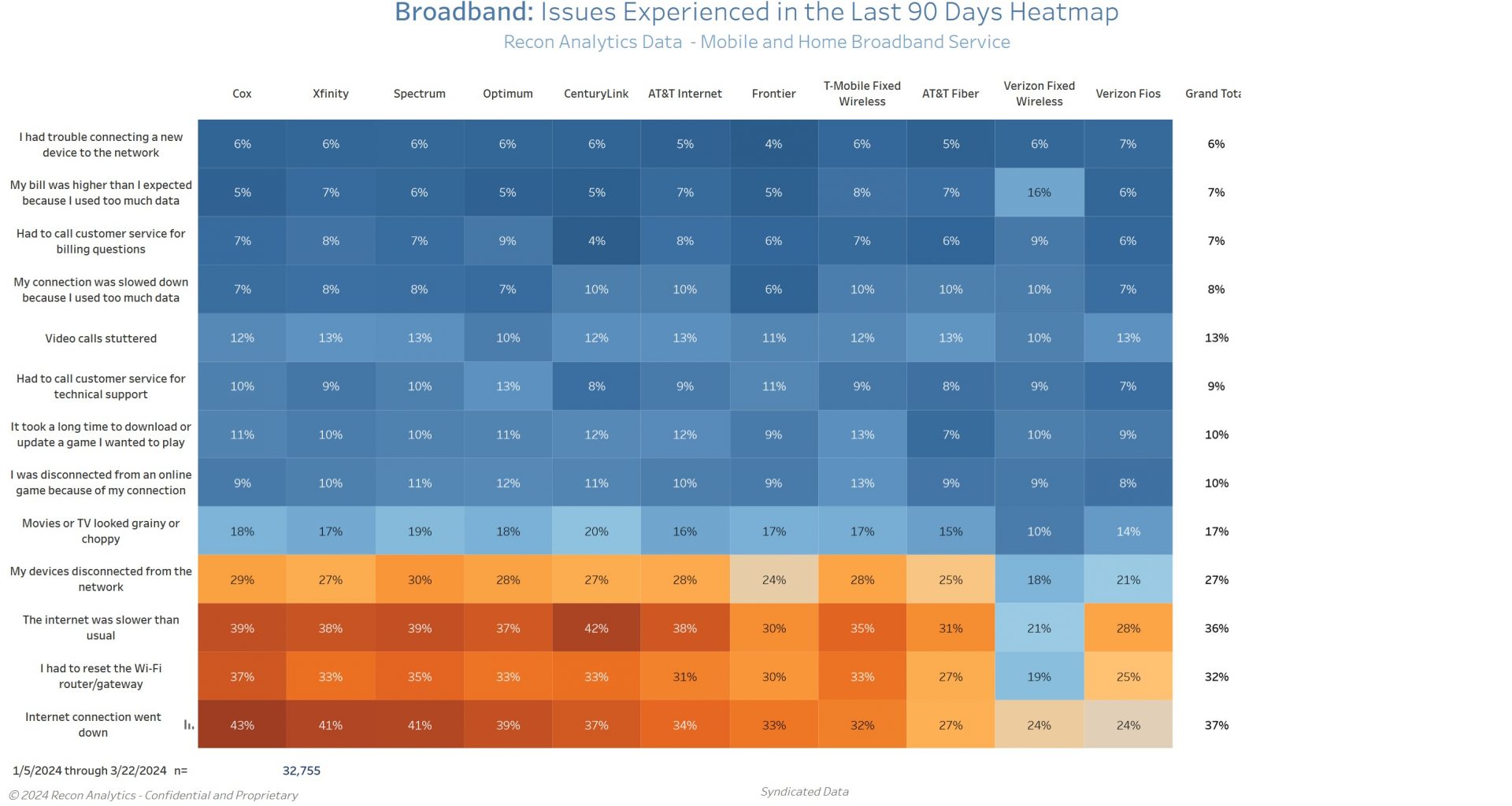
Customer-reported Issues in the last 90 Days (arithmetic average of providers)

 Internet connection went downInternet was slower than usualI had to reset Wi-Fi routerDevices disconnected from the network
Starlink30%24%20%19%
Major Fiber24%31%27%25%
Large FWA25%27%27%25%
Major Cable39%34%33%28%
Major DSL33%32%28%26%
153,770 Respondent from 7/7/2023 to 7/5/2024 (Starlink, AT&T Fiber, Verizon FiOS, Comcast, Charter, Cox, Optimum, Frontier, AT&T Internet, Centurylink, T-Mobile FWA, Verizon FWA)

Considering that Starlink is a service that requires a direct line of sight to a passing satellite, these metrics are impressive. Starlink has been able to get 6,146 working satellites into orbit, providing significant capacity and reliability to its subscribers. It has also been able to manage bandwidth, even during peak hours. It is also clear that Starlink’s router is among the most stable in the market.

How satisfied are Starlink customers with their service?

We are also collecting component net promoter scores (cNPS)* by looking at the customer experience in 16 different dimensions. Starlink’s cNPS scores for all the metrics that do not involve interacting with a person are among the best we are seeing in our data.

Selected cNPS categories

 Complete ExperienceEasy InstallationStreaming VideoConnecting/Maintaining WiFi ConnectionGaming
Starlink+42+30+44+37+23
Major Fiber+18+18+22+18+12
Large FWA+40+52+39+36+29
Major Cable-2+8+6+2-7
Major DSL-10+5-6-8-20
149,625 Respondent from 7/7/2023 to 7/5/2024 (Starlink, AT&T Fiber, Verizon FiOS, Comcast, Charter, Cox, Optimum, Frontier, AT&T Internet, CenturyLink, T-Mobile FWA, Verizon FWA)

Starlink provides excellent scores when it comes to the technical delivery of the service. It is very similar to Fixed Wireless Access, in that when it works, it works very well and when it does not work, the service provider makes it easy to return the product within 30 days with either a total refund or only having to pay for services rendered. Furthermore, especially with Starlink, the rural alternatives are generally underwhelming. Most Starlink customers come from DSL providers or other satellite providers that are just not competitive when it comes to speeds and latency. Even though Starlink is $99 per month after $499 plus cost for the equipment, value for price cNPS is a very healthy +19. When you have no other options, even pricey internet looks like it’s worth it.

In all of our technical categories, we see constant year over year improvements of aggregate cNPS scores. The service providers are trying to provide a better service, and customers recognize it.

Starlink needs to improve in three categories: Billing support over the phone, technical support over the phone, and in-store experience.

More selected cNPS categories

 Billing SupportTechnical SupportIn-Store Experience
Starlink-1-3-17
Major Fiber+1-3-8
Large FWA+24+22+29
Major Cable-13-14-16
Major DSL-15-20-27
149,625 Respondent from 7/7/2023 to 7/5/2024 (Starlink, AT&T Fiber, Verizon FiOS, Comcast, Charter, Cox, Optimum, Frontier, AT&T Internet, Centurylink, T-Mobile FWA, Verizon FWA)

Fixed Wireless is the benchmark: Great in-store experience where customers can get the box, generally without an upfront cost, and take it home. Starlink’s in-store experience numbers are very similar to those of the mobile providers that predominantly sell through Best Buy, Target, and Walmart. It’s a channel where salespeople are not that educated about the product and its ins and outs. Fiber providers with a store are doing a much better job. The challenge for Starlink is that due to the heavily rural customer base, which implies a low population density, it is not cost effective to open its own stores. One solution is to invest in having its own salespeople in its third-party retail stores. The other challenge is support. While Starlink has a similarly great cNPS number for having an easy-to-understand bill like FWA, the billing support numbers are radically different. Generally, an easy-to-understand bill is correlated to billing support satisfaction, and while correlation does not imply causation, it is a necessary prerequisite.

Overall, Starlink’s mostly rural customer base is very satisfied. Customers like it despite the above average monthly cost and the high cost to purchase the satellite dish and router. Where things get interesting is that Comcast for Business just came to an agreement with Starlink to offer Starlink nationwide to businesses. In our business survey, where we speak with up to 800 businesses of all sizes, we find that fixed wireless access is making significant inroads with cNPS metrics that are similar to what we see in the consumer space. We are actively looking at the impact that the Starlink/Comcast for Business has on the market.

*We ask if they would recommend component elements of a product or service on a scale from 0 to 10 as a battery of questions and then calculate a net promoter score from it. We subtract the percentage of people who rate it 9 and 10 from the percentage of people who rate it 0 to 6, which gives us the net promoter score for this component.

5G fixed wireless access (FWA) is transforming how Americans are accessing the internet. In less than three years, 7.9 million customers signed up with FWA as their preferred internet solution. Recon Analytics interviewed more than 40,000 home internet customers in the first 12 weeks of the year and the results are clear: FWA customers are happier with their service than with service through any other technology. The only thing standing in the way of greater success is more capacity, which is why mobile operators are clamoring for more licensed full-power spectrum.

Chart 1:

FWA is the clear winner across the board

The ranking in Chart 1 makes sense, but is surprising at the same time. The mobile network operators built a very robust offering. FWA is not the fastest service, but under the current usage parameters it satisfies its customers not only on the traditional product side such as easy and convenient installation, a superior router experience, delivering an easy-to-understand bill, and online self-help customer service that people actually like, but also on the service side, ranging from the internet usage categories, to support over the phone and, most importantly, value for money.

It is important to keep in mind that there is a double bias going on with FWA customers. First, the vast majority of FWA customers have the same provider for their mobile service. Customers who are unhappy with their mobile service do not select the same provider and network for their home internet service. Second, there is a survivorship bias. Customers who sign up with FWA typically do this while they are still using a previous service with which they are unhappy. It is very easy and convenient to install and, if necessary, to return the FWA router and cancel the service, so prospective customers give it a try and take advantage of the cancellation poicy if it doesn’t work. We have a hard time finding  customers who try the service and are unhappy with it, but have not returned it yet.

Customer service and connectivity

Chart 1 also reiterates what we have known for a long time: cable companies have poor customer service and need to improve. Telecom providers who are phasing out DSL networks and focusing on fiber provide substantially better customer service. What might surprise people is the strong performance of satellite service. This is mostly driven by Starlink, which is getting successively better over time, as a provider of last resort for many of its customers.

Recon Analytics also asks its home internet respondents every week what kind of issues they experienced with their internet connection. Chart 2 is ordered top to bottom with how often respondents experienced an outage. The most common issue, which was internet connection going down, is at the bottom. Furthermore, it is also ordered from left to right by how often they experienced their internet connection going down.

Chart 2:

As we can see in Chart 2, most of the issues are in one of two groups: internet connection going down or slowing down, and router issues forcing people to reset their router or having devices disconnect from the network.

Cable providers had the most issues in all four categories. Up to 43% of respondents reported that their internet connection has been interrupted, while fiber and FWA customers reported the least problems in this category. The newer, better routers provided by fiber and FWA providers also caused fewer problems compared to the routers from cable companies and DSL providers. One fiber and DSL provider told me that once they went away from sourcing the cheapest router to providing an excellent router, it was a game changer for them. The change reduced customer service calls and churn and improved customer satisfaction, more than offsetting the cost of the better router.

How to create more and better home internet choices

As of right now, the Congress and the FCC have created meaningful competition through up to three new providers with up to four brands in the markets where mobile network operators have been able to launch their service. It is incredible that even though we have seen network speeds for some providers decrease from 200 and more Mbps to low 100s Mbps, cNPS scores have not declined. MNOs still have enough capacity to provide their customers with sufficient bandwidth for what customers describe as a superior experience. Verizon and T-Mobile said that they have enough capacity for 5 and 7 million customers respectively with their initial FWA build. They are two thirds to that goal and will probably reach it by the end of 2024. After that, it will become more difficult and expensive to find the necessary capacity to compete with cable and DSL providers as vigorously as they do today. FWA is the fastest growing segment of the home internet market, while cable subscriptions are decreasing.

The government has three options, but the choice is pretty clear: It can spend $80 billion on various fiber incentive programs (BEAD, RDOF, etc) to bring another provider to markets where there is no provider offering more than 100 Mbps speed. It can take $80 billion from the wireless carriers for more spectrum (C-Band Auction for 240 MHz yielded $81 billion) and get three new broadband competitors in the form of FWA providers. Or, it can do both and create more and better home internet choices for Americans with a net zero cost.

One of the key questions around the happiest and unhappiest home internet counties is where they are and what the driver is behind the happiness and unhappiness. Every week, we ask our respondents a battery of questions around how satisfied they are with the service they receive. After surveying more than three hundred and thirty thousand respondents later, we have respondents from 2,368 counties out of 3,142 in the United States telling us are telling us where the happiest and unhappiest broadband customers in the United States and allows us to determine the root cause behind their experience.

Questions that we aim to answer include: Why is home internet service in some places better than in others? Will the famous opening lines of Leo Tolstoy’s book Anna Karenina – “All happy families are alike; each unhappy family is unhappy in its own way” –  be applicable here? Are the larger observable trends, where fixed wireless NPS outperforms Fiber – which outperforms cable, which beats DSL and WISPs – be consistent in a granular county-by-county perspective? Does it matter if a county is in a blue state or a red state? Is the size of a provider any indication that the home internet customers in a county are happier or unhappier? Let’s just say that counties do not show the same behavior as Tolstoy’s families: it all comes down to local execution.

Let’s get politics out of the way first: Five of the ten unhappiest and five of the ten happiest counties are in states that are considered “Republican” and “Democratic”, respectively. Neither party’s approach to how they interact with home internet providers has had an impact on the distribution of the ten happiest and unhappiest counties.

Below is a map of the ten unhappiest home broadband counties in the United States with at least 100 respondents to ensure statistical veracity.

Interestingly, all the counties where the unhappiest home broadband customers are residing are rural counties with one exception: Indian River County, FL, the home of Vero Beach. This county, which is largely suburban, has the fourth highest concentration of millionaires on the United States. The population range per county is between 25,000 and 180,000 people. They are being served by between two providers in Barnstable County, MA and 14 providers in Jasper County, MO, which tells us that limited or significant choice is not a driver of unhappiness, especially when all of the counties are served by all technologies from fiber to DSL. Even if we controlled for coverage, we had some counties where there was fiber coverage in every ZIP-code (we did not check if every physical address was covered) like Georgetown County, South Carolina, Indian River County, FL, or Crook County, OR to where almost none of the ZIP-codes in a county, like Barnstable County, MA, were covered by fiber. These type of systemic, technology-driven or industry structural reasons are not providing the answer, despite being commonly accepted truths. In four of the ten unhappiest counties, membered own co-operatives which are typically non-profits were active.

We then looked at the happiest home broadband counties in the United States. The map confounds the expectations of many.

Who would have thought that four of the happiest broadband counties are in the rural South of Tennessee, Alabama and West Virginia? Nine of the ten happiest counties are rural. In six of the ten happiest counties, coops are active, but not in the happiest broadband county, Mercer County, WV. The poster child for municipal broadband, Chattanooga, TN, comes in as the 9th happiest home internet place in the country. The happiest county, Mercer County, WV does not have any coops providing telecom services there. In six of the happiest and four of the unhappiest broadband counties, coops are providing service. The mere presence of coops is providing better services, as the feedback we receive from customers ranges from terrific to terrible. Fiber or Cable coverage is also not playing a determining role.

The other fascinating insight is what is missing from the list: major urban markets. The idea that urban markets get all the investment because they are densely populated and cheaper to service, and therefore have the happiest broadband customers, is just not reflected in the data. At the same time, the rival argument that urban areas are dystopic wastelands with horrible broadband service is equally not supported by the data.

In the end, we found that what really matters is the individual performance of a provider in a given county. Below are the NPS scores for the providers with at least 20 respondents in each county where we had at least 100 respondents overall.

Almost all the providers displayed uneven performance. The same provider that performed very well in some counties performed poorly in others. Cable providers like Comcast and Charter performed very well in some counties. Comcast’s exceptionally good performance made Mercer County, WV the happiest broadband county. Equally, its poor performance in Barnstable County, MA and Whatcom County, WA made them the second and third unhappiest broadband counties. Only AT&T Fiber performed consistently well in the ten happiest counties and was not present in the unhappiest.

Additionally, 5G fixed wireless service did not make an impact on the happiest and unhappiest broadband counties. While in some of the counties there is 5G fixed wireless service, the adoption numbers were so low that they didn’t make an impact on the overall happiness of broadband customers.

Our research shows that every provider is able to do excellent work and make their customers happy. Considering that the nationwide providers engage in nationwide standard pricing, the satisfaction score differences are not driven by low price, but by actual performance. Technology helps, but the key is local execution.  Providers could improve their performance in markets by internally benchmarking their performance and extending best practices throughout the entire organization. Regulators should look at how satisfied the customers of applicants are before the allocate their broadband subsidies to expand services. If they have multiple applicants for subsidies, they should be given to the providers who deliver for the taxpayers, who provided the funds through taxes in the first place.