AT&T, T-Mobile, and Verizon have chosen to cooperate for the American customer. The three carriers announced an agreement in principle this morning to form a joint venture that pools spectrum and technical resources behind a unified, standards-based platform for direct-to-device (D2D) satellite service. The venture is operator-agnostic and open-spec. Any satellite constellation that meets the industry specification can use it to serve any of the three carriers’ customers. Any phone manufacturer that builds to the spec can ship a handset that works on it. Existing carrier-satellite agreements remain in place, and each carrier can keep pursuing its own connectivity efforts independently. No satellite provider and no phone manufacturer left behind. The Federal Communications Commission and the broader US government should bless this on the merits.

John Stankey, AT&T’s chairman and CEO, framed the cooperation directly in this morning’s release: “By joining with other carriers, we’re bringing our combined expertise to accelerate our customers’ access to reliable, and always-on coverage everywhere. This collaboration not only makes connectivity easier; it strengthens America’s communications leadership.” T-Mobile president and CEO Srini Gopalan added that the JV “will also make it easier for satellite operators to deliver a broader range of direct-to-device experiences and help accelerate innovation across the wireless and satellite industries.” Verizon CEO Dan Schulman closed the loop on the competitive logic: “This partnership gives customers more options, continues to strengthen America’s infrastructure and increases competition for satellite providers.” Three CEOs, one message: the JV expands the satellite-operator market and improves the customer experience at the same time.

The cooperation matters because the current state of US direct-to-device is fragmented in ways that hold the technology back for the customer. T-Mobile, partnered with SpaceX’s Starlink, is the only US carrier with live commercial direct-to-device service today. AT&T and Verizon both hold partnership agreements with AST SpaceMobile and are waiting on AST’s constellation to reach commercial scale. AST currently has six satellites in orbit, with forty-five targeted by year-end and ninety-plus required for full service. Stankey said on AT&T’s first-quarter 2026 earnings call that he expects “at least three” satellite operators “serving the United States with capable products and services,” and named Amazon Leo and SpaceX alongside AST as expected wholesale partners. That multi-constellation future works only if the integration cost between any satellite operator and any carrier is low enough to make the second and third partnerships economic. Today it is not. The JV makes it so.

The mechanism is the part that matters. Direct-to-device sends a signal from a satellite to an ordinary smartphone with no special equipment. The satellite link itself is the easy part. The friction is the handoff back to terrestrial when terrestrial is available, the spectrum coordination that prevents satellite signal from interfering with ground networks, and the back-office integration that authenticates the customer, routes their traffic, and handles billing. Each of those layers is currently bespoke per carrier and per satellite operator. Scaling a bespoke model nationally produces a fragmented sky, a permanent advantage to whichever satellite operator wins the most carrier deals first, and a customer experience that varies with the logo on the bill. A unified industry specification inverts the pattern. The satellite layer becomes an open market on the technical merits. The customer experience becomes uniform regardless of carrier choice.

That is a consumer-welfare gain measured in lives, not basis points. A meaningful share of US landmass has no consistent terrestrial wireless coverage today, concentrated in the rural West, in Appalachia, in tribal lands, and along the maritime coast. The JV’s release puts the customer scope explicitly: nearly eliminating the dead zones that today have no mobile service, restoring connectivity in emergencies when ground-based networks fail, and bringing rural mobile network operators into the same standards-based platform so their customers benefit too. When Hurricane Helene knocked out terrestrial networks across western North Carolina in September 2024, satellite-equipped smartphones were the lifeline that worked when nothing else did. The cooperative JV means that lifeline becomes available to every American with a recent smartphone, regardless of which carrier they pay and regardless of which constellation happens to be overhead at the moment of emergency. The carriers still compete on every dimension that defines the wireless market: price, plan structure, retail experience, network capability, brand. They have agreed to cooperate on the one layer where cooperation produces a public good the market alone could not deliver.

The national-resilience case is the layer above the consumer-welfare case. Resilient communications during natural disaster, large-scale cyber event, infrastructure attack, or coordinated grid failure is a category of public good that the market historically underprovides, because the carrier with the best private resilience captures only a fraction of the social value of national resilience. A unified standard solves that coordination problem.

The FCC has clear authority and clear precedent. Section 332 of the Communications Act commands the agency to manage spectrum in the public interest. The test is met on every axis. Coverage expands. Public safety improves. The satellite-operator market becomes more competitive because any qualified constellation can join. Investment efficiency improves because three carriers stop building three parallel coordination layers. The antitrust posture is the right one. Interoperability cooperation has a long, blessed history in US telecommunications. GSM roaming and 911 Phase II both required competing carriers to cooperate on a shared technical layer for the benefit of every customer. The JV sits in that tradition.

The satellite operators, including AST SpaceMobile, SpaceX, Amazon’s Project Kuiper, and the next wave of qualified entrants, should join the open standard rather than seek private bilateral lock-in with individual carriers. The rural mobile network operators should engage early in the JV’s standards work so their customers benefit from the same coverage gain on day one. The operating system providers, mobile app developers, and phone manufacturers should build to the spec so no customer’s device or app is excluded from the connectivity gain. Open access is net-additive to the satellite market, to the handset market, and to the rural-carrier market. The operators, OEMs, and platforms that move first will earn first-mover credibility worldwide.

When three carriers that compete for every American wireless customer agree to cooperate for those same customers, the country gains an architecture it would not otherwise have. The American customer is the beneficiary. The FCC should approve the license transfer when it happens, the satellite operators should join, the phone manufacturers should build, and the country benefits from each step. That is what good for America looks like.

On May 12, the FCC approved two transactions that move approximately 115 megahertz of mid- and low-band spectrum out of EchoStar’s strategic holdings and into operators that have committed to deploying it. AT&T receives 50 megahertz: 30 megahertz of 3.45 GHz mid-band and 20 megahertz of 600 MHz low-band. SpaceX receives 65 megahertz spread across unpaired AWS-3 (15 MHz), AWS-4 (40 MHz), and H-block (10 MHz). Combined deal value crosses $40 billion.

The FCC press release frames the approvals as a leadership win for next-generation connectivity. The structural framing is more useful. This is the first administrative resolution of the EchoStar buildout problem that has hung over US spectrum policy since the Dish reorganization, and the first time the FCC has handed exclusive nationwide spectrum to a satellite operator for direct-to-device service.

AT&T: Capacity Now, Coverage by Next Year

The AT&T half moves at two speeds. The 30 MHz of 3.45 GHz is already in production. AT&T received Special Temporary Authority shortly after announcement and lit up the spectrum across approximately 23,000 sites within weeks. The results are already visible today. Independent M-Lab NDT data shows market-level variation consistent with capacity additions. Several major AT&T markets such as Gainesville FL, Allen TX, Chicago IL, Concord and Van Nuys, CA exhibit 15-40 percent median download-speed improvements over the November 2025 to April 2026 window.. The deployment pace itself is the credible signal regardless of how the speed number lands. AT&T did not need new equipment or new build sites. They needed permission and frequency assignments and moved within weeks of getting both.

The 20 MHz of 600 MHz is the structural piece. AT&T’s low-band position has trailed T-Mobile’s 600 MHz holdings since the 2017 incentive auction and Verizon’s 700 MHz position since 2008. Contiguous nationwide 600 MHz adds rural coverage parity AT&T has spent fifteen years engineering around. The FCC accelerated the buildout obligation years faster than auction rules ordinarily require, foreclosing the option to warehouse the spectrum. The 3.45 GHz buildout clock gets no extension, which is moot given the deployment is already running.

SpaceX: From Partnership to Position

The SpaceX side is the more consequential structural shift. Until today, every direct-to-device offering in the US ran through a carrier partnership. T-Mobile and SpaceX. Verizon and AST SpaceMobile. AT&T and AST. The terrestrial carrier held the spectrum, the satellite operator supplied the constellation, the consumer relationship stayed with the carrier. The FCC has now handed SpaceX 65 megahertz of exclusive, contiguous, nationwide spectrum for Starlink D2D and other services, with technology-neutral performance obligations and waivers that allow flexible terrestrial, space-based, or hybrid use.

The practical effect: SpaceX is no longer a vendor to terrestrial carriers in the D2D market. It is a spectrum-holding network operator with its own consumer-facing brand in Starlink, its own deployment pipeline, and a regulatory framework that lets it combine ground stations and satellites without partitioning the spectrum between them. The waivers matter as much as the megahertz. They establish a regulatory pattern the FCC will probably extend, modify, or selectively apply as AST SpaceMobile and other constellation operators seek similar treatment.

Market Reaction

T-Mobile retains the SpaceX commercial partnership but loses sole-partner status. The relationship continues. The strategic positioning changes. T-Mobile gets paid for traffic SpaceX cannot serve directly until the new spectrum is deployed and performance obligations are met, a window of at least two years. After that, SpaceX can route around T-Mobile if it chooses.

Verizon is the carrier with the most ground to recover on D2D. Verizon’s D2D position runs through AST SpaceMobile, which received its own approval for a 248-satellite system several weeks ago. AST is a competitive offering but a separately listed company without SpaceX’s launch cadence or capital reserves. Verizon’s spectrum portfolio is intact and its terrestrial network is fine. The deal does not weaken Verizon today. It extends a D2D structural gap Verizon has not closed.

AT&T benefits twice. The 50 megahertz of new terrestrial spectrum is the visible win. The hybrid MVNO arrangement with EchoStar to preserve Boost Mobile is the quieter one. Boost survives as a brand on AT&T’s network, the 2020 T-Mobile/Sprint merger condition’s consumer-facing intent is preserved, and AT&T picks up the wholesale economics from the former fourth-carrier branding.

What the FCC Got Right

The buildout obligations have stated deadlines and accelerated timelines. AT&T’s 600 MHz timeline runs years ahead of standard auction rules. SpaceX faces performance standards on intensive use that any operator would feel. This is not a giveaway with a press release attached.

The Boost Mobile hybrid MVNO keeps the fourth-carrier consumer brand alive without forcing EchoStar to continue funding a network it could not build at scale. The 2020 merger condition’s consumer-facing intent is preserved without requiring buildout commitments EchoStar could not meet.

The $2.4 billion escrow keeps the EchoStar liability cleanup off the agency’s docket while leaving merits to the parties. Whether the number proves sufficient is the open question.

What to Watch

The press release commits the FCC to a 300 megahertz spectrum target by the end of 2027. That number depends on auctions and secondary-market transactions that mostly predate this transaction. The agency deserves credit for putting a date next to the goal. The underlying mechanisms are not new.

Three watchpoints carry into the next two quarters. Whether AT&T’s 600 MHz buildout meets the accelerated timeline or returns for relief in 2027. Whether SpaceX’s terrestrial-flex waivers become the template for AST and future D2D applicants or remain a one-off shaped by Starlink’s launch position. Whether the $2.4 billion escrow proves sufficient for the EchoStar liability cleanup. Recon clients should track AT&T’s 3.45 GHz speed claims in Q3 disclosures and watch for T-Mobile’s response to SpaceX’s shift from D2D partner to D2D principal.

The transaction closes one of the longest-running spectrum policy problems in US wireless. It opens a different one: how the agency regulates satellite operators that hold terrestrial spectrum and behave like carriers.

Every warning sign has a story hidden behind it

When you see a “Don’t feed the crocodile” sign, someone fed the crocodile and it did not end well. When you see “Price lock” offers that means someone raised prices and it didn’t go well.

Carriers raised prices. Customers wanted predictability. Carriers gave them price locks.

That’s the year, in three sentences. Five carriers, five customer-centric programs, four 3-or-5-year price guarantees layered underneath. AT&T launched the Guarantee. Verizon launched Project 624 and the 3-year value guarantee on myPlan. T-Mobile rebuilt the app as T-Life and locked Plan Refresh for five years under Magenta Status. Charter launched Life Unlimited with a 3-year lock embedded. Comcast launched Xfinity Membership and the 5-year price guarantee in the same retention package.

The locks didn’t show up by accident. They showed up because churn was rising as people ran for the exits. They are emergency brakes. The carriers reached for them under duress as industry postpaid gross adds increased from around 30 million to 40 million.

All five are doing the right thing. The question is whether they’re doing enough of the right thing.

There’s also fourth competitor that doesn’t run a nationwide wireless network and is taking 45% of all new wireless customers. Charter’s Spectrum Mobile and Comcast’s Xfinity Mobile (plus Optimum’s smaller line) added 830,000 net mobile lines together in Q4 2025 alone. Spectrum Mobile ended 2025 with 11.8 million lines. T-Mobile’s former CEO Mike Sievert once called them “low calorie net adds.” That underestimates the threat. Cable wireless is the most consequential structural change in the US wireless market in a decade, and three of the five named programs in this report are partly responses to it.

Read the rest with that in mind. AT&T, Verizon, and T-Mobile run the networks. Charter and Comcast run wireless without the network and take share anyway. The five together are the wireless market now.

AT&T: The Guarantee Without the Lock

Let’s start with the exception. AT&T launched the AT&T Guarantee on January 9, 2025. Three pillars: Network, Care, Deals. If your fiber is out for 20 minutes or your wireless for 60, you get a bill credit for a full day of service. If you call customer support, you get a human in five minutes or a scheduled callback. If you’re an AT&T customer, you get the same smartphone deals as new customers without having to be on the most expensive plan. The Guarantee expanded again in March 2026 to add AT&T Internet Air and a free Internet Backup if you bundle Fiber and Wireless.

The Guarantee is the most comprehensive customer commitment any US carrier has put in writing. AT&T deserves credit for it.

Then look at what AT&T won’t do. AT&T has refused to issue a price lock. T-Mobile has a 5-year lock. Verizon has a 3-year lock. Charter has a 3-year lock. Comcast has a 5-year lock. AT&T does not have a price lock and has stated the Guarantee is the answer instead.

Then look at what AT&T did do. Pascal Desroches told the Q1 2025 earnings call: “you benefited from price increases on legacy plans,” followed by “higher churn as you make your way through subsequent quarters.” Same call: “some adjustments we made on auto bill pay discount, which should also help the balance of the year.” That’s a CFO telling investors AT&T raised legacy-plan prices and trimmed the autopay discount in the same quarter the Guarantee was being marketed as the customer-friendly differentiator.

Actions speak louder than words. AT&T pitches stability. AT&T raises prices.

The data shows the contradiction. AT&T postpaid phone net adds: 324K Q1 2025, 401K Q2, 405K Q3, 421K Q4. Stable. ARPU rose from $55.57 in Q1 2024 to $56.57 in Q4 2025, up 1.8% nominal. Postpaid phone churn went from 0.89% to 1.12% across the same window. Twenty-three basis points up. Still the lowest postpaid churn in the industry. Worsening at the same slope as everybody else.

AT&T is also the carrier that produced the boldest all-in pricing product in the industry. OneConnect launched March 2026 as a hard bundle of fiber broadband plus wireless (one phone plus up to three tablets and watches) for $90 per month, taxes and fees included. In a world of unsustainable device promotions first, it is the revolutionary network-first bundle of mobile and broadband that the industry needs. The Recon Analytics podcast covered it the week of launch. OneConnect is the all-in product T-Mobile used to be, in a more disciplined form.

So AT&T runs two pricing layers in opposite directions at the same time. The Guarantee plus the legacy-plan price-up plus no price lock on the wireless rate card. And OneConnect as the all-in convergence bet. The first layer is treading water. The second is the actual customer-friendly innovation in AT&T’s 2025-2026 portfolio.

The verdict on AT&T’s customer-centric work: the Guarantee is real and the most comprehensive commitment in the market, but it’s running cover for a price-up cycle the carrier is not willing to lock against. OneConnect is the right product at the right time, and worth more analytical attention than the Guarantee. The Guarantee is the marketing. OneConnect is the strategy.

Verizon: Project 624, the 3-Year Lock, and an AI-First CEO

Verizon launched Project 624 on June 24, 2025. AI customer support on customized Gemini models. Customer Champions for complex issues. 24/7 live support. Roughly 400 new retail stores added over two years. Enhanced Verizon Access rewards. The 3-year price lock on myPlan, branded as the Verizon value guarantee, launched alongside in early 2025 and Sampath credited it with “double digit growth” on the Q1 2025 earnings call. By Q3 2025, Verizon was reporting a 16% year-over-year increase in consumer upgrades tied to the value guarantee.

Read the components together and the picture is clear. Defensive reset. Verizon was bleeding postpaid phone subs at the front of 2025: -289K Q1, -9K Q2. The Q4 2024 +504K print evaporated in two quarters.

Then Dan Schulman became CEO on October 4, 2025.

On the Q3 2025 earnings call (December 16, 2025), Schulman said all the right things CEOs are not supposed to say: “for the past few years, our financial growth has relied too heavily on price increases, a strategic approach that relies too much on price without subscriber growth is not a sustainable strategy. Raising rates without corresponding value rarely, if ever, delights customers.” Schulman is validating the thesis of this report from inside the company that ran the strategy.

Now the AI angle. Schulman told the Morgan Stanley TMT Conference in March 2026: “Verizon will be an AI-first company.” He’s targeting “multiple billions of dollars to take out of this company year after year” through AI cost efficiencies. He intends to use AI “to simplify offers, improve the customer experience, and reduce churn through smart, consistent, and more personalized marketing and offers.”

That orientation matters more than the carrier headline reads. Schulman built his career running Virgin Mobile, American Express and PayPal on the proposition that customer experience compounds. People do not change their fundamental decision-making patterns. The leopard does not change its spots. Schulman will fund customer-experience investment, fund AI deployment, and refrain from price-up as the engine. Project 624 was launched five months before he arrived under Hans Vestberg as the “third leg” of Verizon’s consumer offering. Schulman will extend it, fund it, double down on it. Bet on Verizon’s customer-experience and AI investment increasing materially in 2026.

The data already shows the Q4 turn. Net adds: -289K Q1, -9K Q2, +44K Q3, +616K Q4. The Q4 numbers are mechanically attributable to Project 624, the value guarantee plus aggressive pricing working together against a customer base that had been actively defecting. The lock did the heavier lift on the front of the year. Project 624 layered in mid-year. By Q4 aggressive pricings was added to the mix and all three were operating together.

Postpaid churn worsened across the same period. Q1 2024 was 1.15%. Q4 2025 was 1.32%. Seventeen basis points despite the program launch. Q4 net adds came from gross-add improvement, not retention improvement. Q1 2026 had the first subscriber growth in ages, but again built on a declining account base. Verizon is acquiring better. It isn’t keeping any better. The ship is righting itself, but it still takes on water.

Verdict on Verizon: Project 624 is the right program at the right time. The 3-year value guarantee is the right defensive structure. Schulman is the right CEO for the time being. The question is whether the customer-experience investment compounds fast enough to outrun the churn pressure that’s been building since 2023. The 12-to-18-month read happens in 2026. Watch the Q2 numbers.

T-Mobile: T-Life as Optimization, Magenta Status as Lock, and the Quiet Reversal on All-In Pricing

T-Life is Srini Gopalan’s optimization play. Mike Sievert built the original case at the October 2024 Capital Markets Day: T-Life will replace every consumer-facing T-Mobile app. Account management. Upgrades. Customer support. Magenta Status benefits. T-Mobile Tuesdays, the long-running weekly customer perks program that started in 2016 under John Legere and now lives as Thank You Tuesday inside the app. The Google Play package ID is literally com.tmobile.tuesdays. T-Life is the customer-facing surface. Tuesdays is the positive weekly engagement loop. The combination is a sticky habit T-Mobile spent a decade building and is now consolidating into one app.

Srini’s framing in March 2026 at the investor conference: “T-Life is the center of a lot of our work” and “one of the four big places where AI and digital really help us from an experience and cost perspective.” The cost-perspective part matters. T-Life is rationalization. Multiple apps consolidated to one. Channel cost moved from retail and care into digital self-service. The frontline organization redeployed to higher-value outbound and the SMRA rural-market expansion. That’s optimization talking, not customer-experience talking, and it shows up in the metrics.

Twenty-four million of 34 million T-Mobile customer relationships use T-Life at least four times a month. That’s roughly 70% engaging with the app multiple times weekly. Seventy-three percent of postpaid upgrades flowed through T-Life in Q4 2025 (39% with no person involved). Nobody else in this report is moving operational metrics this hard.

Now the lock. Plan Refresh launched April 22, 2025, alongside the Magenta Status loyalty wrapper, with a 5-year price guarantee. Two new consumer plans, Experience More and Experience Beyond, dropped to $5 less per line per month versus prior tiers.

And here’s where it gets complicated. T-Mobile walked away from all-in pricing.

Effective May 2, 2025, the new Experience plans and going-forward plans are tax-exclusive. The $5/line decrease shows up before taxes and fees. Magenta and Magenta Plus, the all-in plans Sievert and Legere built the Un-carrier brand around, are being phased out for new customers. The 5-year price guarantee explicitly does not cover taxes, fees, per-use charges, or plan add-ons. T-Mobile took the most distinctive consumer pricing innovation of the Un-carrier era and reversed it to give itself the wiggle room.

Why? Because the rate-card optics look better. $5/line less reads as a price cut in the marketing copy. Add taxes and fees on top and the customer’s actual bill ends up often above where it was before. In categories where competitors price ex-tax, T-Mobile was getting compared against a lower headline number. T-Mobile fixed the optics. The customer pays the difference.

The customer also paid for the 2024 autopay restructuring, which split eligibility between debit/ACH (full discount) and credit cards (no discount or reduced discount). Credit-card payers see an effective per-line price increase. Combined with the $5/line legacy price-up of 2024 and the all-in reversal of 2025, this is a coordinated price-up cycle wearing a 5-year-price-lock costume that leaves the back open to up prices on all the little below the line things that add up big.

Data shows the operational lift and the retention drag at the same time. T-Mobile postpaid phone net adds: 495K Q1 2025, 830K Q2, 1,007K Q3, 962K Q4. That’s 3.29 million for the year, lapping AT&T’s 1.55M and Verizon’s 362K. Postpaid phone ARPU rose from $48.79 in Q1 2024 to $50.71 in Q4 2025, up 3.9% nominal. Postpaid phone churn went from 1.075% to 1.275% across the same window. Twenty basis points up. Worst churn print since the Sprint integration period.

Verdict on T-Mobile: T-Life is the right rationalization play and operationally one of the most successful initiatives of the year. Magenta Status and Plan Refresh are the right defensive structure. The all-in pricing reversal is a customer-unfriendly change wrapped in customer-friendly marketing. The lock locks in the lower base price and exposes the customer to taxes-and-fees creep on top. Net is positive net adds and rising churn. Doing the right thing operationally. Possibly insufficient because the back-end pricing changes are visible to customers regardless.

Charter: Life Unlimited and the Mobile Wedge

Charter Spectrum’s Life Unlimited launched September 17, 2024, and is structurally different from anything else in this report. It’s not an app. It’s not a guarantee. It’s not an AI overhaul. It’s not a loyalty-tier system. It’s a set of pricing and service commitments wrapped in a brand identity, with the price lock embedded.

Four commitments. 100% US-based sales and service. 30-day money-back on internet, mobile, and TV (14-day on mobile devices). Up-to-3-year guaranteed pricing on Spectrum Internet bundles starting at $30/month with mobile or video. Whole-dollar transparent pricing with no annual contracts.

Chris Winfrey told the Q1 2025 earnings call that NPS improved “as a result of having put ourselves in a better position with those customers.” Jessica Fischer told the Q4 2025 call (March 2026): “driving better bundling and a better overall offer structure for consumers.” Customers, she said, are getting “stickier in the medium and longer term.”

Charter killed the cliff. The 12- or 24-month promotional roll-off that had been the back end of the cable book for two decades is gone for new customers. That’s a real customer-positive change for the customer who would otherwise have churned at the cliff. The price they’re locked into is higher than the year-one promotional price under the old model and lower than the year-two-and-three rate under the old model. Charter took the average and locked it. The customer trades the discount for the predictability.

Then look at Spectrum Mobile. Charter ended 2025 with 11.8 million mobile lines, up 19% year over year. Q4 2025 added 428,000 net mobile lines. The Charter sales pitch: $1,000 annual savings versus the big three telcos when bundled with Spectrum Internet. Nearly 90% of Spectrum Mobile traffic offloads to Charter’s own Wi-Fi and CBRS network. The economics are structural, not promotional.

Less than 50% of Spectrum Internet customers also have Spectrum Mobile. That’s the runway. Cable wireless took 45% of all new US wireless customers in 2025. The big three are losing the front-end of the funnel to a category they spent a decade dismissing as MVNO-with-training-wheels.

Cable and Satellite TV CPI rose 7.8% nominal and 3.0% real from January 2024 to September 2025. Cable bills are still rising faster than inflation. The 3-year lock holds the customer through the worst of FWA and fiber-overbuild competitive pressure. Spectrum Mobile prevents the cord-cut customer from leaving the ecosystem.

Verdict on Charter: Life Unlimited is the right pricing-transparency play. Spectrum Mobile is the right wedge into postpaid wireless. The combination is structurally the most coherent customer-strategy play of the five. Charter is doing the right thing, has the right runway and is getting punished by investors for it. Sufficiency depends on whether the brand-awareness gap closes (Winfrey called it Spectrum Mobile’s biggest issue at the Morgan Stanley conference in March 2026: “people don’t know they can get mobile through Spectrum”). Solve the awareness problem and Spectrum Mobile reorders the wireless industry.

Comcast: Xfinity Membership as Table Stuffer, Xfinity Mobile as Real

Xfinity Membership launched January 21, 2026. The cutoff for this report is May 3, 2026. That’s 102 days in market. Anyone telling you they have a verdict on the program is selling you something.

Mechanics first. All eligible Xfinity customers got auto-enrolled into one of four tiers: Silver (newcomers or single-service), Gold (one-to-five years or two services), Platinum (five-to-ten years or three services), Diamond (over a decade or four-plus). Replaced Xfinity Rewards, which 30% of Xfinity customers had bothered to opt into.

Auto-enrollment is the design move. Adoption goes from 30% opt-in to 100% automatic. The same logic that took 401(k) participation from 50% to 90% when Congress and the Treasury made auto-enroll the default. Comcast learned the lesson. Make the customer opt out, not opt in.

What sits inside the Membership tiers, though, is largely repackaging.

Peacock Premium for Diamond and Platinum members is the headline benefit. Two catches. First, you have to redeem it manually; the perk does not auto-trigger. Second, Xfinity Internet customers on Gig speeds and above already had Peacock Premium included for 2-3 years. The Membership program took a benefit that already existed for one customer group and rebranded it as a tier-based loyalty perk for an overlapping group.

Most of the rest of the benefit list is the same pattern. $1 movie rentals were already a periodic Xfinity promotion. Streaming-app discounts existed before. Mobile and accessories discounts existed before. The Membership program is the wrapper that consolidates them under a tier structure.

That doesn’t make the program useless. It makes it a stocking stuffer rather than a substantive value-add. The auto-enrollment design fixes a real engagement problem. The benefit content does not add much that wasn’t already there.

Now the actual Comcast retention play. The 5-year price guarantee launched mid-2025. Approximately 50% of new Connect customers were selecting it by the Q2 2025 earnings call. The Q3 2025 call described “stabilization in voluntary churn.” Stabilization isn’t improvement. The lock is the retention lever. Membership is the loyalty wrapper. Read them as the coordinated retention package and the picture comes into focus.

Xfinity Mobile is the other half of the story. Comcast breaks out mobile lines as cleanly as Charter; the cable MVNO category collectively took 45% of new wireless customers in 2025 and in Q1 2026 Comcast is the larger of the two majors. The same disruption logic applies: keep the broadband customer, attach mobile, raise switching costs.

Verdict on Comcast: Xfinity Membership is structurally the right move (auto-enrollment fixes the engagement problem) and substantively underpowered (most of the benefits were already available). The 5-year price guarantee is the actual retention lever. Xfinity Mobile is the wedge. Doing the right things, putting marketing energy behind the wrong half of the package. Q2 2026 is when the data starts to talk.

The Locks Are Emergency Brakes. The Pricing Reality Beneath Them.

Now the back of the book.

Four of the five carriers introduced or extended a multi-year price guarantee in 2024 or 2025. T-Mobile’s 5-year lock came in April 2025 with Plan Refresh and Magenta Status. Verizon’s 3-year lock launched as the value guarantee on myPlan in early 2025. Charter’s 3-year lock is embedded in Life Unlimited. Comcast’s 5-year guarantee landed mid-2025. AT&T did not do a price lock and pitches the Guarantee instead.

The locks didn’t show up because the carriers had a creative pricing brainstorm. They showed up because customer satisfaction was falling and churn was rising. Recon Analytics’ Customer Telecom Pulse, the largest US consumer telecom syndicated survey at 200,000+ mobile and 200,000+ home internet consumers annually, has been tracking the deteriorating sat trajectory since 2023. The locks are an emergency brake. The carriers reached for them under duress. Customers were saying “we’re tired of exploding bills.” The carriers heard it. Locked the price.

Customers want predictability. A locked price for 3 or 5 years is what they asked for. The carrier that figures out how to deliver predictability without using the lock as a cover for back-end price-up will win the next decade. The lock alone is not the answer. The lock plus genuine restraint on the back end is.

Now the front-end pricing math. The BLS Wireless Telephone Services CPI shows nominal wireless service prices declining slightly: 47.181 in January 2024 to 46.143 in September 2025, down 2.2% nominal. Adjusted by All-Items CPI inflation of 4.7% over the same window, the BLS index reads down 6.6% real.

That’s a value index, not a price index. BLS quality-adjusts. If the customer gets more data, more network coverage, more 5G priority for the same dollar, the index goes down even though the dollar amount on the bill is the same. The BLS number says the customer is getting more value per dollar. It does not say the customer is paying less.

Carrier ARPU disclosures tell the dollar-amount story. AT&T postpaid phone ARPU rose 1.8% nominal across 2024-2025, down 2.9% real. T-Mobile rose 3.9% nominal, down 0.8% real. Per-line ARPU is roughly flat in real terms, which lines up with the BLS read: the customer is paying about the same per line in real dollars while getting more service for that money.

The catch is that ARPU is a per-line average. Carriers added lines per account through 2025. Total bill per account rose faster than per-line ARPU. The customer experiences the bill, not the per-line.

Cable is the more straightforward pricing-up story. Cable and Satellite TV CPI rose 7.8% nominal and 3.0% real from January 2024 to September 2025. That’s not a quality-adjusted reduction. That’s the customer paying more in real dollars for cable bills. The 5-year Comcast guarantee and the 3-year Charter lock are operating in a category where the prices kept rising.

Now the back end. This is where the math actually moves on a customer bill, and this is what the price locks don’t cover.

T-Mobile abandoned all-in pricing effective May 2, 2025. Customers on the new Experience plans pay taxes and fees on top of the base rate. The 5-year price guarantee explicitly excludes taxes, fees, per-use charges, and add-ons. Combined with the 2024 $5/line legacy price-up and the autopay restructuring (debit and ACH only for the full discount), T-Mobile ran a coordinated price-up cycle inside the price-lock costume.

Verizon raised A2P (application-to-person messaging) carrier fees in June 2025. Twilio reported $20 million Q3 pass-through and $23 million Q4 pass-through. Those flow through to consumer bills via apps that send authentication codes and notifications. Verizon also continued raising its Administrative and Telco Recovery Charge through 2025, a multi-year pattern of revenue collected through line items framed as regulatory recovery. They are not regulated charges. They are revenue.

AT&T adjusted its autopay discount in 2025 (Desroches confirmed it on the Q1 2025 call). AT&T also raised legacy-plan prices in Q1 2025 (Desroches, same call). AT&T does not have a price lock to constrain the trajectory.

Cable carriers continued raising regional sports fees, broadcast TV fees, and network enhancement fees. None of those line items are the “price” in carrier marketing language. All of them are on the bill.

The carriers know the difference between what they call the price and what the customer pays. They are running both layers intentionally. The price lock holds the marketing-line price for 3 to 5 years. The back-end fees, autopay restructuring, and tax-and-fee exposure handle the revenue-per-line growth the lock would otherwise constrain.

That isn’t cynical. It is honest. The carriers are doing the right thing on the front of the book (lock the price the customer focuses on) and protecting the economics on the back (capture the revenue the customer doesn’t focus on). Customers want predictability on the headline rate. Customers tolerate fee creep on the back end because they don’t track it line item by line item. The carriers are pricing to that asymmetry.

The risk is that customer attention to the back end is increasing. Once customers start tracking total bill rather than headline plan price, the locks stop quieting the churn. That is the 2026 question.

All Five Doing the Right Thing. Sufficiency Is the Question.

The pattern across all three major US wireless carriers is uniform. From Q1 2024 through Q4 2025, postpaid phone churn went up. AT&T from 0.89% to 1.12%, up 23 basis points. T-Mobile from 1.075% to 1.275%, up 20 basis points. Verizon from 1.15% to 1.32%, up 17 basis points. Three customer-centric programs. Three multi-year price-lock launches. Three churn deteriorations. The customer-centric initiatives modulated the trajectory. They limited the damage. They didn’t reverse it.

Net adds split. T-Mobile led with 3.29 million postpaid phone for the year. AT&T held steady at 1.55 million. Verizon ended at 362,000, almost all of it in Q4 (616,000) under the Project 624 plus value-guarantee bracket. T-Life and the SMRA expansion gave T-Mobile the gross-add lead. The AT&T Guarantee held AT&T’s stable base. Project 624 plus the price lock pulled Verizon’s Q4 back from the brink.

The cable wireless wedge ran underneath all of it. Cable companies took 45% of all new US wireless customers in 2025. Spectrum Mobile alone added 428K Q4 lines and ended 2025 at 11.8 million mobile lines. Xfinity Mobile is on the same trajectory. The big three don’t get to play this market as a three-carrier oligopoly anymore.

Some context on which customers each carrier is fighting over matters. The customer who chases the lowest price is not necessarily the customer worth keeping. Lifetime value is correlated with ARPU and tenure, both of which are inversely correlated with hyper-price-sensitivity. The customer demanding $30/line MVNO pricing is the customer most likely to churn out the next time a competitor goes $25/line. The customer asking for a price lock is the customer signaling tenure intent, which is the right customer for every one of these five carriers to be optimizing around. The locks select for the right customer profile. That’s part of why they’re the right structural answer.

Verdicts on the five.

AT&T Guarantee: comprehensive customer commitment, the right answer in spirit, undermined by the refusal to do a price lock and the legacy-plan price-up. OneConnect is the more important AT&T story for 2026.

Verizon Project 624 plus the 3-year value guarantee: the right defensive reset, mechanically working in Q4, with an AI-first CEO who will compound the customer-experience investment. Sufficiency depends on whether Schulman’s “multiple billions” cost-out via AI translates into the customer-facing investment Verizon has been underweight on for years.

T-Mobile T-Life and Magenta Status: best operational program in the industry, right defensive lock, undercut by the abandonment of all-in pricing and the autopay restructuring. Doing the right thing on the customer-experience side. Doing the wrong thing on the consumer-pricing side. Net is positive net adds and worsening churn.

Charter Life Unlimited and Spectrum Mobile: structurally the most coherent five-year customer strategy of the five. Killed the cliff. Built the wedge. The 3-year lock holds the customer through the competitive overbuild peak. Solve the brand-awareness problem on Spectrum Mobile and Charter reorders the wireless industry.

Comcast Xfinity Membership and the 5-year guarantee: right structural moves, table-stuffer Membership content, the actual retention lever is the price lock and Xfinity Mobile, not the loyalty tiers. Q2 2026 will tell us whether the package is enough.

The cycle as a whole. Customer experience improved across all five carriers. Customer churn worsened across all three major wireless carriers. Customer bills rose faster than per-line ARPU disclosures suggest. The customer-centric cycle was a customer-experience cycle layered over a price-up cycle. Both real. Neither one is the other.

All five are doing the right thing. None of the five have done enough of the right thing yet to reverse the underlying customer-experience deterioration that drove these programs in the first place. The carrier that does in 2026 will redefine the bar.

Six Things to Watch in 2026

Discuss the marketing layer and the pricing layer together. The carriers will not. The five named programs are real. The price-up cycle they were built to defend is real. The relationship between them is the analytical center of the year. Anyone giving you a single-layer read on 2025 carrier strategy is giving you half the picture.

Watch the cable wireless wedge widen. Cable took 45% of new US wireless customers in 2025. Spectrum Mobile and Xfinity Mobile are not MVNOs with training wheels. They are the fourth and fifth wireless competitors and they are taking share that used to default to one of the big three. Brand awareness is the gate. When it falls, the share takes a step function.

Watch AT&T OneConnect. The all-in hard-bundle convergence product is the most interesting customer-pricing innovation in the US carrier portfolio right now and it gets less marketing oxygen than the AT&T Guarantee. Q2 and Q3 2026 OneConnect attach data will tell us whether AT&T can run the all-in product at scale or whether it stays a niche convergence offering.

Watch Schulman’s AI investment translate into consumer-facing improvements. Schulman intends to “use AI as a key tool to simplify offers, improve the customer experience, and reduce churn.” The Q4 2025 turn at Verizon (+616K postpaid phone) is encouraging. Whether the AI investment compounds into churn improvement is the 12-to-18-month question. Schulman’s PayPal track record says yes. Verizon’s 2024-2025 track record says it takes time.

Watch T-Mobile churn through the back half of 2026. T-Mobile is the most successful operator at the front of the funnel and the most exposed at the back. The all-in pricing reversal, the autopay restructuring, the locked-in higher base price on Plan Refresh: these are visible to customers. The 20-bps churn deterioration of 2024-2025 is the warning shot. If churn keeps drifting up while the comp gets harder, the gross-add lead doesn’t compensate forever.

Watch what Comcast does with Xfinity Mobile in 2026. The Xfinity Membership program takes care of the engagement problem on the broadband base. The 5-year price guarantee takes care of the retention problem on the broadband base. Mobile attach is the growth lever. Whether Comcast uses Membership to drive Xfinity Mobile attach (or treats them as separate plays) is the strategic question for the year.

Customer-centric programs that lower churn (rather than slow the rise of churn) will be the breakthrough of 2026. None of the five named programs of 2025 did it. The 2026 winner is the carrier that figures out how. T-Life-style operational efficiency does not do it on its own. Promise programs do not do it on their own. AI overhauls do not do it on their own. Pricing transparency does not do it on its own. Tiered loyalty does not do it on its own. The combination that does it is unbuilt. Whoever builds it first sets the next decade’s baseline.

Data Note

Coverage: September 2024 through April 2026. Pulled May 3, 2026.

Carrier metrics from compiled 10-Q filings. CPI from BLS series CUUR0000SEED03 (Wireless Telephone Services), CUUR0000SEEC02 (Cable and Satellite TV), and CUSR0000SA0 (All Items, urban consumers, seasonally adjusted). Recon Analytics’ Customer Telecom Pulse: 200,000+ mobile consumers and 200,000+ home internet consumers surveyed annually; cNPS validation by carrier-quarter pending direct schema introspection on the survey table and slated for v2 as appendix. Verizon postpaid phone ARPU is not separately cited because Verizon discloses ARPA (per-account) rather than per-phone ARPU. Cable mobile line metrics from Charter and Comcast investor disclosures. Sample-fingerprint discipline applied throughout: cross-period comparisons use like-for-like sample composition.

Earnings sources: AT&T Q1 2025 (April 23, 2025) and Deutsche Bank Media, Cable, Telecom and Video Games Conference (March 9, 2026). Charter Q1 2025 (April 25, 2025), Q4 2025 (January 31, 2026), and Morgan Stanley Media and Telecom Conference (March 9, 2026). T-Mobile Capital Markets Day (October 10, 2024), Q2 2025 (July 23, 2025), Goldman Sachs Communicopia (September 10, 2025), Wells Fargo TMT Conference (November 2025), and an investor conference (March 9, 2026, Srini Gopalan). Verizon Q1 2025 (April 22, 2025), Q3 2025 (December 16, 2025), and Morgan Stanley TMT Conference (March 3, 2026, Schulman). Comcast Q2 2025 (July 31, 2025), Q3 2025 (December 16, 2025). Twilio Q3 2025 (December 16, 2025), Q4 2025 (February 13, 2026). Plus carrier press releases and product pages for the program launches: AT&T Guarantee (January 9, 2025) and the March 2026 expansion; AT&T OneConnect launch (March 2026); Verizon Project 624 (June 24, 2025); Charter Life Unlimited (September 17, 2024); T-Mobile Plan Refresh, Experience plans, and Magenta Status (April 22, 2025); Comcast Xfinity Membership (January 21, 2026).


The Thesis

Companies do not retire disclosure when business is accelerating. They retire it when they fear the optics. T-Mobile’s Q1 2026 investor factbook is the first one in a decade without postpaid phone net adds, prepaid net adds, fiber net adds, or total broadband net adds in the standard tables. The official rationale is alignment with cable peers and a maturing convergence story. My reading is slightly different.

Two organizing facts make sense of the disclosure cull. First, Q1 2026 is Srini Gopalan’s first full quarter as CEO. Gopalan is now in his sixth or seventh time running the same operating playbook. Capital One, Vodafone across roughly a decade in India and Group roles, Bharti Airtel India consumer business, the Deutsche Telekom Group strategy and Europe oversight roles, DT Germany as CEO, T-Mobile US as COO, and now T-Mobile US as CEO. The playbook is consistent: optimize systems, drive profitability, automate, digitalize, expand EBITDA. That is a different operating posture than the John Legere and Mike Sievert eras delivered. T-Mobile is becoming a European operator inside a U.S. wireless story.

Second, the U.S. Cellular base added approximately 11% to the postpaid customer denominator in Q3 2025. Yield per customer is no longer accelerating. The retired metrics are the ones that would have made that visible. This note rebuilds the missing numbers and explains what the disclosure cull is hiding.

Companies do not retire disclosure when business is accelerating. They retire it when they fear the optics.

Recon Estimates for the Retired Metrics

Recon Analytics Estimates, Q1 2026 with Q1 2025 and Q4 2025 Actuals
Metric Recon Q1 2026 Q1 2025 Q4 2025 YoY QoQ
Postpaid phone net adds ~520K 495K 962K +5% Seasonal decline
Postpaid other net adds ~900K 842K 1.42M +7% Seasonal decline
Total postpaid line net adds ~1.42M 1.34M 2.38M +6% Seasonal decline
Prepaid net adds ~50K 45K 57K Approx. flat Approx. flat
5G FWA total net adds ~470K 424K 495K +11% -5%
Fiber organic net adds ~50K n/a ~60K New Approx. flat
Total broadband net adds 500K+ 424K 558K +18% -10%

Year-over-year comparisons are clean: every wireless customer category grew. Quarter-over-quarter comparisons run into the seasonality wall: Q1 is structurally the weakest wireless quarter and Q4 the strongest. Anyone reading the Q4-to-Q1 wireless line as deceleration is reading the calendar, not the trajectory.

Logic for Each Estimate

Postpaid phone net adds (~520K). Three independent methods converge inside 480 to 560K. Q1-to-Q4 ratio of 0.55 applied to Q4 2025’s 962K returns 530K. Year-over-year scaling of Q1 2025’s 495K against the disclosed 6% account growth and the Recon Analytics Telecom Pulse switching position returns 520 to 545K. Yield against the 85.6 million postpaid phone base at start of Q1 2026 lands at 0.61%, modestly below Q1 2025’s 0.63% on the smaller 79.0 million base.

Postpaid other net adds (~900K). Recon-tracked 5G FWA postpaid net adds trended 387K, 427K, 466K, and 439K through 2025, supporting roughly 470K total FWA in Q1 2026. Add fiber lines now sitting inside postpaid customer count at 40 to 60K and other connected devices at 330 to 380K.

Prepaid net adds (~50K). The 2025 quarterly band was 39K to 57K. The Recon Analytics Telecom Pulse shows Spectrum and Charter mobile capturing 5.6% of all recent carrier switchers in Q1 2026, up from 4.2% a year earlier. Cable MVNO share of switchers grew by roughly one-third year over year, eating bottom-of-funnel volume that historically would have routed to T-Mobile prepaid brands.

5G FWA total net adds (~470K). The disclosed “over 0.5 million” total broadband figure plus management’s framing of FWA accelerating year over year against the Q1 2025 base of 424K supports the estimate.

Fiber organic (~50K). Backed in from the disclosed total broadband figure minus the 5G FWA estimate. Q4 2025 returned the same arithmetic at approximately 60K.

The Gopalan Defense, Decoded

Mike Rollins of Citi asked why postpaid account churn rose 10 basis points year over year while management has been signaling stable churn. Gopalan’s answer is mathematically correct and analytically damning.

The customer cohort growing fastest at T-Mobile churns the most.

He said underlying postpaid phone churn was up only about 3 basis points. He said two cohorts churn faster than the company average: new customers and broadband-only customers. He said the lines-per-account in those cohorts are lower, so they weight more heavily in the account denominator than the line denominator. He said the fastest-growing business by a long distance is broadband, which structurally has higher churn than wireless.

Read forward, the message is: the customer cohort growing fastest at T-Mobile churns the most, and that mix shift is now lifting the headline KPI the company elevated. Gopalan is not running the same franchise Sievert ran. He is running a higher-mix, higher-ARPA, higher-churn business that throws off more EBITDA per customer at the cost of structurally noisier customer counts.

For comparative context, postpaid phone churn moved year over year as follows in Q1 2026: AT&T plus 6 basis points, T-Mobile plus 3 basis points on lines per Gopalan’s stated math, and Verizon plus 2 basis points. AT&T led the field on churn deterioration.

The Fiber Number T-Mobile Would Not Say

Gopalan said fiber is tracking great, leveraging the T-Mobile brand to draw strong interest. Note the verbs. The number that is missing is net adds.

Recon backs into approximately 50K Q1 2026 organic fiber net adds. Set against the relevant peer set with actual Q1 2026 figures:

Q1 2026 Fiber Net Adds Comparison
Operator Q1 2026 Fiber Net Adds Approximate Fiber Passings Per-Passing Yield
AT&T Fiber 292K ~37M ~0.79%
Verizon (Fios + Frontier) 127K ~25M ~0.51%
Brightspeed Fiber ~25K ~2.7M ~0.90%
T-Mobile (Lumos + Metronet) ~50K ~2.5M ~2.0%

T-Mobile delivers the highest per-passing yield in the comparison set, helped by a smaller and partially mature acquired base where the T-Mobile retail brand is generating real lift. The harder read is the absolute number is small.

T-Mobile’s approximately 50K fiber net adds stack against AT&T’s 292K and Verizon’s 127K of Q1 2026 fiber alone. T-Mobile’s broadband growth still comes overwhelmingly from FWA.

The Un-carrier Spirit, in Commemorative Form

T-Mobile will deny that the un-carrier spirit is dead. The company is running visible un-carrier-style moves to keep the brand DNA alive. Live Translation as the first network-native AI application. The Figure AI humanoid-robot connectivity partnership. The MLB Automated Ball-Strike System rollout. T-Life as a unified consumer platform with 25 million monthly actives.

None of these are growth engines. They are brand-coherence gestures, designed to maintain the un-carrier identity while the operating model shifts underneath toward European-operator efficiency.

The brand is doing the work the operating posture no longer wants to.

Beat-and-Raise Sandbagging, on Script

T-Mobile continues with their beat-and-raise sandbagging. Guidance increases were small relative to the size of the business: postpaid account additions raised by 50,000 at the midpoint, core EBITDA by $50 million at the low end, adjusted free cash flow by $50 million at the low end.

Against a roughly $77 billion service-revenue company, these are rounding-error raises. The sandbag is the point.

CFO Peter Osvaldik’s competitive snipes against Verizon and AT&T were corroborated in Q1 2026 actuals: Verizon lost 127,000 postpaid net accounts, and AT&T’s 6-basis-point year-over-year postpaid phone churn deterioration was the largest in the big three.

Deutsche Telekom: The Bloomberg Leak That Killed It

Craig Moffett of MoffettNathanson opened the Q&A by referencing the reports of a contemplated Deutsche Telekom merger structure. Those reports are the Bloomberg story that surfaced in the days before the call.

The persistent industry rumor is that Deutsche Telekom wants U.S. expansion but cannot or will not let its T-Mobile US ownership fall below the 50% threshold for consolidation accounting. Any structure has to keep DT above the line.

Once Bloomberg printed the structural mechanics, the deal architecture was effectively over. Gopalan’s policy deflection on the call confirmed only that majority-of-the-minority approval would be required, which is the legal architecture invoked for transactions with the controlling shareholder.

The leak of the structure was what killed the structure. Counterparties typically prefer not to be the named subject of a transparent controlling-shareholder workaround. Minority-investor counsel mobilizes on the language. Whatever was being prepared is now in pause or rebuild.

Marketing has been calling it convergence for twenty years. Every carrier’s annual investor day has featured a bundle slide. Most of them have been wrong about what they were selling. Real Convergence as a service that is seamless and works better together than separately is still years away. What we have settled on calling convergence is selling wireless and home internet to the same customer. What we have is one company owning both the fiber running under the street and the wireless network running over it allowing that company’s market share to compound. Everything else is packaging.

This is a different reading of the consumer data than the industry narrative assumes. It’s also the reading the numbers support. Across 691,743 mobile survey responses and 688,282 home broadband responses collected between April 2023 and March 2026, the cleanest predictor of a carrier’s wireless market share in any given DMA is not brand, not network quality, not price, and not the sophistication of the bundle offer. It’s whether that carrier owns the fiber in the ground. Everything that a marketing organization can do to sell convergence matters less than the one decision made five to ten years earlier about where to pull fiber.

What Ownership Actually Moves

In markets where AT&T has fiber deployed at meaningful scale, AT&T’s total wireless subscriber share averages 28.9%. In markets where AT&T has no wireline footprint at all, the same AT&T wireless brand, running on the same national network, with the same pricing, averages 13.9%. A 15-point gap driven by nothing observable on the customer-facing side of the business. The brand didn’t change. The network mostly didn’t change. The customer service definitely didn’t change. Fiber got laid, and wireless share followed.

The conservative estimate across the full sample is a 14-point share lift from fiber ownership. Survey sampling, DMA-level aggregation, and self-report bias all compress that number below whatever the true effect is. The floor, not the ceiling.

Two tests rule out the obvious alternative explanations.

The first is the legacy ILEC test. If the share lift were just the AT&T and Verizon phone-company advantage coming back to life through modern retail, we’d see most of the effect in markets where the ILEC has legacy DSL and copper but no fiber. We don’t. Those markets show a 6.2-point lift over the non-ILEC baseline. Real, but modest. Adding fiber at 15%-plus penetration on top of the legacy copper raises the total share to 31.3%, an 11-point increment on top of what legacy alone delivered. Legacy matters. Fiber matters more. At the highest fiber densities, fiber ownership does nearly twice the work the fifty-year legacy does on its own.

The second test is T-Mobile. T-Mobile has a wireless brand consumers like, a relentless marketing organization, and has talked about convergence for a decade. It also has almost no fiber. T-Mobile’s wireless share varies widely at the DMA level, from below 10% in some markets to nearly 38% in others, but the variation is driven by local density, demographics, and coverage depth. Average T-Mobile share across DMAs inside each fiber-footprint classification moves by only 2 points. AT&T and Verizon swing 12 to 15 points by footprint classification. T-Mobile doesn’t. One carrier without the fiber mechanism, and the mechanism doesn’t operate on that carrier’s share. The marketing isn’t the lever. The ownership is.

The Symmetric Pattern Nobody Should Be Able to Ignore

If you still think the convergence lift is a brand or network artifact, compare two cities. Houston and Boston are similar mid-to-large markets with similar demographics and competitive structures. AT&T owns the Houston fiber. Verizon owns the Boston fiber. In Houston, AT&T beats Verizon in total wireless subscriber share by 11 points. In Boston, Verizon beats AT&T by 16 points. Same two carriers. Same national networks. Same national brands. Same pricing architectures. Opposite outcomes. The only variable is who wired the neighborhood.

That pattern is not unique to Houston and Boston. Norfolk at 16% Fios penetration runs 22 points in Verizon’s favor. Dallas-Ft. Worth at 20% AT&T Fiber runs 24 points in AT&T’s favor. Oklahoma City at 15% AT&T Fiber delivers AT&T a 37.8% wireless share, more than double what the same AT&T pulls in New York, where Verizon owns the fiber. The pattern replicates in every market pair we examined. Higher fiber density, wider wireless gap. That is not an accident.

Density isn’t the story. The fiber uplift is 14.8 points in the top 25 urban DMAs, 14.3 points in mid-sized suburban DMAs, and 13.1 points in small rural DMAs. A 1.7-point spread across the entire density range. The mechanism works where the fiber is, regardless of whether the fiber is in Manhattan or in Louisville. The only variable is who owners the fiber.

Cable Shows What Happens When Ownership Alone Isn’t Enough

If the thesis were only about owning both products, cable operators should be winning the convergence game by now. Comcast and Charter own both broadband and wireless (via MVNO agreements with Verizon) across most of the country. They have the distribution, the retail, the pricing, and the installed broadband base. They are the fastest-growing wireless providers in the US.

And yet, cable’s same-brand wireless attach rate runs 16 to 21% on the broadband base. Fiber ILECs attach at 42 to 52%. A two-and-a-half-to-three times gap in how much convergence the same “both products” structure extracts from the customer relationship.

The gap is the quality of the anchor. Fiber cNPS sits at 27 in our survey. Cable cNPS sits at 2.6. Ownership alone doesn’t generate the multiplier. Ownership of a product customers actively prefer generates the multiplier. Cable operators are executing focused multi-year programs to raise broadband cNPS, and the trajectory is moving in the right direction. Whether the cable attach rate catches the fiber attach rate in this decade depends on how far that work travels over the next 24 to 36 months.

What This Means for the Sector’s M&A Logic

If convergence is about ownership, the sector’s M&A pipeline has an obvious reading. Pure-play fiber ILECs without wireless assets cannot apply the multiplier to their own footprint. They are worth a fiber DCF to themselves. They are worth a fiber DCF plus the multiplier to any buyer with a wireless franchise. That valuation asymmetry is why the pipeline keeps clearing toward the converged buyers. Verizon bought Frontier. AT&T bought Lumen’s consumer fiber. T-Mobile bought Lumos and Metronet. The remaining independents, Brightspeed, Consolidated, Ziply, Tillman, and the regional operators, all trade on one book and sell at another. Whichever of AT&T, Verizon, T-Mobile, Comcast, or the combined Charter-Cox gets there first captures the premium.

Pure-play wireless carriers face the inverse problem. Without fiber ownership at scale, they cannot pull the full wireless share the ownership mechanism would otherwise deliver. T-Mobile under Srini Gopalan is trying to solve this through a 12 to 15 million passings target by end of decade, building from a roughly three million passing base. The German fiber scale-up he ran at Deutsche Telekom from 2020 through 2025 is the reason DT placed him in Bellevue. Whether US capital markets and the copper-sunset capability gap inherited from the Sievert era let him replicate the pattern is the question to watch over the next eight quarters.

The Bundle Slide Has Been Lying

Go look at any carrier’s investor day deck from 2008, 2015, or 2023. The bundle slide is there. The convergence talking points are there. The marketing discount structures are there. And for most of those years, the convergence effect described in this note wasn’t moving. The mechanism started working when the same company owned both sides of the relationship at material scale, which is a recent condition. AT&T’s 32 million fiber passings today didn’t exist a decade ago. Verizon’s post-Frontier footprint just closed this January. T-Mobile’s fiber business started in 2025. The ownership had to get built before the bundle could deliver.

Carriers that own both sides at scale are compounding their economics through the multiplier. Carriers that own one side are buying the other at the premium or selling to someone who can apply it. Carriers that own neither at scale are capped by the formation they cannot enter. Twenty years of marketing didn’t move the share. Five years of cross-ownership did. What you put on a promotional flyer matters less than what you put in the ground.

If you want to read a more expanded report about this topic visit Digital Products – Recon Analytics

The wireless industry has a Walmart problem. Not because Walmart is hostile to carriers or OEMs, it’s quite the opposite. The problem is that Walmart has quietly become the single most important physical destination for wireless shopping in the United States, and no carrier directly controls what happens inside it. Many Walmart wireless departments operate through third-party firms like Premium Retail Services, OSL, and T-ROC, whose representatives work the floor under Walmart contracts rather than any carrier’s payroll. Carriers have contractual pathways into this model, but none have deployed them at the scale the foot traffic data now warrants.

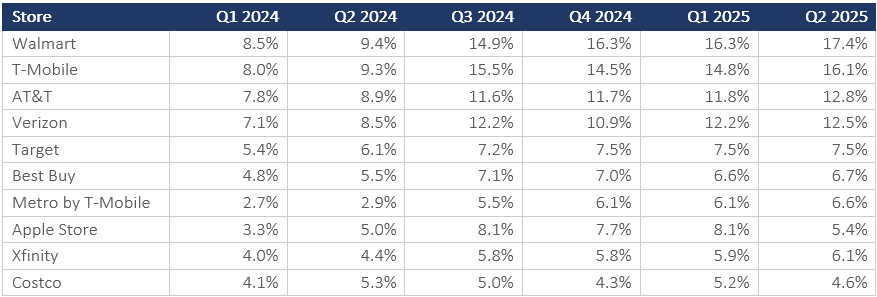
According to new data from the Recon Analytics US Consumer Device Purchase Journey report series, which tracks more than 100,000 US respondents over five consecutive quarters from Q4 2024 through Q4 2025, Walmart Supercenter accounted for 17.4 percent of wireless store visits in Q2 2025. T-Mobile, the closest competitor, checked in at 16.1 percent. AT&T trailed at 12.8 percent. Verizon at 12.5 percent.

Let that sink in for a moment. A big-box retailer best known for groceries and $6 t-shirts is pulling more wireless foot traffic than the country’s most-subscribed carrier. And the people walking through those doors look nothing like the customers carriers typically design their promotions around.

The Prepaid Goldmine Nobody Owns

Half of Walmart’s wireless visitors, 50.8 percent, earn under $50,000 annually. That’s 4.7 points above T-Mobile stores, whose under-$25K visitor concentration already exceeds that of AT&T or Verizon. At the other big-box formats, Costco skews almost precisely the opposite direction: 19.6 percent of Costco wireless visitors come from the $100K–$149K bracket. These two stores are not serving the same customer, and treating big-box retail as a monolithic channel is a strategic error.

What makes Walmart particularly consequential is the prepaid concentration. Straight Talk and Tracfone together account for 9.9 percent of Walmart wireless visitors, three to five times the rate recorded at every other major retail location in the dataset. Factor in Cricket and Metro by T-Mobile, and nearly one in five Walmart wireless visitors currently carry a prepaid or MVNO plan. These are the exact consumers every major carrier wants to convert from prepaid to postpaid. They are clustered at a single, high-traffic physical location. And no carrier owns that location.

The table below shows how dramatically Walmart’s visitation share grew over six quarters, moving from statistical parity with T-Mobile in early 2024 to a clear lead by mid-2025.


Table 1: Store Visitation Rates by Quarter (% of Respondents), Q1 2024 – Q2 2025.

Source: Recon Analytics US Consumer Telecom Distribution Module Survey. Sample sizes range from 4,588 to 14,392.

The practical implication is direct: any carrier promotion designed to drive postpaid conversion needs to be built around households earning under $50,000 and being present in Walmart’s wireless section. However, in this income segment, the traditional credit-score-based approach for postpaid needs to be modified to mitigate credit-related risks. The research also identifies the offer threshold that motivates potential switchers. A free iPhone with trade-in activates 23 percent of potential switchers, nearly 10 percentage points above the equivalent Android offers. That sets a specific, high-cost floor for conversion economics that carriers cannot negotiate away.

Word of Mouth Is Still Running the Show

Before consumers walk into any store, they research. And there the industry’s assumptions break down in a different direction. Ask a carrier strategist where device research happens, and the answer usually involves something digital. The Recon Analytics data is more specific: friends and family recommendations are the top research sources for every brand, every month, across the full May through December 2025 tracking period. Not online reviews. Not manufacturers’ websites. Not AI. Word of mouth runs at 9.5–13.5 percent across all brand tiers, and it costs manufacturers precisely nothing to reach, because it operates entirely within their existing user base.

The seasonal patterns in the data are as instructive as the absolute levels. Apple’s word-of-mouth rate peaks in July, tracking the iPhone launch cycle almost perfectly. Motorola does the opposite; it peaks in December at 13.5 percent, the highest single-month reading among brands. When a brand’s strongest advocacy moment is gift season rather than device launch season, its buyer base skews toward casual acquirers rather than enthusiast adopters. That distinction matters for how a brand should allocate marketing expenses and which retail channels to prioritize.

The implication for brand equity is uncomfortable for Samsung, Google, and Motorola. Apple’s 71 percent installed-base penetration among 18-to-29-year-olds isn’t just a market-share statistic; it’s a word-of-mouth engine compounding with every person who joins the iOS ecosystem. Every satisfaction point (cNPS) Samsung, Google, or Motorola fails to recover is another recommendation that doesn’t get made. Brand satisfaction scores, often treated as a customer-retention metric, are the wireless industry’s most cost-effective marketing channel. Brands that let satisfaction erode are not just losing renewals, they’re defunding their own referral network.

AI Research Is Neither a Premium Behavior Nor a Young Person’s Game

The AI research channel is real, growing, and demographically inconvenient for anyone who assumed it was a luxury behavior.

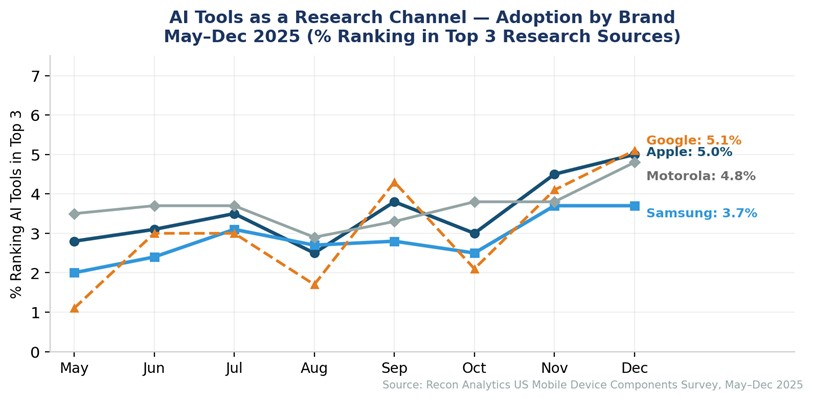
Among Apple buyers, usage of AI tools for device research climbed from 2.8 percent in May 2025 to 5.0 percent in December, a nearly 79 percent increase in eight months. Samsung’s AI research adoption also rose meaningfully, from 2.0 percent to 3.7 percent, while Motorola started the period at 3.5 percent, already above Samsung’s level throughout, and finished at 4.8 percent. That baseline anomaly is analytically significant. Motorola serves a demonstrably lower-income buyer base, yet its adoption of AI research led Samsung from the very first month. The data points to a specific use case: value-segment buyers using AI to navigate spec-to-price comparisons across a crowded $200–$400 Android mid-range market. That is a fundamentally different task from the premium ecosystem research OEM marketing teams typically assume AI serves.

Google’s trajectory requires a structural explanation, not a behavioral one. The apparent climb from 1.1 percent in May to 5.1 percent in December is real in aggregate, but it reflects two distinct product cycles layered atop one another. The June and July readings near 3.0 percent coincide with peak carrier promotional activity for the Pixel 9a. The August collapse to 1.7 percent reflects a research-intensity trough as that promotional window closed — visible simultaneously across friends-and-family, online reviews, and retail visits, not just AI. The December rebound to 5.1 percent is driven by Pixel 10 buyers entering the sample: those buyers use AI research tools at 8 to 11 percent, roughly four times the rate of Pixel 9a or legacy Pixel buyers. As Pixel 10 respondents grew from under 1 percent of the Google sample in August to 10 percent in December, they mechanically lifted the aggregate. Product-cycle awareness matters when reading these trends. A methodological note: Google’s monthly AI tool readings range from 6 to 51 respondents, which means individual monthly readings have wide confidence intervals, and the month-to-month pattern should be read as directional rather than precise.

Figure 1: AI Tools as a Research Channel — Adoption by Brand Tier, May–Dec 2025

The Research Phase Is Where Brands Are Won and Lost

The US Consumer Device Purchase Journey – Part 3 Report findings from Recon Analytics establish the precise mechanisms by which brands enter or exit consumer consideration sets before anyone walks into a store or opens a carrier website. And the picture that emerges is uncomfortable for anyone who has assumed the hard work of brand building happens in the channel.

The research phase is not a passive information-gathering exercise. It is where the consideration set forms and hardens. Consumers who rely primarily on friends and family, the plurality across every brand, are not conducting open-minded evaluations. They are asking people whom they trust whether to do what those people already did. For Apple, with 71 percent penetration among 18- to 29-year-olds, that dynamic creates an almost self-reinforcing competitive moat. Every iOS user is a potential advocate. Every cNPS point the brand sustains above its competitors is compounded through millions of peer conversations that no advertising budget can replicate or intercept.

For Android brands, the arithmetic runs the other way. Google’s word-of-mouth peaked in July at 13.9 percent, then collapsed to 5.7 percent in August, a swing of 8.2 points in a single month, consistent with the opening and closing of the Pixel 9a promotional window, though Google’s monthly sample sizes make single-month readings directional rather than precise. That kind of volatility, where it holds across larger samples, reveals a brand whose advocacy is promotional rather than organic. When the carrier offerings stop, the conversations stop. Samsung shows more structural stability in its word-of-mouth readings, but Apple’s dominant penetration among younger buyers, 71 percent among 18-to-29-year-olds per our previous report (US Consumer Device Purchase Journey – Part 1: Market Landscape, Brand Performance & Consumer Satisfaction – Digital Product Reports), suggests its advocacy engine is structurally deeper, compounding through a cohort that recommends devices to peers at the highest rate of any age group. The AI channel adds a new layer of complexity to this picture. Manufacturer websites are beginning to compete with AI-generated product comparisons for the consumer’s attention during the research phase. The brands that lose this competition are not losing a marginal channel. They are losing the moment when a consumer’s consideration set is still open. Amazon’s role as a neutral research environment, drawing 1.1 to 1.7 percent of cross-brand web traffic regardless of which device a consumer ultimately buys, illustrates the same principle: the early research phase is brand-agnostic terrain that favors whoever has the clearest, most accurate, and most findable product information.

The window is closing. Adoption curves tracked through December 2025 confirm that brands lacking structured, AI-indexed product data are already losing specification comparisons at the discovery stage — before a consumer ever sets foot in a store. This is not a risk to monitor in the future. It is a present one to act on.

Note: Data in this article is drawn from the Recon Analytics US Consumer Device Purchase Journey: Part 3, Pre-Purchase Research and Distribution Channel Dynamics. The series covers Q4 2024 through Q4 2025 using the Recon Analytics US Mobile Device Components Survey (n = 104,408 respondents across five quarters). If you are interested in the report, you can find it here: US Consumer Device Purchase Journey – Part 3: Pre-Purchase Research and Distribution Channel Dynamics