
When Nvidia announced that it was in the process of buying Arm from Softbank, many analysts and industry observers were exuberant about how it would transform the semiconductor industry by combining the leading data center Artificial Intelligence (AI) CPU company with the leading device AI processor architecture company. While some see the potential advantages that Nvidia would gain by owning ARM, it is also important to look at the risks that the merger poses for the ecosphere at large and the course of innovation.

An understanding of the particular business model and its interplay highlights the importance of the proposed merger. Nvidia became the industry leader in data center AI almost by accident. Nvidia became the largest graphics provider by combining strong hardware with frequently updated software drivers. Unlike its competitors, Nvidia’s drivers constantly improved not only the newest graphics cards but also past generation graphics cards with new drivers that made the graphics cards faster. This extended the useful life of graphics cards but, more importantly, it also created a superior value proposition and, therefore, customer loyalty. The software also added flexibility as Nvidia realized that the same application that makes graphics processing on PCs efficient and powerful – parallel processing – is also suitable for other heavy computing workloads like bitcoin mining and AI tasks. This opened up a large new market as its competitors could not follow due to the lack of suitable software capabilities. This made Nvidia the market leader in both PC graphics cards and data center AI computation with the same underlying hardware and software. Nvidia further expanded its lead by adding an parallel computing platform and application programming interface (API) to its graphics cards that has laid the foundation for Nvidia’s strong performance and leading market share in AI.

ARM, on the other hand, does not sell hardware or software. Rather, it licenses its ARM intellectual property to chip manufacturers, who then build processors based on the designs. ARM is so successful that virtually all mobile devices use ARM-based CPUs. Apple, which has used ARM-based processors in the iPhone since inception is now also switching their computer processors from Intel to ARM-based internally built CPUs. The ARM processor designs are now so capable and focused on low power usage that they have become a credible threat to Intel, AMD, and Via Technology’s x86-based CPUs. Apple’s move to eliminate x86 architecture from their SKUs is a watershed moment, in that solves a platform development issue by allowing developers to natively design data center apps on their Macs. Consequently, it is only a matter of time before ARM processor designs show up in data centers.

This inevitability highlights one of the major differences between ARM and Nvidia’s business model. ARM makes money by creating processor designs and selling them to as many companies that want to build processors as possible. Nvidia’s business model, on the other hand, is to create its own processor designs, turn them into hardware, and then sell an integrated solution to its customers. It is hard to overstate how diametrically different the business models are and hard to imagine how one could reconcile these two business models in the same company.

Currently, device AI and data center AI are innovating and competing around what kind of tasks are computed and whether the work is done on the device or at the data center or both. This type of innovative competition is the prerequisite for positive long-term outcomes as the marketplace decides what is the best distribution of effort and which technology should win out. With this competition in full swing, it is hard to see how a company CEO can reconcile this battle of the business models within a company. Even more so, the idea that one division of the New Nvidia, ARM, could sell to Nvidia’s competitors, for example, in the datacenter or automotive industry and make them more competitive is just not credible, especially for such a vigorous competitor as Nvidia. It would also not be palatable to shareholders for long. The concept of neutrality that is core to ARM’s business would go straight out of the window. Nvidia wouldn’t even have to be overt about it. The company could tip the scales of innovation towards the core data center AI business by simply underinvesting in the ARM business, or in industries it chooses to deprioritize in favor of the datacenter. It would also be extremely difficult to prove what would be underinvesting when Nvidia simply maintained current R&D spend rather than increasing it, as another owner might do as they see the AI business as a significant growth opportunity rather than a threat as Nvidia might see it.

It is hard to overestimate the importance of ARM to mobile devices and increasingly to general purpose computing – with more than 130 billion processors made as of the end of 2019. If ARM is somehow impeded from freely innovating as it has, the pace of global innovation could very well slow down. The insidious thing about such an innovative slow down would be that it would be hard to quantify and impossible to rectify.

The proposed acquisition of ARM by Nvidia also comes at a time of heightened anti-trust activity. Attorney Generals of several states have accused Facebook of predatory conduct. New York Attorney General Letitia James said that Facebook used its market position “to crush smaller rivals and snuff out competition, all at the expense of everyday users.” The type of anti-competitive conduct that was cited as basis for the anti-trust lawsuit against Facebook was also that of predatory acquisitions to lessen the threat of competitive pressure by innovative companies that might become a threat to the core business of Facebook.

The parallels are eerie and plain to see. The acquisition of ARM by Nvidia is all too similar to Facebook’s acquisitions of Instagram and WhatsApp in that both allow the purchasing entity to hedge their growth strategy regardless of customer preferences while potentially stifling innovation. And while Facebook was in the driver’s seat, it could take advantage of customer preferences. Whereas in some countries and customer segments the core Facebook brand is seen as uncool and old, Instagram is seen as novel and different than Facebook. From Facebook’s perspective, the strategy keeps the customer in-house.

The new focus by both States and the federal government, Republicans and Democrats alike, on potentially innovation-inhibiting acquisitions, highlighted by their lawsuits looking at past acquisitions as in Facebook’s and Google’s case, make it inevitable that new mergers will receive the same scrutiny. It is likely that regulators will come to the conclusion that the proposed acquisition of ARM by Nvidia looks and feels like an act that is meant to take control of the engine that fuels the most credible competitors to Nvidia’s core business just as it and its customers expands into the AI segment and are becoming likely threats to Nvidia. In a different time, regardless of administration, this merger would have been waved through, but it would be surprising if that would be the case in 2021 or 2022.

A week into the C-Band auction, all signs point to an intense struggle for spectrum among the auction participants. With 5G deployments in full-swing, the 280Mhz of mid-band licenses being offered sit directly in the ‘goldilocks zone’ that straddles attractive propagation characteristics -good in-building penetration and range- and 20Mhz blocks large enough to deploy significant capacity and speed for 5G.

For bidders looking to use spectrum quickly, the 100MHz that makes up A block for the auction is scheduled to be cleared as early as 2021 while B and C block licenses may not be available until 2023. As such, A block licenses for 46 of the top 50 markets can be bid on separately and will likely come at a premium compared to B and C block licenses in the same market.

While we won’t know who bid on which markets until the auction is over, for each round the FCC reports the demand for licenses versus those available via the public reporting system. For each round, in every market where demand exceeds supply, the price increases by 10% for the next round. Ten percent may not sound like much initially, but exponential growth soon catches up and markets with intense bidding quickly get expensive. For example, after ten rounds where demand exceeds supply the price more than doubles, after twenty rounds it increases by six-fold and after fifty rounds the price has increased to 100x the original cost.

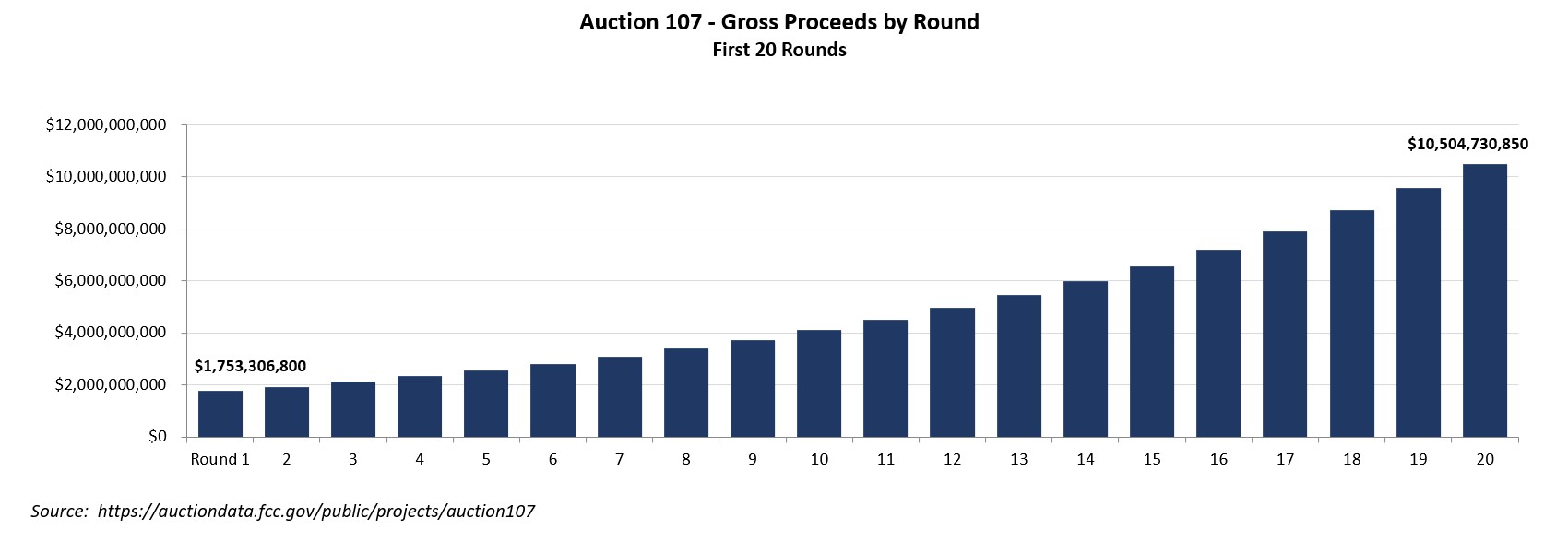
Price escalation invariably forces decisions on even the most well-heeled bidders, but we have not yet reached that point with the C-Band auction. So far the volume of markets with bids over supply has INCREASED, not decreased, resulting in over $10.5B gross proceeds across the 411 markets offered through round 20.

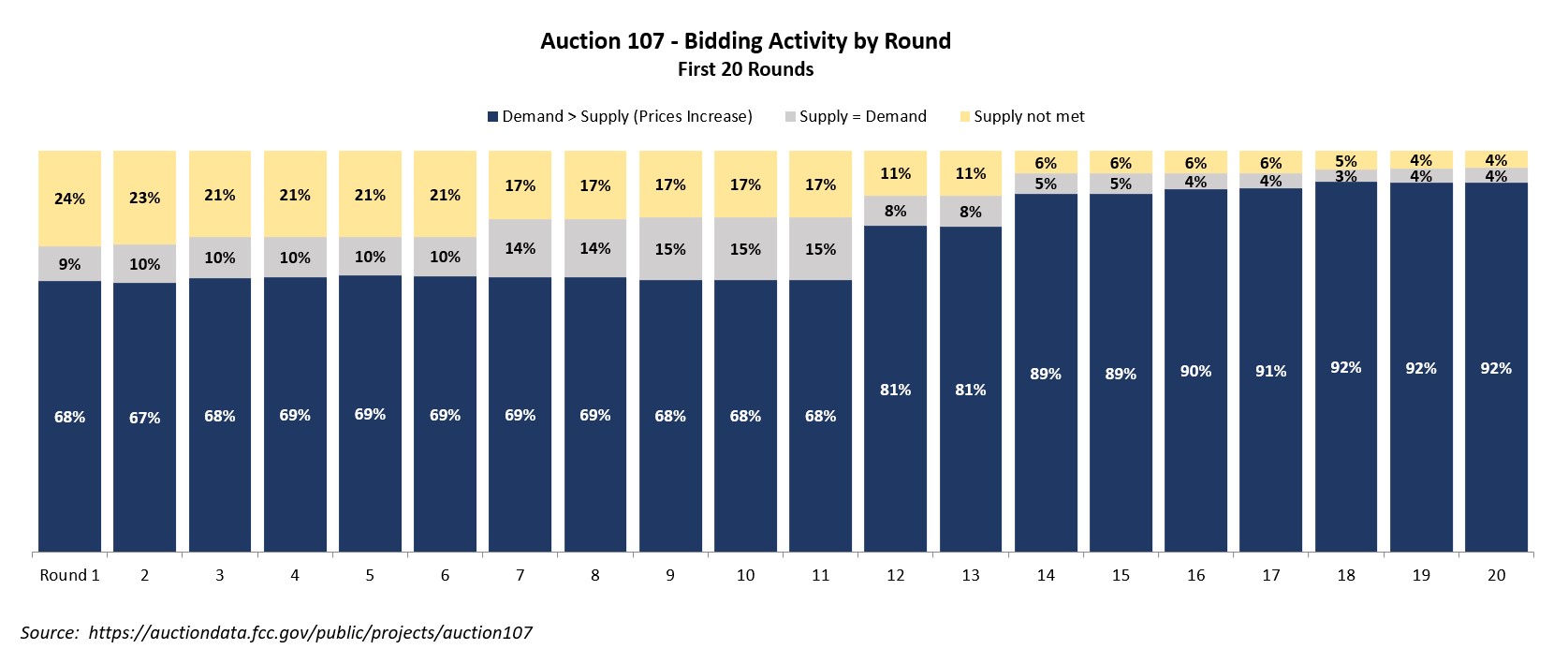
What is interesting about the C-Band auction so far is that the bidding volume for smaller markets that typically happens later in the auction has heated up early. During the first ten rounds demand for roughly 2/3rds of markets exceeded supply and therefore increased in price by 10% every round. Starting in round 12 bidding volume increased.  This increased volume catapulted markets with price increases from 68% of all markets to 81% of all markets and continued to build to over 90% of all markets by round 17.

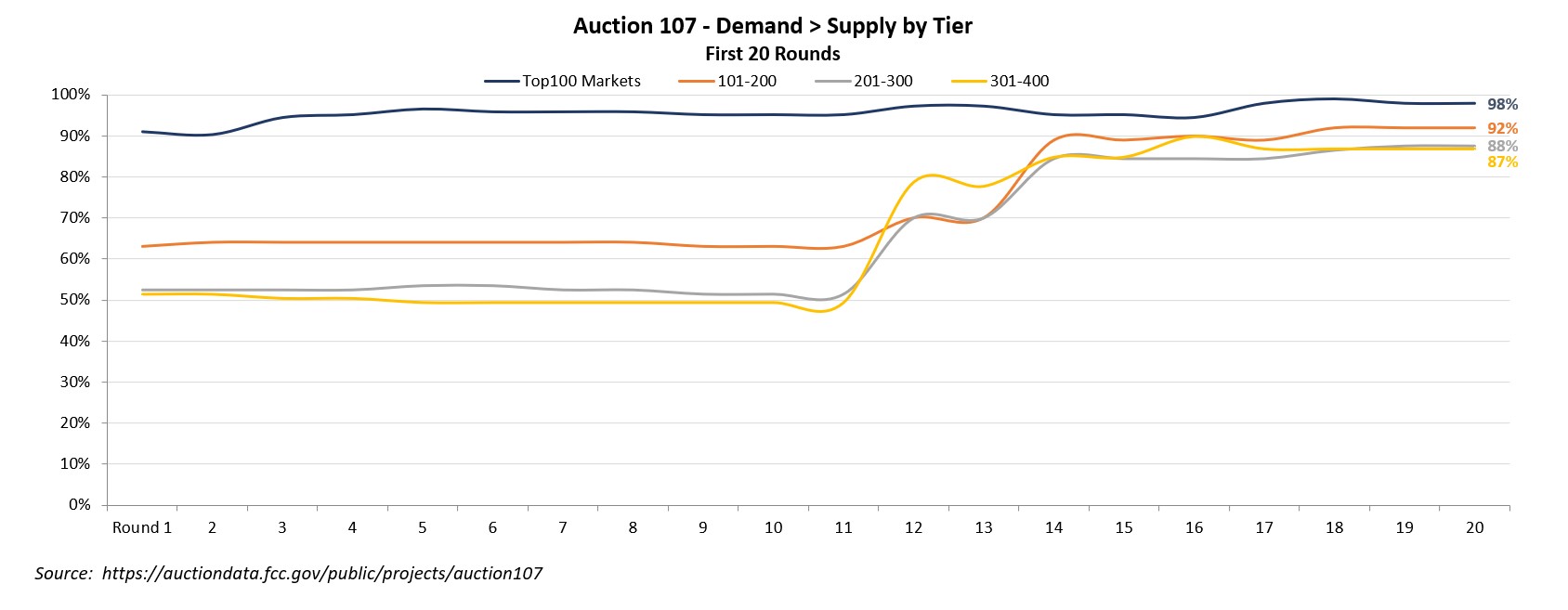
Digging a bit deeper, the jump in markets with more demand than supply that began in round 11 was driven by an increase in interest in smaller population markets while prices for larger markets were still not settled. Through round 10 only about half of markets lower population tier markets ranked 100-400 had more bids than supply, but by round 15 over 86% of markets ranked 100-400 by population had more bids than supply.

But what about those A sub block licenses that could help the winner race to deploying mid-band 5G? There are only 5 sub blocks available per market, but bidding for many of the top markets through 20 rounds still shows bids in the double digits in excess of supply. In fact, demand for A block markets is still so strong that in the first 20 rounds every A sub block in the 46 markets increased in price every round. That adds up to a 612% increase over 20 rounds and over $3.5B of the total gross proceeds of $10.5B across the entire auction.

Bidders seem to be slowly adjusting to the expectation that they may not win the entire A block. In round 18 demand for the top 39 markets dropped by 2 to 3 units across all markets, likely indicating a coordinated pull-back by one bidder. While demand has fallen across the top markets, none of the A block markets have reached bidding equilibrium where supply equals demand and price increases cease. At current pace the licenses in A sub block markets would be collectively worth over $5B in just 5 more rounds and over $10B by round 32.

Within A sub block, which markets are most popular among bidders? As always, the top 10 markets have among the highest demand, but the market with the most demand in excess of supply so far is Salt Lake City, the 27th largest market in the auction, with 4 bidders for every available block (5 blocks available, 15 in excess of supply).  A cluster of markets follow Salt Lake City for second most activity: Chicago, Dallas, Miami, Houston, Orlando, Las Vegas, Kansas City, Austin and Milwaukee all have 12 bids over supply (total bids of 17 each).

So what can we learn from the first week of the C-Band auction? At $10.5B through round 20, the levels of interest in mid-band 5G spectrum are sky high. Verizon and AT&T’s well understood need for mid-band 5G spectrum is surely playing a role in the bidding intensity, but bidding volumes suggest there are also other players willing to throw their hat in the ring, particularly for the A block which will be available soon.  Regardless of who wins, it’s likely we’ll see consumers enjoying the benefits of C-Band 5G sooner rather than later.

Over the past 15 years, there have been several government initiatives to expand the adoption of broadband in the United States. At the same time, industry has been busily focused on extending the reach and capacity of both fixed and mobile broadband networks.  Yet, a digital divide still exists.  Why?  Let’s review the history here.

Since xxx, the cable and telecom industry have successfully provided broadband connectivity to more than 110.8 million households, adding about 2.4 million households per year. Gigabit speeds are now available to 85% of households. The broadband companies expand their  footprint in an economically responsible way as they are accountable to their shareholders. Regardless, this leaves us with 17.7 million households left to cover. With the number of households increasing by roughly one million per year, at the current pace this would take us around 13 years. The current pandemic, with its work and study from home demands, shows us that we do not have 13 years to close this digital divide. In order to make the best possible decision on how to solve the problem, we should look at what has and has not worked in the past.

One of the most hotly debated solutions being proposed to close the digital divide is to have the government support municipal broadband, a catch-all term  for providers of broadband that includes telephone and electric cooperatives. The general caveat of government entering what is a private business market is what economists call crowding out. A for-profit company typically has no chance of competing against a government entity. The latter does not have a profit goal and can provide service at a loss for an infinite period of time, as it has access to government revenue in the form of taxes or bonds to cover the losses. At the same time, the government has a poor record of innovating adjustments to a rapidly changing technological environment. The pro-municipal broadband argument holds that if for-profit companies are not offering services in a particular geographic location, they cannot be crowded out.

Electric cooperatives were founded in the 1930s to solve the 20th century equivalent of the broadband problem, and the solution is instructive for our current situation. The Institute of Local Self-Reliance, an organization in favor dispersing economic power and ownership, identified eight municipal networks that failed in the United States. The common thread of failure was inexperience in running customer-facing organizations as a neophytes struggled to learn a new skill set. This highlights the gap between running a relatively small number of government services and running much larger and more technically complicated broadband network and the problems recruiting the people with the right existing skill sets.

The most likely scenario for success is the addition of broadband service to an existing electric or telephone cooperative’s portfolio. In this case, an entity with experience in running a customer-facing operation and network for decades simply expands its service. The cooperatives are already serving mostly rural customers and do not crowd out for-profit cable and telecom providers. The FCC has recognized this and has explicitly included electric cooperatives in the Connect America Fund II initiative (which we will discuss later)

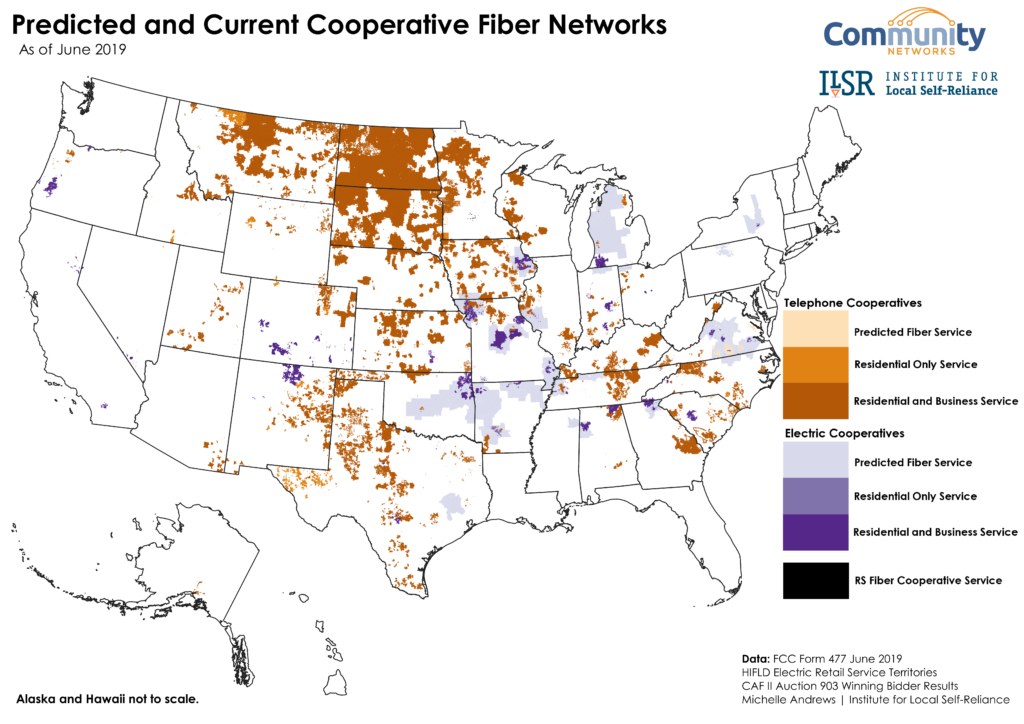
Source: ILSR

As we can see from the map above, the opportunity for rural broadband coverage from cooperatives is significant as rural areas often in the South and the Great Plains have low population density. Perhaps engaging both electric and telephone cooperatives in rural areas is an effective way to close the digital divide in some areas.  These could take the form of public private partnerships and potentially avoid the pitfalls of muni-broadband.

Muni-Broadband has failed for different reasons.  Research shows that most of the failed entities are urban, often engaging in direct competition with incumbent providers. Examples such as Monticello, MN, Salisbury NC, and Tacoma, WA come to mind. In other cases, the municipal broadband networks such as in Muscatine, IA, Utopia, UT had to be bailed out by taxpayers or the electric cooperative because it could not stay afloat. We also have Provo, UT and Groton, CT, which ended up selling to private companies at a great loss to tax payers,  and Burlington, VT where the lack of oversight and cover-up of incompetence lead to failure to Bristol, VA where corruption meant the end of the network.

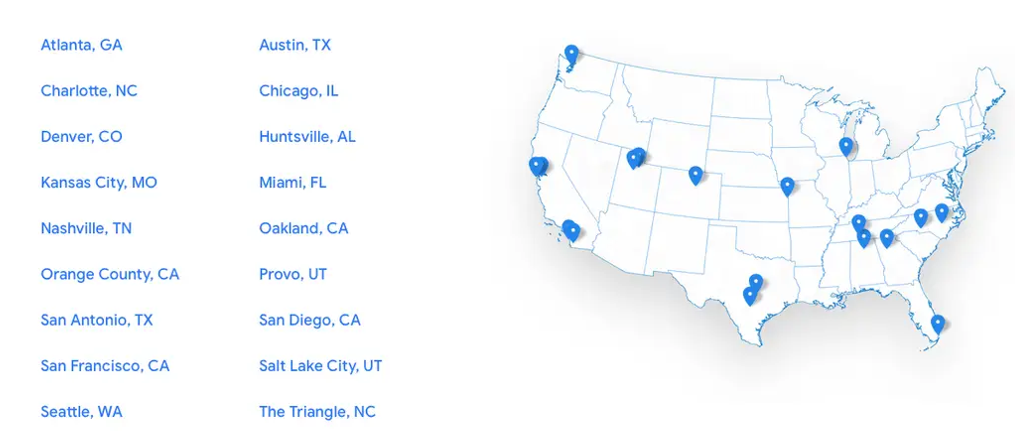
In 2010, Google announced that it would start providing broadband fiber connectivity in a number of cities to between 50,000 and 500,000 households. Cleverly, Google put out a request for information asking municipalities to apply to have Google offer fiber in their city or town. This reversed the traditional relationship between provider and municipality. Traditionally, the provider asks the municipality if it can provide service in the area. The municipality responds with what they ask for in terms of fees and extra services. Ever wondered why so many pools, parks, and sports areas are sponsored by telecom and cable companies? It was one of the demands of the city in order to allow the service provider to offer service in the town. By inverting the relationship and asking towns to apply to Google for consideration, Google shifted the power relationship, and was able to receive such favorable terms that telecom and cable providers went to cities and demanded the same terms and conditions that Google got, but they were never able to get by themselves. Under equal treatment rules, these cities had to extend the favorable Google terms and conditions to every other provider. Kansas City was the first city Google Fiber launched followed by Austin, Provo, and fifteen more cities. The Provo network was a defunct municipal network that was built for $39 million and then sold to Google for one dollar. After realizing the high cost to build a fiber network and the long delay of a payback to themselves, Google first halted further network expansions after it had deployed in five cities, and then switched to a private public partnership (PPP) model where the municipality builds the network and incurs the cost and Google sells the service. In addition, Google made an acquisition in the fixed wireless broadband space to also provide broadband wirelessly. This has slowed down the expansion significantly, but the scope has increased beyond what can be called a trial – as Google likes to call every endeavor they get into – as Google now covers 18 cities.

The 19th market for Google Fiber will be West Des Moines, Iowa. Similarly to Huntsville, Alabama, the city will build a fiber network for $39 million, in exchange Google will pay the city $2.25 for each household that connects to the network. Over the 20-year agreement, Google will pay at least $4.5 million to the city. The project will be completed by the end of 2023. By entering PPPs, Google gets the various cities to pay for the expensive built out and make money by providing the service. Google’s experience highlights that even one of the largest companies in the world does not have the focus, wherewithal and patience to actually build out a nationwide system, but relies on the government to pay for the physical buildout.

When the government helps in areas with adverse circumstances, either through low population density or low income, a business case can be made that allows the deployment of broadband services. The societal good that comes from broadband in the form of access to online learning for students, job resources for adults and an overall increase in computer skills will create greater long-term benefits than long-term costs.

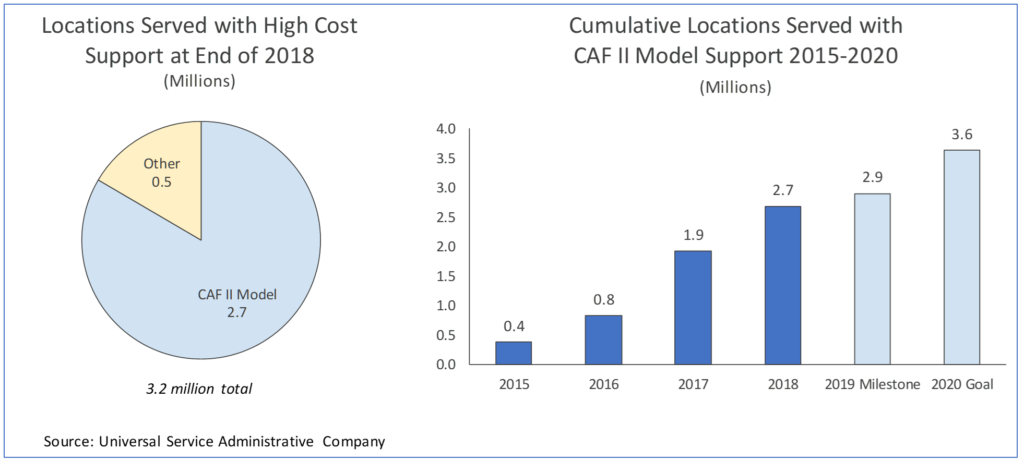
On the government side of the equation, the FCC has been very focused on allocating monies (and spectrum) for broadband.  The FCC’s Connect America Fund (CAF) was born out of the National Broadband Plan from 2010 aiming to broaden the availability of broadband. Now in its second iteration, CAF II, the fund is a reverse auction subsidy for broadband providers, satellite companies and electric cooperatives to provide coverage in underserved areas.

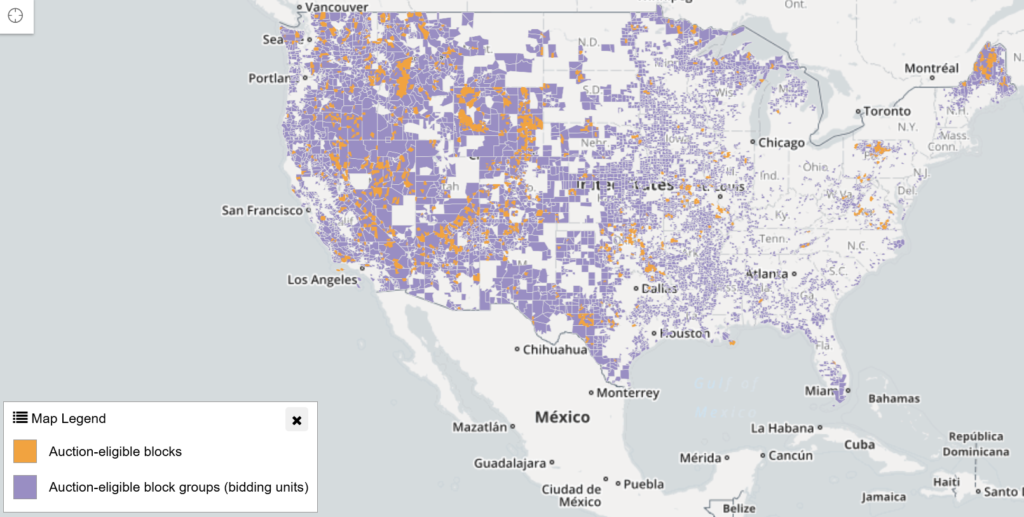
At the end of the CAF II auction, $1.49 billion of subsidies over ten years were awarded to provide broadband and voice services to 700,000 locations in 45 states highlighted in the map above. Prospective providers successively bid on who would cover the underserved market for less and less subsidy. This ensures that the area is covered for the least cost to taxpayers.

The CAF II and other government programs are increasingly closing the gap more than $20.4 billion over the next 10 years. The US Department of Agriculture has been one of the longest standing sources of support to bring broadband to rural America with $600 million per year from the ReConnect program. In October 2020, the FCC will launch the auction for the Rural Development Opportunity Fund (RDOF), a 10-year $20.4 billion program to bring broadband to areas that do not have broadband defined at 25 Mbit/ss download speed and 3 Mbit/s upload speed.

The biggest controversy around CAF II is the mapping issues. In a nutshell, if only one location in a census track has access to broadband, it is assumed that all locations have broadband. This is in a significant number of cases is not true and some locations have access when others do not. This is especially true in urban areas where we still have some high population pockets that lack access to broadband. Parts of the FCC Commission wanted to delay additional projects until the mapping problem was solved, whereas the majority voted to release the fund and work at the problem concurrently as the underserved markets are underserved even with a tighter requirement.  While being criticized for its complexity and lack of clarity of how overachievement of the target goals gets recognized and impacts winning the subsidy, the program has been overall lauded a success.

When we look at what has worked and what hasn’t worked, it becomes apparent that the for-profit system has worked for 90% of Americans to have access to at least one broadband provider. The problem becomes the hard to reach, both in urban and rural environments. No matter how we look at the issue, it becomes clear that government and cooperatives plays a role to alleviate the problem as we need to fix a societal problem.

  • Since Silicon Valley giants like Google with almost infinite resources have balked at building out fiber in many urban areas and are relying on cooperatives or municipalities to foot the bill, the economics of building out hard to reach parts of the United States are even more difficult.
  • The broadband industry is investing between $70 billion and $80 billion per year to connect Americans, the wireless industry investing another $25 to $30 billion just shows that the industry can’t shoulder it alone.
  • Electric cooperatives as non-profits have a longer time horizon, which makes their investment in underserved rural areas easier, as they have an already established customer relationship with the prospective customers and an established connection to the location.
  • The CAF and other funds have worked by providing the minimal subsidy to cover underserved markets, but we just need more. Even though some have complained that it provides for only one choice ignoring that 85% of households have a choice of two wireline providers and 99% of Americans can chose between at least three mobile service providers. The counter argument for very rural parts of the United States is that one choice in an economically unprofitable market is better than no choice. Also, one has to consider that requiring every location to have two choices roughly doubles the cost of deployment and half of the infrastructure being idle.
  • The program will work even better with more accurate mapping of underserved areas and through that broaden its scope from mainly rural to also urban areas and become location agnostic. If a follow-up program not only wants to bring access but also competition to an underserved area, the government would have to not only double but probably quadruple if not quintuple the subsidy due to the doubling the cost of deployment while halving the expected revenue.

The consequences of not building out areas that do not have broadband access today – regardless if urban or rural – perpetuates the current trends where we have parts of society that cannot participate in the economic and social life of our country. As 2020 has shown us, broadband internet has become the lifeline of businesses and video conferencing has become a necessity for employees to work remotely. This means that many better paid jobs are closed to people depending on where they live regardless if it is an area without broadband in the urban or rural place. Unsolved this will force a further depopulation of rural America, a flight from unserved urban areas as critical employees and business owners are effectively prevented from earning a living there. At least as important is the equal access to education. Student homework and tests cannot be counted for grading unless every student in the class is able to participate. Without broadband access, not only children who live in these unserved areas are affected but also their classmates who have access.

For a country that is known for being as efficient, organized, and technologically advanced as Germany, its state of mobile networks constitutes a rare black mark. Germany is the third largest economy in the world with 82 million inhabitants (double that of California in half of the area) with a highly efficient and advanced high-tech manufacturing industry. Where it is struggling is with the digitalization of the economy and both fixed and wireless networks. Germany’s wireless networks are ranked 32nd out of 34 countries, ahead only of Ireland and Belarus. Yet no other European country has a larger share of 3G users than Germany, and it is not uncommon to fall back to EDGE networks both in urban and rural areas. The reasons for this atypical performance lie with the actions of regulators and companies alike.

In 2010, Germany auctioned 4G licenses with the requirement that within 5 years 97% of the population would be covered by 4G. However, even by 2020, every operator has failed to meet the 2015 buildout requirement. How could this happen in a country that prides itself on following the rules?

 RequirementTelefónicaTelekomVodafone
Baden-Württemberg97%82,7%96,01%97,7%
Bayern97%80,7%97,58%98,3%
Berlin97%100%99,96%100%
Brandenburg97%62,6%97,5%99%
Bremen97%99,9%99,99%100%
Hamburg97%100%99,99%100%
Hessen97%76,7%98,39%97,4%
Mecklenburg-Vorpommern97%72,9%97,52%99,3%
Niedersachsen97%85,9%98,6%99%
Nordrhein-Westfalen97%94,3%99,28%99,4%
Rheinland-Pfalz97%65,4%96,48%97%
Saarland97%78,9%95,43%97,9%
Sachsen97%80,9%98,12%99%
Sachsen-Anhalt97%80,6%98,49%98,7%
Schleswig-Holstein97%90,6%98,53%99,9%
Thüringen97%73,2%97%98,1%
Nationwide98%84,3%98,1%98,6%
Interstates100%77,9%97,6%96%
Rail100%80,3%96,4%95%***

Souce: Bundesnetzagentur, May 2020

With every new generation, German mobile operators suffer from low technology adoption because they use the same playbook over and over again (3G, 4G and now 5G), resulting in the same poor outcome. Wireless licenses in Germany and most of Europe are tied to a specific technology, whereas US licenses can be used with any technology that allows a more efficient transition from one generation to the next. Regardless, German operators rightfully realize the high value of new spectrum for next generation technology and bid more money per capita for next generational licenses than anywhere else in Europe. As a result of the significant investment in licenses, German operators position the next generation product as a premium product with a significant price premium. For this reason, consumers and businesses are reluctant to adopt next generation service plans and devices, leading to suppressed next generation revenues and profits. These low profits are then used as a justification limit capital investment in next generation technologies. Consequently, German wireless networks cover less area than they can and should. This self-fulfilling prophesy is now in its third iteration. We have seen it in 3G, 4G, and now 5G in Germany.

US carriers start from the same point of recognizing the value of next generation technology and spectrum, and US spectrum auctions have yielded the highest values globally. Unlike Germany, US mobile operators make the new technology available for the same price point as the last generation technology, creating greater profitability through a significantly lower cost structure given that next generation technology typically lowers the cost per gigabyte by 90% over the previous generation. As a result, US mobile operators see a rapid shift from the old generation to the next generation network usage as customers upgrade their devices to be able to take advantage of the new networks. By holding the price points steady for next generation networks with their faster speeds, US operators are under less price pressure than European operators, allowing operators to invest heavily in their networks and differentiate on coverage. As a result, the US ranks fifth in the world for 4G availability, behind South Korea, Japan, Norway and Hong Kong, which make up a combined 9.3% of the areas of the United States. As a result, everyone wins in the US approach: customers have faster access to next generation technology, and operators make a higher profit.

Germany’s cost problem is compounded by a legal and regulatory regime that does not favor the building of cell sites similar to Section 332 of the Telecom Act. German building permits are notoriously lengthy endeavors that take a long time. Frequent lawsuits against many cell sites lead to drawn-out legal reviews which slows down network buildout. All of these policies are not friendly for capital investment in wireless networks.

The problem of how to cover thinly populated rural areas in Germany persists. Mobile operators complain that it is unprofitable to cover many rural areas. During the 2018 Mobilfunkgipfel (Mobile Summit) between the German government and mobile operators, the government committed to share part of the cost of covering rural parts of Germany.

Coverage issues in rural parts of a country are not unique. Germany’s neighbor France – roughly the size of Texas – has tackled the issue in three different ways. For the 2G rollout mobile operators, the central government, and the departments (provinces) with coverage gaps in the rural parts of France split the cost three ways between the parties. In 2015, the French government set aside $1 billion to close the 3G coverage gaps. In 2018, the French government came to an agreement with the four incumbent operators to extend the license term in exchange for closing coverage gaps and to install jointly more than 5,000 masts and antennas.

There are four key lessons that we can take away from the German and French examples:

  1. The business model matters. American operators are providing world class service, especially considering the size of the country. The US operator model of capturing profit through cost reduction rather than price increases is the superior model. It results in faster and higher adoption of next generation technology and greater capital investment. The one US carrier who tried to charge a premium for 5G, Verizon, has two European executives at the helm. Customer pressure quickly forced Verizon to abandon its European model of a price premium and revert back to the US model.
  2. A mobile-friendly regulatory regime that enables the rapid building of new cell sites makes a positive difference. It is a no-brainer that when it is difficult for operators build new sites, coverage suffers.
  3. Even medium-size economically prosperous countries like France and Germany have similar problems to economically build out mobile networks. While it is more cost effective to build out rural areas with wireless rather than fixed technology, the business case is far from a foregone conclusion.
  4. The comparison between the US and more tightly regulated countries shows that incentives and support for wireless networks without red tape and strings attached are creating better results.

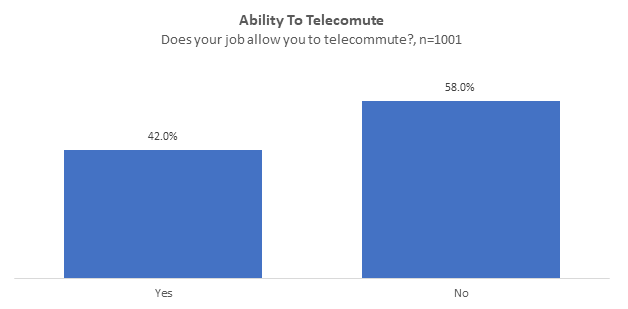
A new report called “Broadband 2020” by Recon Analytics shows that over 40% of employees in the United States are able to telecommute. The Department of Labor’s Bureau of Labor Statistics defines the professional workforce as all workers in the “management, professional, and related occupations” colloquially known as white collar workers, which make up 41.2% of all jobs in America. This means that basically every white collar worker is able to telecommute. This highlights the dramatic change that the American workplace has undergone during the pandemic.

The pandemic also has the potential to halt or even reverse the decades-long migration of Americans from rural to urban settings. A slight majority (50.9%) of Americans that can telecommute are contemplating moving to a smaller city or town as the pandemic has prompted many Americans to reevaluate their priorities and living conditions.

What is surprising is that even 31% of Americans that cannot telecommute are considering moving to a smaller city or town. It shows that the luster of metropolitan areas has been waning.

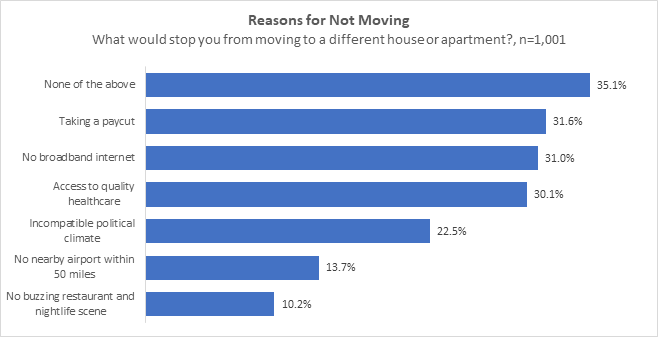
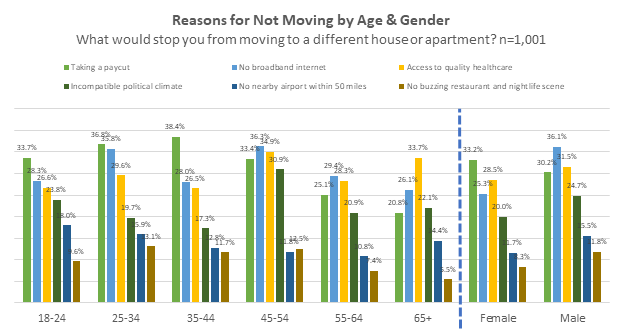
But not all new places are equal, so we asked what factors would stop people from moving to a new place. The results were equal parts predictable and surprising:

More than a third of Americans do not have any reasons that would prevent them from moving to a different place. Where it gets interesting is the reasons why people would not move. The number one reason for not moving to a different town or village is a pay cut – 31.6% of respondents. Companies like Facebook have announced that employees who work from home from lower-cost areas – and everything is lower cost than Silicon Valley – would receive a pay cut. A move that ties compensation to location rather than contribution would prevent a significant number of employees from moving away from Silicon Valley, which already is experiencing a severe housing shortage and overloaded roads. Facebook’s reasoning also allows a glimpse at its compensation philosophy, which seems to focus more on competitive factors than what is good for the community or the employee. Almost as many, 31%, would not move to a town or village without broadband, which is just ahead of access of quality health care with 30.1% – and that in the midst of a pandemic. One has to recognize the magnitude of this finding: Availability of broadband, access to quality healthcare, and a pay cut are equally important in the mind of Americans during a pandemic and recession.

At 36.3%, the 45-54 age segment considers the lack of broadband to be the most significant barrier to moving, followed by the 25-34 age segment with 35.8%. More than a quarter of seniors (26.1%) will not move to a new location if broadband isn’t readily available.

Broadband is even more important than politics. While 22.5% of Americans would not move to an area with what they consider an incompatible political climate, which is significantly less than the importance of broadband. The  45 to 56 age segment is most focused on  politics with over 30.9% citing an unwillingness to move due to an incompatible political climate. The next most polarized age segment is those over the age of 65, where 22.1% mention an incompatible political climate prevents them from moving.

The lack of a nearby airport or a buzzing nightlife was the least important in people’s minds. Only 13.7% of respondents thought that not having an airport within a 50-mile radius would prevent them from moving there. A buzzing nightlife or restaurant scene is even less on people’s minds. Only 9.6% of 18 to 24-year-olds find it an obstacle to move, whereas 13.1% of the 25 to 34 age segment needs a buzzing nightlife and restaurant scene.

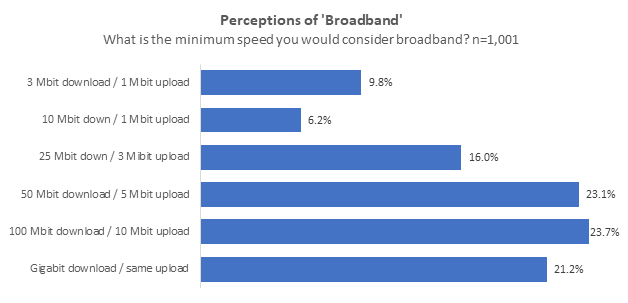
We asked people what they considered broadband. The median American considers 50 Mbit/s download and 5 Mbit/s upload as broadband. The people’s expectations are leading the FCC’s definition of broadband which currently sits at 25 Mbit/s download and 3 Mbit/s upload.

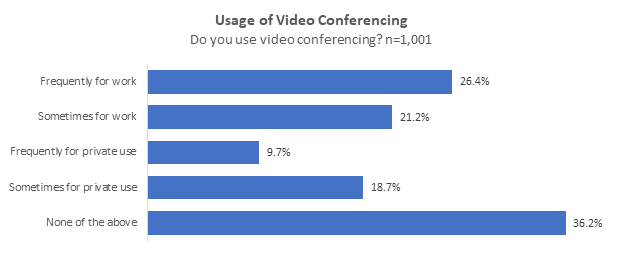
The reason for this becomes apparent when we look at the use cases. In our survey we looked at several use cases, but the prevalence of video conferencing has driven bandwidth requirements upwards, especially on the upload side. A HD video stream requires a minimum of 5 Mbit/s upload and download per stream. With more than 25% of Americans now frequently using video conferencing for work and another 21% using sometimes for work the bar has effectively been raised.

While the lack of widely available broadband is a significant hurdle for cities and towns to attract new residents, it is almost outright disqualifying for housing options: 77.5% of respondents would not move to a place, like a house or apartment, that does not have broadband. This makes the availability of broadband one of the key selection criteria when choosing a new residence. When almost half of the population has to be sometimes or frequently on video conferencing, having broadband becomes a job requirement. The pandemic, for the good and bad, has made our homes places of work with the IT and connectivity needs that were traditionally reserved for places of work. These are just some of the highlights of the new Recon Analytics Report “Broadband 2020.”

The results of the report are reinforcing the data from FCC’s 2020 Broadband Deployment Report which represents the most recent government data on the topic and the progress the industry has made from 2014 to 2018.

As of 2018, 94.4% of the Americans have access to broadband as the FCC defines it, 25 Mbits download, 3 Mbits upload (25/3). In urban areas, it is even 98.5%, but as we look towards rural areas and tribal lands, the availability is significantly less. In rural areas 77.7% of Americans and in tribal lands, 72.3% of Americans have access to 25/3 broadband. In higher tiers, access in urban areas drops only slightly, but much more significantly in rural areas and in tribal lands. At the 250/25 Mbps tier, 94% of Americans in urban areas have access, a drop of 4.5% from the 25/3 level. In rural areas,  51.6% of American have access to 250/25, which is 26.1% less than 25/3. In tribal lands, 45.5% have access to 250/25 which is 26.8% less than 25/3.

The numbers make it clear that there is still more than enough to do in urban, rural and tribal areas to provide connectivity for essential tasks. As it looks increasingly unlikely that children in every school district will be able to go back to school, we need to ensure that every child in the United States can access the internet to be able to participate in school and classroom work. If only one child cannot participate, the progress and grades for the entire class are not counted. While fixed broadband deployment is a time-consuming endeavor, mobile broadband can and should close the homework gap. T-Mobile has announced that as part of its merger commitments it will deliver mobile broadband to 10 million households we have only a few weeks to turn this promise into a meaningful difference as the new school year starts. The other mobile operators, in conjunction with the FCC and federal funding, should seize the opportunity and close the homework gap as quickly as possible.

In order to recover as quickly as possible from the current economic slump, we should put money where it has the biggest impact. Different technologies are able to achieve the same goals but have strengths and weakness in different areas. This means that any funding has to be technologically agnostic and look at the performance characteristics. The United States has wisely always used performance characteristics such as download and upload speed as well as latency as its selection criteria rather than being tied to a technology regardless if it is fiber, hybrid fiber coax, VDSL, satellite or whatever generation of wireless standards.

If you would like to buy the underlying report, please give us a call at 617.823.3363

4G wireless networks powered remarkable economic growth and transformed the way Americans live and work, according to a new report by Recon Analytics and CTIA, the wireless industry association. The study shows the powerful impact of wireless on our economy as American providers begin to rollout next-generation 5G networks, which will create a new 5G economy over the next 10 years.

The report’s key findings include that nearly 10% of the GDP increase of the entire U.S. economy from 2011 to 2019 was due to the growth of the U.S. wireless industry, and that U.S. 4G networks support 20 million jobs, drove nearly $700 billion in economic contribution last year alone, and save consumers $130 billion each year.

“Our 4G success didn’t happen overnight: investment dollar by investment dollar, cell site by cell site, America’s wireless industry brought the benefits of high-speed mobile broadband to communities across America, creating  jobs, powering economic growth and spurring innovations that make our lives better,” said Meredith Attwell Baker, CTIA President and CEO. “Over the next decade, our emerging 5G economy will unleash even greater consumer benefits and maintain America’s position as the world’s innovation hub.”

Today, 4G networks are widely available and there are more 4G subscriptions in the United States than people. As the study shows, however, this was the result of ten years of gradual network improvements, industry investment, spectrum auctions and innovation.

Additional highlights include:

  • Between 2011 and 2019, U.S. wireless industry GDP grew 253%. In 2019, the industry contributed $690.5 billion to U.S. GDP, which would make America’s wireless industry the world’s 21st largest economy.
  • At the start of the decade, the wireless industry enabled 3.7 million U.S. jobs. By the end of the 4G decade, wireless-enabled jobs grew to 20.4 million—one out of every six U.S. jobs, which makes wireless the largest job contributor across all industries.
  • In 2010, an unlimited data, talk and text plan cost $113.87 on average for one line. By 2019, that same plan cost $64.95. That means U.S. subscribers now save $130 billion annually in wireless plan costs, without considering the added value of faster speeds, superior network availability and more powerful mobile devices available today.

“The report’s findings make clear that 4G’s impact in the U.S. can be felt across every meaningful measure, from job growth and network speeds to data traffic and GDP contribution,” said Roger Entner, Analyst and Founder of Recon Analytics. “The trajectory of U.S. 4G development should serve as a guide to consider—and to enable—the full transformational power of the coming 5G decade.”

Download this new report from Recon Analytics and CTIA.

The FCC is on a rampage trying to make as much spectrum available for 5G as it can. But in so doing, is it creating an imbalance in spectrum allocations in the U.S., and if so, what will that mean for the mobile industry in the U.S. At the same time, cable companies are renewing their efforts around spectrum usage and ownership understanding that their future involves both licensed and unlicensed wireless. In various ex parte’s by cable companies they eloquently show the need and benefits of unlicensed spectrum, especially for WiFi 6 and the upcoming WiFi 7 standards. In addition, the cable companies state that they are likely bidders in the upcoming CBRS auction. Licensed CBRS would not only help cable companies with their wireless efforts to potentially off-load MVNO traffic but also expand their footprint to households that are currently not served by cable.

This spring, the agency is widely expected to approve the allocation of 1,200 MHz of spectrum in the 6 GHz band (5.925 to 7.125 GHz) for unlicensed use. Although the FCC proceeding assessing what to do with this spectrum has been ongoing since 2017, media attention has only recently been focused on the issues. The FCC’s expected decision would depart from the agency’s typically Solomonic spectrum allocation process where critical spectrum resources are provided for both licensed and unlicensed use.

As pointed out in a recent OpenSignal report, the US spectrum position is less than ideal. Due to the lack of mid band spectrum, US carriers have to provide a mixture of high speed 5G with very limited range or slow 5G with significant coverage. Only Sprint, as the single American carrier with a deep 2.5 GHz mid band spectrum portfolio, can provide both good coverage and higher speeds, and leads in the combined 4G/5G download speed tests.

5G done right requires low band for coverage, mid band for general capacity and speed and high band for hot spot ultra-high speed and capacity. We have low band spectrum, the FCC is doing a world-leading job in clearing high band spectrum, but we are falling short on mid band. The brewing controversy around making the entire 6GHz allocation unlicensed seems to be a real one because this spectrum could be the answer to the licensed operators’ need for mid-band spectrum.  Specifically, licensed use of  6 GHz could give the network operators spectrum to close the gap between the 350 Mhz licensed spectrum for 5G (280 MHz allocated in the C-Band plus the 70 Mhz licensed part of the 150 Mhz CBRS spectrum), and what other countries have allocated or are already using for mid-band 5G. For example, South Korea’s 5G networks run on 280 MHz of mid-band spectrum and will gain another 320 MHz for a total of 600 MHz. Japan’s 5G networks rely on 800 MHz with another 200 MHz for a total of 1,000 MHz and China has 460 MHz allocated to 5G as it is.

Curiously no one seems to be jumping up and down on Capitol Hill asking about the foregone billions of dollars in auction proceeds that would normally go to Treasury if the spectrum were auctioned.  An especially odd fact given the economic uncertainty around the impact of the Covid-19 virus.

There seems to be widespread agreement across the tech and mobile industries that the United States leads the world with innovations evolving out of unlicensed spectrum, including WiFi 6 and WiFi 7.  5G and WiFi are important complements. Thus, it’s curious why the FCC seems so disinclined to figure out a way to divvy up the 1200 MHz of 6 GHz for both licensed and unlicensed used. WiFi 6 is using 160 MHz channels aimed at high bandwidth, low latency applications such as AR and VR, with WiFi 7 doubling the channel size to 320 MHz for double the speed. The 6 GHz band lends itself to a high reuse pattern due to the medium range of outdoor usage combined with the difficulty of the radio waves at 6 GHz to go through walls.

In order not to fall behind other countries who are vying for technological leadership and become the country or region where new inventions are created and rapidly monetized, the United States must bring its spectrum allocations up to par. The United States through its lead in 4G LTE was able to benefit greatly from the smartphone boom and the app economy.  We had the right spectrum when we needed it. Other countries with less flexible spectrum availability fell behind and until now, were not able to catch up. Without our leadership in 4G LTE, companies like Google, Facebook, and Apple would not have become the globally successful companies that have driven the US stock market to unprecedented heights. Without our global leadership in WiFi, fixed wireless devices in the home would be unthinkable. For example, roughly 70% of Americans are using their mobile device, using both licensed and unlicensed spectrum, when they are watching content on their TV.  A company like Qualcomm is similarly successful in both 4G LTE, 5G and WiFi, having developed the necessary underlying technology and chip sets that makes all of mobile communications work.

The most effective US spectrum policy has been to supportsboth licensed and unlicensed allocations.   Departing from that now, at a critical stage in 5G development and deployment, seems alarming and brings into question the ability of US companies to maintain their global leads in innovation, mobile standards setting and more.

The Department of Justice announced on July 26, 2019, that it approved the T-Mobile/Sprint merger under a series of conditions involving divestitures to Dish Network. What do all the conditions of the transaction mean in plain English?
In short, Charlie Ergen’s Dish has been given a new lease on life for several years, while the impact across the industry in terms of pricing, competition and rollout of 5G is less clear—other than we can expect Verizon and AT&T to focus on implementing their respective 5G strategies while Sprint and T-Mobile integrate their businesses.

DISH gets Sprint’s prepaid businesses
Dish Network is becoming a wireless service provider with 9.3 million customers. Until it builds out its own network, Dish will be the second largest MVNO in the United States. The brands that Dish is buying are in distress.
According to the T-Mobile/Sprint/Dish announcement, Sprint’s prepaid business has almost 7,500 distribution points from Walmart and independent retailers. As a comparison, T-Mobile’s MetroPCS has over 10,500 distribution points. More importantly Sprint’s prepaid business lost over the last year about 3,000 distribution points from Target, Best Buy and Meijers due to poor performance.
This represents a decrease of about 30% of Sprint prepaid sales distribution network and probably at least of 25% of Sprint prepaid’s gross adds. This would indicate that Sprint prepaid’s gross adds will decrease from roughly 4 million over the last year to 3 million going forward, translating into a subscriber loss of the same number. The $1.4 billion that Dish pays for Sprint’s prepaid business roughly represents the expected future cash flows of somewhere between $1.5 billion to $2 billion from the 9.3 million customers over their expected remaining life time. Building a retail store costs between $1 million and $2 million. If Dish wants to have a similar physical presence as the other competitors, it would need around 2,000 corporate retail stores for $2 billion to $3 billion cost.
What is interesting is that 9.3 million prepaid customers are being transferred from Sprint to Dish but Sprint only recognizes 8.1 million as prepaid in its financial statement. The solution to this puzzle is that Sprint counts any prepaid customer that pays for their phone in installments, like the BoostUp program, as postpaid customer, not prepaid.

DISH gets Master Services Agreement for network access
The key in the Master Service Agreement (MSA) is the phased approach. Logically, Dish would add all new customers onto the T-Mobile network and subsequently to its own 5G network. With Sprint’s 4.37% prepaid churn rate, mathematically all of its customers quit the carrier within 22 months. The big question here is what route Dish will take. Dish intends to build a stand-alone 5G network based on the 3GPP Release 16 standard.
The problem is that 5G Release 16 has not been finalized yet—delayed until March 2020—as it has been caught in the crossfire of the U.S.-China dispute over 5G and Huawei. It takes roughly six to 12 months after the standard has been finalized for equipment to become available. Dish’s Ergen said he would like to have the first city up by the end of 2020. This is an extremely ambitious time line and assumes no delays in finalizing Release 16 and immediate availability of equipment and manpower to install the network, while design and deployment companies are at full capacity. Until then, Dish is dependent on T-Mobile as its host network provider.
Transition services agreement to support prepaid customers
This means that Sprint’s CDMA network will be operational for up to three years and that the New T-Mobile will provide core networking services if needed during that time. Considering that the expected average life of Sprint’s prepaid customer base is 22 months, a 50% additional life will provide services for 90% of the customers. After the three years, the customers have to be off the Sprint network, either on Dish’s 5G Network or T-Mobile’s network.

DISH gets Sprint’s 800 MHz spectrum licenses
Low-band spectrum is needed to provide coverage outdoors and reliable service inside buildings since the signals travel far and penetrate buildings well. Sprint has a nationwide 800 MHz license with 14 MHz of bandwidth. Fourteen MHz is sufficient spectrum to provide voice communications in people’s homes and businesses, but not enough for high-speed data. Even using carrier aggregation with higher bands and therefore more bandwidth will be challenging due to the inferior propagation characteristics of the higher band spectrum. The two-year lease-back is there to continue to allow Sprint to maintain its current coverage without impacting Dish’s actual deployment plans.

Dish gets option to take over decommissioned cell sites and retail locations
One of the biggest challenges for Dish is to quickly build a wireless network and have a large retail distribution network. After T-Mobile has integrated the Sprint sites into its network, Dish will be able to take over decommissioned cell sites and retail locations, which is a blessing and a curse at the same time. The cell sites and retail locations that the New T-Mobile will decommission and look to divest after the merger closes are going to be the most expensive, least performing assets. Some sites and retail locations might work for Dish, but in general the rejects of another carrier’s are not the best foundation to build a real competitor.

Dish gets agreement to engage in negotiations with T-Mobile for Dish’s 600 MHz spectrum
Dish owns at least one license in all 486 nationwide license areas. This could serve as Dish’s low band frequency to cover in-building customers very well. T-Mobile has a 600 MHz nationwide license that it uses for its 5G network, especially in rural America. Neither AT&T nor Verizon were allowed to bid on the 600 MHz licenses and therefore are unlikely buyers. This makes T-Mobile the natural buyer.
More 600 MHz spectrum would always be useful for T-Mobile as it plans to bring wireless broadband and TV into the parts of the country that do not have broadband at all. At the same time, these parts of the country are where satellite TV providers like Dish are the strongest. It remains to be seen how likely Dish is to arm T-Mobile with more spectrum to attack satellite customers with a better and faster offer. The agreement to engage in a negotiation is not particularly meaningful, considering that all other negotiations to buy or sell spectrum have not needed an explicit agreement to negotiate.
As part of this agreement, Dish has also committed itself to build a 5G network with speeds exceeding 35 Mbps that covers 70% of the U.S. population with 5G by June 14, 2023 or it has to pay $2.2 billion to the U.S. government. Dish had also previously committed to the FCC to have deployed a core network and provide 5G service to more than 20% of the U.S. population by 2022. Dish’s AWS-4, 700 MHz, and H Block licenses need to cover 50% of the U.S. population by June 2023 to get a two-year build-out extension. All of the build-out requirements culminate in the 2022 and 2023 time frame. It’s either build out or return the licenses to the U.S. government.

What’s the impact on the market?
Currently, what the Dish deal actually represents is not that Dish is becoming a facilities-based network operator, but a $3.6 billion option to become one, when 5G Release 16 equipment becomes available.
By choosing to build a stand-alone 5G network, Dish puts itself at the mercy of the U.S./China trade conflict with all the ups and downs that come with it. With all the exuberance about a new entrant, we have to remember it will take several years for Dish to become a facilities-based operator. In the interim, Dish will be an MVNO with all the constraints that come with it. For decades the FCC did not consider MVNO full competitors as they are dependent on a network operator for its services and how the contract has been structured financially.
We also need to keep in mind that the T-Mobile/Sprint deal will not close until the lawsuit with the states is resolved. The trial pits now 15 state attorneys general against this deal, which could start as early as December. After the deal was approved by the Department of Justice, the Republican attorney general of Texas joined his 14 Democratic attorney generals. This development creates a lot of doubt about the notion that the Department of Justice conditions would address most if not all concerns of the state attorneys. The Republican Attorney General of Texas would not have gone against the Republication Department of Justice if he thought the remedies ordered in the federal approval of the merger would be anywhere near what he thought necessary. Just when T-Mobile, Sprint and Dish could hope for an easy settlement with the states, the new plaintiff clearly upset that notion.
The longer the state trial takes, the less time Dish has to build out as the deadline for 70% population coverage is fixed. We also cannot discount that Dish pulls out at the last moment and sells its spectrum. It’s spectrum is worth much more—with some estimates around $30 billion—than $3.6 billion that it paid for the Sprint prepaid business and the fine to the government. Not buying the 800 MHz from the New T-Mobile would cost only $72 million.
The other white elephant in the room is that Dish does not own millimeter wave (mmWave) spectrum. If a key differentiator of 5G is ultra-high speeds which are only achievable with the multiple hundreds of MHz wide channels, then Dish is at a serious disadvantage of being the only competitor in the market without it. The experience of the last decade has clearly shown that network quality and speed is indispensable for a wireless competitor—the lack of it was Sprint’s undoing.
Dish mentioned on their Q2 2019 earnings call that they intend to migrate from being an MVNO on T-Mobile’s core to being an MVNO on its own core to being a mobile network operator. A core-to-core connection between Dish’s and T-Mobile’s cores in conjunction with eSIM/dual SIM would allow seamless roaming with uninterrupted voice and data sessions as Dish customers would move on and off the respective networks.
On the network design level, Dish would build a fully virtualized 5G network, similar to Rakuten’s virtualized 4G network, including Open RAN and edge computing capabilities. This would allow Dish to build the network 25% cheaper and substantially lower operating costs. This, together with the MVNO deal, would allow Dish to be modestly profitable from the outset.
Dish also mentioned that it expects its network to cost $10 billion and that it would eventually need more funding. AT&T, Verizon, and soon the New T-Mobile will spend $10 billion every year to maintain and improve their already existing networks. Basically, $10 billion per year has become the standard capital expenditure spend for a nationwide carrier that wants to compete. Dish, without a network, will need more than $10 billion per year to catch up and be ready when the wholesale deal with T-Mobile expires in seven years. If it spends less like its peers, like Sprint did, Dish will suffer the same fate as Sprint.
Rolling out a wireless network city by city is not something that the U.S. wireless market has seen for 40 years. The nature of nationwide television advertising made it increasingly inefficient to go to market city by city but favored nationwide rollouts. A consumer could walk into a store anywhere in the United States and get the service they heard of.
It also gives competitors less insights of how the company will compete and more importantly less time to react to the product launch. A competitor that you see coming to new markets is not as impactful as one that launches nationwide. Digital advertising has made media campaigns a lot more surgical and localized but online only represents about 10% of wireless gross additions. It will be interesting to see how Dish is going to approach selling the different packages it is offering in different parts of the country.
Ultimately, Dish could be an aggressive competitor similar to what it is in satellite. Dish competes on price and features with good customer service. Unfortunately, at the current trajectory, the satellite business will become unprofitable in about three years as subscribers, revenue and profit are declining precipitously. The underlying profitability of Dish’s core satellite business, capital intensity of wireless, the hyper-competitiveness of the wireless industry, the vagaries of international politics, delays in technical standards, the fickleness of investors, and plain old execution risks are the biggest complicating factors in Dish becoming successful in wireless.
For T-Mobile, if the states’ suit gets successfully resolved, then T-Mobile got everything it wanted and had to give up on the things it didn’t want or need. Sprint’s prepaid business does not fit into T-Mobile’s brand line up with Metro by T-Mobile being their very successful prepaid brand.
Boost Mobile, Virgin Mobile USA and Sprint Prepaid are brands in distress and customer bases under pressure. If T-Mobile wouldn’t have found a buyer for them, they would have just let them wither on the vine collecting revenue from an ever smaller customer base.
The 14 MHz in the 800 MHz band is not enough spectrum to make a difference to T-Mobile, especially since it’s about only half of that along the border due to interference issues.
With the Sprint merger, T-Mobile has leapfrogged not only AT&T as second largest postpaid phone carrier, but it also has overtaken AT&T and Verizon in terms of traditional band spectrum, plus T-Mobile has more than 120 MHz in the 2500 MHz band. This lays the foundation for T-Mobile to regain the speed crown outside the 5G mmWave areas where their competitors have more spectrum deployed than T-Mobile.
When we combine Sprint’s spectrum with T-Mobile’s track record of 22 quarters of leading the industry in branded phone customer growth, we see a super-charged competitor that has now even more tools at its disposal to win against AT&T, Verizon and Dish. In Q2 2019, T-Mobile added 710,000 postpaid phone customers, AT&T added 72,000, Verizon added 245,000 and Sprint lost 128,000. In a nutshell, T-Mobile added more than twice as many valuable postpaid phone customers than AT&T and Verizon combined. With the Sprint acquisition, T-Mobile’s run of industry leading growth is likely to continue, if not accelerate.

If you missed our analyst call on Wednesday with Roger Entner, Peter Rysavy and Avi Greengart you can listen in now! Topics discussed included 5G network deployment, the future of smartphones in a 5G world, cloud computing, use cases for artificial intelligence, and more!

What to Listen For:

“Even though the opportunity to connect to 5G today is limited – it’s amazing that we can connect to 5G at all. Because when we started working on the standards we weren’t expecting any deployment until 2020. So we’re actually a year ahead of schedule which is remarkable for the complexity.” – Peter Rysavy, Rysavy Research

On the benefit of advancements in AI and AR technology: “If you’re trying to wire up an airplane, having a heads up display where it can show you how to wire up the airplane in real time, with overlays of what you’re seeing and what you should be seeing…the return on investment is crazy high. It’s so high in fact, that in that particular use case, Boeing and Airbus are willing to develop these systems in-house, building their own custom software, in some cases building their own custom hardware.” – Avi Greengart, Techsponential

“Another topic that’s going to be really interesting is the whole convergence issue of telecommunications with content…70% of wireless usage is video, and so video becomes more and more important and some of the more obscure things that nobody paid attention to will become much more prevalent. For example, the STELAR re-authorization.” – Roger Entner, Recon Analytics

Have Questions? Head to Twitter and Chat With Us:

Host Roger Entner: @RogerEntner
Peter Rysavy: @peter_rysavy
Avi Greengart: @greengart

Working 5G
We are at the dawn of a new generation with 5th Generation networks launching. As with every new technology some launches are smoother and others are rougher. Since we are all doubting Thomas’s, we travel to the places where these networks are actually up to see with our own eyes if they work. During the first week of April, I was in Dallas to check on the status of AT&T’s 5G launch. Since smartphones with integrated 5G have not been launched yet, we tested AT&T’s network with their Netgear 5G hotspot. I done tests at approximately 50 meters, approximately 100 meters, approximately 200 meters, and tried to determine the cell edge to check the state of current technology.
For consistency purposes, I used Ookla’s Speedtest for all tests. To give you a benchmark, my Verizon FiOS fiber internet connection is 879 Mbit/sec at 1ms latency connecting to the Starry server in Boston. My AT&T Wireless LTE service on an iPhone X Model A1865 (Qualcomm chip version) in Boston was tested with 89 Mbit/sec and 58 ms latency connecting to the AT&T Wireless server in New York. Considering Boston is 215 miles from New York, we should deduct about 1 ms from the LTE connection speed time as light travels with 186 miles per millisecond to have a real apple to apples comparison. The 5G test in Dallas was to the server in Dallas.
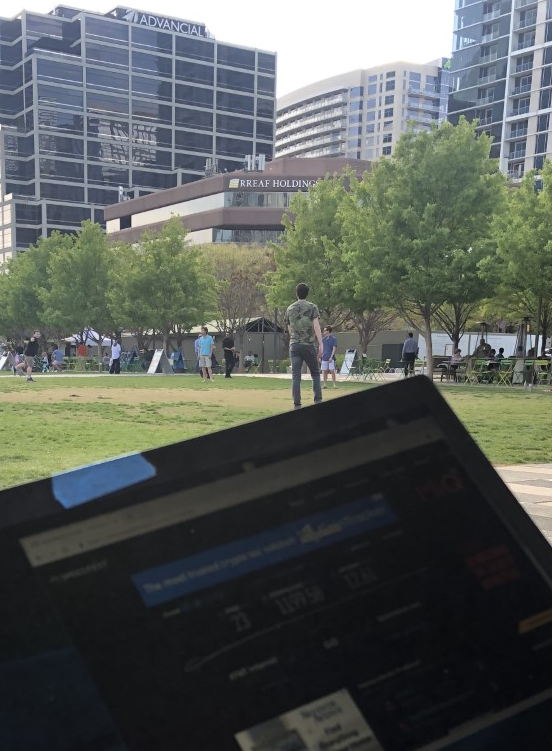
I performed several tests at 50m, 100m, 200m and to determine the cell edge. The mmWave antenna is the little box to the upper right of the regular cellular antennas over the RREAF letters.

100m out from antenna

200m out from antenna

At 50 meters / 150 feet the speed was 1320 mbit/s at 24 ms latency, at 100 meters / 300 feet the speed was still at 1199 mbit/s and 23 ms latency. Going out to 200 meters / 600 feet, the speed dropped to 762 mbit/s but latency was at 18 ms.

At these speeds WiFi becomes the gating factor if you are using it as a hotspot. Even at 200 meters / 600 feet download speeds came close to my fiber connection at home and is at the level where the bottleneck is the connection to the website and not the connection to the consumer device. These are impressive speeds, especially this early in the 5G life cycle and deployment.
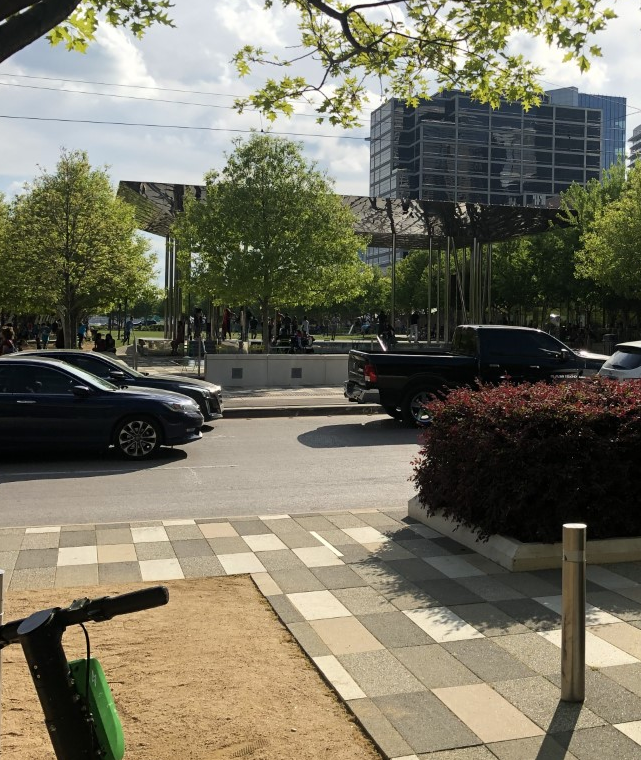
As I went further out to the cell edge, the signal finally gave out at approximately 250 meters. With the antenna being a small little block at the top right of the picture below, just above the hall, left from the trees.

Currently, the signal and thereby speeds drop off rather quickly beyond 200 meters / 600 feet, which shouldn’t be surprising considering AT&T uses 39 GHz for 5G. Operators that use lower frequencies should have large cells in the same conditions, simply due to the law of physics.
In a nutshell, 5G works and the speeds are actually better than what a lot of people expect. The good news is that performance will improve from the base line tested here as carriers and vendors learn more and improve software and deployment. Considering that in urban deployments, cell sites are usually spaced at 100 to 200 meter, 300 to 600 feet anyway, we can expect robust speeds from 5G without a dramatic increase in capex for a basic layer of 5G. This increases the time to deployment and reduces cost as existing infrastructure and backhaul is being used. When we get to a more robust deployment with limited line of sight and when the network gets more loaded, we will need to support it with more small cells. From a regulatory perspective, this gives us a little bit of time to stream line the US siting policies so that our 5G deployment does not fall behind that of China and other countries with fewer rules and regulations on where to deploy small sites.
Also, the limitations on the number and placement of 5G antennas on devices plays a significant role . Based on FCC filings the Motorola 5G addon has four antennas with a 7 centimeters (cm) or roughly 3 inches proximity sensor. When something comes within the 7 cm of an antenna the antenna shuts off. With 7 cm it is quite possible that somebody’s hand is within 7 cm of all four antennas and with it turns all four antennas off. Can’t wait for another press event about talking about holding the phone in the wrong way. Also it seems like Verizon or Motorola chose a technology indicator that only changes when in an active 5G session causing the indicator to change often which caused the confusion. These problems can be overcome with more antennas and proximity sensors that have a more precise proximity sensor.