
Qualcomm is the quintessential American tech company steeped it engineering excellence. Its genesis was the development of a new wireless standard called CDMA. Initially, it was written off as a failure, often ridiculed by its larger global rivals. It created a niche by getting American mobile providers like Verizon, Sprint and South Korean mobile providers like SK Telecom to adopt its technology. Qualcomm found redemption as the mobile providers often had the best networks in their respective countries, better than the globally dominant GSM standard. It found salvation when a variant of its CDMA standard was adopted as the global 3G standard called Wideband CDMA or to those who still harbored old animosities UMTS. It then became the global leader in 4G by holding most of the patents on the OFDM technology that underlies LTE.

By the late 2010s, Qualcomm that engineered itself through superior technology to unprecedented success was faced with five major problems that no engineering solution could easily fix.

  1. Despite being the premier mobile technology company growth had slowed down as upstarts like MediaTek was gaining market share, first in the entry level, highly price sensitive segment but was closing the performance gap between the solutions of the two companies. Qualcomm still dominated the flagship segment, but MediaTek dominated the entry level.
  2. Broadcom launched a hostile takeover to buy Qualcomm as investors were frustrated with low stock returns. Broadcom was only thwarted through the intervention of the US government.
  3. Qualcomm’s largest customer Apple with the support of the Department of Justice was using the courts as a price negotiation tool.
  4. The Android smartphone market was increasingly concentrating with Samsung and Chinese providers driving other manufacturers out of the market. Former mobile phone giants like LG and HTC exited the market.
  5. The relationship between the United States and China was becoming increasingly hostile. The US government instituted unprecedented sanctions against Huawei and imposed trade restrictions on semi-conductors.

Qualcomm CEOs are engineers at heart, Irwin Jacobs, the legendary founder; his son Paul, and Steve Mollenkopf. While Cristiano Amon is also an engineer has cut his chops as President of Qualcomm by spearheading the diversification of Qualcomm into more business segments and therefore to enable Qualcomm to participate in more growth sectors.

Under Cristiano Amon the company is continuing to focus on mobile and IoT but is expanding into computing and automotive. By doing so Qualcomm has expanded its addressable market from $15 billion to over $700 billion. The impact has been almost immediate. Qualcomm has now a $30 billion design win pipeline until 2030.

How did he do this? Qualcomm purchased several companies to strengthen its position in the respective sectors. It bought Cellwize and Augmented Pixels to improve its positioning in mobile, Clair AIR to strengthen its capabilities in the AR/VR area. But most importantly, Qualcomm bought Nuvia, a company focusing on ARM-based computing solutions and Arriver, a company with particular strength in advanced driver assistance software and hardware. And just a last week, Qualcomm acquired Autotalks, a fabless chipmaker making silicon and systems-on-chip for automotive safety.

The Nuvia acquisition is laying the ground work to strengthen Qualcomm’s core base of computing, just like the acquisition of P.A. Semi in 2008 did for Apple. P.A. Semi focused on low power processors and brought to Apple the expertise to build first the A-series chips that have powered iPhones since 2010 and now the M-series chips that were launched in 2020. If Apple’s success is any indication then ARM-based processors are going to be the processors of the foreseeable future. The power envelope of compute power, electric power consumption and heat generation are not on the side of x86 processors, but ARM-based processors. It could also help Qualcomm to close the mobile processor speed gap between itself and Apple A-series processors and increase the gap between Qualcomm and MediaTek processors. Faster, more powerful processors will also help in Qualcomm’s greatest growth market: automobiles.

Where Qualcomm is most likely to replicate the strong position it has in mobility is in electric vehicles. Qualcomm has created a comprehensive solution for automobile manufacturers called Snapdragon Digital Chassis. It combines safety and connectivity with entertainment, customization and upgradability. It takes the basic lessons of a smartphone and takes it to the automobile. The parallels and similarities as the car becomes essentially a mobile server are striking. Qualcomm is coming into this market at the right time when other’s have laid a foundation for the demand, but Qualcomm has the more comprehensive and elegant solution. Qualcomm has also the opportunity to provide a solution that rivals that of Apple. Apple’s Carplay service is viewed by many car manufacturers as a bear-hug take-over of a large part of the user interface between the drivers and passengers of the car most of the navigation and entertainment interface. Automobile manufacturers are especially sensitive due to the long-rumored Apple project to build their own electric car and Google’s Waymo autonomous car company. The car manufacturers know Apple and Google do not come in peace and do mean harm to them. Car manufacturers have to own the user interface between the vehicle and the customer, but know their solution has to be on-par if not better than that of Apple and Google. Working with Qualcomm gives them a chance to do that and so much more. In addition, while there exists significant brand loyalty for traditional car buyers with more than 50% of owners of one car brand to own a car from the same car brand, this loyalty does not exist when it comes to the switch to an electric vehicle. This levels the playing field and is an incredible threat to incumbents and opportunity for new market entrants. Tesla is the embodiment of this new generation of automobile manufacturers. While Tesla had to pioneer a lot of the systems themselves, the next generation electric vehicles can rely on integrated solutions from a company like Qualcomm. Car manufacturers like General Motors, Cadillac, Stellantis, and Mercedes-Benz as well as BMW, Hyundai, Nio and Volvo are in varying degrees of partnership with Qualcomm. Such an array of car manufacturers and a solution that offers breadth and depth gives Qualcomm critical mass to win the automotive market. Who would have thought three years ago?
AST Spacemobile (AST) and AT&T just completed the first call between a regular smartphones using just the electronics and antennas that are common for decades in mobile devices using a satellite as the cell site. AST has talked about its technology for years, laid out its plans to investors and received only the scantest of interests. Unlike Apple’s technology that uses special chips in Apple’s new iPhone 14 smartphones to send text messages through a satellite connection the AST solution works with any phone. While T-Mobile and SpaceX’s announcement last year of bringing satellite connectivity to any phone was a vision statement, AT&T and AST’s call was the proof of concept. We know now that it works not only on paper but also in the field.

The first part of the feasibility study was the reverse of the actual proof of concept. AST put a cell phone on a satellite and built a base station on the ground. With this ingenious way, AST could exactly dimension the size of the antennas, the strength of the signal amplifiers, processing power requirements and the power consumption that the satellite would have in order to work in space and make the connections to smartphones from there. It is much easier to tinker with and faster to interate the hardware when it is on the ground than hundreds of miles in space.

The hard work begins now. Until now, the FCC has been a lot less accommodating to AST than the other innovative satellite providers. The FCC needs to allow AST to use regular terrestrial frequencies that have been exclusive to mobile service also for satellite service. Historically, the FCC has been very accommodating to satellite providers like Lightsquared to use their satellite frequencies for terrestrial communications, but this resulted in basically no usage for several reasons. The satellite to mobile spectrum conversion players forgot for the longest time to include their spectrum in mobile standards. If you are not in the standard, nobody will build devices that have your band in them. The next hurdle is to get devices that include a band that nobody is yet using for mobile communications as it costs money to include a new frequency band. This problem does not exist with the AST solution as all devices that have a cellular connection can connect to the satellite. What is needed from the FCC to move from a proof of concept to mass adopted reality is the permission to use regular cellular frequencies with satellites and the permission for AST to launch enough satellites. Then AST has to raise more money to build and launch the satellites.

Where AST and AT&T differentiate themselves is the data throughput they promise: Speeds of up to 50 Mbit/s and the ability for streaming video. While this is certainly handy when fighting wild fires in a remote part of a state or recovering victims from a plane crash in a remote part of the state, it becomes down right indispensable for people documenting on a live stream when they have climbed a mountain and then call first responders because they are too tired to climb back down.

While initially mentioned that the smartphone to satellite connections would be used just for FirstNet, it is almost inconceivable to stay restricted to first responders. The ability to eliminate outdoor dead spots and to provide full geographic coverage is huge. Based on our Recon Analytics Mobile Pulse data the ability to “make a calls anywhere” is the third most important purchase decision factor based on 161,976 respondents. From May 2022 to end of March 2023, 10.9% of respondents ranked it their most important decision factor choosing a mobile provider, 10.5% chose it number 2 and 10.9% as their third most important factor.

AT&T has a very promising solution on its hand. Bring ubiquitous outdoor coverage to first responders everywhere in the United States, something that has not been done before. But not only with text messaging with a long time delay like Apple does now and got a lot of accolades for, but with streaming video. This is a real game changer for first responders. It is also a game changer for consumers in areas with low signal strength or coverage holes outdoors. With AST’s technology they are gone. Consumers will still have to content with issues when being indoors as they do not have direct line of sight to the satellite and the buildings they are in are potentially interfering with the signal.

Now that we know this is possible, how quickly will regulators pull out all the stop signs that are preventing the real world application for it? How quickly can these satellite get into space and who will be the first to deliver ubiquitous outdoor coverage to first responders and consumers with what real world speeds?

The converged communications industry is undergoing significant change. It has been well reported that fixed wireless access has captured most of the broadband industry’s growth, followed by fiber, with cable not adding customers, while DSL gets rapidly replaced. Recon Analytics’ research also shows that a substantial number of fixed wireless access subscribers did not have dedicated home internet access before; hence, it is not a zero-sum game.

Adjustments are common in the wireless industry. An operator buys another operator, customers switch from prepaid to postpaid or vice-versa, new rules on what it takes to continue to be a customer get implemented – essentially, a cleanup of the subscriber base. These changes are typically in the low hundreds of thousands, important but not earthshattering. With the shutdown of 3G networks, we are entering another period where these changes are significant. No matter what we call these disconnections and whether they are included in the churn statistics or not, they still represent a reduction of subscribers in the industry. These adjustments to what is and is not a subscriber and where that gets counted provide valuable insights into the health of the wireless industry.

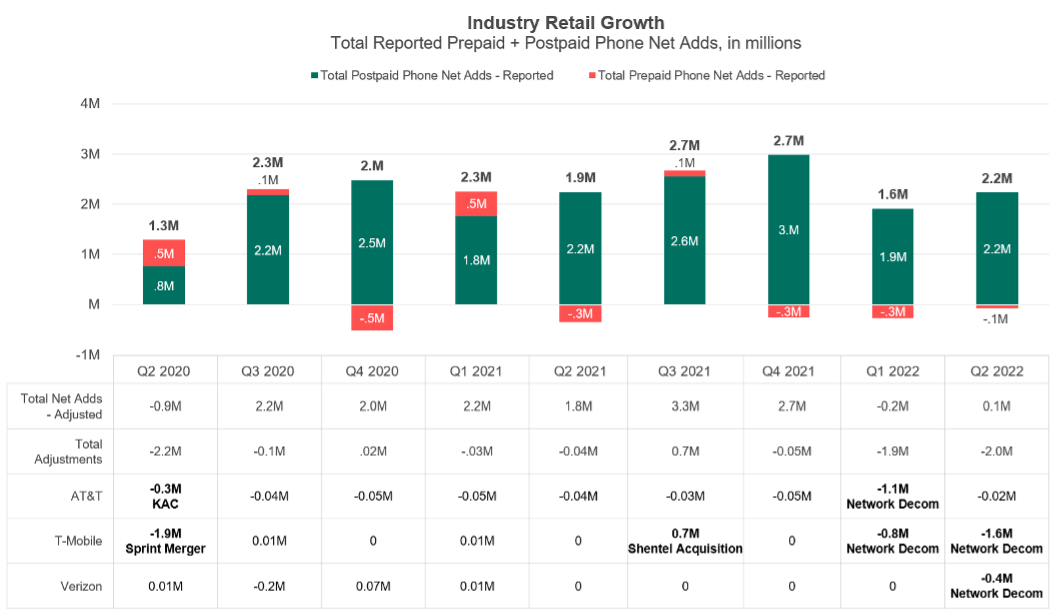
In the chart below, we are looking at the overall phone universe and see that the two segments have more overlap than what many people want to acknowledge. The orthodox, adjustment-free view shows us solid growth over the last two years and creates the perception that industry growth exceeds population growth followed by exasperated questions of “Where are they all coming from?”

When we look at the impact of the adjustments, a different view emerges. For example, in Q2 2020 there were two significant adjustments: a clean-up of the Keep America Connected disconnects by AT&T and, more importantly, a large adjustment by T-Mobile as part of the Sprint merger. Sprint had created a bit of a mess ahead of the merger and counted people as customers who might really live up to that moniker. It counted some connected devices as phones, didn’t disconnect people even though they were significantly in arrears, and counted prepaid Boost customers who financed a device as postpaid. As a result, 1.9 million subscribers disappeared from the books. The total subscriber numbers actually show a reduction of 900k subscribers despite an “official” 1.3 million subscriber gain. We saw a similar trend due to the 3G network shutdown at AT&T and T-Mobile. What looked like strong subscriber gain quarters were actually flat quarters due to the disconnects of 1.9 million and 2 million 3G subscribers. We will see further adjustments when Verizon shuts down its 3G later in the year.

The interesting implication of the adjustments and their use to net out the official numbers is that the three mobile network operators did not add subscribers in the first half of 2022. The entire growth of the wireless sector comes from the cable industry in the form of Charter and Comcast.

In 2011, Verizon was in a pickle as it could project when it would run out of spectrum and needed to maintain its strategy of being the network leader in the United States. The deal was straightforward: get spectrum from the cable companies in exchange for an MVNO agreement and hope that the cable companies will be as successful as they were in their previous attempts with Sprint, which is not at all. This premise held up until 2017, when Comcast started offering service, followed shortly thereafter by Charter. The two cable operators went to market by positing that they could offer the best network experience for combined mobile and home internet for roughly the price of a premium wireless subscription. Customers liked the premise, and cable providers have consistently been between a quarter and a third of industry postpaid net adds, taking a healthy bite of the wireless industry growth. Examining Comcast’s and Charter’s total market flow share performance, which includes prepaid and postpaid, it becomes clear that Verizon is coming out ahead. For example, during July 2022, based on our Recon Analytics Data services, only 27% Comcast’s and Charter’s customers have come from Verizon. Tracking Verizon’s revenue components for many years, we estimate that Verizon gets an average of $13.13 from its MVNOs per customer, which include providers like US Mobile, Red Pocket Mobile, Lively, Affinity Cellular to mention only a few. A comparison between Verizon’s $18.35 EBITDA contribution and its $13.13 MVNO revenue per customer, which is almost pure profit, shows that Verizon is coming out significantly ahead. For every Verizon customer that moves to Comcast and Charter, three join the Verizon network from other providers, both postpaid and prepaid. The 661,000 Comcast and Charter net adds in Q2 2022 contributed an incremental $41.4 million in overall annualized revenue. If Verizon would disclose more numbers and be more transparent, it could easily dispel the erroneous notion that its wholesale business is a negative for the overall business when it is clearly not. While Verizon’s branded subscriber base which it reports quarterly is under pressure, its unreported network share is performing substantially better. More people are using the Verizon network today than ever before, and its wholesale partners are an underappreciated part of the story.

The headwinds that Verizon is facing are coming from its two main rivals T-Mobile and AT&T. T-Mobile continues to perform well with a “have your cake and eat it too” positioning by marketing a superior network at a lower price value proposition. Considering that it trails AT&T in postpaid phone net adds, we can only conclude that the message could be resonating better. AT&T is leading the industry with a straight-forward consistent promotion strategy for new and existing customers. The lack of fading-in and fading-out promotions that the two other operators are offering is paying off for AT&T. The new AT&T leadership has transformed the company from being the source of everyone else’s growth to being the fastest growing postpaid phone provider in the United States.

To take the fight back to the cable providers and utilize fallow spectrum, T-Mobile and Verizon have launched fixed wireless internet access to compete against traditional home internet providers. With 2.1 million fixed wireless customers between them, they have captured the buzz of the telecom market. With easy to set up wireless routers, straight forward pricing, and speeds around 100 to 300 Mbps, FWA providers are on top of Recon Analytics’ net promoter score list in every one of the 14 metrics we are tracking. What we see in our FWA flow share analysis is that FWA is currently a threat to every other technology, as it captures many disgruntled home internet subscribers who are looking for a different, attractively priced option. The questions are: How long can this last? and From where geographically do these customers come?

The main constraining factor is the availability of fallow spectrum and the usage profile of home internet users. It is not uncommon that home internet users use 500 to 800 GB per month compared to approximately 15 GB for a mobile user, while paying around less than $50 per month for their subscription. In urban and suburban areas, due to the much higher population density and approximately the same amount of spectrum, the maximum amount of fixed wireless customers before they impact wireless user experience is much more limited than in rural areas. In rural markets, fixed wireless access performance is much more driven by cell site density rather than the availability of spectrum. At the same time, rural America has the problem of being by definition rural, which means not a lot of people live there.

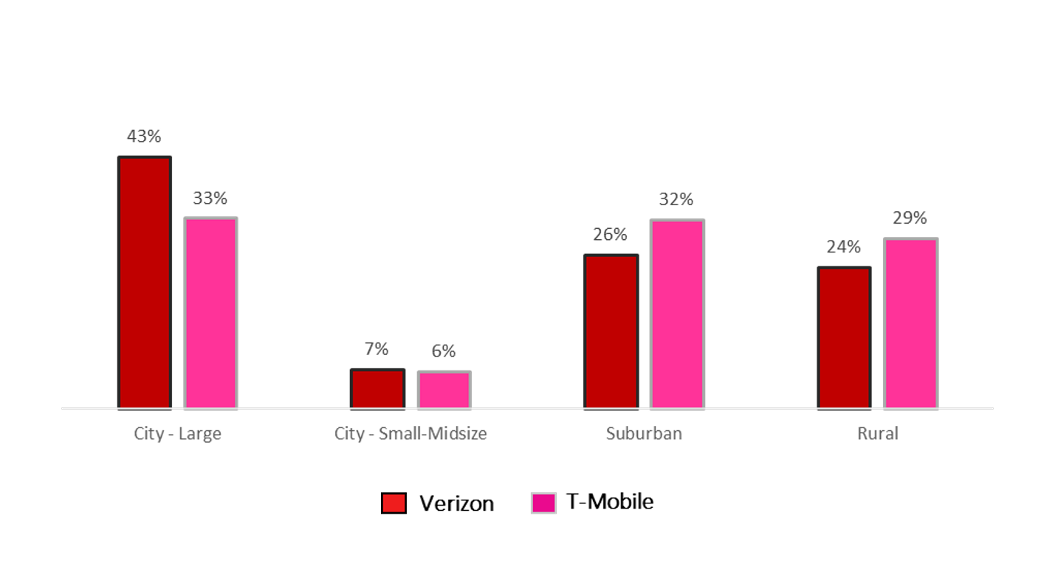
Fixed Wireless Subscriber by Urbanicity

Source: Recon Analytics Data, April to August 2022

Both Verizon and T-Mobile have been a lot more successful in urban and suburban markets than in rural markets, which is both an opportunity and limiting factor at the same time. The much-touted transformation of rural connectivity is still a lot more talk than reality. T-Mobile’s new Home Internet Lite plan demonstrates the strain on the network from unlimited plans. It introduces usage-capped price plans in the name of being customer friendly and allowing to be available everywhere. The positioning will be that not everyone needs unlimited data and with a fixed amount of data rather than unlimited data these customers and it allows T-Mobile to charge a higher price per GB in constraint areas. At the same time, it makes T-Mobile closer to the cable companies it derided in the past that have usage caps. It also proves AT&T’s argument that fixed wireless is not a fiber replacement in many places.

The competitive intensity is greater than ever before and the battle ground is larger than before. The battle for market share in this new converged communications provider world has just begun, with the tides of the battle swinging back and forth.

In case you are just tuning in, Verizon has been going through a rough time for about two years now. In fall 2021, it replaced Ronan Dunne as CEO of Verizon’s Consumer Group (VCG) as it struggled before filling the position with Manon Brouillette. It would be difficult to say that things have improved.

We live in peculiar times. For a long time, financial analysts wanted to convince us that when a mobile network operator (MNO) has a larger size than its competitors, the size advantage gives them a substantial edge in the market. Now, other financial analysts want to convince us that Verizon, because it is the largest provider in the market, is destined to lose customers for the foreseeable future. I disagree with both positions but would point to having a good plan, the ability to rapidly adapt to new circumstances, and superior execution to being the only sustainable competitive advantage in the market. 

Verizon has traditionally differentiated itself as the premium provider in the market based on superior network performance. Taking network leadership to heart, Verizon charged ahead in 2G, 3G and 4G and created the fastest and largest network for at least the first three to four years of what is generally a seven-year technology era. The shock and awe of the early, rapid build created a nimbus of permanent network superiority even though, at least in urban markets, by year five, we had network parity. In contrast, in rural markets the network superiority persisted.

For the last decade, Verizon has internally fretted about what it should do if and when this trick would no longer work and its network superiority nimbus would be diminished, or even worse, large swaths of customers would perceive network parity or, even worse, someone else to have the better network.

Several poor decisions and outcomes around spectrum auctions weakened the strong network foundation. Verizon seems to have then tried to replace the internal differentiation of being the provider of the undisputedly best network with having the best streaming bundle and differentiating around that.

Replacing an internally generated differentiation with an externally acquired differentiation, especially when it is so easily replicable, is a dangerous gamble. To make this decision even more puzzling, Verizon engaged in the content-differentiation strategy at the same time when AT&T exited the content bundling with wireless.

AT&T and T-Mobile having seen the 2G, 3G and 4G outcomes decided they didn’t want to live through the same experience with 5G and put a lot more emphasis on network performance. While in Recon Analytics Data weekly net promoter score data, Verizon still leads in the network performance categories, the gap has undoubtedly diminished. Metered speed tests show Verizon being behind, but how much does it matter? In our purchase decision factor ranking, speed is a solid second out of nine metrics.

Especially T-Mobile, powered by Sprint’s spectrum and a greater network focus with various firsts has given Verizon’s network team a run for its money. AT&T has been more judicious in spectrum expenditures and build-out pace betting that speed test results alone don’t win customers and aligning its build-out more with customer and technical capabilities and usage. The slower build-out has not hurt AT&T’s success in the marketplace because it was able to execute on other purchase factors that existing and prospective customers find important.

Verizon’s recent promotion

On May 22, 2022, Verizon launched an online promotion where single-line customers would get $15 off, two-line customers $12.50 per line off, and three-line customers got $5 per line off. Since Verizon did not issue a press release around it, it was largely unreported.

We took it as an opportunity to test Verizon’s value proposition of all plans – 5G Start, 5G Play More, 5G Do More, and 5G Get More – against what the customers of the other providers, ranging from T-Mobile and AT&T to Google Fi and Mint Mobile, were willing to pay for the different plans for a different number of lines. This gave our clients one week later a read if they should worry, to what degree, and about what part of Verizon’s promotion they should be worried about.

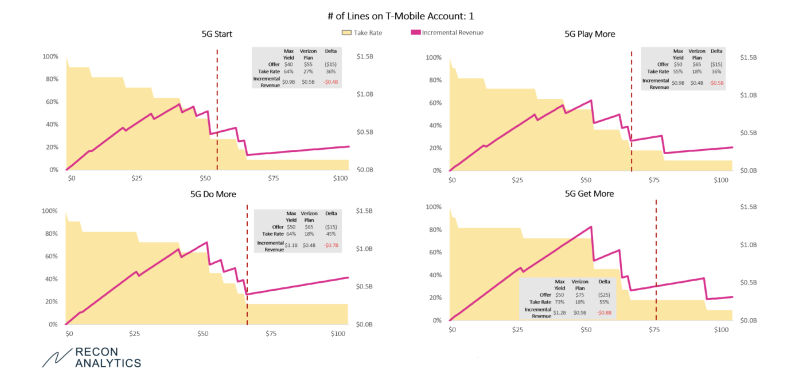
Below is how just T-Mobile customers were viewing Verizon’s single-line plans and for what price they would switch to the plan. While this is no sophisticated conjoint pricing analysis, it nevertheless gives some interesting insights. It also does not consider larger long-term pricing strategies that a company like Verizon would have to consider when making pricing decisions. The yellow shading represents the take rate at a given price point, while the magenta line represents the revenue that would be realized.

With the promotion, Verizon charged for a single line $55 for 5G Start, $65 for 5G Play More, or 5G Do More, and $75 for 5G Get More. As a reference point, Verizon just launched Welcome Unlimited for $65 for a single line for a skinnier offer than 5G Start.

T-Mobile customers’ highest revenue price point was $40 with a 64% take rate for 5G Start vis-à-vis Verizon’s $55 promotion. 5G Play More and 5G Do More were valued at $50 with 55% and 64% take rates respectively while Verizon was charging $65. Verizon 5G Get More plan discounted to $75 during the promotion was also valued at $50 with a 73% take rate.

Analyzing the data as in the above example vis-à-vis T-Mobile, it became apparent that in the one-line segment, the Verizon promotion would not save Verizon’s quarter. The numbers for the other providers for single-line customers were roughly similar to those of T-Mobile customers.

Interestingly, despite being the least generous, the three-line offer was the most competitive for several of Verizon’s offers. This brings us back to Verizon’s new Welcome Unlimited plan. It looks like a significant uphill battle to convince single-line customers to spend $65 per month when only two months ago, at least T-Mobile customers thought it was only $40 worth.

As I mentioned before, customers of different mobile service providers and for different line counts value Verizon’s plans differently, but in the one- and two-line part of the market a similar picture emerged.

Verizon isn’t suffering from a large size that dooms its progress; it suffers from a value positioning, value perception, and long-term pricing strategy issue.

Americans overwhelmingly support that broadband should be available to every American and that the funding base to achieve that should be broadened to every company that makes money through the internet.

More than 78% of respondents agreed that broadband internet should be available to every American showing broad support from large parts of the population. When looking a bit closer at the answers given by respondents who say they have broadband versus the people who said they didn’t have broadband, the support of those respondents who do not have what they consider broadband (26%) for everyone having access to broadband drops to 64%. This indicates that there is not only an availability and affordability gap but also an educational gap. Many people who don’t have broadband internet access either do not want it or do not understand why they should have it. These findings, which are mirrored in other studies, indicate that any broadband infrastructure program should include an educational component to increase the number of broadband subscribers. Otherwise, broadband penetration will never reach its full potential.

As we found in previous surveys on the topic, around 54% of respondents use the internet for work purposes from home. This is equal to the number of employees that are classified as white-collar employees by the U.S. Department of Labor. This number highlights the importance of broadband for the functioning of American businesses and enterprises during the continuing pandemic. It is likely that the added agility and flexibility to work from home will continue to be utilized after the country has emerged from the pandemic restrictions. We also found similar opinions around what Americans consider broadband. The median American considers 50/5 MBits as broadband whereas the most answered response was Gigabit speed with 29% of respondents.

The high percentage of Americans who think broadband should be available to everyone is probably based on the intensive usage and the need of many Americans to use it from home to work. Using the weighted average of the responses, Americans spend around six hours every day on the internet.

How many hours do you spend on the internet with a mobile device or computer?Use the internet from home for workDoes not use the internet from home for workCombined Response
Less than an hour4.8%18.0%10.9%
Two to four hours18.1%36.0%26.4%
Four to six hours15.2%26.3%20.4%
Six to eight hours25.2%8.8%17.6%
Eight to twelve hours25.7%4.8%16.0%
More than twelve hours11.0%6.0%8.7%

When looking at those who also use the internet from to work from home, unsurprisingly the usage pattern is significantly heavier as their usage pattern includes both business and leisure activities.

While only 37% of respondents knew that the Lifeline Program provides low-income Americans with basic phone and internet service, they were open to new funding sources to close the digital divide. More than 71% of Americans are in favor that companies with business models that rely solely on the internet to exist and who also generate revenue from those businesses, like Google and Facebook, also contributing to provide access to Americans who currently do not have access to the internet. Such a move would dramatically expand the funding sources for a broadband access plan and include companies that have exerted the most valuable and profits from the internet.

What is really interesting, the survey also found support to extend net neutrality rules to websites and ecommerce companies. We framed questions around the net neutrality principles of no blocking, no throttling speeds, and no paid prioritization by asking Americans if websites like Google, Facebook or Amazon should be allowed to restrict access to legal sites, give preference to their own products and services over others and change the search results based on how much money they receive from others.

More than 72% of Americans are against companies like Facebook or Google restricting access to legal sites for any reason. This is exactly the behavior that Facebook showed when it made it impossible to link from Facebook to news sites in Australia (and for a short time to itself) to avoid having to compensate news sites linked to. In essence, it was a commercial and legislative conflict where Facebook wanted to use its customer base as a bargaining chip in its negotiations. This is the essence of the “No Blocking” rule in net neutrality.

More than 55% of Americans believe companies like Amazon, Google, or Facebook should not be allowed to give preference to their own products and services over that of others, a self-dealing practice that has cost Google more than $10 billion in fines by the European Union. Search engines like Amazon, Google, and Facebook, all of which provide you with what you are looking for, are increasingly the prism through which we see the world. They have incredible power over our perception of what it is we are actually looking for. By pushing competing products into the obscurity of lower-ranked results, they, in essence, throttle the success of other products that are better but do not fit the commercial objective of the search engine provider.

In terms of pay-to-play result manipulation, more than 80% of Americans say they are against search engines altering results based on how much websites and advertisers pay for preferential positioning. It is common that the first view search results for a given term are occupied by responses that are marked by the easily missed word “Ad” in front of the link. This effectively operates as paid prioritization, something the ISPs are not allowed to do under California’s net neutrality law, nor under earlier versions of net neutrality that the Democrats might be considering reinstating.

The results of our survey showcase two key points: Americans are open to reigning in tech giants, who solely rely on the internet to generate revenue, and curbing their ongoing uncompetitive behavior, and having these companies contribute part of said revenues to subsidize access to broadband for low-income Americans. While the Biden Administration focuses on proposing ideas that have been tried and tested, perhaps it should take a step back and listen to consumers, who are those who the administration ought to serve and prioritize.

While we all agree that the United States needs more broadband and net neutrality, most Americans do not support the Biden administration’s plan. The majority of Americans want internet companies to pay their share to build the broadband network that these companies are profiting from. They also want to be protected from the demonstrated behavior of internet-based companies that violate the net neutrality rules that these companies want to impose on other companies but not themselves. Net neutrality rules need to protect consumers and not one set of companies that want to prevent other companies to effectively compete with them. Any net neutrality rules that do not apply to internet service providers and internet companies like search engines, social media companies, and e-commerce providers is just cleverly disguised corporate welfare with the government picking winners and losers.

Between March 16 and March 26, 2021, Recon Analytics conducted a demographically representative survey of 1,000 Americans using the internet and cell phones, asking them about their opinions and attitudes around universal access, funding mechanisms, conduct, and usage.

Do you believe that access to broadband internet should be available to every American?

Yes 78.2%                                                                                                            No 21.8%

Did you know that the government requires a small portion of your phone bill to be used to fund phone service for low-income Americans aka lifeline service?

No 62.9%                                                                                                             Yes 37.1%

Do you think companies like Google and Facebook that make money through the internet should contribute to the provide access for Americans who do not have the internet?

Yes 71.4%                                                                                                            No 28.6%

Should companies like Google or Facebook be allowed to restrict access to legal sites for any reason?

No 72.7%                                                                                                             Yes 27.3%

Should companies like Amazon, Google, or Facebook be allowed to give preference to their own products and services?

No 55.8%                                                                                                             Yes 44.2%

Should search engines be allowed to alter search results based on how much money they receive from websites or advertisers?

No 80.6%                                                                                                             Yes 19.4%

How would you define broadband internet access?

3/1 9.3%                                                                                                              10/1 9%

25/3 14.8%                                                                                                          50/5 17.3%

100/10 20.9%                                                                                                      Gigabit 28.8%

Do you currently have broadband internet access?

Yes 74.2%                                                                                                            No 25.8%

Does your job require internet access at home?

Yes 53.4%                                                                                                            No 46.6%

How much time per day do you spend on the internet (via your mobile device or on your computer?)

Less than an hour 10.9%                                                                                    2-4 hours 26.4%

4-6 hours 20.4%                                                                                                  6-8 hours 17.6%

8-12 hours 16.0%                                                                                                More than 12 hours 8.7%

Japan’s Rakuten is the first global mobile network operators (MNO) to fully virtualize their networks, with millions of active customers on commercial service. Rakuten has taken their expertise of being a fully virtualized operator to create the Rakuten Communications Platform (RCP), which packages its vendor portfolio and deployment expertise and markets it to other operators who also want to run their network in the cloud. Interestingly, the vendor product portfolio that is being sold is more extensive than what Rakuten has chosen to deploy. Based on news reports, Rakuten has already signed up 15 customers on RCP. The first publicly announced RCP trial partner is Ligado. A would-be US operator, Ligado owns spectrum in the United States that was previously used for satellite use. Up until recently Ligado has been involved in a fight with the Department of Defense over potential interference with GPS and NTIA, but the FCC sided with Ligado and allowed them to use their spectrum for commercial use.

Based on our research, the RCP universe consists of the following players:

AreaCompany
4G CoreCisco
Converged 4G/5G CoreNEC
ServersQuanta
Service orchestrationInnoeye (acquired by Rakuten)
IMS/RCSMavenir
Open RAN softwareAltiostar
4G Sub-6 GHz RadiosNokia
5G Sub-6 GHz RadiosNEC
4G/5G Sub-6 GHz mmWave Radios and SoftwareAirspan

Qualcomm and Intel are also mentioned as RCP participants but apparently are mostly involved as silicon providers for their particular area of expertise.

Rakuten continues to use Innoeye and Altiostar, which it has purchased outright in Innoeye’s case or has an equity investment like Altiostar, for orchestration and Open RAN software, respectively. Mavenir continues to supply the IMS/RCS software and Quanta provides the servers.

RCP made several adjustments in its vendor portfolio when it added 5G support to the network. Rakuten switched from Cisco as a 4G packet core provider to NEC, which will work with Rakuten on building a converged 4G/5G core. NEC also replaced Nokia for the sub-6 GHz radios as Nokia only provides 4G radios for Rakuten. This change was surprising as the NEC 5G radios are actively cooled, whereas state-of-the-art radios are passively cooled. Rakuten did not switch mmWave radio providers which, Airspan continues to provide for 4G and 5G.

One of the powerful features of RCP is that an MNO can mix and match from any vendor in the RCP portfolio. If an MNO  prefers Nokia or Airspan as their radio vendor, they can use Nokia’s mmWave product for 5G or use Airspan for both mmWave and sub-6 GHz Airspan’s Open RAN software or use Altiostar’s software.

RCP fits into an interesting sweet spot in the market. Most large MNOs, especially in the United States, will chart their own path towards Open RAN based on how it fits into the current network. Changing or introducing vendors for such a significant network transition is like changing an airplane’s engines in midflight. Small operators, especially if they have already chosen Huawei equipment, are locked in. These operators typically have lean engineering and operations staff that are not trained or sized for such a significant network transition. This makes small operators dependent on large network providers as prime project managers and for vendor financing. Huawei’s growth to become the largest global provider of 5G equipment to MNOs has been based on both significant deployment and customer service capability to the point where almost every Huawei-powered network is a custom network with generous vendor financing packages. A side effect of the customization of each network is that it makes it difficult for other vendors to get a part of the network equipment. Medium-size MNOs and greenfield operators, especially if they are not dependent on vendor financing and the small rural MNOs in the United States who have to replace the Huawei equipment in their network and are collectively paid $1.9 billion to do so are a prime target for RCP. Rakuten’s offering lets MNOs jump to state-of-the-art software-defined networks with Open RAN. Software-defined networks are more flexible and cheaper to operate and due to the standardization of hardware, they are less expensive to buy.

Especially the rural operators who are replacing their equipment should invest in the technology of the future, SDN, and Open RAN, regardless of whether they choose RCP or a custom route, rather than invest in the past’s integrated hardware and software. For rural MNOs  who have to run their network with a lean team, SDN’s automation allows the network operation teams to be more efficient and effective. Before RCP, the path to SDN and Open RAN was quite daunting as, for example, Dish’s Charlie Ergen remarked during the Q4 2020 earnings call. RCP solves the complexity problem by allowing rural MNOs to use a working suite of products from another network operator. As a further bonus, several MNOs could combine their network operations and share a common core and operations team for additional cost benefits. Switching to SDN and Open RAN would also work with President Biden’s Buy American initiative. Several leaders in the field are American companies such as Airspan, Altiostar, Cisco, and Mavenir. For all too long, we have complained that there are no American telecom network equipment providers. Now the telecom industry has an opportunity to diversify its vendor base.

In recent years, the FTC raised concerns that Qualcomm’s patent portfolio and unbiased licensing scheme would prevent other companies from manufacturing and selling 5G chipsets, leading to an anti-trust lawsuit that concluded in November 2019. However, the prediction has not borne out. Currently, there are two companies, Qualcomm and MediaTek, that sell 5G chipsets to the device ecosphere at large, two captive suppliers who make their own 5G chipsets for internal consumption, and one company that is creating its own new 5G chipset also for internal consumption.

The mobile chipset business has a series of players with different objectives. Companies like Qualcomm and MediaTek provide mobile chipsets to device manufacturers and serve the vital function of ecosphere enablers. Without them, the plethora of devices and choices consumers enjoy when it comes to smartphones would not be possible. Another set of companies are making mobile chipsets only for themselves to create a competitive advantage in the marketplace. Apple and Samsung fall into this camp. Huawei is potentially a hybrid case as it was previously only providing its own handset group with chipsets, but now also provides them to a Chinese state-led consortium that purchased the Honor handset line.

 CustomerModemIntegrated SoCStand-alone Application ProcessorRF Frontend
QualcommEcosphereYesYesNoYes
MediaTekEcosphereNoYesNoNo
HuaweiDivested divisionsYesYesDiscontinuedNo
SamsungCaptiveYesYesNoNo
AppleCaptiveFutureFutureYesNo
Intel
(sold to Apple)
EcosphereYesNoAbortedNo

Currently, Qualcomm provides high-quality Systems on Chip (SOC) that are integrating multiple components, ranging from baseband, AI, graphics, camera, to CPU into one chip to anyone interested in them. Qualcomm was the first company to offer 5G chipsets with the first devices hitting the market at the end of 2019. MediaTek is offering a similar, but less advanced and less integrated product line to device manufacturers looking for low-level to medium-level chipsets. By the middle of 2020, MediaTek’s chipsets were powering a broad portfolio of handsets.

Intel, another ecosphere provider, sold its mobile chip business to Apple in December 2019, nine years after it entered the mobile chip market by buying a division of Infineon. Intel’s motivation to buy Infineon was that Infineon was the sole provider of modems to Apple. Reportedly during the negotiations between Intel and Infineon, then-Intel CEO Otellini sought reassurances from then-Apple CEO Steve Jobs that Apple would continue to use Infineon products after the Intel acquisition as Otellini recognized the importance of Apple as a customer for its chipsets. During the nine years after the Infineon acquisition, Intel’s mobile chipset division’s fate was intricately linked to Apple as Intel struggled to find other customers in the mobile device manufacturer ecosphere. In a nutshell, Intel was unable to compete with Qualcomm on quality like RF performance and SoC integration and was unwilling to compete with MediaTek as it had a more integrated solution and Intel did not. Intel ultimately threw in the towel on the heels of Apple and Qualcomm settling their lawsuit and agreeing to a six-plus two-year licensing and multiyear chipset supply agreement.

Huawei through its HiSilicon subsidiary has developed and used its own 5G chipsets and has integrated them into its own devices. While the Huawei chipsets are not as integrated and small as Qualcomm’s, Huawei’s engineers have found ways to integrate the chipsets into its devices. It is using Qualcomm, Skyworks and Qorvo, all from the US, for its RF front-end. Huawei’s role in the mobile world got a lot more interesting as it has sold its Honor-brand device division to a Chinese state-led consortium of more than three dozen companies as Huawei experienced a lot of pressure on its devices sales due to American sanctions. Reportedly, Huawei is also considering selling its Mate and P-line device groups in the hope that American sanctions will not follow to the new owners of the device businesses. Up until now, Huawei is not selling its HiSilicon chipsets to other companies, other than the group of Huawei dealers that acquired the Honor-brand device division, as a competitive weapon in order to keep their best technology capitive. In 2019, during the trade tensions between the US and China over Huawei, the company offered to license its 5G intellectual property to American companies to alleviate any spying concerns, but no deal has emerged until to date. If Huawei is divesting its entire device portfolio Huawei might either also divest its HiSilicon division with it or become an ecosphere provider for other handset manufacturers. The direction of Huawei’s HiSilicon business will be quite telling of the size of the Chinese walls between Huawei and its divested handset businesses as well as other handset vendors.

Samsung has been producing its own Exynos modems and mobile processors, and has also purchased mobile chipsets from Qualcomm. Samsung’s new 5G devices, including its S20 5G flagship smartphone, is shipping either with the Exynos or Qualcomm Snapdragon chipset. Samsung sells the Qualcomm variant in the US, China, and most recently South Korea, and its Exynos variant in the rest of the world. Benchmarking has shown that the Qualcomm chipset version regularly outperform the Exynos one and that Samsung uses the Qualcomm variant in the most competitive markets to close the gap against Apple’s iPhone.

In 2008, Apple with its computer heritage bought P.A. Semi, a processor development company specializing in highly power-efficient designs, to build its own ARM-based processors for iPhones, iPads, and similar devices. Apple’s ARM processors are now the fastest CPUs in the market and will start powering Apple Mac computers starting in 2021. Apple sourced its baseband chipset first from Infineon, then post-acquisition from Intel, then a few years later from Qualcomm, then dual-sourced from Intel and Qualcomm, and most recently in 2019, signed an agreement to return to Qualcomm. In 2019, Apple also bought Intel’s baseband chipset business and has started hiring more wireless engineers in San Diego, Qualcomm’s home market. Considering Apple’s track record it is quite logical that Apple is going to try to replicate its successful ARM processor endeavor in modems, and internally source its 5G mobile chipsets when the Qualcomm agreement expires. The Qualcomm agreement gives Apple breathing room to pour its resources into an area that is a key differentiator between mobile devices.

These successful 5G chipset endeavors demonstrate that Qualcomm’s patent portfolio and licensing policy do not present a significant barrier to innovation. Qualcomm’s licensing rates have not changed since it first started licensing CDMA in the 1990s, while its portfolio has grown substantially, facilitating continued innovation that has made the United States a leader in international telecommunications on a fair, reasonable, and non-discriminatory basis. As silicon merchants to the industry, Qualcomm and Mediatek’s participation in chipset development creates choice and opportunity for many mobile device manufacturers to have a chipset that meets their needs and budgets exponentially increases the range of consumer choices without infringing on the ability of other companies to enter the market.

The Super Bowl is not only the pinnacle of the American Football season, but it is also the show case event for wireless carrier. Every year, every wireless carrier sets aside tens of millions of dollars to improve the wireless network for the big game. The newest and best gets installed so that attendees and regular citizens alike get a superior experience. One of the challenges that mobile operators have to overcome in order to provide faster speeds is how to best use the spectrum they have. The spectrum portfolio of each carrier has different amounts of spectrum ranging from 600 MHz and 700 MHz all the way to 39 GHz. In order increase the speed for customers, the spectrum slivers can be bonded together in a process called carrier aggregation (CA). The maximum amount of spectrum that LTE can have in a channel is 20 MHz and 5G is 100 MHz. So even if a mobile network operator has 1,200 MHz of contiguous spectrum with 5G they could aggregate 12 100 MHz channel for the maximum amount of bandwith which directly translates into speed.

Global Wireless Solutions (GWS) conducted network testing during the 2021 Super Bowl in Tampa and provided some additional insights that typically don’t get mentioned with other tests. GWS found that AT&T used 8 channel CA using 800 MHz of its 39 MHz spectrum, Verizon used 6 CA using 600 MHz in 28 GHz, and T-Mobile 4 CA using 400 MHz in 39 GHz plus 80 MHz in the 2.5 GHz band. The availability using the 28 and 39 GHz band was almost the same for every carrier at 73% to 77%, which isn’t surprising considering the relatively small area covered. T-Mobile’s 2.5 GHz coverage added another 20% of coverage. Considering more spectrum means more speed, it comes as no surprise that AT&T was the fastest with peak speeds of 1.7 Gbps, Verizon with 1.5 Gbps and T-Mobile with 1.1 Gbps.

The GWS tests show that it is not only important to have a lot of spectrum. It is even more important to use it. Not only does the network have to be ready for it, but also the device. Most flagship devices are using the Qualcomm Snapdragon X55 modem. Devices using this modem, like the Samsung Note 20 that the GWS engineers used for the tests can utilize 8 channel CA in the mmWave band (> 6 GHz) with 2×2 MIMO and 200 MHz 4×4 MIMO below 6 GHz with 7×20 MHz channel CA for LTE. This means that when T-Mobile uses all its on average 130 MHz 2.5 GHz spectrum, current flagship devices will be ready. When Verizon and T-Mobile are ready to follow AT&T’s lead with 8 channel CA, the devices will also be able to support that. The Qualcomm X60 modem that’s for example in the Samsung Galaxy S20  can aggregate spectrum below and above 6 GHz. This allows to combine the better coverage characteristics of sub-6 GHz spectrum with the massive spectrum bands and therefore speeds that are available above 6 GHz. The X60 modem also works with the upcoming C-Band networks that will probably become available in 2022.

The bidding for licenses in the C-Band auction has ended with bids of $81 billion for 280 MHz, surprising most observers. The C-Band auction exceeded the previous record holder, the 2015 AWS-3 auction, which yielded $44.9 billion. While C-band raised almost twice as much as AWS-3, one of the things to consider is that different amounts of spectrum were for sale: 280 MHz in the C-Band auction versus 65 MHz in the AWS-3 auction. In terms of dollars per MHz of Population covered ($/MHz Pop), the metric by which we compare different amounts of spectrum and population coverage, the AWS-3 auction is still the most expensive auction in US history.

What are the drivers for spectrum prices? Looking at some of the most important auctions over the last 15 years gives us some important pointers, both when comparing prices within an auction and from auction to auction.

AuctionYearMHzMhzResult$/MHz PopNotes
C-Band20213700280$80.9b$0.94Unincumbered spectrum
CBRS2020350070$4.6b$0.22Maximum 30 MHz & combined with unlicensed, limited power
600 MHz201760070$19.6$0.88AT&T & Verizon mostly ineligible to bid
AWS-3 paired20151700/210050$42.5b$2.71Unincumbered spectrum
AWS-3 unpaired2015170015$2.4b$0.52Unpaired spectrum
700 MHz B Block200870012$9.06b$2.24Unincumbered spectrum
700 MHz A Block200870012$3.87b$1.17Needed filters
700 MHz C Block200870022$4.75b$0.76Net Neutrality
700 MHz E Block20087006$1.26$0.74Unpaired spectrum

Conducted in 2008, the 700 MHz auction sold four different blocks of spectrum. A Block had significant interference issues because some broadcasters were still operating in the spectrum at that time and handsets required filters in order to work properly. However, none of the handsets in the time had those filters. The B Block was clean and ready to use spectrum. The C Block comes with net neutrality provisions attached to it because Google promised the FCC to bid on the spectrum. The FCC at the time was very eager to incentivize a new entrant into the US wireless market and the FCC interpreted from what Google had told them that Google would win the C Block auction and become a mobile network operator. Finally, E Block is a sliver of unpaired spectrum.

To no surprise B Block, the clean, ready to use spectrum, sold for the highest price. The problem A Block sold for half the price of the B Block. The C Block sold for one third of the A Block after Google bid once in the first round, Verizon topped it in the second round, and nobody else bid on it in the next 222 rounds of the auction. The smaller E Block of unpaired spectrum sold for a tiny bit less than the C Block because at the time, nobody really knew what to do with it as the technology to use it was not mainstream yet.

In the 2015 AWS-3 Auction, clean paired spectrum again sold for substantially more than unpaired spectrum. This time, it was more than five times the amount: $2.71 per MHz Pop compared to $0.52. Since the AWS-3 block laid next to the AWS-1 block which mobile operators had already deployed, it was very easy and cheap to use the spectrum without incurring infrastructure cost as the same equipment could be used. Basically, roughly the amount of the cost of the infrastructure went into the auction and drove up the price for the spectrum since operators calculate their total ownership cost of spectrum plus the cost to deploy in their budgeting process.

Prior to the 2017 600 MHz Broadcast Incentive Auction, T-Mobile and regional operators argued that AT&T and Verizon had too much low band spectrum in the market for others to be competitive, and therefore should not be allowed to bid on the 600 MHz auction. T-Mobile argued that it had no 700 MHz spectrum and therefore it was at a disadvantage, omitting that it chose at the time not to bid in the 700 MHz auction. Long story short, AT&T and Verizon were excluded from bidding on the vast majority of license. T-Mobile won more than half of the spectrum on bid for the auction (37 Mhz of 70 MHz) for one third of the price ($0.88 per MHz Pop) of what spectrum went for at the AWS-3 ($2.71 per MHz Pop) and 700 MHz ($2.24 per MHz Pop) auction since the regional operators did not have the financial resources to effectively compete with T-Mobile and Sprint chose not to participate.

Fast forward three years: T-Mobile buys Sprint for $26 billion. Sprint owned between 160 and 194 MHz of 2.5 GHz spectrum in the Top 100 markets with a nationwide average of 137 MHz plus 37 MHz in the 800 MHz, PCS, AWS bands and the Department of Justice and the FCC only require T-Mobile to divest 14 MHz of 800 MHz spectrum to Dish for $3.6 billion. Suddenly, T-Mobile has three times the low- and mid-band spectrum of Verizon and two times that of AT&T. Well played, T-Mobile, well played!

In 2020, the FCC auctioned off 70 MHz of 150 MHz CBRS spectrum. In the CBRS band, the 70 MHz CBRS auction winners could buy up to three 10 MHz Priority Access Licenses (PAL) and use them exclusively in addition to the 80 MHz General Authorized Access Licenses (GAA) licenses. Wherever PAL licenses were not sold, these licenses became GAA and could also be used by anyone. This novel approach of combining shared access with a licensing approach created an auction totaling $4.6 billion for the US Treasury or $0.22 per MHz Pop. This is by far the lowest amount per MHz Pop of all the auctions. One quarter of the 600 MHz Auction and one tenth of 700 MHz and one twelfth of the AWS-3 auction.

A few months after the CBRS auction concluded, the C-Band auction took place. The two spectrum bands are adjacent to each other and have identical propagation characteristics. The same spectrum at the same time could one lead to believe that the prices for the two bands would be very similar. The C-Band auction, which is clean, unincumbered spectrum yielded more than four times the price per MHz Pop than the CBRS Auction with its sharing characteristics. Furthermore, CBRS licenses were auctioned on a per county level whereas C-Band was auctioned on a Partial Economic Area basis, which are much larger.

Comparing the different prices, the following drivers of spectrum proceeds become obvious and should be considered by the FCC when designing upcoming spectrum auctions. After all, it’s the taxpayer’s money:

  1. Exclusivity and larger license areas: Exclusive use in larger license areas has a 4x premium over shared use – C-Band versus CBRS (427%)
  2. Clean spectrum: Cleared spectrum without incumbents sharing the spectrum is up to 2x as valuable – A Block versus 700 B Block (191%)
  3. No bidder restrictions: Allowing everyone to participate in an auction increases spectrum value by up to 3x – AWS-3 paired versus 600 MHz (307%) or 700 MHz B Block versus 600 MHz (254%)
  4. No restrictions on business models: Lack of business model restrictions increases spectrum value by 3x – 700 MHz B Block compared to 700 MHz C Block (294%)
  5. Propagation characteristics: Unrestricted low band spectrum in 3x as valuable as mid band spectrum – AWS-3 paired compared to C-Band (288%)
  6. Paired and unpaired spectrum no longer matters: The historic 3x difference between paired and unpaired spectrum does not have a technical reason anymore as 5G works better on unpaired spectrum.

As China has become a major global economy and grows more assertive on the global stage, the country has discovered the power of anti-trust legislation. While created on three common pillars of fighting anti-competitive agreements between companies, the abuse of a dominant position, and mergers that may eliminate or restrict competition, the implementation is increasingly different. There have been hundreds of cases where Chinese authorities have looked at mergers between Chinese companies, and not one has been objectionable to the authorities. But if it doesn’t matter that two separate companies are owned by the state or merged, how can a merger between state-owned businesses be anti-competitive?

In a state capitalist system, as we have now, Communist Party groups are part of every company, including private domestic or international joint-ventures and all foreign investment is in the shape of a joint-venture with a Chinese partner with three or more employees. While they have long-established formal power in state owned enterprises (SOE), for joint ventures there is increasing pressure to allow party groups to approve all critical matters before they are presented to the board based on the 2017 Communist Party Directive entitled “Notice about firmly promoting writing SOE party building work into company articles of association.” Following this logic, reviews of intra-Chinese mergers have always been approved.

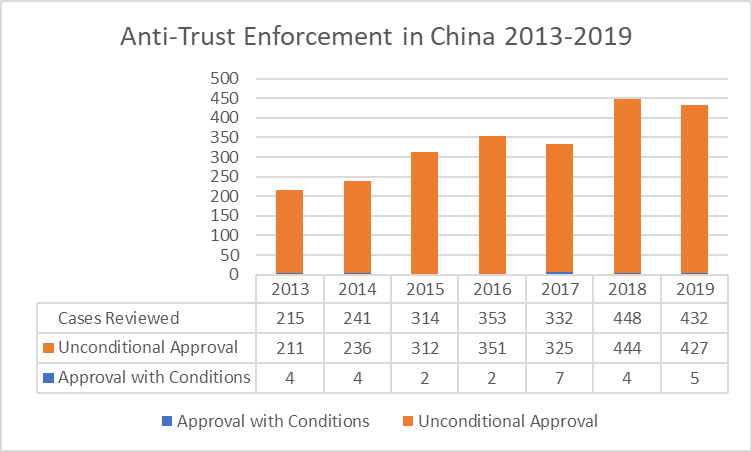
Mergers in the last decade

As you can see from the chart above, there are no outright merger rejections and only a small number of approvals with conditions. Interestingly, the only mergers that have come under scrutiny are mergers without Chinese involvement. Due to the extraterritorial nature of Chinese anti-trust law, even mergers of companies outside China fall under its purview when it involves companies with a substantial amount of business in China. For example, in 2019, the five cases that were approved with conditions were KLA Tencor (US)/ Orbotech (Israel), Cargotec (Finland)/ TTS (Norway), II-VI incorporated (US)/Finisar (US), Zhejiang Huayuan Biotechnology (PR China)/Royal DSM (Dutch), and Nevelis (US)/Aleris (US). In addition, there are cases like Qualcomm (US) / NXP (Dutch), where instead of denying the application, Chinese anti-trust authorities just ran out the time. After two years of waiting for the acquisition of NXP by Qualcomm to be permitted, the companies reached the end of the contractual merger period and were forced to give up. This de facto denial was never recorded as a denial, as the Chinese anti-trust authorities simply did not rule. Due to the small size of China’s anti-trust authority, the country has plausible deniability when it delays ruling on a merger. At face value, China’s perfect record of only approving mergers remains intact, when in reality the merger was forcibly abandoned.

What’s really at stake

Cases such as those mentioned above create the appearance that Chinese anti-trust concerns are not directed at protecting Chinese consumers but protecting Chinese industrial policy. The approval with conditions of the Marubeni (Japan) acquisition of Gavilon (US) and Glencore (Swiss) of Xstrata (Swiss/UK) demonstrates that China’s industrial policy leads anti-trust merger enforcement. In both cases, China was concerned about the supply of vital commodities, copper and grain respectively, and the merger was approved only after significant divestitures that alleviated these concerns.

With this in mind, the acquisition of ARM Technologies (UK) from Softbank (Japan) by Nvidia from the US will be another interesting case. Most casual observers would conclude that Chinese anti-trust authorities would not be involved. Au contraire, mon ami! Almost all smartphone central processors are using ARM instruction sets, and Chinese companies have built their AI and neural processing technology on them. Huawei even went a step further and built its Ascend AI and Kunpeng general purpose processor programs entirely on ARM. The increasing reliance is due both to technical and to political reasons.

President Trump’s moves to use American intellectual property in trade battles with China, as well as restricting their use in military and dual-use applications, has complicated the lives of Chinese high-tech companies and it is likely to continue during President Biden’s administration. As a reaction, China has accelerated its Made in China 2025 project focused on reducing its dependency on foreign technology and products and shifting to non-American suppliers. If the Nvidia acquisition of ARM goes through, another key technology will be more closely under the control of US authorities, giving them another potential tool to assert pressure on China. It would also give Nvidia a significant boost in the AI competitive race that China considers one of its highest priorities. Nividia is a leader in network-based AI and ARM a leader in device-based, also known as edge AI. Combining the two companies makes them a much more formidable competitor, allowing to cross pollinate network AI with edge AI technology and vice-versa. Both companies have substantial business in China and hence fall under Chinese anti-trust laws and are subject to review.

Considering China’s track record, it is almost inevitably going to either block or just refuse to approve the Nvidia/ARM transaction to protect its domestic industry from further US sanctions and restrictions and to prevent a stronger competitor in the AI marketplace. It is more likely that China will simply run out the clock on the merger, while a more aggressive and higher profile move would be an outright denial of the merger. This would send a much stronger signal to the United States than passive aggressive non-approval and would be a harbinger of a more adversarial phase in the relationship between the two countries.