

Businesses across the country are racing to deploy artificial intelligence, and that race is beginning to show up in a place where carriers and ISPs should be paying close attention to internet access requirements of their large and midsize customers. Between October 1st and October 29th, 2025, Recon Analytics conducted an online survey of U.S. business decision-makers for internet access requirements across large (1,000+ employees), midsize (20–999 employees), and small (fewer than 20 employees) companies and asked a straightforward question: has your company’s use of AI, or planned use of AI, changed your internet access requirements? The results reveal a market that is bifurcating along company size lines, creating new opportunities for providers who position themselves as AI-ready connectivity partners.
A Tale of Two Markets
The figure below tells the story clearly. Among large businesses we surveyed, 67% said AI has already changed or was changing their internet access requirements. Among surveyed midsize businesses, the number is 57%. Among small businesses who answered the initial question on changing requirements, that figure drops to just 17%. The spread from large to small is 50 percentage points, a gap that should give every ISP and carrier clear direction when thinking about where to direct their AI-forward messaging and product investment.
Of course, not every business that says AI has changed their internet requirements has already made a network change. Some are in the planning stage, and the pace of actual procurement decisions will vary. But the intent signal is real and concentrated in the segments that tend to carry the highest lifetime contract value for business connectivity providers.
Figure 1. Has AI changed your company’s internet access requirements?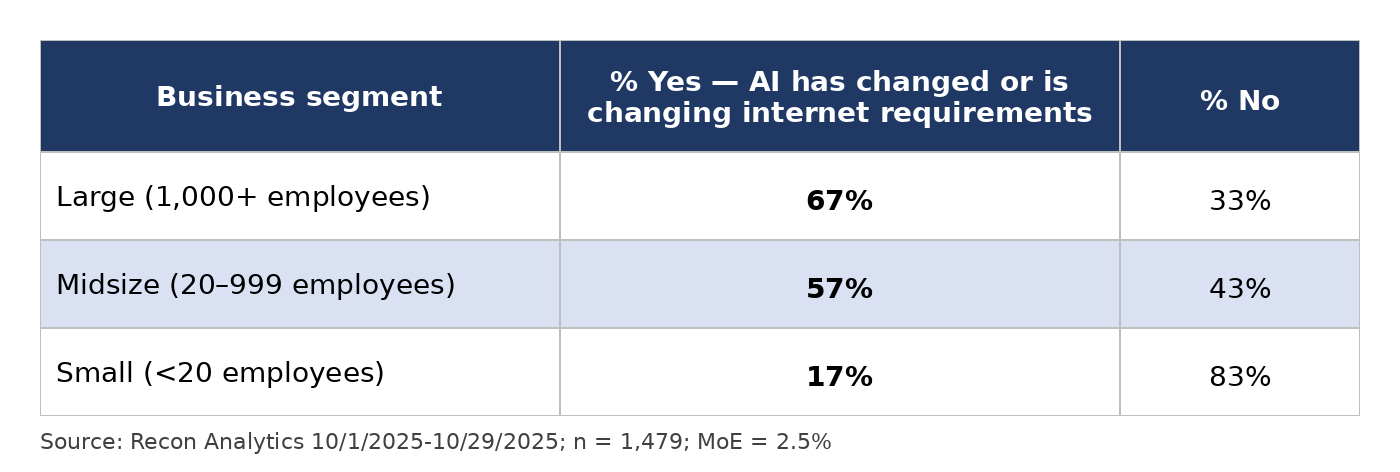
What Is Actually Changing
For those respondents that said AI had changed or was changing access requirements, the survey asked a follow-up question: How specifically has it changed? Respondents could select multiple answers, and the results, shown in Figure 2, reveal that the impact is both broad and operationally meaningful.
Increased bandwidth tops the list for large and midsize businesses, selected by 58% and 49% of AI-affected respondents, respectively. This is the expected answer, AI workloads are data-intensive, and inference at scale consumes bandwidth at a rate most businesses did not anticipate when they signed their last internet contracts. What is more interesting are the other AI driven changes.
For large businesses, backup connection ties bandwidth at 58%. This finding deserves careful attention. Large businesses running AI-dependent workflows, whether for customer service automation, supply chain optimization, or real-time analytics cannot afford connectivity outages that halt those systems. AI is effectively raising the operational stakes of internet reliability, turning what was once a “nice to have” secondary connection into a business-critical requirement. Midsize businesses at 43% are also showing an increased appreciation for the value of a backup connection.
Results for change of access type come in at 46% for large businesses and 45% for midsize, nearly identical and the tightest result across both segments in the entire survey. This suggests that a meaningful portion of businesses are not simply asking for more of what they already have; they are actively reconsidering the technology underpinning their connectivity. As respondents could select more than one answer, a safe assumption that there is significant overlap between respondents who said increased bandwidth and change access type. Whether that means moving from cable broadband to fiber, adding fixed wireless as a failover, or evaluating SD-WAN solutions, AI adoption is prompting a fundamental rethink of the access layer.
Direct cloud connection registers at 47% for large businesses and 32% for midsize, a 15-point gap that reflects the difference in cloud maturity between the two segments. Large businesses with more sophisticated hybrid cloud architectures are more likely to recognize that routing AI workloads through the public internet introduces latency and security risks that a direct cloud interconnect can address. The midsize segment as a whole does not use public cloud providers at the same level as businesses in the enterprise segment, which plays a role in the lower percentage selecting direct cloud connection as a change factor.
Lower latency rounds out the list at 37% for large and 30% for midsize. It is worth noting that latency sensitivity varies significantly by AI use case. Real-time applications like voice AI, live fraud detection, and edge inference are acutely latency sensitive. Batch processing and back-office automation far are not as latency sensitive.
Figure 2. How has AI changed your internet access requirements?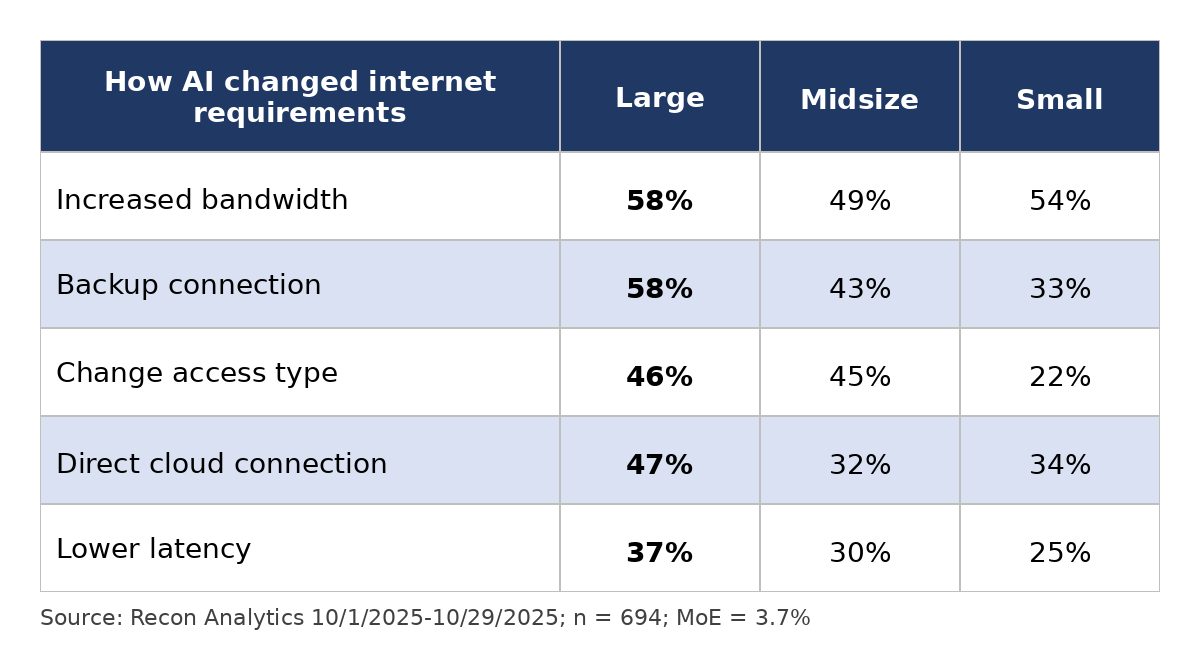
Small Business: A Different Story
Small businesses are not completely absent from this trend. While only 17% of respondents in this segment said AI had changed or was going to change their access requirements, this segment represents over 99% of all U.S. businesses. That alone makes this an attractive market. The leading access requirement change or expected change, is the need for more bandwidth at 54%. This puts the small segment in a similar trajectory as the larger two segments when it comes to their expected top internet change requirement.
What This Means for Providers
It is still early days for AI-driven network transformation, but the data makes clear that large and midsize businesses already have it on their radars. Of course, this survey only measures intent, not action. So, we cannot say with certainty that everyone who says AI has changed or will change their internet access technology will actually do so. However, we can say that AI is making businesses think about their internet access requirements and that will open up new opportunities for ISP and telecom carriers.
The most obvious sales upside opportunities for ISPs and carriers are for increased bandwidth, backup connections, and upgrade in access technology. ISPs and carriers need to make sure AI is part of their access discussion with businesses. Small businesses should not be left out of this discussion. Even though only 17% responded positively to the initial question, the size of the small business segment makes this a discussion worth having. ISPs and carriers also need to continue to develop their marketing story around AI and how they are building their networks for premium AI support.
As for when ISPs and carriers can expect to see changes in their business customers’ access purchasing habits, based on what we are observing Recon Analytics believes that is already happening. Current AI marketing campaigns from service providers are one indicator that is happening right now. An immediate opportunity for internet access providers is to go back to their current business customers about making changes to their service agreement to accommodate new AI driven requirements. ISPs and carriers can also go after their competitors’ customers right now by pushing backup connections and the value of provider diversity. Recon Analytics expects access providers will start talking about the positive commercial results they have generated based on new AI driven internet access requirements before the end of this year, though conversion timelines will vary by segment and contract cycle.