


Thanks to its “Un-Carrier” program and acquisition of Sprint, T-Mobile has gone from an “also ran” in the U.S consumer market to one of its dominant service providers. It has also gained a foothold in the small business/SOHO market where the purchasing habits of businesses are not that far from those of consumers. However, the company’s ambitions do not stop there. As former CEO Mike Sievert said at T-Mobile’s September 2024 Capital Markets Day, the company wants to gain share with midsize and enterprise businesses to ensure continued subscriber growth. Achieving that objective requires T-Mobile to move beyond its current Un-Carrier playbook to offer services that appeal to the more demanding requirements of those business segments. One of the services T-Mobile has launched since then to help achieve that goal is SuperMobile, and early response has been positive.
As a quick reminder T-Mobile unveiled its SuperMobile plan in late August of 2025. The plan had six main features upon its launched: network slice to enable lower latency and higher speeds in time of network congestion, unlimited voice and data, built in threat protection security, nationwide satellite connectivity, a now expired promotion of up to $1,000 back per line when adding 10 or more lines, and $42/month/per line (excluding taxes and fees) when adding six or more lines. Some of the early SuperMobile wins for T-Mobile have been with Delta Airlines, CNN, and Siemens Energy. These major wins are just the “tip of the iceberg’; more wins are sure to come.
When Recon Analytics surveyed U.S. businesses, well over 50% of enterprise and midsize business respondents had a favorable outlook on switching to T-Mobile to take advantage of the SuperMobile offering.
Between September 3rd, 2025, and November 12th, 2025, Recon Analytics surveyed 562 large businesses (1,000 + employees) and 577 midsize businesses (20-999 employees) on the likelihood they would switch to a SuperMobile type of service within the next 12 months. For the survey we did not specifically call it SuperMobile. Instead, we listed out the six key initial features of SuperMobile. Respondents could answer in five ways: very likely, likely, not sure, unlikely, and very unlikely. Roughly half the respondents were told the service was offered by T-Mobile, the other half were given no specific service provider information. The results are below for those who answered specifically to T-Mobile.
Likelihood of switching to T-Mobile’s SuperMobile in the Next 12 Months
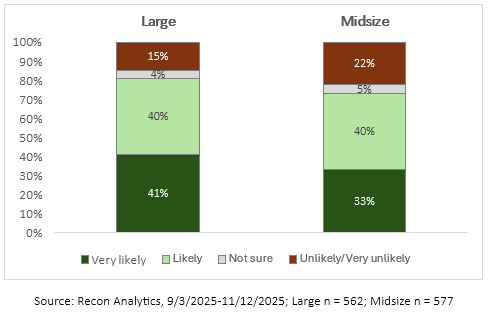
As the results show, 81% of large businesses and 73% of midsize businesses said they were either “very likely” or “likely” to switch to T-Mobile within the next 12 months to take advantage of SuperMobile. Respondents who answered the question that did not specify T-Mobile provided similar results when combining “very likely” and “likely.” Where the difference lies between the two versions of the question is the percentage of respondents who answered, “very likely.” For the unbranded version of the question 22% of large business and 19% of midsize business respondents said, “very likely” versus 41% of large business and 33% of midsize businesses answering “very likely” for the branded question. The addition of T-Mobile branding had a net positive impact on the interest level in SuperMobile.
Of course, not everyone who responded positively to the question will actually switch in the next 12 months, but it does show T-Mobile has put together a service offer that will make it more competitive when it comes to selling wireless services to those segments.
To get a better understanding of what specifically made respondents answer “very likely” or “likely” to switching to SuperMobile we asked them to rate the initial six service features from 1 to 6, with one being the most important. The figure below shows the percentage of respondents, by size of business, which ranked each service feature number 1.
SuperMobile Features That are Most Compelling (Sum Rank 1)
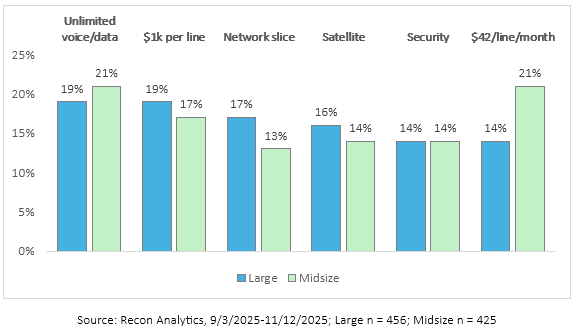
There was little difference in rankings between large and midsize businesses with the exception of network slice and $42 per line per month with 6 lines or more. For all the other features large and midsize were within two percentage points of each other. Within the large business segment, the spread from the most popular feature to the least was five percentage points. Within the medium business segment, the spread between the most popular to least popular feature was bigger at 8 percentage points.
When looking at the results as a whole, unlimited voice and data, the now expired promo offering $1k rebate per line, and service pricing of $42 per line per month with 6 lines or more were the most important features in persuading respondents to switch, but that doesn’t mean the other features are not important in creating the value proposition of SuperMobile.
When summing the rankings from one to six, no feature had a total ranking lower than 74%. This means competing mobile service providers will have difficulty countering T-Mobile’s SuperMobile by going after just one or two features. Nor does the $1k promo expiration mean that interest in SuperMobile will evaporate. Competitors will need to create a service similar to SuperMobile that brings together all of SuperMobile’s ongoing features. Network slicing and satellite connectivity are the two hardest features to replicate, but AT&T and Verizon have the assets and relationships needed to come up with their own version of SuperMobile.
SuperMobile is an important step forward for T-Mobile when it comes to gaining share with larger businesses. Both large and midsize businesses are showing strong interest in the service. The level of interest in the underlying features that make up the service shows that T-Mobile’s competitors cannot easily fight back by just focusing on one or two aspects of SuperMobile. They will need to build a comprehensive service offering like SuperMobile. It is still early days for SuperMobile, but I will be surprised if by December of 2026 we do not see some share shifting due to it. I also expect by end of 2026 T-Mobile’s competitors will have launched their own answer to SuperMobile.