


On November 12, 2026, Microsoft’s Outlook email went down globally, with Teams and Copilot also affected. More than 12 hours in, Microsoft reported only marginal success in restoring service and attributed the outage to elevated load, meaning overstretched servers. Microsoft 365 apps have about 430 million users, and Downdetector logged reports from more than 70 countries.
Two standards of availability
Telecom set the benchmark: five nines (99.999%), or 5.26 minutes of downtime a year. IT settled on four nines (99.99%), or 52.6 minutes a year, in exchange for lower cost and faster release cycles. Cloud providers formalized that level. AWS, for example, commits to 99.99% only for workloads spread across multiple availability zones.
Telecom networks are noticed mostly when they fail, which is the best evidence of how rarely they do. The Bell System engineered its electronic switches to a target of no more than two hours of downtime over 40 years, and the industry has carried that discipline through every technology transition since, from analog to digital, wireline to wireless, and circuit-switched to IP. Much of the work is invisible to customers: backup batteries and generators at cell sites and central offices, diverse fiber routes so a single cut doesn’t isolate a region, and redundant network cores that fail over without dropped calls. In 2020, when lockdowns moved work, school, and medicine onto home and mobile connections almost overnight, US networks absorbed the traffic surge without a systemic failure. Telecom has shown that very high availability can be achieved at national scale, and AI infrastructure should follow that model.
Two standards of availability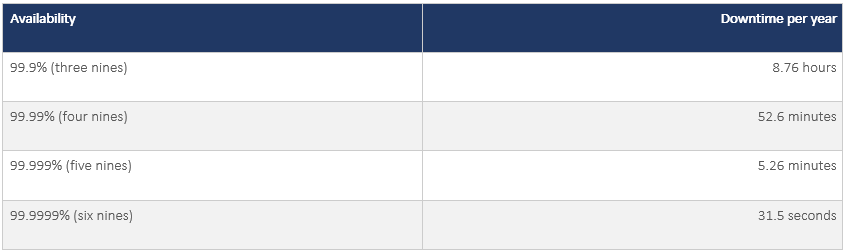
Source: Recon Analytics calculation based on a 365-day year.
Assuming a 12-hour outage, Outlook’s availability is 99.86% for the year and 98.3% for November. Both figures are below Microsoft 365’s 99.9% monthly SLA. Twelve hours is 137 times the annual downtime allowed under five nines.
AI runs at three nines
Discussion of the AI buildout has centered on compute, memory, and power. Where availability is published, it sits at three nines. OpenAI’s Scale and Priority tiers, Azure OpenAI Service, and AWS Bedrock all advertise 99.9% monthly uptime. Standard pay-as-you-go API traffic carries no uptime SLA, and one review of Anthropic’s commercial terms found no uptime commitment. Remedies are small: when Azure OpenAI misses 99.9%, Microsoft credits 10% of that month’s Azure OpenAI charge, and 25% below 99%, never as cash. AI is one nine below IT and two below telecom.
AI services also inherit their dependencies’ failures. OpenAI and Anthropic were among the companies affected by the Microsoft outage.
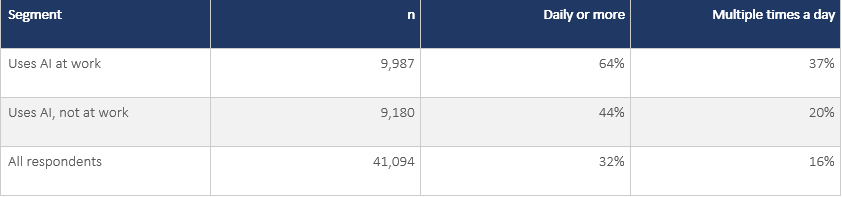
Recon Analytics’ AI survey shows how much depends on that availability now. Among people who use AI at work, 64% use it daily or more and 37% use it multiple times a day, compared with 44% and 20% among those who use AI only outside work. Usage is also concentrated: among daily work users, ChatGPT is the primary tool for 51% and Google Gemini for 21%, so an outage at either provider would cut off a large share of the AI-dependent workforce at once. Microsoft Copilot is the primary tool for 8% of daily work users, who lost both their email and their AI assistant on November 12.
How often AI is used, by whether people use it at work
Source: Recon Analytics US AI survey, weekly waves September 18 to November 6, 2026.
What the right standard is depends on the workload
A single availability target for all AI would be the wrong frame.
- Model training needs goodput (the share of compute that produces useful progress), not availability. Checkpointing absorbs hardware failures.
- Interactive assistants can tolerate three to four nines. An outage costs productivity, as the Outlook outage did, but a person can work around it.
- AI in a critical path includes agents running network operations, fraud detection, clinical workflows, and industrial control. When an agent runs a process instead of assisting a person, no one is there to work around an outage. This tier needs five to six nines. Six nines allows 31.5 seconds of downtime a year.
Investment implications
Moving from three nines to six cuts allowable downtime from 8.76 hours a year to 31.5 seconds, a thousandfold reduction. Reaching that level requires geographically redundant capacity running in parallel, which means GPUs held in reserve rather than serving revenue. Capex rises for the spare capacity. Opex rises for standby power, multi-region networking, and round-the-clock reliability engineering. No public data yet shows the cost of each additional nine for GPU clusters, so the multiplier cannot be sized.
Availability becomes a buying criterion only once a market matures. Telecom got there decades ago, and IT did with cloud. AI providers today compete on model capability and price per token. The first major outage of an AI agent running a critical process will change that, and the buildout that follows will be larger than current forecasts based on compute, memory, and power assume.
Telecom shows how this plays out once buyers mature. In Recon Analytics’ business telecom survey, better network reliability is the leading reason large enterprises would switch providers: 35% of companies with 1,000 or more employees rank it among their top three for internet service and 37% for mobile, ahead of lower prices. Small businesses still buy mostly on price, with 57% to 61% ranking it in their top three. AI buyers are on the same path, and enterprises deploying AI into critical processes will be the first to make availability a contract condition.
What would entice a business to switch providers, by company size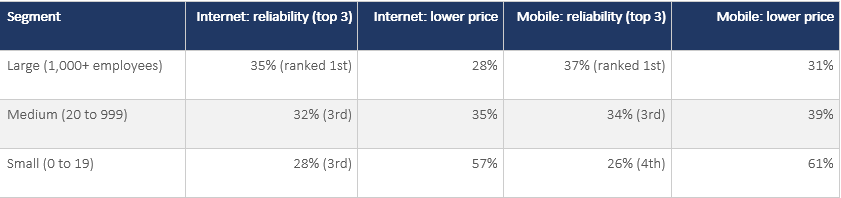
Source: Recon Analytics US Business Telecom survey, February 2025 to February 2026.