


AI Does the Research and People Still Do the Buying
Every major AI assistant can shop, and the payment networks are issuing credentials built for AI agents. The industry expects consumers to hand over the wallet once the payment plumbing is safe. Our weekly AI Pulse survey of US AI users points to a different obstacle.
- AI rarely completes the sale. In late October, 38% of AI users had bought something in the past 30 days that AI helped them research. The AI completed the purchase in 4% of those cases.
- The default is no. Nearly two in three AI users (65%) would not let an AI spend a single dollar without asking first. Averaged across all AI users, the amount they would let an AI spend unasked is about $27, while about half of AI-researched purchases cost $100 or more.
- Consumers want the card held elsewhere. Only 2.5% would trust the AI company to hold the payment details its assistant uses. Banks and card issuers lead at 27%.
What Would Change Their Minds
We asked AI users what would make them comfortable letting an AI spend more. The two most popular answers were promises to make the consumer whole.
Figure 1: Safeguards that would raise the AI spending limit, ranked in top three
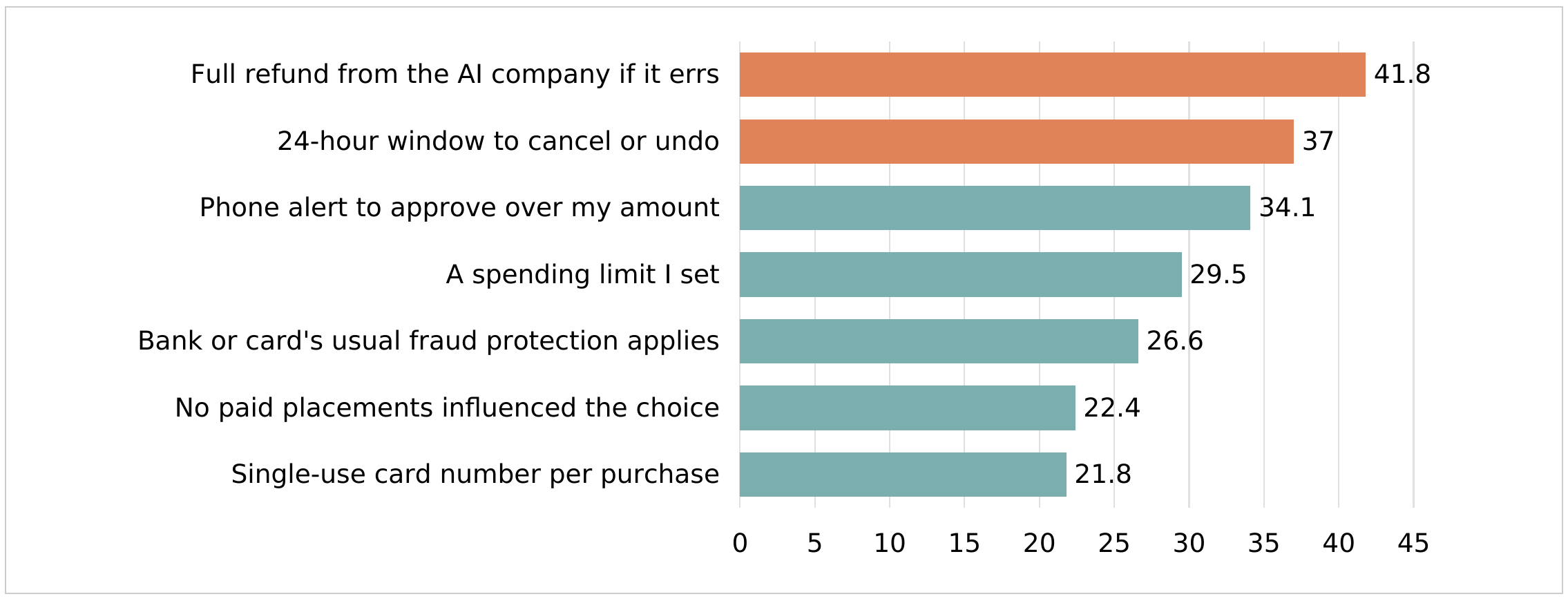
Legend: Orange = guarantees (a refund from the AI company, a 24-hour undo). Light teal = guardrails and other safeguards.
Base: 6,436 AI users; respondents ranked up to three. Data pulled November 14, 2026. Coverage: waves of October 30 and November 6, 2026. Source: Recon Analytics AI Pulse.
A full refund from the AI company leads at 42%, followed by a 24-hour undo window at 37%. The bank’s usual fraud protection (27%) and single-use card numbers (22%) rank near the bottom. When we asked the same people about their spending limit again with their preferred safeguards in place, those who put a guarantee first were about one and a half times as likely to move off $0 as those who put a payment-security feature first.
Why It Matters
The companies building agentic checkout are solving for who can pay and how much. Consumers are asking who pays when the agent buys the wrong item, overpays or falls for a fake seller, and whether the purchase can be undone. Until someone answers that question, the product that works is “AI finds, you approve,” and autonomous buying stays confined to small, routine purchases.
In the Full Report
The full report, Guarantees, Not Guardrails: Why AI Agents Won’t Get the Wallet Until Someone Owns the Mistake, sets out:
- The within-respondent test behind the finding, and how it held up across two survey waves
- Spending limits by AI assistant, including ChatGPT, Gemini, Copilot, Meta AI and Claude
- What retailers, payment networks, banks and subscription providers should take from the data
- How much of AI-researched spending agents could handle without asking, before and with safeguards
- How AI users plan to shop this holiday season
- Six recommendations for AI companies and our forecast through 2027
Read the full report: [INSERT LINK TO FULL REPORT]
Methodology: Recon Analytics AI Pulse, a weekly online survey of US adults; questions asked of AI users (use AI a few times a month or more). Purchase questions: wave of October 23, 2026 (3,071 AI users; 1,160 buyers). Spending-limit, safeguard and payment-holder questions: waves of October 30 and November 6, 2026 (6,436 AI users). Results are unweighted and reflect stated willingness. Data pulled November 14, 2026.