



A Recon Analytics research note. The full report, The AI Advertising Playbook, is available to clients and for purchase.
Why this matters
AI assistants have the audience and lack the profits. ChatGPT reaches 1.2 billion people a week[1], most of whom pay nothing. Every free conversation costs money in computing power, where one more search or page view cost Google and Facebook almost nothing. OpenAI was reported in September 2025 to expect about $115 billion of cash burn through 2029[2]. Advertising is how Google and Facebook turned free services into profitable ones.
On February 9, 2026, OpenAI began showing ads to ChatGPT’s free users. Our weekly AI Pulse survey of US adults tracked what followed (275K respondents, December ’25 through October ’26)[3]. We compared ChatGPT’s users with Gemini’s, whose app carries no ads. This note covers the headline findings. Our full report, The AI Advertising Playbook, has the complete analysis.
What users did when the ads arrived
The fear going in was reasonable. In December 2025, half of AI users told us that ads in their main tool would make them less likely to recommend it (10K respondents, December ’25)[4]. Eight months later, that reaction has not shown up in what users report.
- Free users’ concern about ads has not moved. Before launch, 2.2% of ChatGPT’s free users named ads among their concerns about AI. After launch, 2.1% did. Among Gemini’s users the share went from 2.0% to 2.1%.
- People leaving ChatGPT blame ads no more often than before. Before launch, 13.1% of leavers ranked “my old tool added ads” among their top three reasons. After launch, 12.5% did.
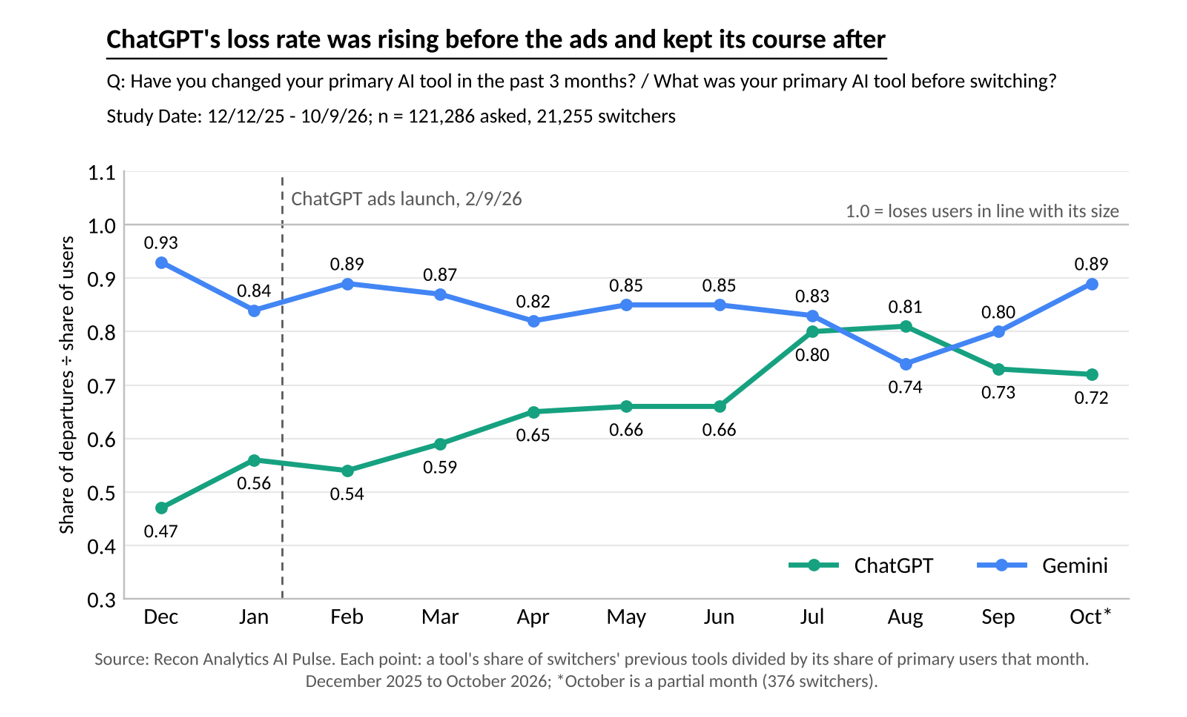
ChatGPT is losing users faster relative to its size than it was in December. The rise began in January, before the first ad. One rival has taken a much larger share of them since the spring. Those switchers point to output quality and features. Most leavers keep ChatGPT as a second or third tool. The full report shows where they go and what they say drove the move.
Who is paying, and who is starting to worry
ChatGPT’s paid share rose from 20.9% before the ads to 25.2% from late April through October. Part of the rise reflects free users leaving. About two-thirds of it came after OpenAI released GPT-5.5 on April 23[5]. Most came from people who use AI every day.
Paying users are where the ads have registered. Nearly all of them are on plans without ads. Even so, their concern about ads rose from 2.3% in April through July to 4.2% in October[6]. It is the only ad-concern measure in our survey to move in eight months. The full report breaks the rise down by plan price and by month, alongside the OpenAI announcements it followed.
The money came fast and is still thin
ChatGPT ads reached a $1 billion annualized run rate in under 200 days by OpenAI’s count[7]. Netflix and Google each took until their third year of selling ads to pass that mark. Each message still earns little: about 62 cents per 1,000 ChatGPT messages, against about $50 per 1,000 Google searches.
OpenAI expects $100 billion of ad revenue in 2030[8]. Our central estimate comes in at well under half of that. Subscriptions are likely the larger prize. The full report sizes both, sets out scenarios at four ad prices, and shows which targeting choices narrow the gap with search.
What this means for AI companies
For OpenAI, the data points to keeping ads on the free tier and keeping Plus, its $20 plan, free of them. It should also say plainly what its ad targeting uses, since paying users are the group whose concern is rising.
The other companies face different choices. Google, Microsoft, Meta and Amazon each come to AI advertising with an ad business already built. Anthropic has pledged to keep Claude free of ads. Perplexity dropped its ad program in February. The full report gives each of them a recommendation and maps how every major assistant handles ads today.
About the full report
The AI Advertising Playbook runs to 19 pages. It covers how ChatGPT chooses which ads to show and what that means for price, sizing scenarios through 2030, a market map of AI advertising as of October 2026, and what search, streaming, mobile and Facebook show about how ad businesses grow. It is available to Recon Analytics clients.
The survey figures in this note come from Recon Analytics’ AI Pulse, a weekly survey of US adults that asks which AI tools people use, how they pay, what worries them and whether they have switched.
[1] CNBC, OpenAI DevDay 2026 (1.2 billion weekly users, September 29, 2026; 900 million in February 2026), https://www.cnbc.com/2026/09/29/openai-devday-2026-live-updates.html
[2] Reuters via Yahoo Finance, https://finance.yahoo.com/news/openai-expects-business-burn-115-022035561.html
[3] Recon Analytics AI Pulse: 275,329 respondents in 44 weekly waves, December 12, 2025 to October 9, 2026; 226,580 of them from February 6, 2026 onward.
[4] Recon Analytics AI Pulse: 10,400 respondents, December 12 to 26, 2025.
[5] NYU Shanghai RITS, OpenAI releases GPT-5.5 (April 23, 2026; Plus, Pro, Business and Enterprise at launch), https://rits.shanghai.nyu.edu/ai/openai-releases-gpt-5-5-agentic-coding-ceiling-tops-14-benchmarks/
[6] Recon Analytics AI Pulse: ChatGPT paying users naming ads as a concern: 166 of 7,366 from April through July 2026 (2.3%), 50 of 1,493 in August (3.3%), 60 of 1,517 in September (4.0%) and 33 of 785 in October (4.2%); 785 to 2,262 respondents a month.
[7] MediaPost, https://www.mediapost.com/publications/article/417561/chatgpt-ads-reaches-1b-annualized/
[8] Axios, April 9, 2026, OpenAI ad revenue forecast ($2.5 billion in 2026, $100 billion in 2030, 2.75 billion weekly users), https://axios.com/2026/04/09/openai-100-billion-in-ad-revenue