

Most coverage of the AI race keeps score with capital spending, and on that scoreboard Apple barely registers. Amazon, Alphabet, Microsoft and Meta expect to spend $720 billion to $740 billion on capex in 2026. Apple’s capex for the fiscal year ended in September fell 29%, to $9 billion, about 1.2% of what the other four will spend.
That doesn’t mean Apple is sitting out. Its AI money is in R&D.
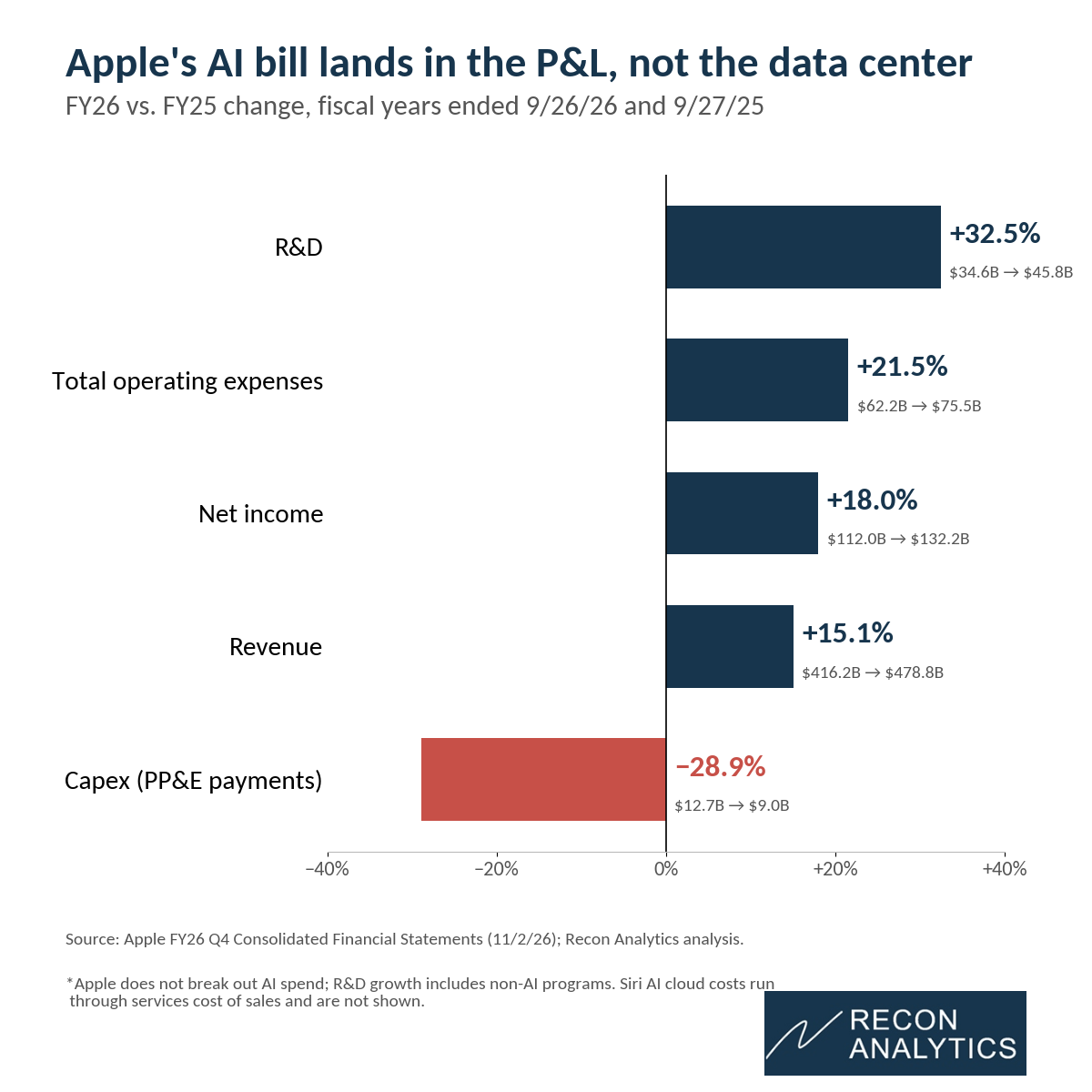
R&D rose 32.5% to $45.8 billion, more than double Apple’s 15% revenue growth. Total operating expenses grew 21.5%.
The reason is privacy. Apple’s AI pitch is that as much as possible runs on your iPhone or Mac, not on someone else’s server. That makes AI an engineering problem: models small enough to run on a phone, chips to run them, software to tie it together. That’s R&D, not data centers. Heavier requests go to Private Cloud Compute, Apple’s own fleet of Apple-silicon servers, designed so Apple itself can’t see the data. That’s most likely where Siri AI runs. Apple does rent capacity from Google Cloud, but mostly for iCloud storage rather than AI computing. And instead of training frontier models at hyperscale, Apple licenses them.
Build versus buy
Faced with the classic build-or-buy decision, the hyperscalers built at scale. Apple built small, for privacy, and bought the rest: licensed models and rented storage.
If AI doesn’t pan out, buying is far cheaper. Right now, though, building is paying. AWS earned a 39% operating margin last quarter, and Google Cloud’s margin jumped to 36% from 24% a year earlier as its revenue doubled. The flip side is that if AI takes off, Apple has to scale up its own servers, which would push capex back up, or lean on Google Cloud as a stopgap and pay the builder’s margin.
The cash picture runs the other way. The four hyperscalers’ combined free cash flow over the past year has fallen to about $62 billion, and three of them burned cash in the September quarter. Apple generated about $136 billion in fiscal 2026, more than double the other four combined.
Why it shows up in EBITDA
Where the money sits changes how the earnings look. Capex never touches EBITDA, and it reaches profit only slowly, through depreciation spread over several years. R&D hits EBITDA and operating income the year it’s spent. Apple’s AI costs are already fully loaded in its earnings. Most of the hyperscalers’ aren’t yet. Compare EBITDA margins across these companies, and the builders look better than their economics.
The same shift is reaching Apple’s gross margin. It guided December-quarter gross margin to 45–46%, down from 47.9% in the September quarter (about 46.9% excluding a one-time tariff refund). Apple says memory prices drive most of the decline, but the cost of rolling out Siri AI is in the guide too.
Consumers aren’t asking for AI. Yet.
Our Recon Analytics Consumer Device Survey asked 16,671 US smartphone users, between July and October, to pick the three features that matter most for their next phone.
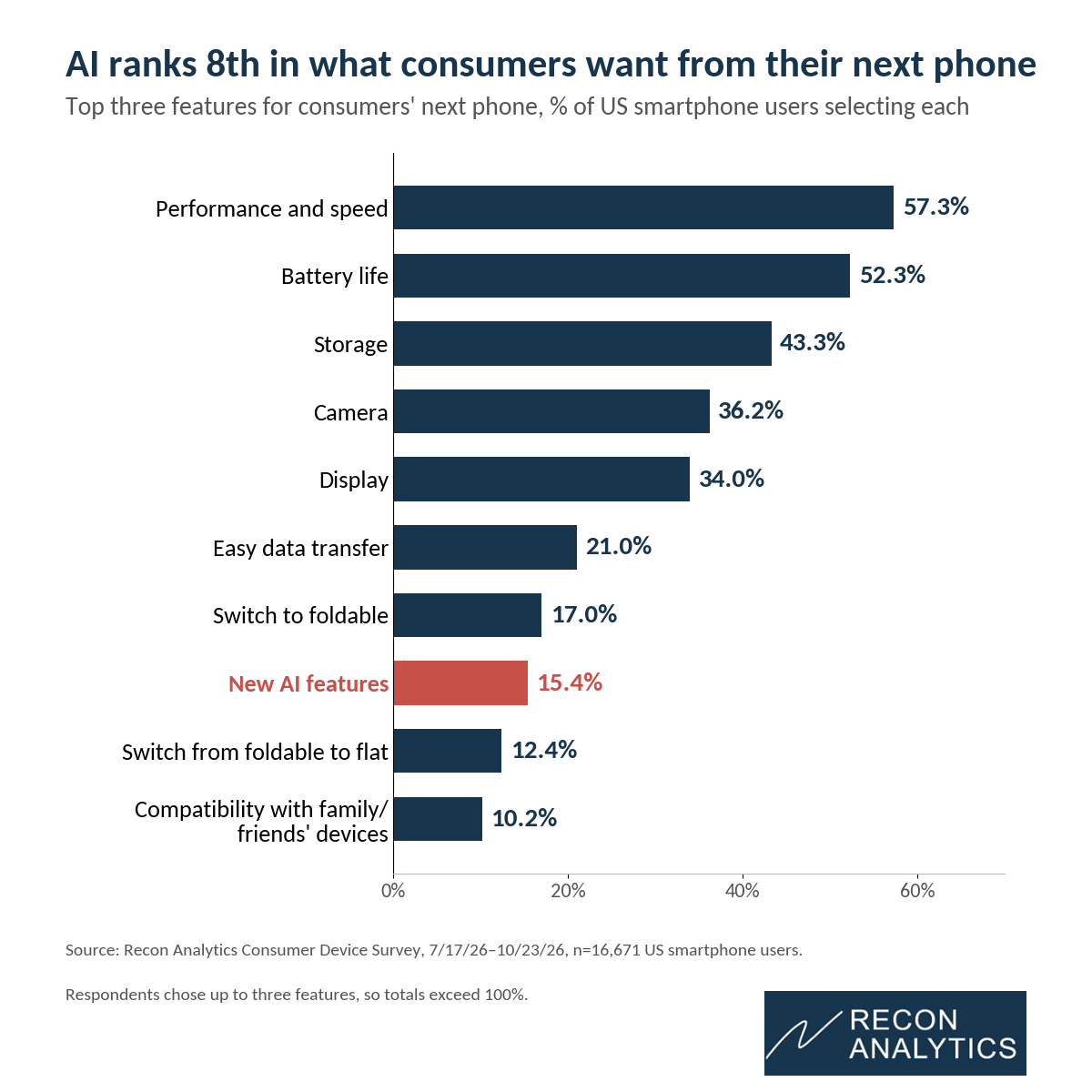
Performance and speed came first at 57%, then battery life at 52% and storage at 43%. New AI features ranked eighth of ten at 15%, behind easier data transfer and switching to a foldable. Siri AI launched in beta in the US in September, between our two survey waves. Among iPhone owners, AI interest was 15.9% before and 15.6% after.
It’s tempting to read that as consumers not wanting AI. A better reading is that nobody has shown them anything worth wanting yet. As Steve Jobs put it in 1998, “people don’t know what they want until you show it to them.” Nobody listed a touchscreen phone as a must-have in 2006 either.
AI ranking this low reflects the industry’s failure to deliver, not a ceiling on demand. Younger users are already more interested: about 17–18% of those under 45 pick AI, versus 10% of those over 60. And some people choosing “performance” may be asking for AI without using the word.
The “for now” part
Apple’s approach buys it time to figure out what AI should actually do for people, without betting $200 billion a year on the answer.
Relying on partners has its own risks. Apple depends on others for frontier models, and those suppliers can set the price. If AI becomes the reason people buy phones, Apple will need far more server capacity of its own, and until it’s built, it will be renting from Google at Google’s margins.
Watch four signals: whether gross margin keeps sliding while services growth slows, how many people buy expanded Siri AI access once it’s offered, whether AI moves up our feature rankings as the industry ships more, and whether Apple’s capex starts climbing again, the clearest sign it’s scaling up its own AI servers. Any of them could force a strategy change.
For now, Apple spends about 1.2% of what its peers spend on capex and is still in the race. It’s betting the finish line is further away than everyone else thinks.
Sources: Apple FY26 Q4 Consolidated Financial Statements and earnings call (Nov 2, 2026); Amazon, Alphabet, Microsoft and Meta Q3 2026 results and guidance; Recon Analytics Consumer Device Survey, 7/17/26–10/23/26, n=16,671 US smartphone users.